[This walk was completed on Friday, the 24th May, 2024]
Today, I must fill in the missing gap. And, I have a very unpleasant cycle ride along the busy A9, with narrow lanes and a horrible surface to cycle on. Cars and lorries whizzing by my elbow. Frightening.
I head down the quiet lane in Crackaig (the road surface here is terrible too), and stop near the entrance to the campsite by the railway bridge. This is where I finished my walk on Tuesday. Chain up my Scooty bike near a stack of hay bales, and set off back up the little lane towards the A9.

The John o’Groats Trail does follow the coast from Crackaig, but the website warns that the Loth Burn might be hard to cross if the water is high. So, I decide to use their alternative route, and that goes along the A9 for a short section.
The fields on either side of the lane are dotted with sheep. I watch a man and his sheepdog rounding up individual ewes and their lambs. The dog isolates the animal the shepherd wants, and then the man catches it with a long-handled crook.

I stop to watch, fascinated. I’ve never seen a long crook used in action before. He puts some of the sheep on a trailer attached to a quad bike, others he turns upside down and seems to inject. Maybe they are sick?
It reminds me of when my husband and I kept sheep, and the difficulty we had catching them to deliver any treatment. A trained sheepdog would have been useful!
Anyway, I can’t stay and watch him all day. Onwards.
At the top of the road, I pass beside a farmyard and a farmhouse, before joining the A9.
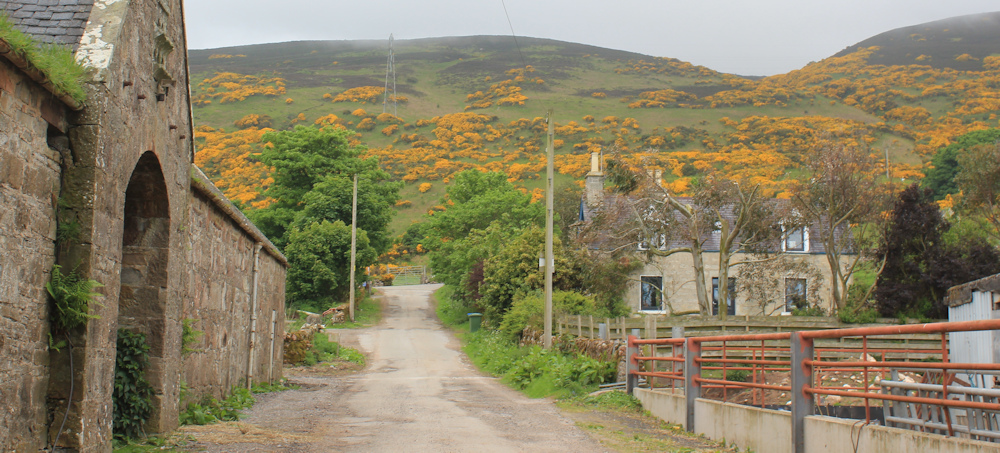
It’s actually nicer walking along the road, compared to cycling, because there is a grassy verge.
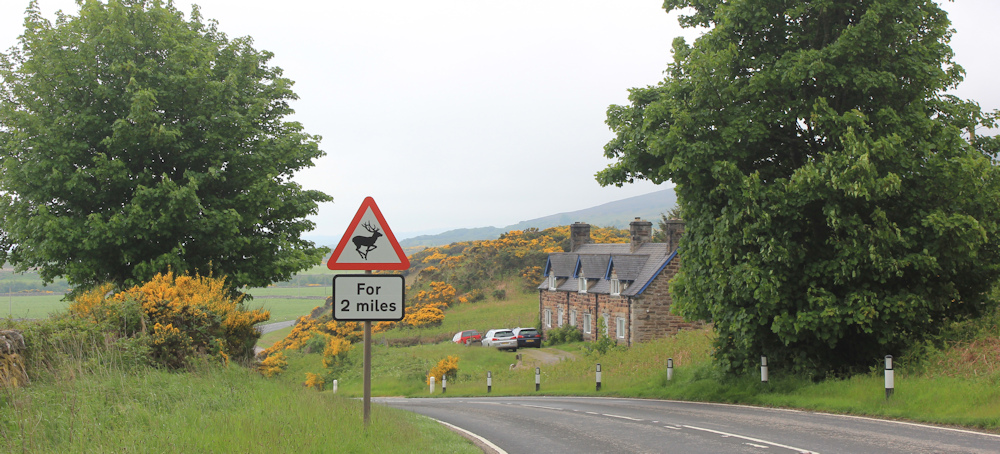
I pass a layby, where a couple are arguing beside their van. Or rather, the man seems to be shouting and waving his fingers at the woman, while the woman keeps her arms crossed and her shoulders hunched.
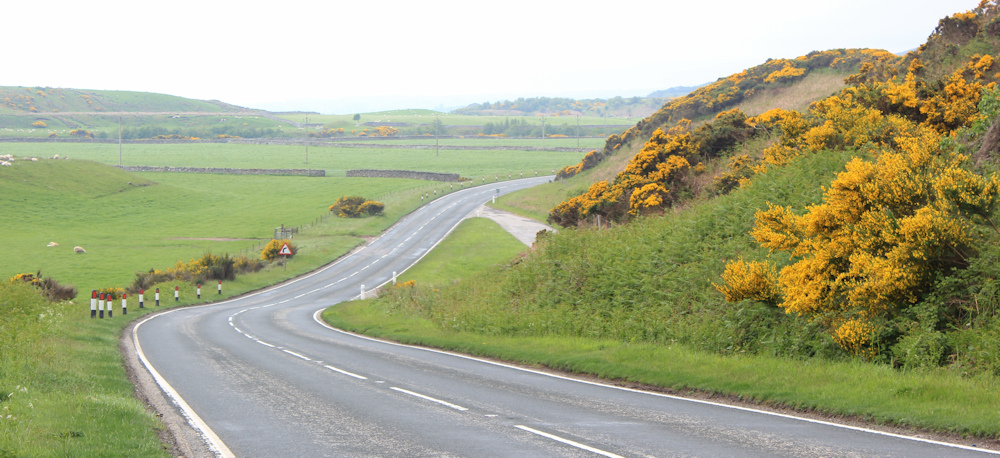
I walk past slowly, wonderfing if she needs help, but they both ignore me. (Always difficult to know what to do in this sort of situation.) I worry about her for the rest of the day, and hope she is alright.
Soon, I can leave the road and rejoin the John o’Groats Trail. This is via a farm track that leads towards the coast.
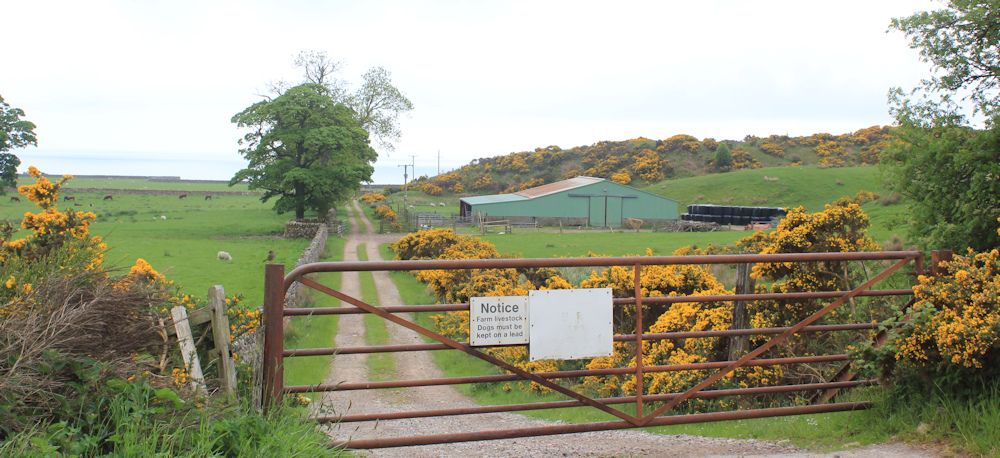
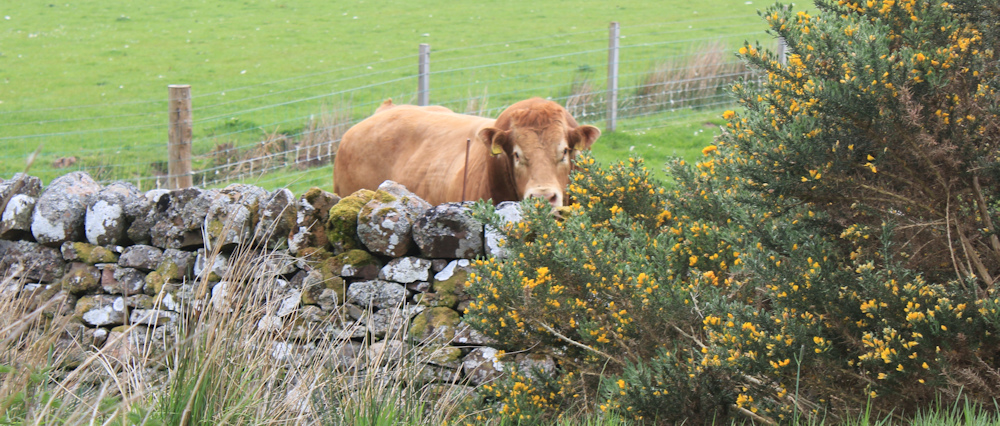
The track turns and twists. There are sheep and cows in the fields… and a bull!
Finally, I am in sight of the coast again. Just down the hill, and I must cross over the railway track once more…

… and I am back on the coastal path! This is better.

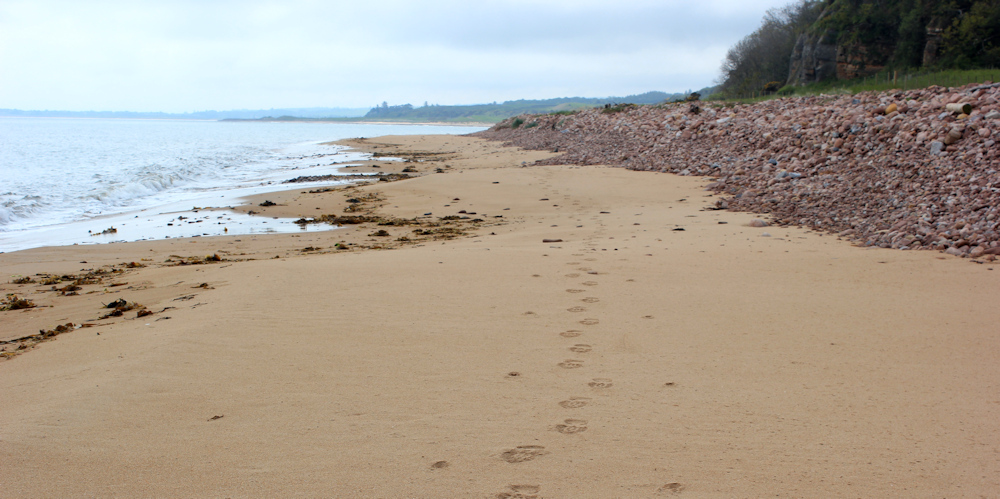
Actually, the shore is quite difficult to walk along, as there are some difficult pebbly sections to navigate. It’s a relief when the pebbles clear and I can walk along the sand for some stretches.
Footprints. Someone has been here before.
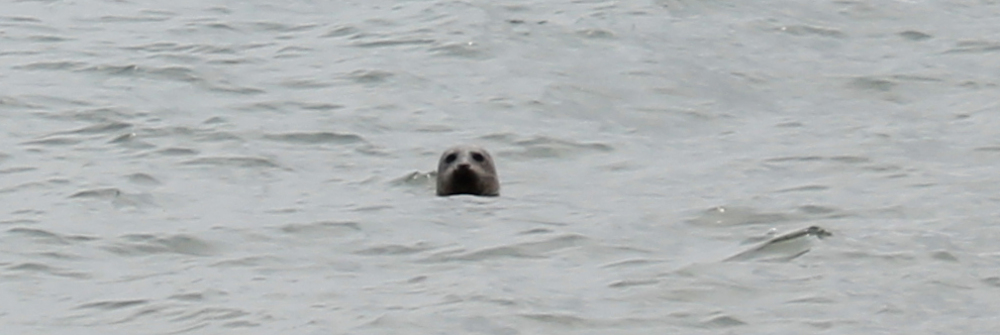
But I am alone on the beach now. Alone, apart from some curious seals. They bob up to see what I’m doing, and I manage to snatch a photograph of this one.
My youngest daughter phones again, and wants to talk about her arrangements for maternity leave. Seems like her provision for time off is not as generous as she thought it was. We discuss her options.
I watch the seals, and the sea birds. What are these handsome birds? They make a change from ordinary gulls and oyster catchers.

Onwards. The path is narrow above a pebbly beach, and strewn with stones. Surprisingly hard walking today. I must constantly watch my feet and adjust to new surfaces.

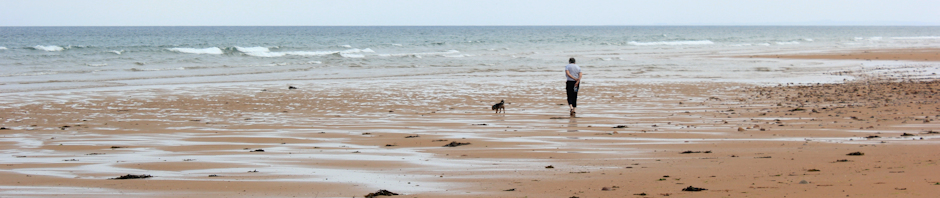
It’s better when I can drop down onto the sand. What a long stretch of unspoilt coastline. Beautiful.

Uh, oh. Cattle. They seem very curious, and I am glad of the protection offered by the fence – although it looks quite flimsy.
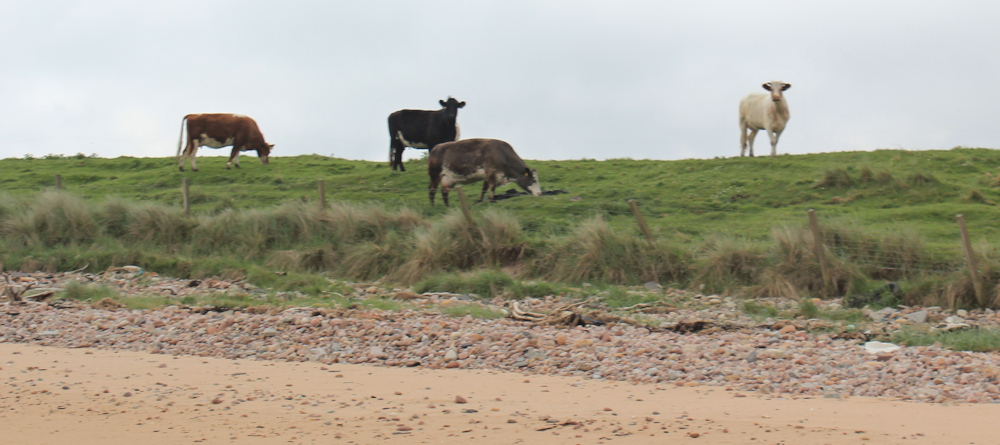
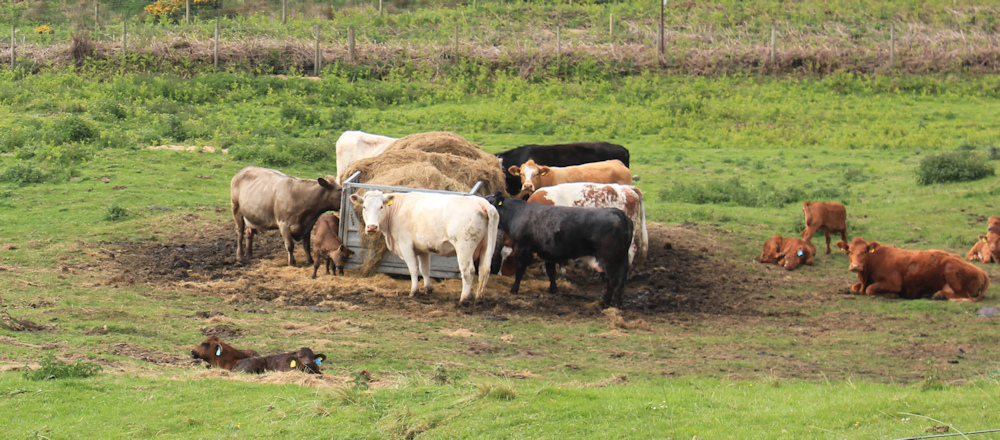
In fact, the fields inland are full of cattle. Some with very young calves. Very sweet to watch, as long as they keep at a safe distance.
Round a corner, and the coast changes. The beach has disappeared and the shore is covered in slippery rocks and shifting pebbles. The JOG Trail runs beside a fence, along a narrow path that is covered in long grasses.
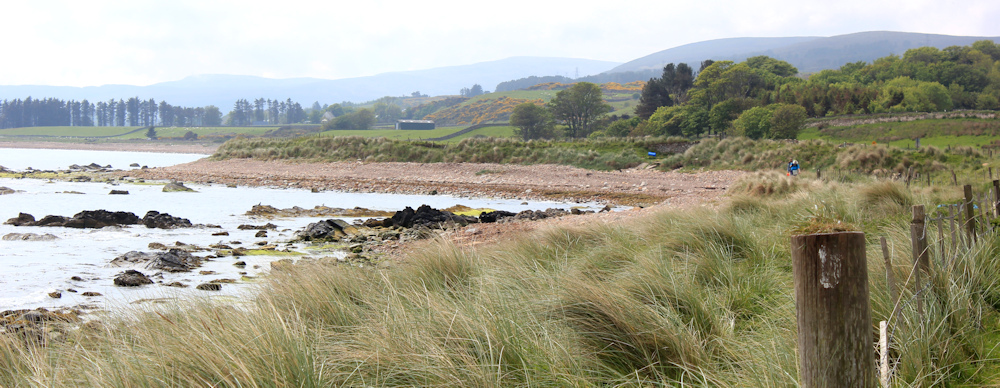
In places, the going is quite tough. Driftwood and flotsam are piled up against the fence, and the path is interrupted by a number of shallow burns that must be waded across. The railway line is a constant companion to my right.

Earlier, I thought these birds were cormorants. But I haven’t seen many this far north and, on closer inspection, I think they are shags. They stand on rocky ridges in the same way, but don’t constantly spread their wings to dry as cormorants do.

I meet a few walkers coming my way. A old woman and a younger one (her granddaughter?) who tell me it is the last day of their holiday and the older woman was a keen walker in her youth. She wears a waterproof map slung around her neck.
The path runs very close to the railway track now. And narrows almost to the point of non-existence.

On a particularly narrow section, I must negotiate some piled up rocks. It’s hard to tell from the photograph, but these rocks are really large and unstable, and the slope below the path is much steeper than it looks on the photo.

I am just negotiating this section, when I hear a loud squawk, and a seagull flies up from under my feet. She leaves an egg behind. Oh dear! But, next to her is another seagull, clearly also sitting on her nest.

This one is NOT going to abandon her egg. She squawks loudly and darts her beak in pecking motions at my boots.
I consider my options. What a stupid place to make your nest – right on the JOG Trail. But, I really don’t want to disturb her, and she seems quite vicious. So, I carefully clamber down the rocky slope and make my way past her.
She watches me carefully and looks quite smug. Victory!
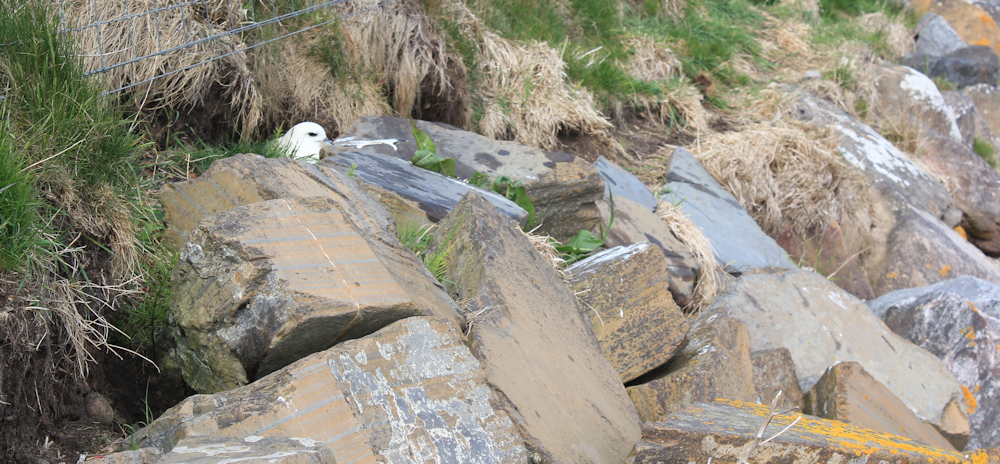
Later, a man tells me this same bird spat at him. Spat? Yes, a foul-smelling liquid. (In fact, you can see the white streak on the rocks beside the bird, which I assumed was guano, but might have been the contents of this bird’s crop!)
I cross another burn. Is this Clynemilton Burn? I don’t check my map. Growing tired now.

The path remains difficult. These heaped up concrete slabs (old railway sleepers), rock and sway under my feet.

So, I am very glad when I can finally drop down and walk along the shore. Oh, what a beautiful bay. And that must be Brora ahead. I’m nearly there!
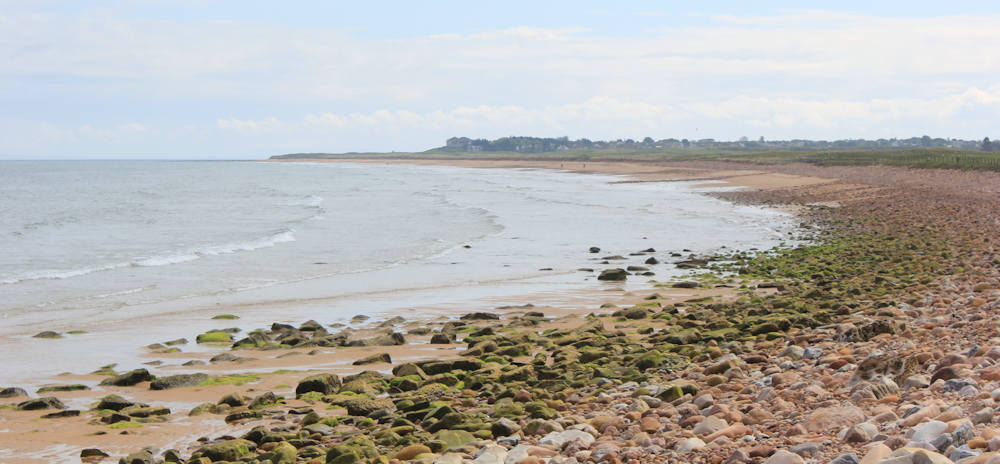
But, I’m not “nearly there”. The beach is much longer than it looks.
I stop to take a photograph looking back. Compared to yesterday, the sea is relatively calm, but I love the series of white waves rolling gently towards the shore. Dark skies, and mist over the hills, but down here the air is filled with light and there has been no rain.
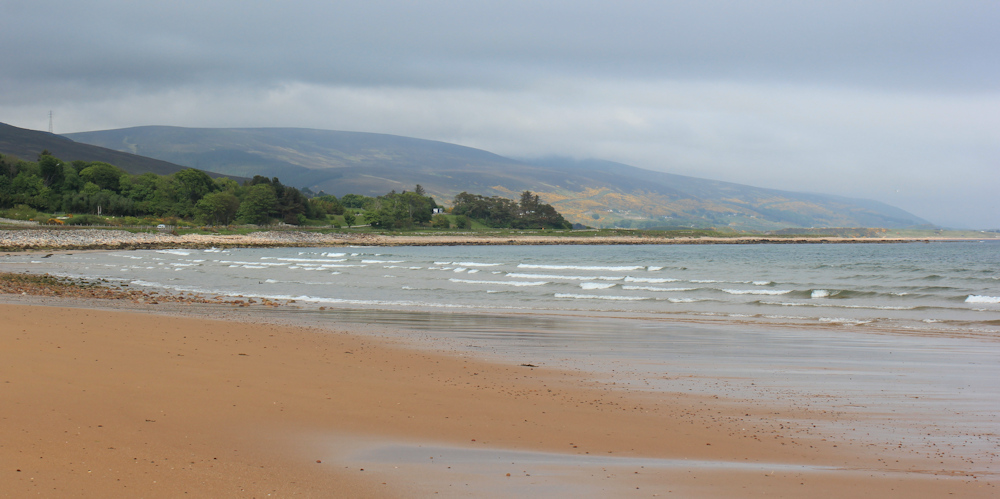
It is a beautiful beach. An interesting mix of sandy stretches and patches of pretty pebbles.
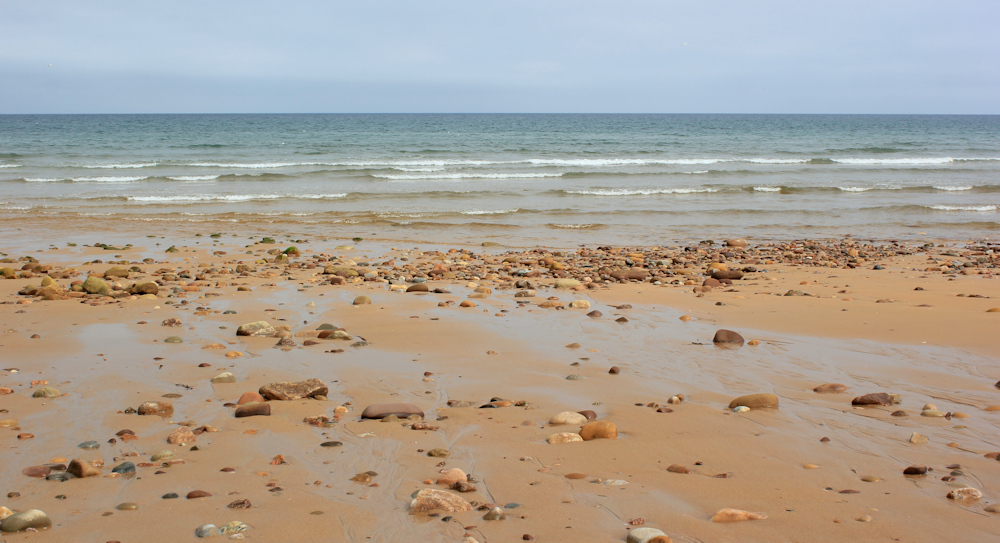
And nobody around for miles. Such a wonderful, empty space – filled with light and the gentle sound of swishing waves. Beach-walking at its finest.

As I get closer to Brora, people begin to appear on the sands. A few dog walkers, and a couple with a little girl who falls on the wet sand and shrieks at the chill of the water.
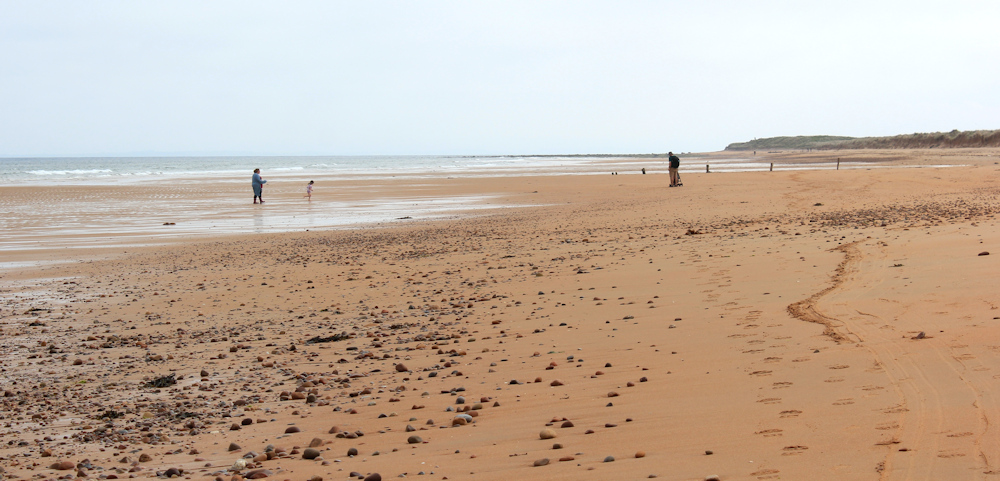
I round a low promontory, and reach the opening to Brora Harbour.
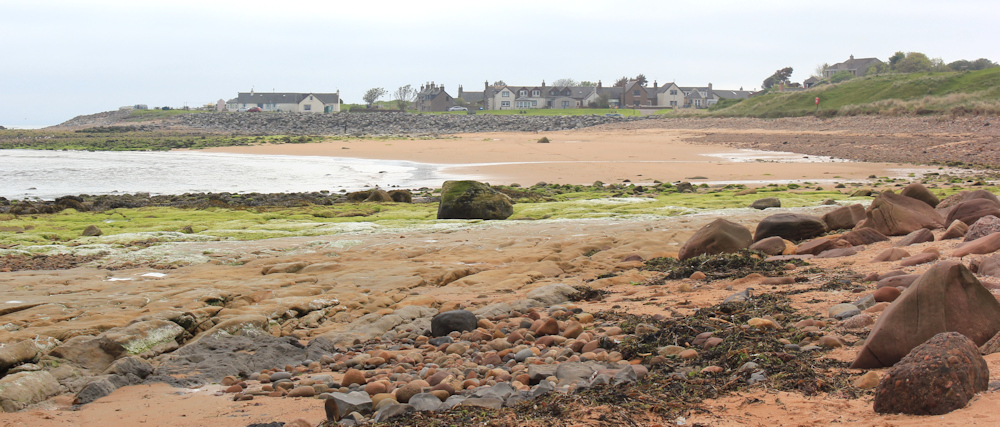
Walk inland along the northern bank of the harbour. Skirt around the decomposing cadaver of a dead sheep. Yuck.
Over there, on the southern side of the harbour, is where I started my walk yesterday.

I walk along minor roads to reach the A9, and the familiar landmark of the clock tower. My van is parked nearby.

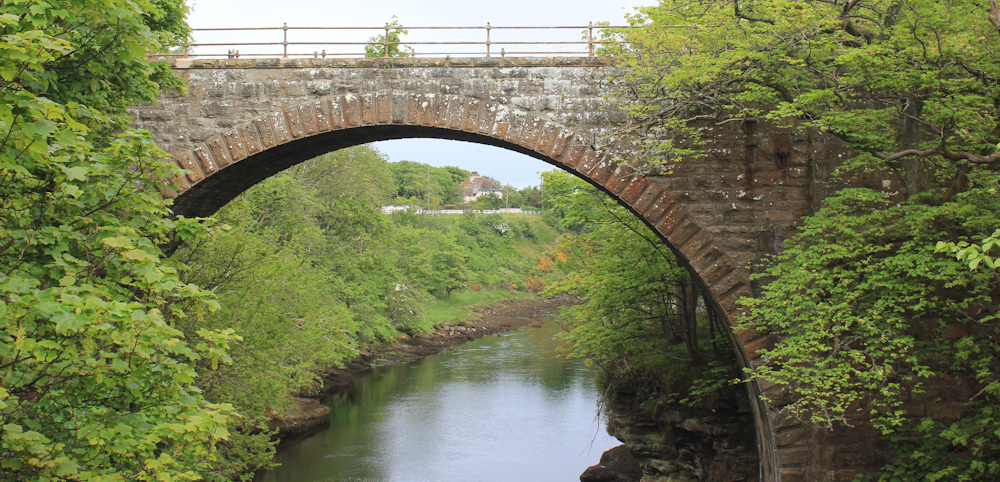
Stop to take one last photograph of this very elegant bridge that carries the railway line over the River Brora. Beautiful arch.
It has been a lovely walk today, although at times it was much harder than I anticipated.
Driving back to Crackaig to pick up my bike, I spot the old woman and her granddaughter (?) standing by the side of the A9. I drive down the lane to retrieve my bike, intending to offer them a lift when I return, but they are gone by the time I get back.
Miles walked today = 7 miles
Total distance around coast = 5,148 miles
Route today:





 Ruth's Coastal Walk (UK)
I think the sea birds you were wondering about are eider ducks.
ah, thank you.
I live in the Southern Hemisphere. Gorse looks like what we call a noxious weed. It seems to me that Gorse is overtaking pasture in Scotland. Am I unduly concerned? Interested in your views. Thanking you. Loving all your trip reports.
I think that gorse tends to appear where pasture is not being grazed. I would think sheep would kill it off once it was cut back.
Where I live in Devon there are sections of the coast path where they fence off a section and put in sheep or ponies to keep meadows. But the gorse is also good for the pollinators, what we need is variety.
Thanks John.
I don’t think gorse is a threat in Scotland. It is not as much of a threat as bracken or rhododendron ponticum which a lot of the estates are now bulldozing out and getting rid of. As John describes below on my coast coast walk I saw a lot of areas fenced off particularly by the National Trust to put horses such as Exmoors on. Goats are also really effective. I would not worry, gorse is relatively easily maintained. At least Scotland does not have much Himalayan Balsam which is destroying many areas I saw in Wales.
Good point Chris. Hopefully private land owners are as diligent as the N T.
Beautiful eider ducks. I love their elegant faces.
They were certainly striking. Eider ducks? Thank you.
I walked all the way along the beach on my way north in June 2010. My main memory is being dive-bombed by arctic terns just north of Brora. They were nesting in the dunes near the golf course. I had a light rucksack and ran as fast as I could to get past them. I hadn’t seen arctic terns before and was excited to see them but that was a closer encounter than I wanted.