
The humid weather continues, and the BBC forecast predicts thunderstorms arriving at around 1pm this afternoon.
I was planning to walk from Tenby to Freshwater East, but instead I decide to cut today’s walk short. My new plan is to be safely under cover in a pub in Manorbier by lunch time, just before the storm breaks. So, anticipating an easy 8 mile stroll, I set off from Tenby and begin my walk along the magnificent South Beach.

Slowly I make my way towards the end of the sands, and the promontory called Giltar Point.

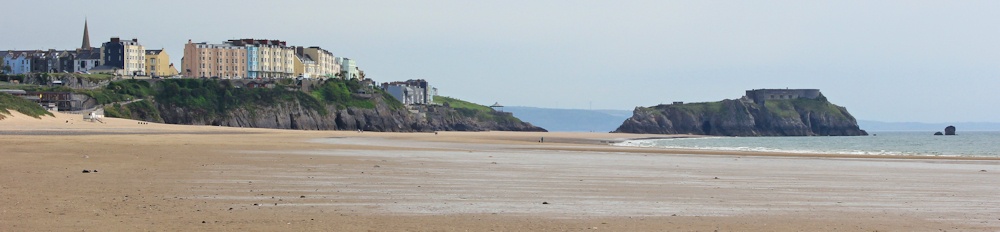
I stop to take a photograph of Tenby and St Catherine’s Island. The buildings on this side of the town are higher than those around the harbour area, but retain the attractive multi-coloured theme.
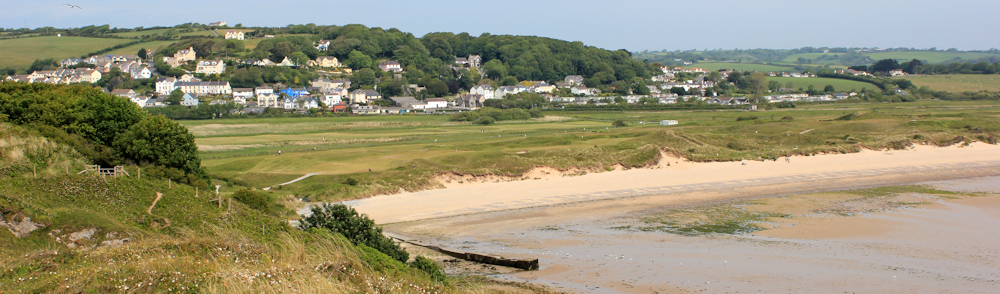
From a high vantage point on Giltar Point, I take a photograph looking down onto South Beach – and discover the village of Penally. It was hidden behind the sand dunes and invisible from the shoreline.
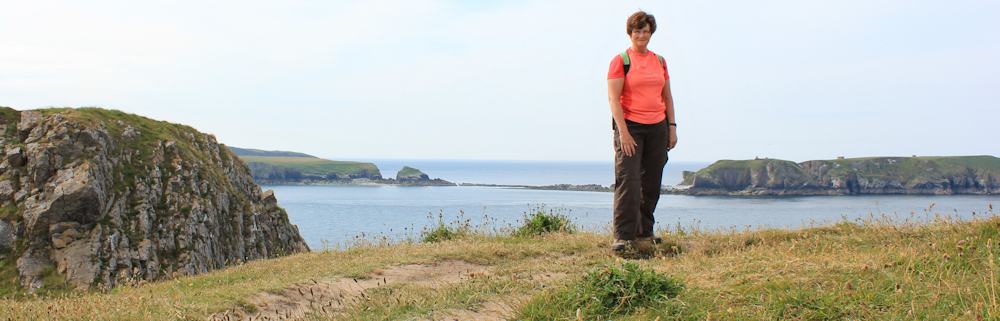
I take a self-portrait. The two islands behind me, linked by a line of rocks at low tide, are St Margaret’s Island and Caldey Island, where there is a monastery.
Ahead is an easy stroll over flat grassland across the top of the cliffs, towards Lydstep Haven.

On the way I pass within a few feet of some blackbirds sitting on the grass. They catch my attention because they are making a horrible noise – which is unusual for blackbirds who have the most beautiful song in the UK. And then I notice these birds have narrow beaks with a slight curve. Are they choughs? Before I can pull my camera out, they take off.
Below are rocks of craggy granite. I see groups of climbers, their helmets like bright flowers against the grey cliffs. The sea below is clear and calm.
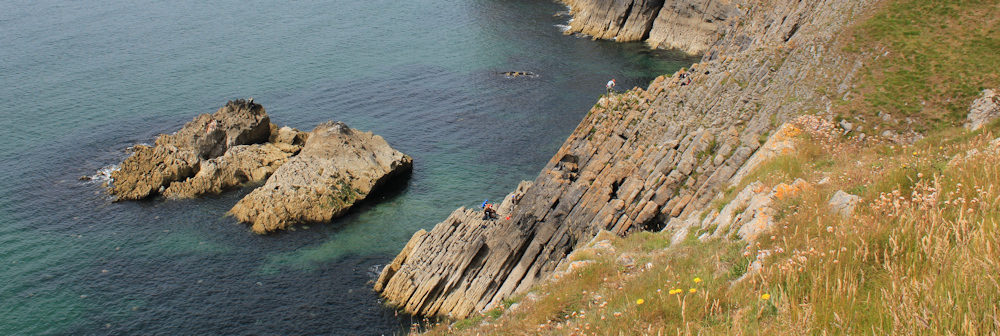
With the sun shining, it’s hard to believe there is a thunderstorm brewing. The sunny morning has brought out walkers, as well as climbers. Everybody I meet stops for a chat. And everyone warns me about the thunderstorms. Yes, I know.
As I get closer to Lydstep Haven, I realise the beach is dominated by a holiday park of static homes. Shame. But at least this park is well-maintained and not too unattractive.
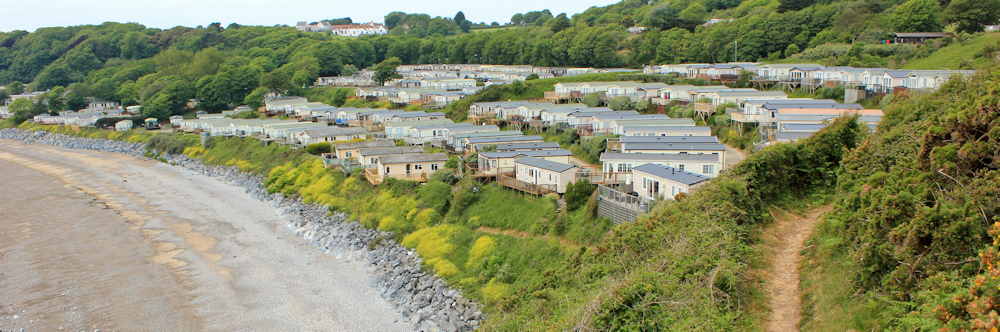
When I stop for a drink by the shore, a local man comes up for a chat. He tells me the Pembrokeshire Coast Path follows the road up the hill for a distance, and then cuts straight across the base of Lydstep point. The turn-off is easy to miss.
He also explains I could walk right around the perimeter of the Point if I wanted to. It’s a very pleasant circular walk, he says, but don’t forget there are thunderstorms coming. He heard the warning on the BBC this morning, and the BBC forecast is never wrong.
It’s still sunny and I decide to take the detour around the point. The path is lovely. I don’t know why it’s not part of the Coast Path. (This is another example of how the Wales Coast Path, and now the Pembrokeshire Coast Path, don’t always follow the most obvious coastal route!)
Up on Lydstep Point I walk along a broad track, over a carpet of summer flowers, surrounded by fading gorse. bushes
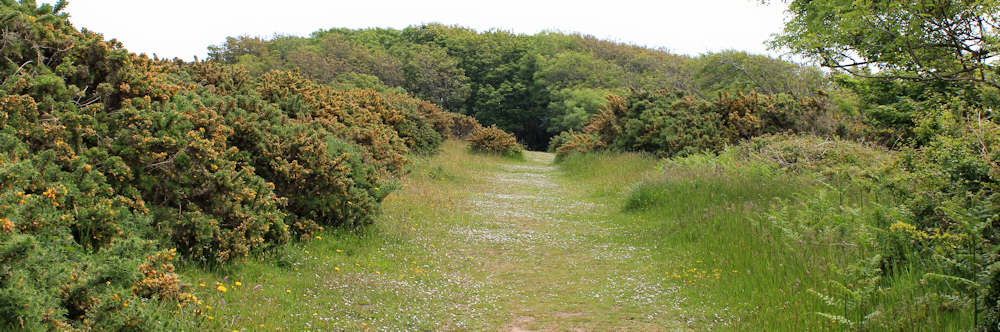
And through some woodland…
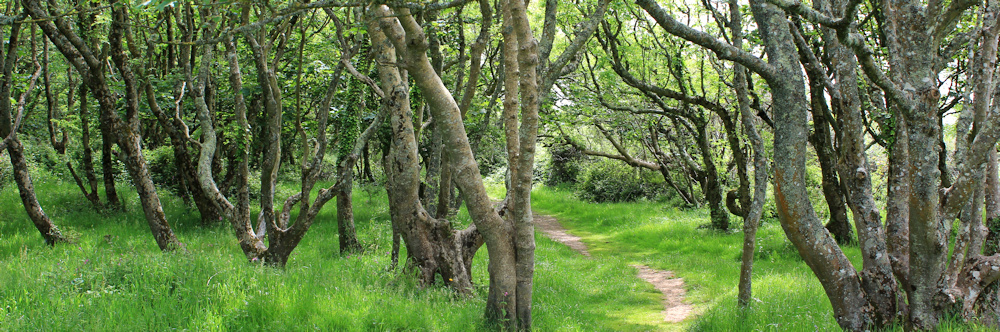
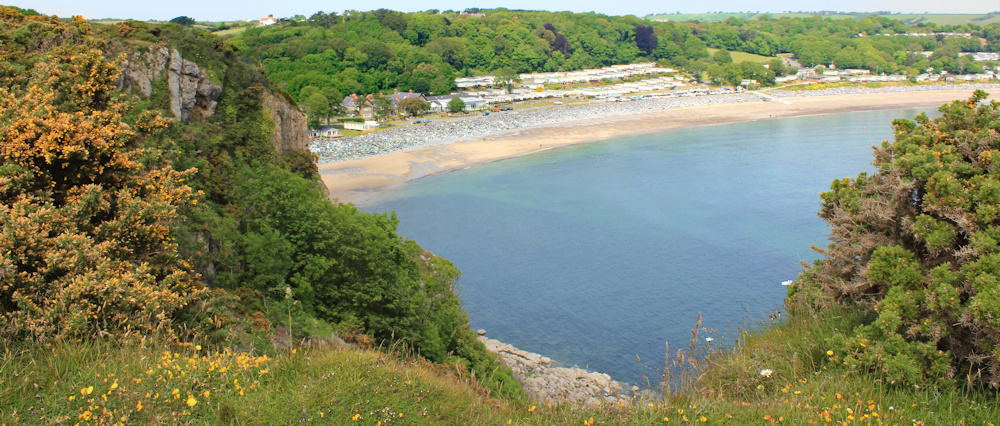
… before emerging into open countryside above Lydstep Haven, with a wonderful view down into the bay.
I meet a man with an enormous zoom lens on his camera. He’s looking for choughs but hasn’t seen any. I tell him I think I’ve seen some on the other side of the bay, but he looks dubious. (Choughs have amber status and there are only around 300 breeding pairs in Britain, according to the RSPB website.) The bird-watcher also warns me about coming thunderstorms.
After completing the tour around Lydstep point, I rejoin the official coast path. Now I’m looking down into a rocky bay, and the path plunges straight down towards the water, and then back up again. It’s a rollercoaster of a walk and much tougher than I expected. I wish I’d brought my poles

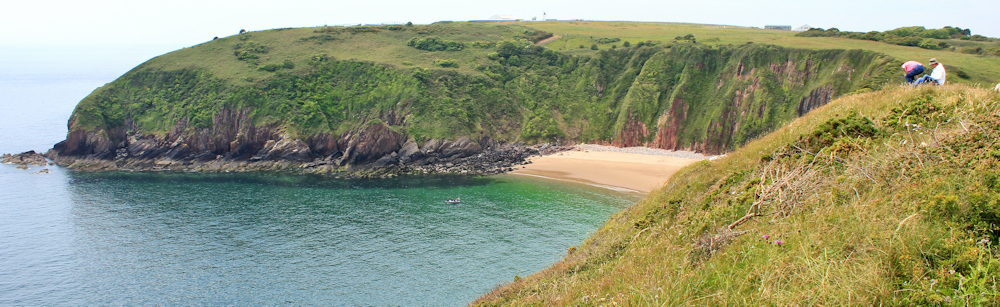
The map shows this part of the coast is called Draught, or maybe it’s called Skomar – the map seems rather confused. Part of the cliff is called Church Doors and there are caves below. And plenty of walkers about. Ahead is an isolated little beach, with the gloriously descriptive name of Skrinkle Haven.
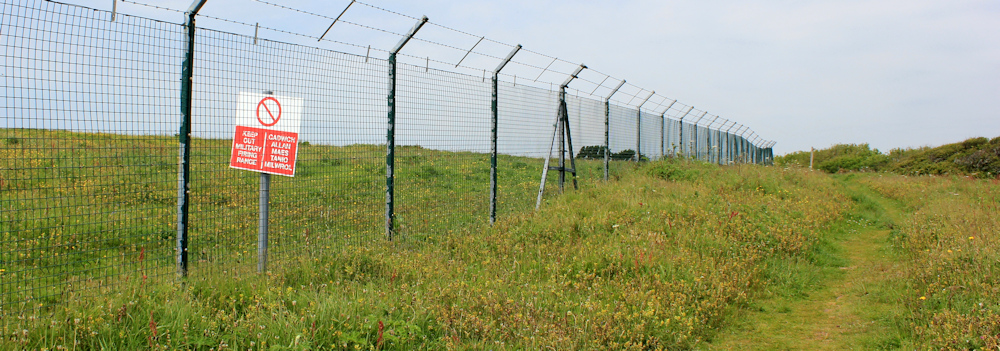
Beyond Skrinkle Haven the path turns inland and I walk around the perimeter of a military base: Manorbier Camp.
On the other side of the base, the path snakes away across the top of cliffs.
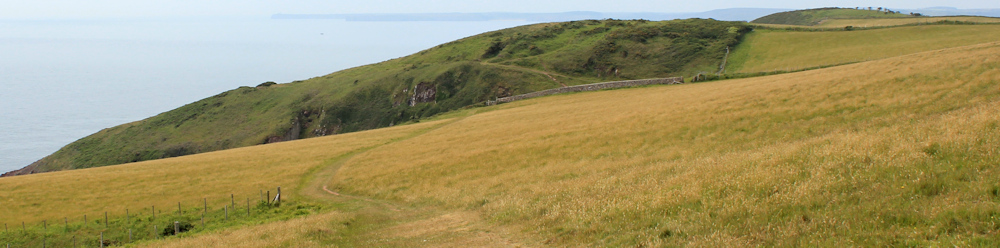
This is an isolated stretch, and yet I meet several groups of walkers – some of them serious hikers with huge backpacks and carrying rolled up sleeping bags – but they all seem in a hurry and no one stops to chat. Maybe they’re worried about the coming storm? I look at the sky. The air is hazy and the light is dull, but there are no dark clouds brewing. Yet.
Below me, granite cliffs have given way to red sandstone. Crumbly.
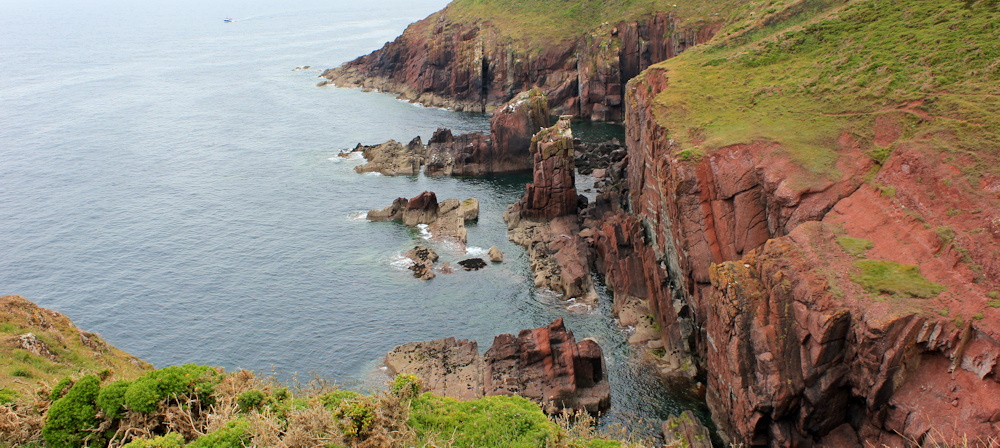
The path grows narrow and clings to the side of the slope. I wish I had my poles and I’m really glad the rain hasn’t arrived yet. This would be treacherous if the ground was slippery. I hope I get to Manorbier before the thunderstorm breaks.
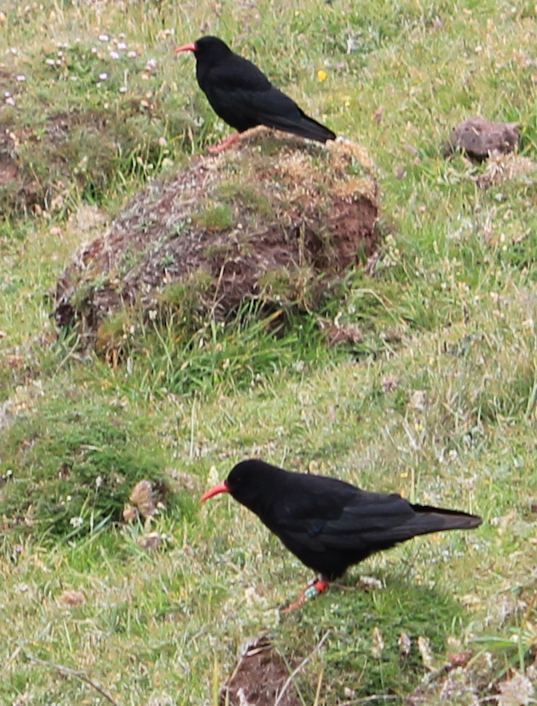 And then I see something that makes me forget the weather.
At first I think they are a couple of big blackbirds. Then I think they are rooks, because they are making a rather hoarse crowing noise. (Not so much ‘caw, caw’ but more like ‘cough, cough’.) They have intensely glossy coats and strange curved beaks which are… red?
The penny drops. They’re choughs.
I swing my camera up and take several photos, until they finally seem to notice me and fly away.
I’m not much of a twitcher, but these birds are rare and its a privilege to see them. I’ve spotted Cornish choughs on a previous walk, but only through binoculars. This pair are my second sighting today and again I got to within a few yards of them. I’m pleased to have been able to snap a decent photograph.
I’d been following a couple of walkers for some time and was nearly catching up with them, but the choughs delayed me and I notice my fellow walkers are rapidly disappearing into the distance. I pick up speed and follow them around the headland…

… where I find myself looking into a bay, with a beach at the far end. And a castle. That must be Manorbier. I’m nearly there. The view looks vaguely familiar, which is odd because I’m sure I’ve never been here before.

The path down to Manorbier is crowded with strollers coming up from the beach. It’s nearly 2pm and still there is no sign of the coming thunderstorm.
I walk up from the beach, past a car park, past the castle, towards the village.

My plan was to have lunch in the pub, but it is closed until the evening. What a shame! I walk through the village, looking for another pub, but can’t find one. Luckily there is a café nearby. I take a long time over lunch, timing my exit according to the bus timetable.
Unfortunately, on the way to the bus stop, the Tenby bus overtakes me. I break into a run, but can’t catch it up. Damn! It’s early and I’ve missed it. I sit down at the bus stop and resign myself to an hours wait, hoping the thunderstorm won’t arrive in the meantime.
Half-an-hour later, and completely out of schedule, another Tenby bus arrives. I can’t make my mind up if the service is running horribly late or ridiculously early. But I don’t care. And there is still no sign of the thunderstorm.
Here is a colourful painting of the morning’s walk, by my resident artist, Tim Baynes, and based on one of the photos above.


After walk notes:
The thunderstorm never did arrive.
And the reason the view of Manorbier Bay looked familiar was because it features on the front of my current OL36 Ordnance Survey map.
Walked today = 9.5 miles
Miles along Wales Coast Path: 313 miles
Total distance around the coast: 1,920 miles
Route:





 Ruth's Coastal Walk (UK)
A good story with the build up to the non-performing thunderstorm. I’m glad you saw the choughs. I saw them also, and enthused much about the Pembrokeshire coast.
“If you want to get fit walk The Pembrokeshire Coast Path. Steep ascent follows steep descent at short and regular intervals. The scenery is a coastal addicts dream with savage cliffs, spuming foam, fascinatingly clear water in many shades of blue and green, and wind and sunshine in abundance – wonderful!”
Hi Conrad, yes, the Pembrokeshire Coast is what coastal walking should be all about 🙂
Ruth, you are highly likely to see (or hear them first) choughs all the way around the coast now every day you walk. Also red kites are possible. You can easily recognise them by their folked tail. Also keep a good look out to sea. Dolphins are also possible, particulary pass St. Davidss. Look out for Gannets diving into the water for fish that the dolphins chase to the surface.
John
Hi John, I look forward to seeing more choughs. We have plenty of red kites in South Lincolnshire, so they are one of the few birds I can easily recognise! And thank you for the tip about dolphins. I’m dying to see some. I kept an eye out when I walked north Devon and Somerset, because I gather groups of dolphins often come into the Bristol Channel to have their babies – but I never saw any. Fingers crossed I will see some in the St Davids area.
Hi Ruth, sounds like you’re fair racing along now…..almost reached your 2000th mile? Or have you already passed that milestone. Hope you enjoy Pembrokeshire….it sounds wonderful. Hope you get to see dolphins…..I haven’t seen any yet either…. I’m way behind with my blog & my walking….but hoping to do some more of the SW coast path in September…. Enjoy Wales! Best wishes Rita
Hi Rita, need to add the recent miles up but think I’m just about to hit the 2,000 mile mark 🙂 Hope you manage to do some more of the SWCP. It’s beautiful. As is Wales 🙂
Happy memories of a childhood holiday, and subsequent holidays, in the area.
We had a ‘thunderstorm’ around this time – two flashes of lightning, two bangs of thunder and a very brief scattering of ‘rain’. Which was a shame cos we could have done with the rain. We’ve had proper rain since.
Yes, I’m back home now and glad not to have been caught on the cliffs during the recent torrential downpours!
You managed to take some lovely shots, even when getting weary! Shame the pub at Manorbier was closed. Weird about those buses – but glad you managed to get one.
I’ve discovered a lot of village pubs only open in the evenings. I guess it’s not worth their while opening during the day, but it’s always disappointing for a hungry walker to come across a closed pub!
Weathermen, like rural bus timetables, are often wrong it would seem. I’m glad the rain didn’t fall on you and the choughs were a great find. I wonder if the bird spotter ever saw them!
The BBC is usually spot-on with the weather. But they do tend to err on the pessimistic side. On this occasion, I’m glad they were wrong.
Gorgeous photographs of scenery and chough. Man with long lens would have looked at you sceptically mainly because you’re a female telling him where the birds he hasn’t seen are! Bet he went to look though.
Hi Ruth. I’m just reading this post because I am walking this stretch this weekend, I’ll have to look out for the path around Lydstep point. It’s great to be able to get tips from other walkers. Thanks 🙂
Definitely you should go around Lydstep point. It’s beautiful. And hope you enjoy this walk. It’s quite tough in places, so take your poles if you use them.
How exciting to see the choughs. I’m glad the storms didn’t arrive and you stayed dry. You wouldn’t think the BBC accurate with the weather if you lived here, to me it seems they’re rarely right!
What a lovely description of the walk. We’re planning a weekend in Manorbier this month -staying in the YH and thinking of walking to Tenby & getting the bus back. I wonder if we’ll be lucky enough to see some choughs?
Hi Carol. Thank you for your kind comment. Hope you enjoy your walk and fingers crossed for the choughs. Best wishes, Ruth
You might be interested that blackbirds have a flushing or alarm call that is a warning of some danger they perceive. It is easily recognised and helps spot their location and identification along a walk. Lots of free apps have bird calls on them and I have found it adds to my enjoyment as I know and am able to identify birds I might have missed before. Hope that this is useful for you
Regards
Hi John. Thank you for the tips. I think I need to download one of those apps. Love the sound of bird song, and now I’m walking in Scotland there are varieties I’ve never seen before and have no idea what they are.