[This walk was completed on the 19th May 2022]
I set off down the driveway. My B&B overlooks Loch Ewe, and the view is wonderful despite the dark clouds over the mountains.
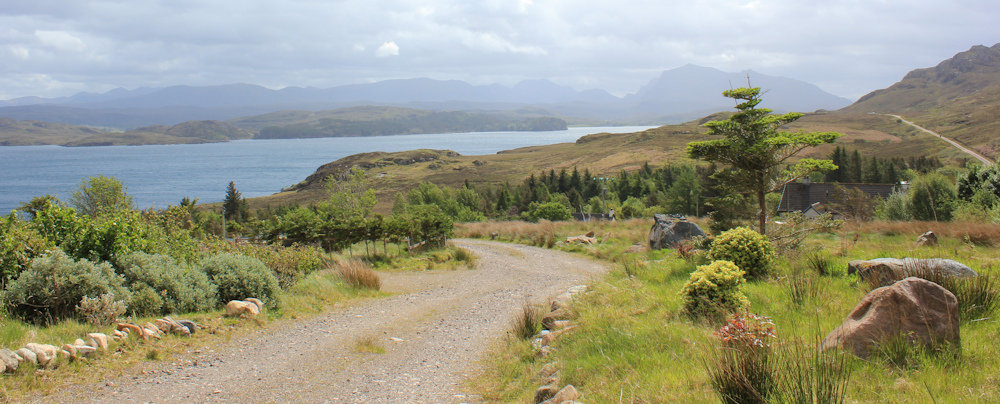
Today I’m walking to Poolewe, and then on to a viewpoint further along the road, where I have left my van. If I have the energy, I might walk further… but we’ll see. My distances seem to be getting shorter and shorter!
The road to Poolewe is straightforward, and passes through empty countryside. The first section is uphill from Naast.
I seem to be “feeling” the surface of the road more than I usually do. When I look down, I discover why. I’m wearing a pair of worn-out trainers, instead of my walking shoes!
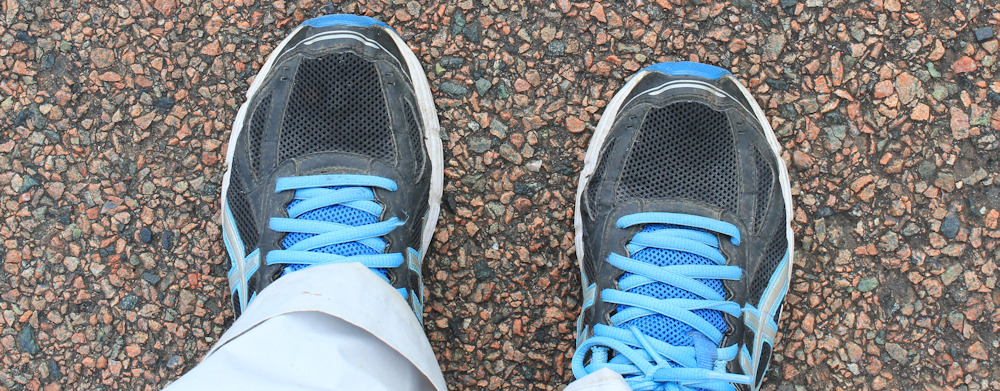
Too late to turn back now. Plod on. Have a feeling it’s going to be one of those days.
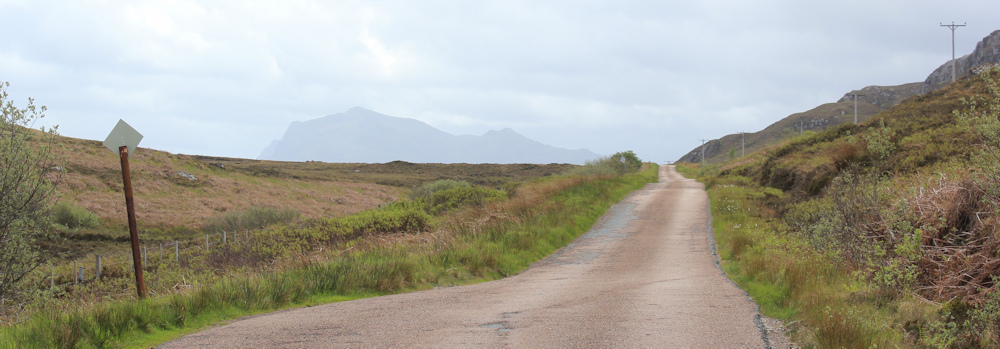
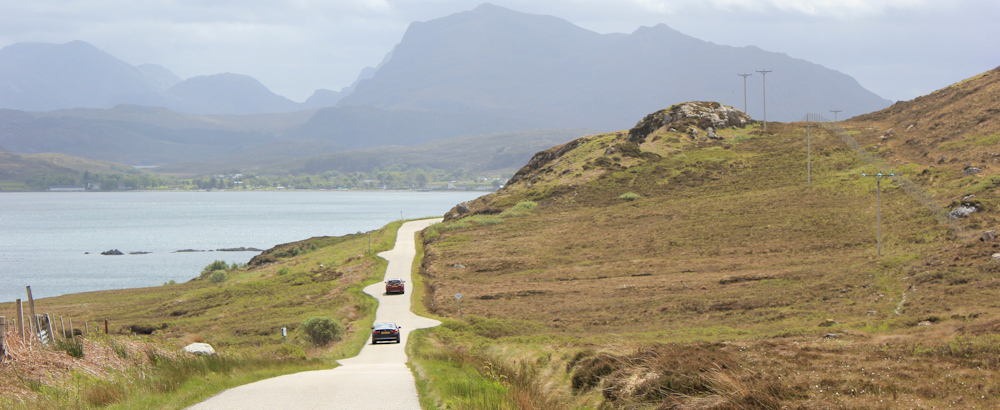
Anyway, this road is lovely – a single-track road with beautiful views. Just the occasional passing car to make me stand aside.
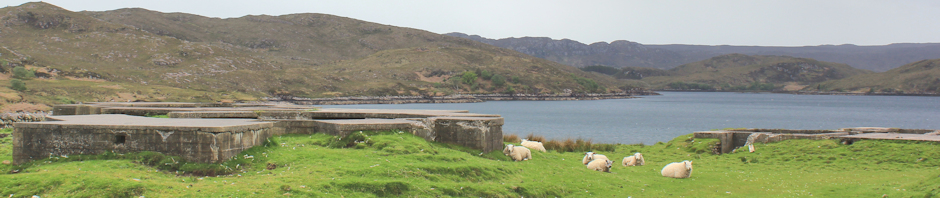
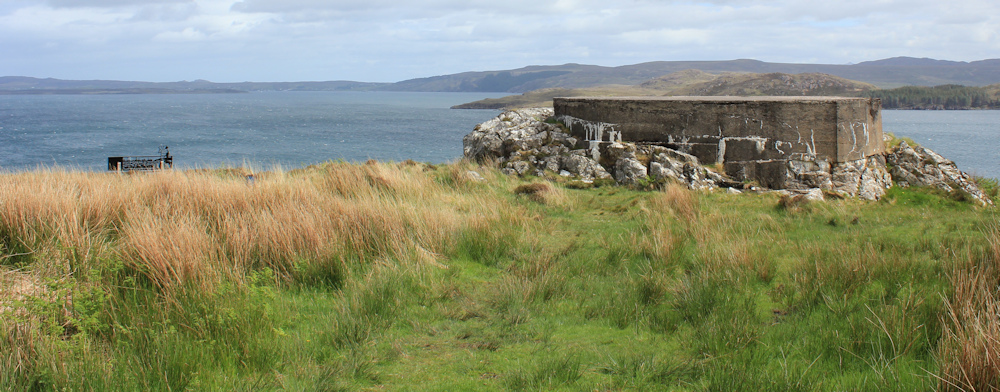
On a raised promonory, I see an old military construction, and a nearby bench. Walk over to take a closer look, and curse as the boggy ground embraces my trainers with gusto, and I feel my socks getting damp.
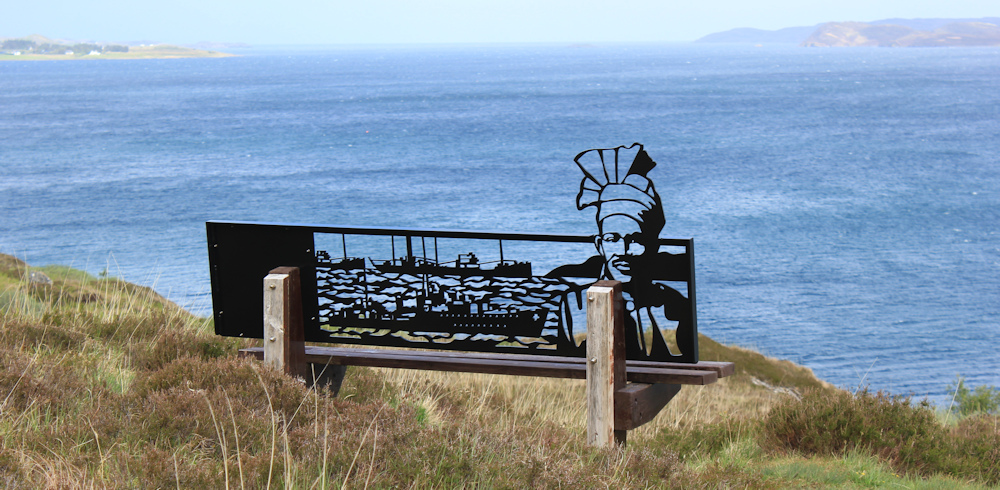
The bench looks fairly new, and is obviously designed to commemorate the Arctic Convoys, with scenes of ships carved in silhouette on the back. Beautiful handiwork. But the figure in the scene confuses me. With his elaborate headdress, he doesn’t look like either a sailor or a military man.
An information plaque on the front of the bench explains that the nearby concrete structure is an old gun emplacement. It was built to defend the ships moored in Loch Ewe and is nicknamed the “Threepenny Bit” because of its multisided shape. (I do wonder how long this nickname will last if the younger generations have no idea what a threepenny bit looks like.)
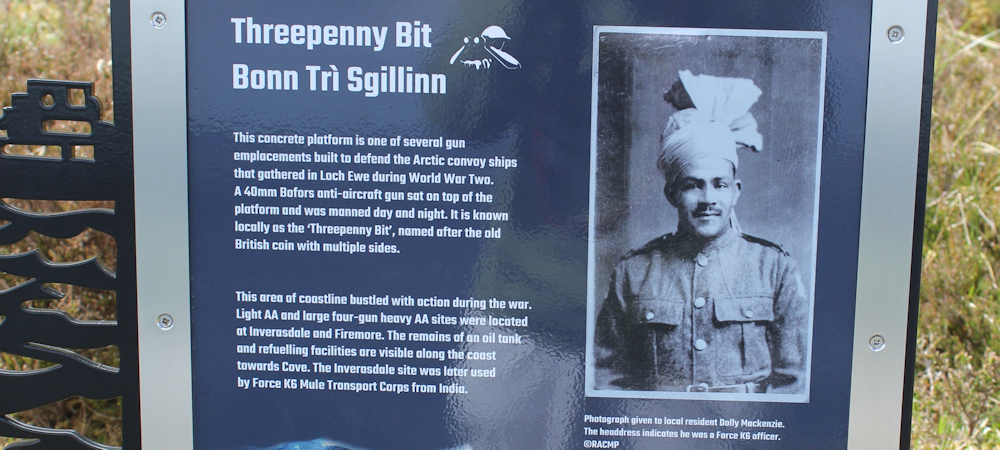
The mystery of the man in the headdress is solved. The sculpture was based on an old photograph, showing a Force K6 officer from the Indian Mule Transport Corps, who were stationed around the Loch. I wonder how that Indian gentleman coped with the harsh Scottish winters and the long hours of darkness.
Onwards. I ignore my damp feet. The road twists through an area of woodland, which makes a welcome change from the openness of the landscape yesterday.
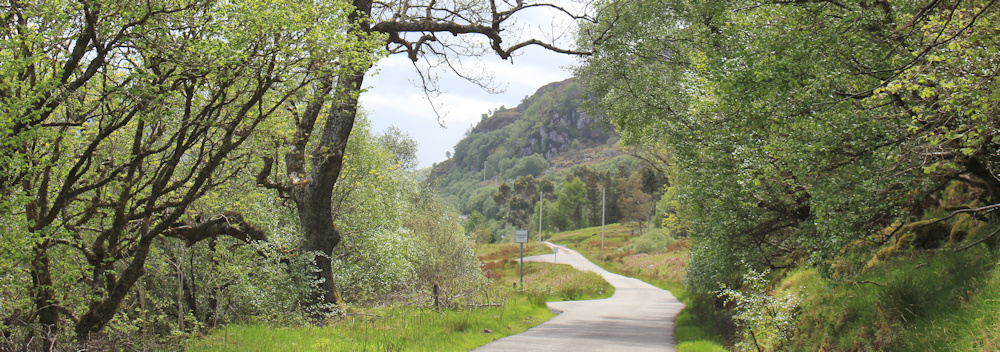
Spring comes late in Scotland. I hear cuckoos calling – and the bluebells are in full bloom among the trees. I stop to take a closer look at the drooping stems of flowers, and snap some photographs. Yes, these are definitely our native variety of bluebells. How lovely.

I cross a bridge, where foaming water tumbles down over rocks to join the loch. From a high point in the road, I look down along a gravelly beach. I’m nearing the top of Loch Ewe. Poolewe must be just around the corner.
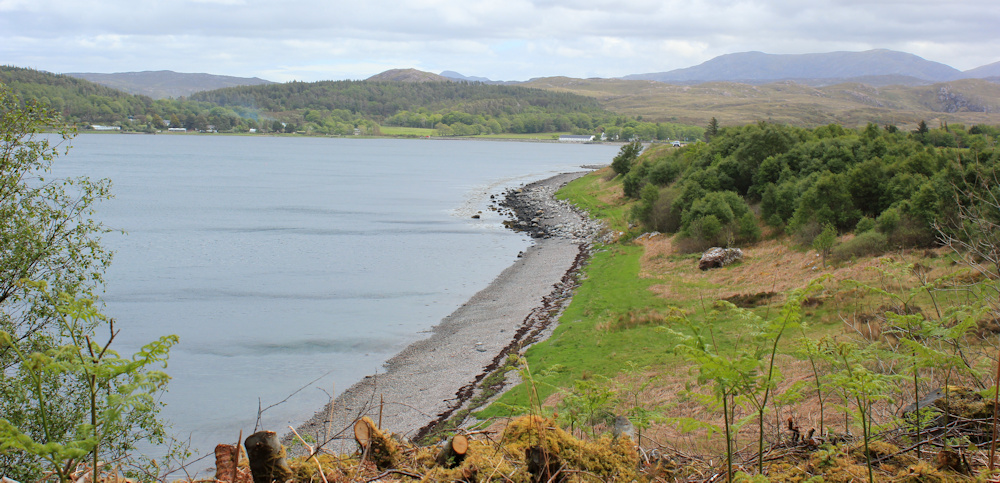
“Just around the corner” always turns out to be further than you think.
An elderly guy, wearing a bright orange rucksack, walks towards and past me. Several cars pass at the same time, and I don’t have the opportunity to talk to him, but I wonder where he is going and if he, like me, is a coastal walker. There are quite a few of us now – all walking the coast in our own ways – although few are doing it as slowly as me! Many of us know each other via Facebook and Twitter, but not every coastal walker uses social media.
Past the turn off to the “Loch Maree Water Treatment Works” – a sign that perplexes me, because this is Loch Ewe, not Loch Maree – and then round a few more bends as the road hugs the shore – and I finally reach Poolewe.
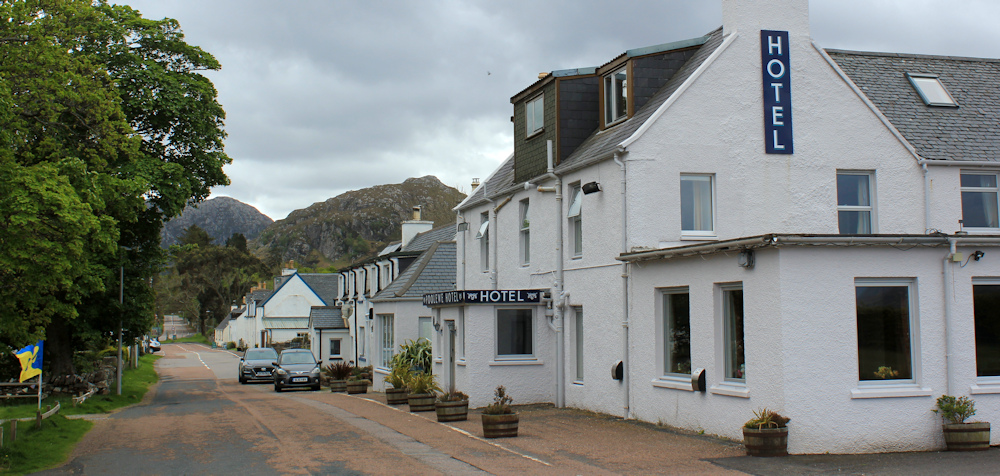
I walk past the hotel, past an inviting cafe (sadly it’s still a bit too early for lunch) and then a little Mace shop. My little road meets the main road and I turn left, heading over a bridge.

This is the top of Loch Ewe, where the River Ewe empties into the sea. I check my map. Ah, the mystery of the Loch Maree Water Treatment Works is solved! The River Ewe basically connects the inland waters of Loch Maree to the sea estuary of Loch Ewe.
There is a pretty house on the embankment, close to the mouth of the river.

Further along the road is Poolewe village hall, a craft shop and an antiques shop (from which I later buy a little statue of a man sitting on the back of an ox, which I believe to be Chinese – a bizarrly incongruous piece to find in the Scottish highlands).
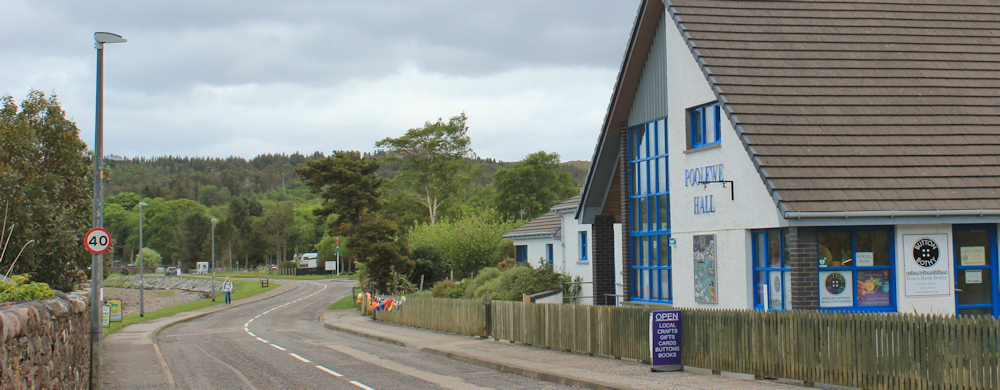
Poolewe is bigger than I anticipated. The road follows the curve of the shore around the top of the loch, passing a camp site among the trees, and a layby where a gaily-painted food-and-drink trailer is parked. If it wasn’t so cold I would stop and eat here… but I’m underdressed for Scotland in May.
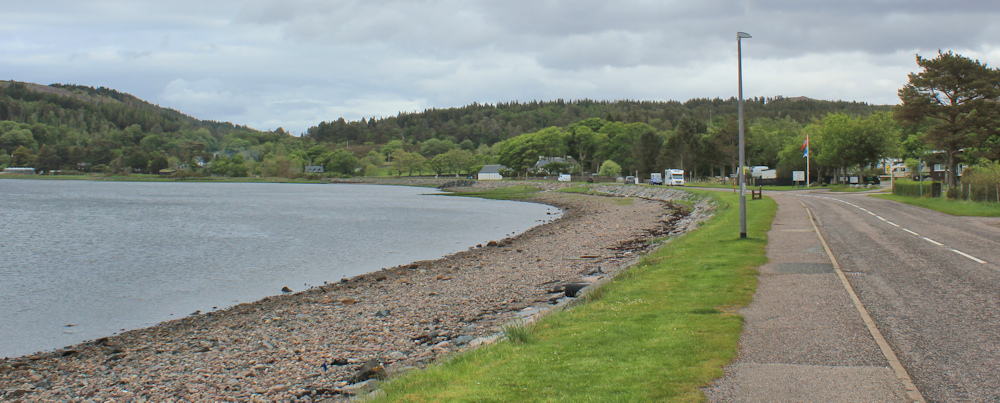
When I packed for this trip, I was freshly back from a sunny week in France where we celebrated my daughter’s wedding (much delayed from Covid – and very precious because of her recent brush with breast cancer). I simply wasn’t anticipating quite how cold and rainy it was going to be in Scotland.
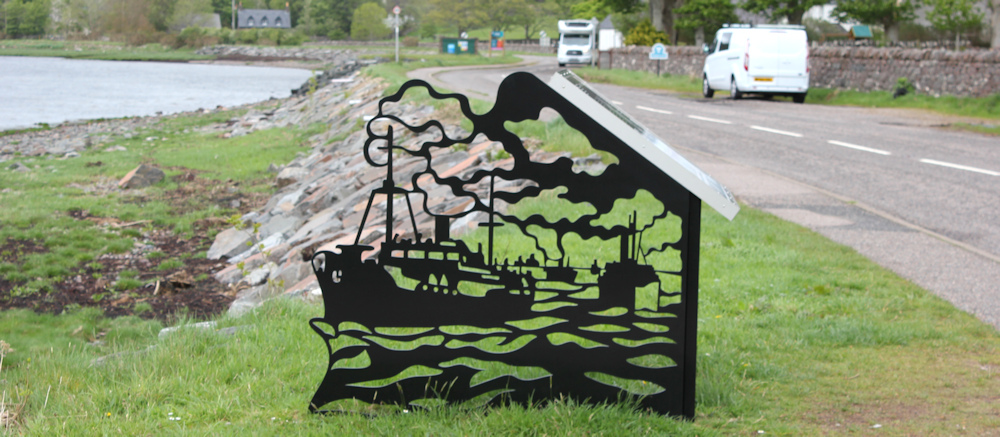
Here is another wonderful piece of sculpture commemorating the Arctic convoys. They really are making the most of this historical connection!
On the other side of the Loch, I follow a path off the road, which leads to nearby Inverewe House and gardens. Here is a weird beehive-shaped structure. I stop to read the old metal plaque embedded in its side.
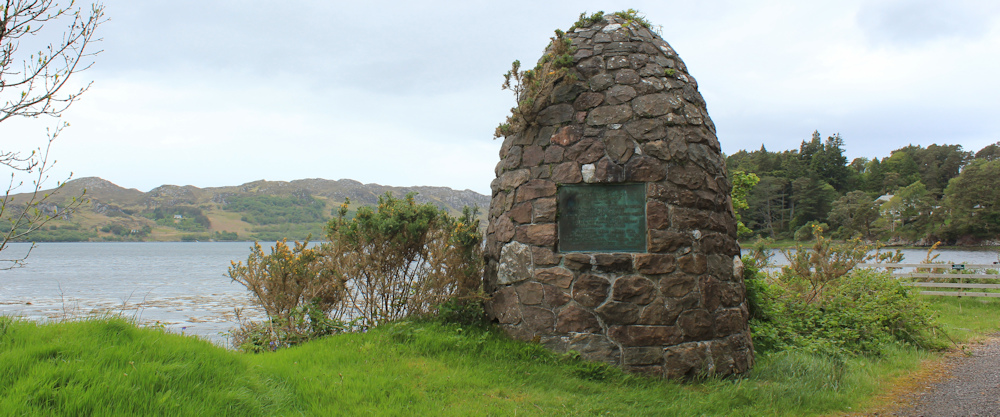
It’s a monument to someone called Alexander Cameron, “the Tournaig Bard”. Later, I look up his name on Google. Although I find plenty of references to his memorial monument, I can’t find anything about his life or his work.
I walk through some gates and approach Inverewe House. Masks are still requested here, and I feel embarassed because I haven’t packed one in my rucksack. I take a quick look around the entrance hall, but the fee to access the house and gardens is steep, and all I want is the cafe.
Make my way despondently across the car park and… thank goodnes… there is the cafe. I don’t have to pay to enter after all.
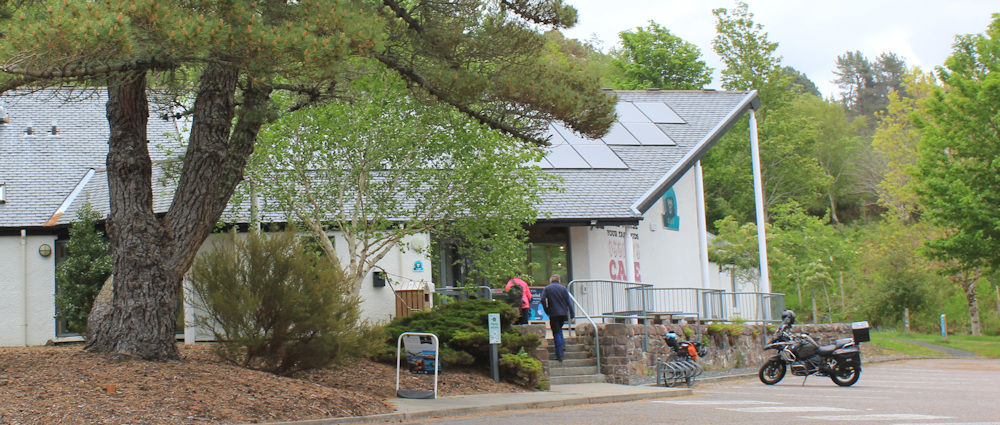
I apologise for my lack of a mask, but the staff make me feel welcome and the place is half empty. The cafe is designed to be eco-friendly, with disposable wooden cutlery, recyclable containers for the food, etc. Unfortunately, I would much rather eat off proper china plates with proper metal cutlery, because the whole experience feels a bit fast-food and Mcdonaldish, which I am sure is not the look they are going for! Anyway, the food is good.
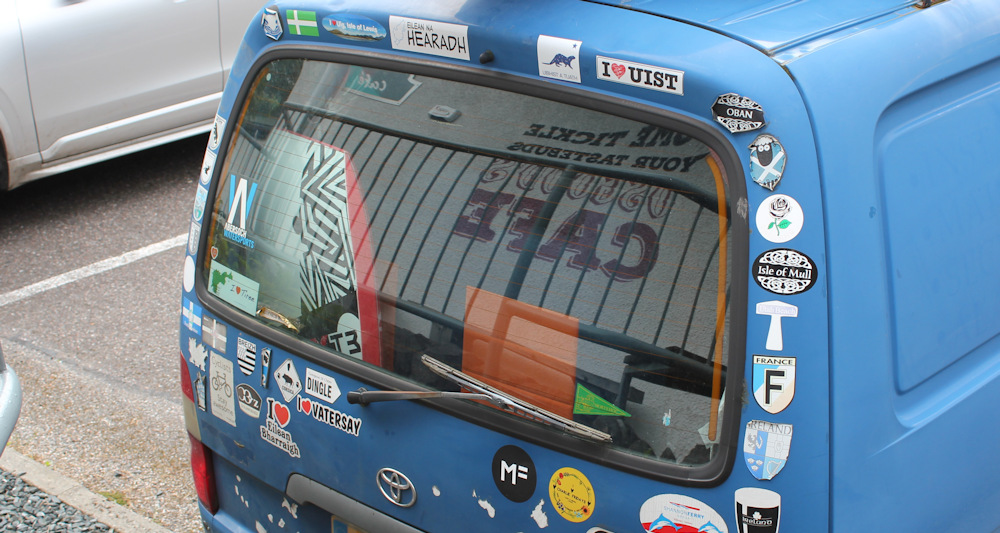
As I’m leaving, I spot this little van with dozens of stickers. Although I quite like the idea of advertising the places you have been, I wouldn’t want to plaster my van in the same way. He’s much too handsome as he is.
I’m back on the main road, and heading towards Laide. The pavement ends shortly after leaving Iverewe House, and this is the busy N500 route, so I am anticipating a few unpleasant miles.
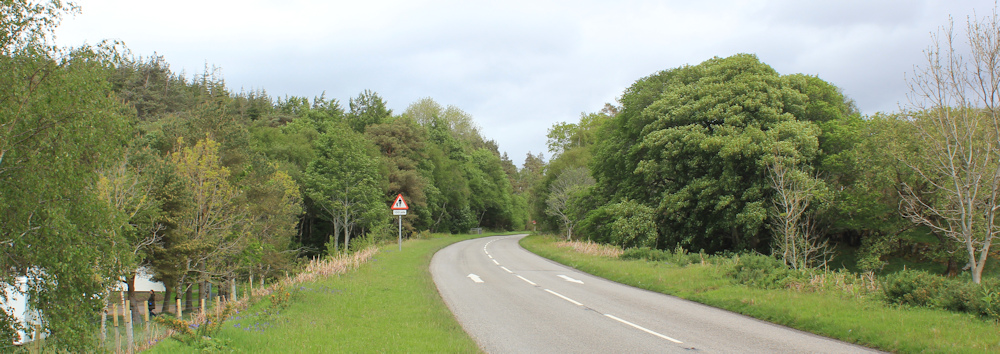
Funny how when you’re anticipating the worst, things can turn out much better than you thought. As I climb the hill away from Inverewe, I get into one of those sublime states that comes with walking – although not on every walk and sometimes when you least anticipate it.
So, unexpectedly and out of the blue, an intense feeling of calmness and well-being engulfs me. Life is good. I’m lucky to be here, and in good health. My daughter has weathered her cancer treatment, I’ve survived my divorce and emerged happier, stronger, and with a better, richer life – surrounded by thoughtful friends and a loving family. I’m a very lucky woman and life is wonderful.
There are trees on either side of the road, but through gaps, I have amazing views looking inland. The intermittent sunlight falls across a quiet little loch.

Even the devestation caused by unsympathetic logging doesn’t dampen my mood. The trees will regrow. Scotland is quietly reforesting itself.

Down the hill, and the road runs along the shore of another little loch – Lachan na Ba Caoile. It’s water is dotted with little circular disks, some of which stand on end in the breeze…
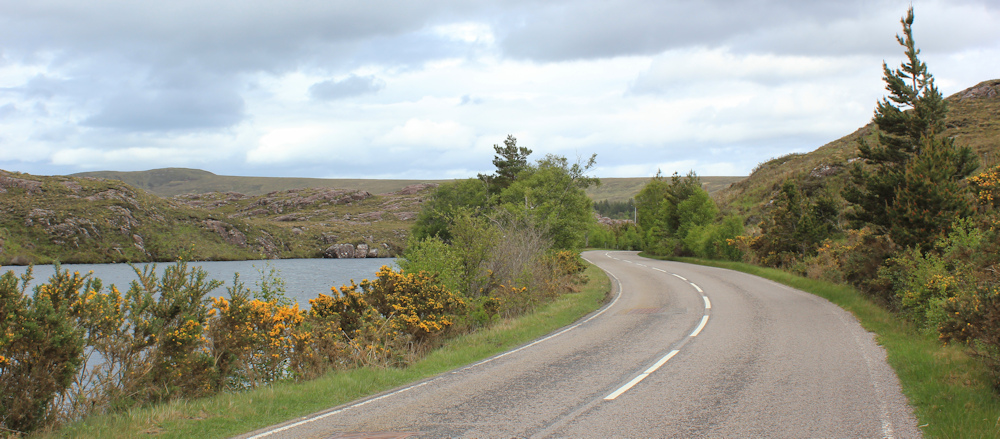
… ah, waterlillies. Just the heart-shaped leaves, pushing up from the depths and straining to reach the surface. No flowers yet.

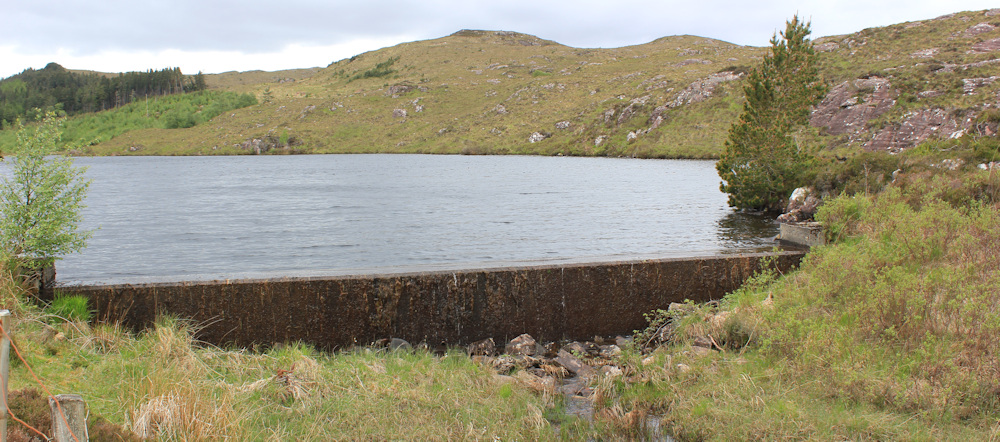
There is a concrete wall at the end of the loch, turning this into a little reservoir. It’s full. The water gently breaches the dam, pushed by the wind, in a series of dribbles and drips.
A half-hidden road sign is engulfed by the foliage of a nearby tree. What does it warn of… Oh, cattle.
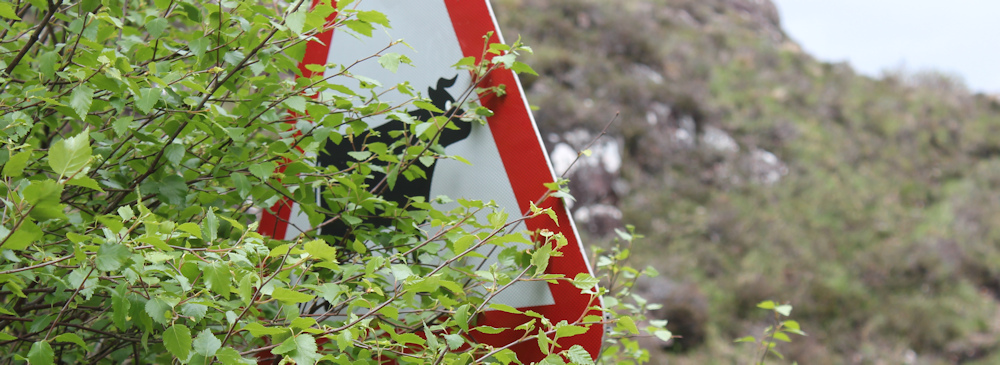
Luckily, I see no sign of the beasts. I’m not at all fond of cattle.
Here’s another loch on my right (so much water in Scotland!). Loch nan Dailthean. This end of the loch is ringed by trees, while the far end has a great view over the surrounding hills and distant mountains.
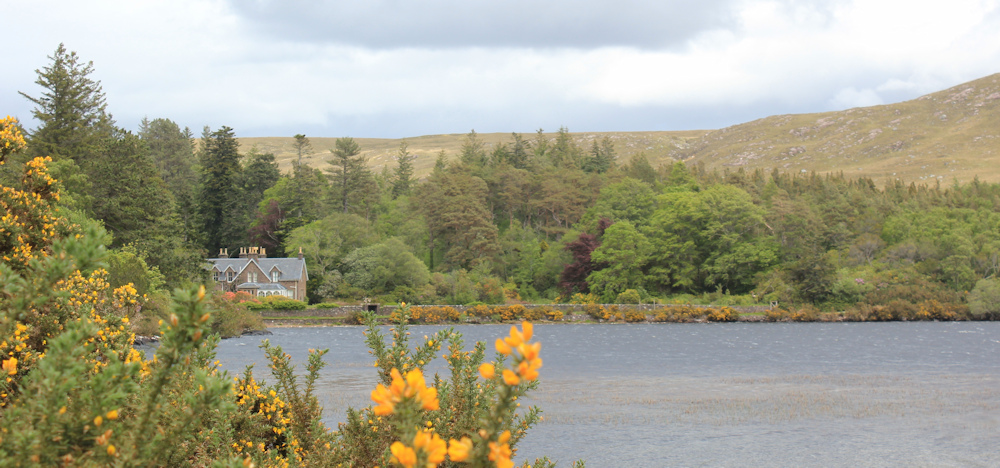
This little area is called Tournaig, according to my map. The place where the bard – Alexander Cameron – came from.
I walk past the turn off to a garden centre, past a dilapidated barn, a field of sheep.. and towards a strange brick tower. Looks functional, but an odd shape for a farm building. Is it a storage unit, for grain maybe?
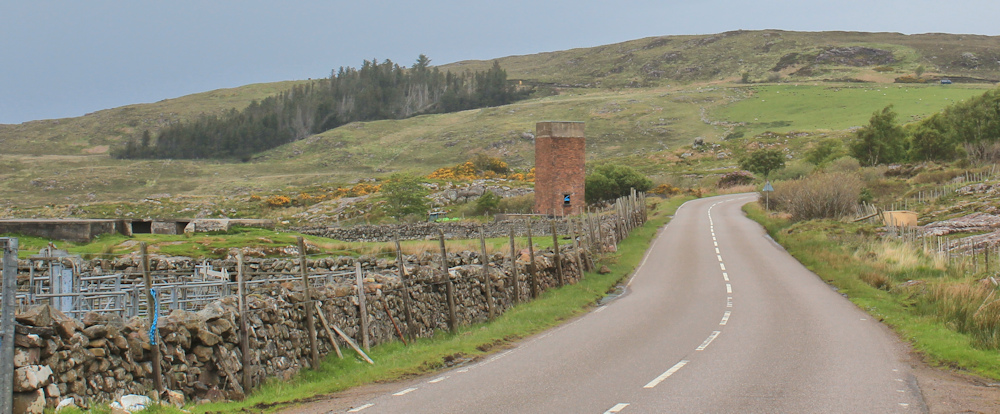
The road bypasses the tower and its use remains a mystery. [Later I learn this was an old water tower, left over from WW2.]
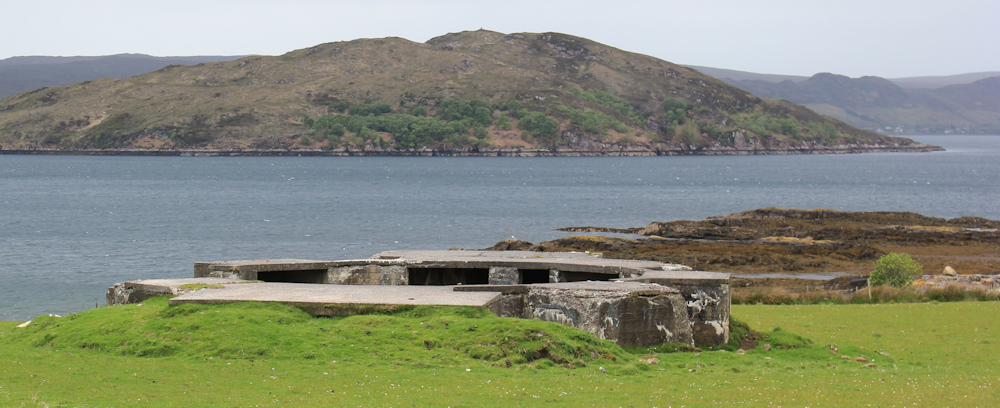
In the fields to my left are remnants of the defences of the Arctic Convoy. Old gun emplacements.
Oh dear. I recognise these red/purple shoots poking up through the ground in the roadside verge. Somebody has made an attempt to cut them down, but they are difficult to eradicate. Japanese Knotweed.

It’s the first sighting I’ve seen of this invasive plant for a long time. What a shame. I hope they get it under control.
Since passing the brick tower, the road has been steadily climbing, and now sweeps around in an arc, skirting around the high hill ahead.

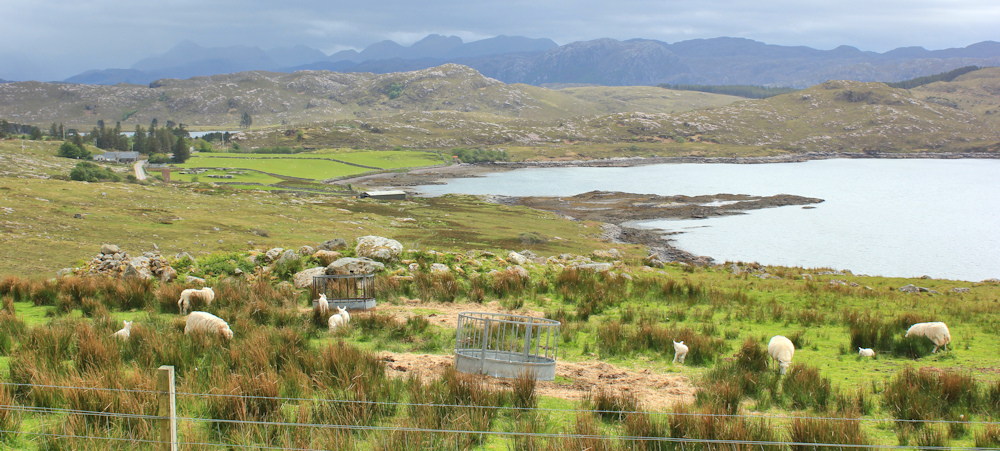
As I climb higher, I get some great views. I stop to take photographs of the landscape. This is looking down across green fields, towards Tournaig. Look at the dark clouds gathering over those mountains!
Britain was wracked by a series of powerful storm last winter, and Scotland didn’t escape. A sign in the cafe at Inverewe House talked about the damage done to their gardens and the loss of many fine trees. I have passed several toppled trees, but am struck by this giant. Its severed roots stick up like a precipice. At its exposed base a pool has formed, and new shoots are growing.
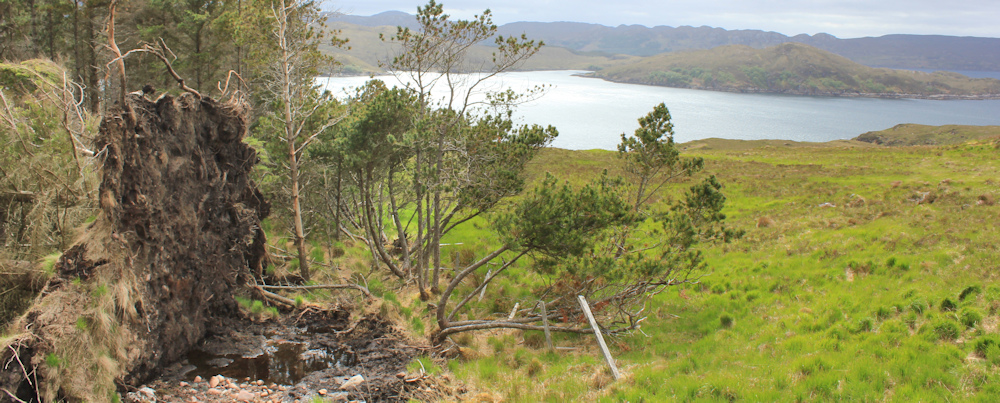
It’s a reminder that all things come to an end, even giant trees that seem invincible, but nature is unstoppable. It is already recolonising the vacated space.
At this point, still climbing the hill, the rain clouds catch up with me. I speed up when I’m hit by the first flurry of drops. The rain is driven by the wind and whips the back of my legs. Thank goodness I’m nearly at the top… in fact, I can see my van parked at the “viewpoint”.
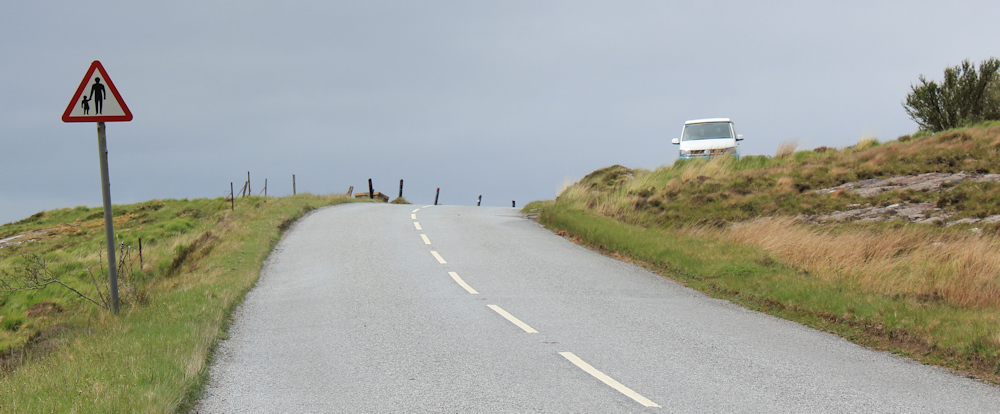
I was hoping to walk a little futher, but the rain and wind put me off. I’d either have to do a there-and-back walk, in the rain, or drive back to pick up my bike, and then do a cycle-there-and-walk-back walk, also in the rain.
One thing even worse than walking in the rain is cycling in the rain. I can’t see with rain dotting my glasses, and bike brakes don’t work well in the wet… so, I decide to end my walk here.
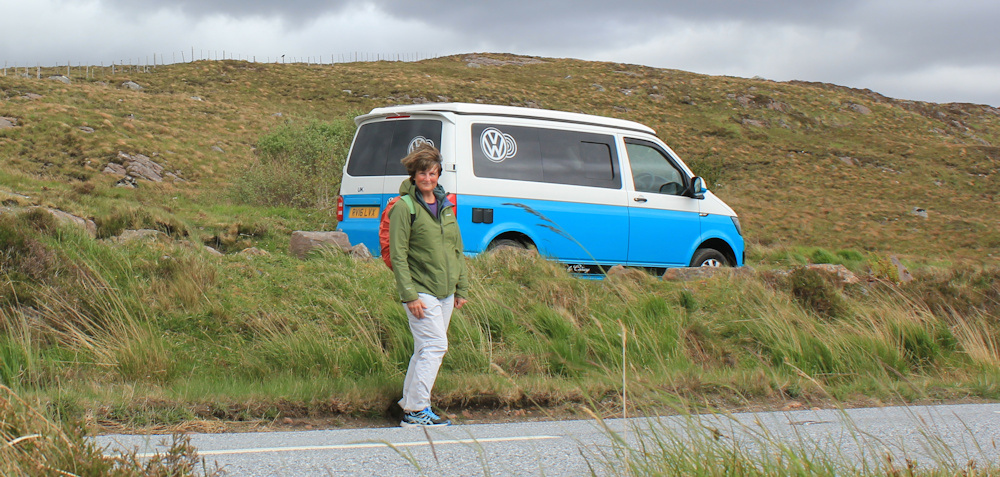
The rain stops long enough for a self-portrait in front of my new (to me) van.
I look out over Loch Ewe, take more photographs of the darkening view. There, on full zoom, I manage to catch a shot of Naast and can even spot my B&B.
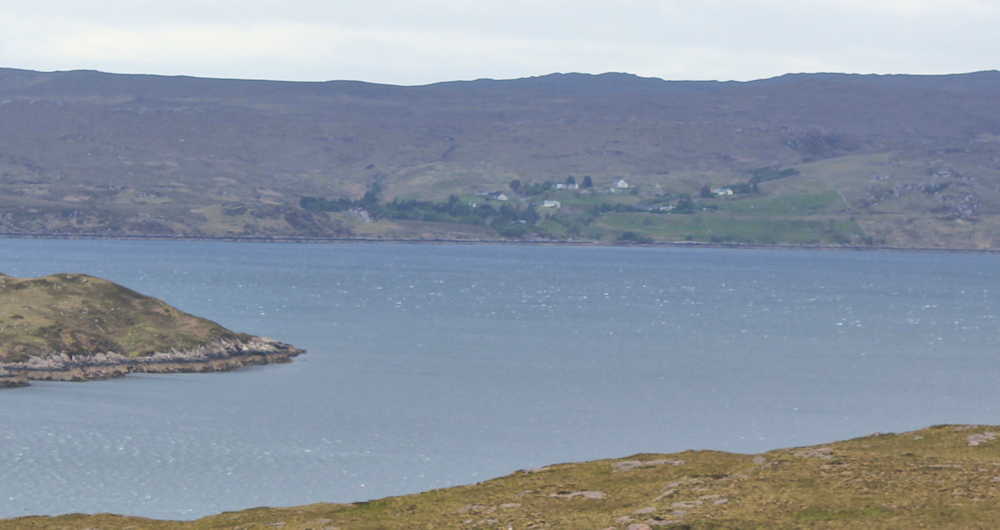
Time to go back. The wind is blowing wet and hard. The rest of the walk can wait until tomorrow.
You can find out more about Force K6 and the Indian soldiers who helped us win the war: Press and Journal and more about the Arctic Convoys here: Russian Arctic Convoy Museum
Miles walked today = another meagre 7 miles
Total around coast = 4,731 miles
Route:





 Ruth's Coastal Walk (UK)
Happy to read that you are happy, and all is well in Ruth’s world!
Thank you Annabel. I was really happy to be back in Scotland too, despite the dismal weather.
Yes an uplifting post.
Thanks for the link to the article about the Indians. As well as the cold, damp and long winter nights, the silence must have been very strange.
Yes, although the place was bustling during the time of the arctic convoys, but they must have had long, lonely nights manning the defences in isolated spots.
Dear Ruth, I loved your blog particularly today’s, that feeling of calm, so happy you found that. It’s along journey but as you say, there is a strength that comes with going through it all (thinking divorce not your daughter, that’s terribly hard).
Take care Sarah.
Sent from my iPhone
>
Thank you for your lovely comment, Sarah. My life is better now, but it was a hard process.
Although I enjoy the results when I garden I hate the physical side of it because it all goes back to jungle so quickly. However, I have visited Inverewe Gardens TWICE and been happy to pay the price. It is most impressive. The founder had patience. He obtained conifer saplings from an island in Loch Maree and planted them to make a windbreak before starting on the serious construction of the gardens – I think he waited for more than ten years for them to be effective enough for his requirements – so I have read.
I’m reminded of the Chinese proverb (allegedly). “The best time to plant a tree was 20 years ago. The second best time is now.” I’m making a note of all the places I should return to and visit – and perhaps the Inverewe Gardens should be on that list.
Great narrative & lovely photos Ruth.
Thank you, Mike.
Those moments of joy spring at unexpected moments on a hike.
It’s strange isn’t it. Yes, quite unexpected on this particular day.
Glad to hear you are happy and happy to be back on the coast and in Scotland. I remember also using the view point where you finished. I also didn’t visit Inverewe Gardens but I confess I made use of one of their picnic benches in the car park!
It’s a huge car park. I’m sure nobody noticed!
Pingback: 471 lay-by through Dundonnell Forest to lay-by | Ruth's Coastal Walk (UK)