58. Pagham to Selsey Bill to East Wittering

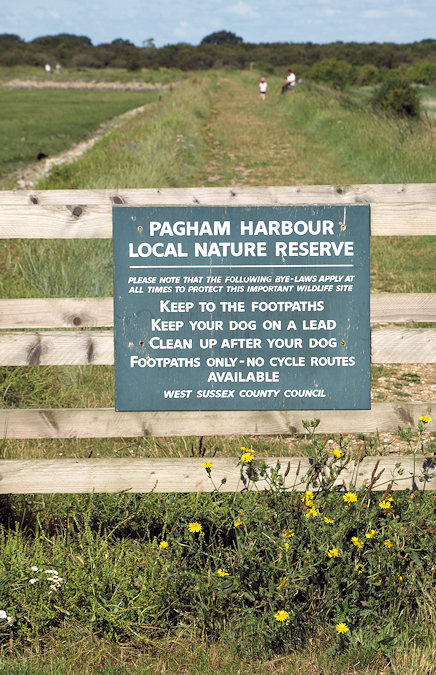
Entrance gate, Pagham Harbour, Ruth's coastal walk.Despite its name, Pagham Harbour is no longer a place where boats come, the entrance to the harbour having silted up years ago. (In fact, I don’t see a single dinghy, yacht or ship of any sort during this stage of my journey today.)

After the death of the harbour, the land was reclaimed as agricultural land in the 19th Century. Then, during a violent storm in 1910, the unforgiving sea broke through the banks and claimed it back. Now this area is an important Nature Reserve.

From here to Selsey Bill is only 3 miles as the crow flies. Of course, not being a crow, my route is much longer. Unable to walk across Pagham Harbour – on account of acres of mud, creeks and rivulets – I am walking around the circumference of this wide area of marshes and mud flats.

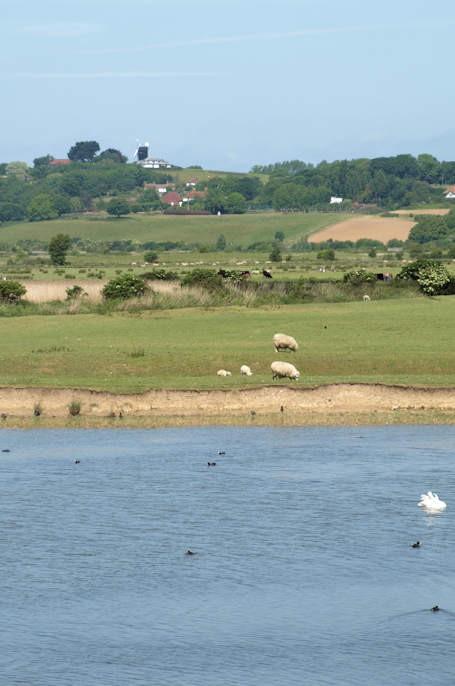
Egret and Swan, Pagham Harbour, Ruth's coastal walk. Sussex.The sun is shining and the day is beautiful. At the entrance to the Pagham Harbour, I stop and take photographs of a group of white water birds. There is a swan grooming itself in the sunlight and, close by, a beautiful little egret strides around, busily darting its neck in and out of the water.

Oyster Catcher in Pagham Harbour, Sussex. Ruth on her walk round the coast.Beyond are ducks and some birds with over-large heads wading in the mud. Ah, I recognise these birds – oyster catchers. They seem a little different from the oyster catchers I met on the Chetney Marshes in Kent. Their beaks are paler – not such a bright orange. I wonder if their diet is different here and this has affected their colouration.

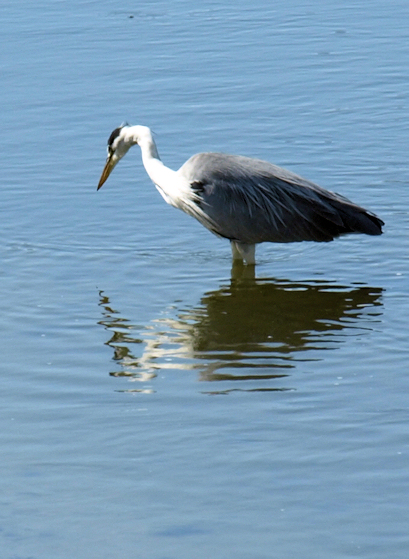
Heron in Pagham Harbour, Sussex. Ruth on her walk round the coast.Heron in Pagham Harbour, Sussex. Ruth on her walk round the coast.Heron in Pagham Harbour, Sussex. Ruth on her walk round the coast.Then I see a large bird, dirty grey in colour compared to the brilliant white of the egret and swan. It wades through the water, close to the swan, keeping a careful eye on the water, looking for breakfast. It is a heron. I have never seen one so close up before.

I leave the little creek behind and head into the marshes. I overtake an elderly couple of bird watchers. He has a huge camera with an enormous lens around his neck. She has a tiny pair of binoculars. I ask them if they have seen anything interesting.

‘Not much happening,’ they tell me.
‘There are oyster catchers, swans, an egret and a heron back there,’ I tell them.
‘Oh yes,’ they say, dismissively. ‘Those are all very common here.’

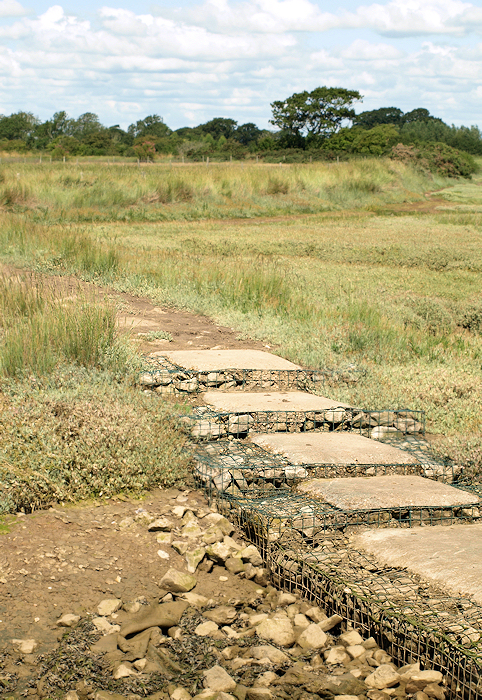
Dead trees in Pagham marsh, Ruth on her coastal walk, Sussex.Path across Pagham harbour, Ruth walks round the coast, SussexThere are a number of paths to choose from, and I stick to the route that takes me closest to the distant sea.

The footpath looks well maintained and I am falsely reassured by the paving slabs and wooden steps over the muddy areas.

Luckily the tide is out, or I could have been defeated by mud and water. I find myself wading through mud and stumbling over uneven, tussocks of grass in the marsh. It seems the sea is gradually reclaiming this area, taking over the ancient footpaths and drowning the trees.

At one point, while slipping a sliding along a muddy section of path, I see debris on the marshy grass around me. I recognise this; here are the tiny carcasses of little white crabs, just as I saw on The Strood, Mersea Island.

07 Dead crabs, Pagham Marshes, Ruth walks the Sussex coast.

It is the tide that washed them up here. I wonder if they were dead on arrival or died later, stranded on the unfamiliar territory, unable to find their way back to the sea?

I come to an area called Sidlesham Quay. There are a collection of houses and a road winding round the apex of the marsh. Here there used to be an old tidal mill. The inland pond (where sea water was stored when the tide came in) is visible on the other side of the road. When the harbour silted up and the land was reclaimed as agricultural land, the tidal mill died. Only some ruins remain, stranded in the mud.
Remains of Tidal Mills, Sidlesham Quay, Ruth's walk through Sussex
I wonder about the feasibility of resurrecting some of these mills, in this age where we are looking for ‘green’ energy sources. We have built huge off shore wind mills to generate electricity. What about harnessing the power of the tide?

I walk around Sidlesham Quay and rejoin a foot path, taking me along the western side of Pagham Harbour reserve. I pass two ladies, sitting on a bench, painting the scene in watercolour on long, horizontal strips of paper. The sun is warm and the paint is drying too quickly. I stop and chat to them. They tell me there is a way straight across the marsh at low tide. But they don’t know the exact route.

Sidlesham Quay, Pagham Harbour, Ruth's walk through Sussex

From the footpath, I take photographs of Sidlesham Quay, looking very attractive in the sunshine.

view across Pagham Harbour, Ruth walks around the coast.I walk on a raised bank, skirting the edges of the marshy land. The sky is clouding over and the sunlight drifts across the flat landscape. In the distance I can see the sea wall that stretches across the old entrance to the old harbour. Path with flowers, Pagham Bay, on Ruth's coastal walk through SussexI am growing tired of mud and grass and look forward to seeing the sea again.
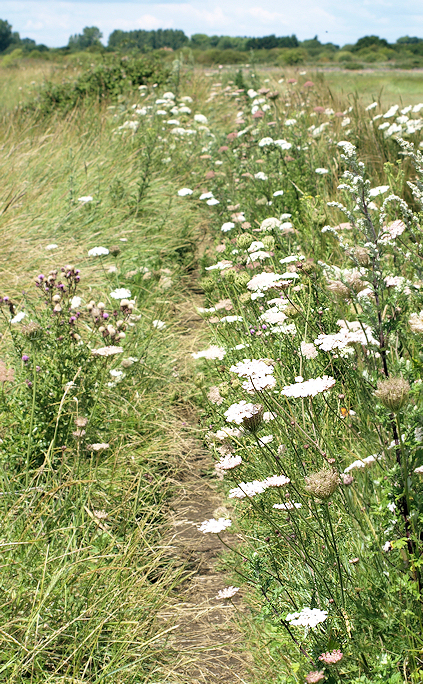
Later, I walk through an area where the path is surrounded by tall grasses, wild flowers and blackberry bushes.

Suddenly, I notice, there are butterflies everywhere. And big, fat bumble bees. I spend far too long on this section of the walk, taking photographs.
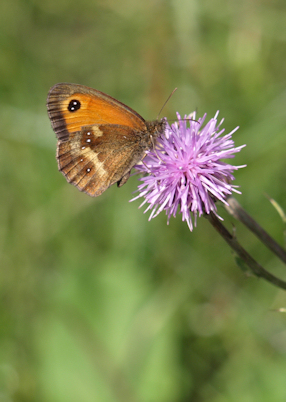
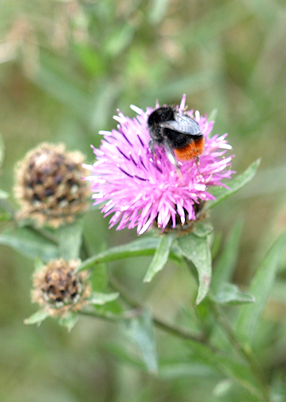
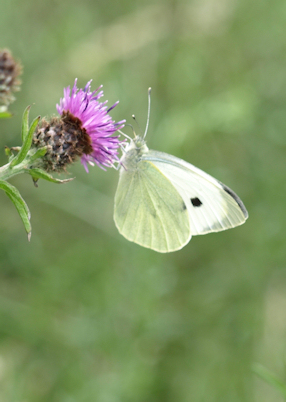
butterfly, on Ruth's coastal walk through Sussex11 bee, on Ruth's coastal walk through Sussexbutterfly, on Ruth's coastal walk through Sussex

Photographing butterflies is immensely frustrating. Just as you line up a perfect shot – in focus, sun out, no grass stalks in the way – the damn things flit off. But I am pleased that I do manage some good shots.

The path becomes more overgrown and overhung with oak trees. I am surprised to see such large trees with their roots close to salty marshes. I wonder if they will survive.

I meet a man pushing a bicycle along the overgrown path. He has telescopic equipment hung around his neck. He warns me ‘it is a jungle’ ahead. I grow worried that I won’t be able to get back to the shore. We stop and chat. He is a very enthusiastic bird watcher and travels all over the place to pursue his hobby. I ask him how far it is to Selsey Bill, but he seems unsure of where this is.

But I needn’t have worried. I turn a corner, cross an area of flat marshes, climb up a bank and find myself looking out over a long shingle beach.

Shingle beach, looking back towards Bognor, Ruth's coastal walk.

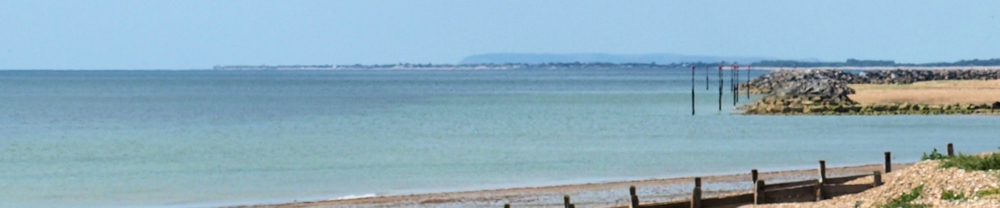
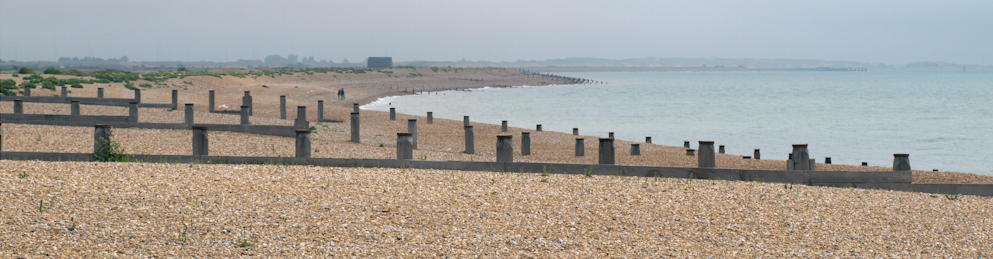
To my left, I can see back to Bognor. The break in the shoreline is hidden, giving the illusion you could walk, uninterrupted, along the beach. I am now only a mile away from yesterday’s finishing point. I was planning to walk, eastwards, along the beach, to the mouth of the Harbour. But the beach consists of rough shingle and I am both tired and behind schedule.

So I turn right and begin walking towards Selsey. Selsey Bill is the triangle of land you can see jutting down, clearly visible on the weather maps. I am looking forward to arriving here. It seems an important landmark on my walk.

I see more people about, walking and fishing. I would like to walk beside the water’s edge, but the shingle is too difficult and I follow a track along the top of the beach. At one point, the track becomes a ‘private road’. Houses have gardens that stretch across the road and encroach on the shore – private areas of lawn, fenced off with ‘keep off’ signs.

Blue plaque for 'Sleepy Lagoon', Ruth's coastal walk. Selsey.Then I meet the beginning of Selsey’s promenade. And here is a blue plaque and I learn that By the Sleepy Lagoon, the famous theme tune to Desert Island Discs, was inspired by the view across the bay.

The sky has clouded over completely and the light is dull, so the view does not look too appealing today.

The walkway along Selsey shore is narrow and crowded. People are out, walking dogs and with push chairs. Some are in mobility scooters. I find it difficult to adjust to the crowds after my morning of isolated walking.

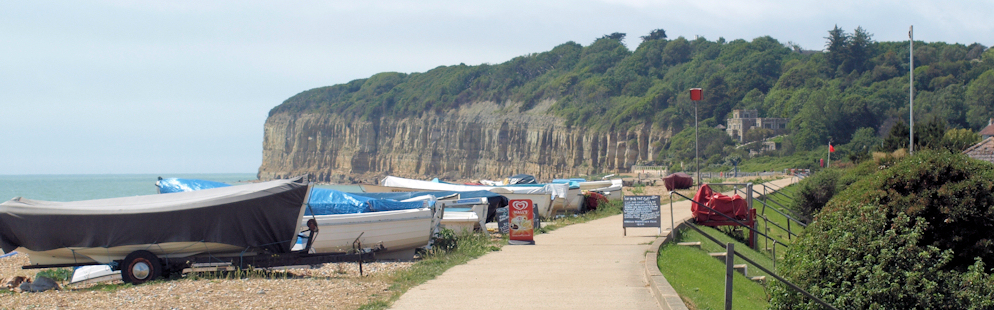
There is a collection of fishing boats on the shingle and places where you can buy fresh sea food.

Selsey promenade - Ruth's coastal walk through Sussex.

Selsey Bill lifeboat station - Ruth's coastal walk through Sussex.

Further along, I see a structure I believe to be a pleasure pier. But as I draw nearer , I realise it is a pier for a life boat station. Presumably, in low tide, the pier is necessary for the launch of the boat.

Scuba divers, Selsey Bill. Ruth walks around the coastline.At the foot of the pier, people in scuba diving gear are assembling. They are getting dressed, pulling on their body suits and adjusting equipment. I wonder what they are up to. Is it a lesson? Or a communal dive? Or a special expedition of some sort?

Keep out sign, Selsey Bill. Ruth tries to walk along the coast.As I near the tip of Selsey Bill, I come across an obstruction to the path – a private house. The tide is high and waves are splashing up around the concrete skirt of the bottom of the property. Maybe, if the tide was out, you could walk around. But now I have no choice. I turn inland and walk through a park area, missing out the tip of Selsey Bill, before arriving back on the shore. I am now on the west side of the triangle.

After a brief stop for lunch (and there are not many pubs or eating places in this area), I continue my walk, heading for East Wittering. Again, I am unable to follow the shore – there is no walkway and the sea is up to the sea wall itself. So, I walk through streets.

Look out tower, Selsey Bill. Ruth walks the coast.Towards Holiday Village, Selsey, Ruth's coast walkI rejoin the coast at the end of a road. Here there is a tall look-out tower. I guess it is connected to the lifeboat station on the east side of Selsey Bill.

The sky is dark ahead. Heavy clouds threaten rain. I walk along the shore, grateful for patches of firm sand among the shingle, trying to speed up.

There is a holiday park ahead with a plantation of static caravans. The sea wall is being eroded and the path along the top of the wall has become too dangerous and is closed. Some of the caravans nearest to the sea look weather-beaten and have boarded up windows. I walk along the road through the holiday park, past a complex of buildings with fluttering flags.

On the other side of the holiday park, the shingle beach stretches ahead towards Bracklesham and East Wittering. There are fishermen on the shingle and people out walking dogs.

Selsey, fishermen, on Ruth's coastal walk, Sussex.

I meet a younger woman (late 30s, maybe) with an energetic dog. She tells me she has come here to escape from her family. The dog is a new acquisition. She talks non-stop for about 10 minutes. As a result, I could tell you lots of personal things about her and her intimate family relationships, but I won’t.

Walking towards East Wittering and Bracklesham, on Ruth's coastal walk, Sussex.Now I walk for miles along a high shingle bank, with dark sea on my left and flat marsh on my right. The going is difficult. I slip and slide on shingle, hunting for stretches where the stones are packed down. There are few features to break the monotony of the walk. I have the illusion I am walking on an endless treadmill of stones. A distant piece of driftwood (a rare sight on this beach) appears of monumental importance as a landmark.

I have plenty of time to think. I wonder if the shingle will ever end. I wonder why I am doing this. I think about the woman I have just left. (The amount of private information she offloaded within a few brief minutes, suggests she was either desperately lonely or hypomanic.)

It is a relief to reach Bracklesham. But also a disappointment. There are private houses backing onto the beach, but no promenade or footpath. Then shingle beach becomes steeper. The stones on the bank become looser and harder to negotiate. I am very tired and slide down the shingle bank to walk near the waves. This was a mistake, the shingle here is even deeper and more tiring than on the bank.

Seeing a carpark ahead, I leave the beach and text my husband. Am I in East Wittering? No, I am in Bracklesham. Don’t I want to walk another mile and meet at the East Wittering car park? No. I don’t. I’ve had enough.


Miles walked = 11 miles

High points = Sidlesham Quay, birds and butterflies
Low points = Selsey Bill and endless shingle

Route:


Posted in 06 Sussex | Tagged , , , , , | 18 Comments

57. Littlehampton to Bognor Regis and Pagham

A long weekend, with four great days of walking, stretches before me. It is midday on Friday when I arrive at Littlehampton’s East Beach and my plan is to walk into Bognor Regis for a late lunch.

01 From Atherington to Middleton-on-Sea, Sussex. Ruth's coast walk.

The tide is coming in and much of the sand is covered. I walk along the top of the beach, over packed-down shingle, around the top of groynes. As I start this walk, to my right are fields and open countryside. As I approach Middleton-on-Sea and, later, Bognor Regis, more and more houses appear.

1 - distant view Isle of Wight, Sussex. Ruth's coastal walk.

In the distance, I can make out a finger of low-lying land, extending out into the sea. That must be Selsey Bill. Beyond this low land, I can see a higher cliff. Is that towards Portsmouth, I wonder? I didn’t think there were cliffs ahead. Strange. Perhaps my eyes are playing tricks on me.

2 - Looking back to Littlehampton, breakwaters. Ruth on coast walk through Sussex.

I come to an area of beach where artificial breakwaters – large rocks – have been formed to protect the shore from erosion. Between the gaps in the breakwaters, small semi-circular ‘coves’ have been formed. I am reminded of the first time I saw similar breakwater reefs, back in Sea Palling, Norfolk.

I perch on one of the breakwaters and have a drink and a snack. The tide is still coming in and I am surprised to see how quickly the water begins to swirl around the base of the breakwater. I realise I am in danger of being stranded and quickly climb down off the rocks and head back up to the top of the beach.

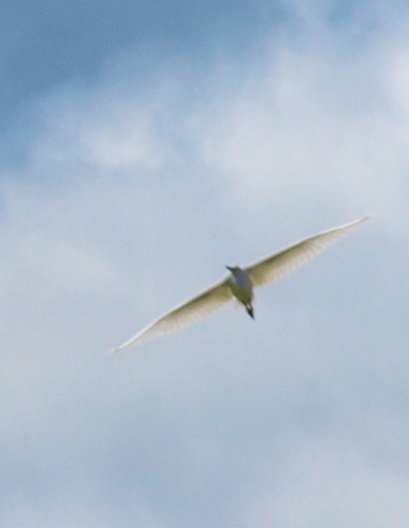
4 - Egret on beach - Sussex, Ruth's coastal walk.4- egret in flight, Sussex, Ruth's coastal walk.I see an egret, flying low and graceful above me. I pull out my camera, but am not quick enough. By the time I am ready, the egret has landed some distance away. I take this fuzzy shot of the bird on the beach. Then it is off again and I manage to capture it in flight.

I really love these birds. They are unmistakable – completely white plumage and very stylish in flight. This might be a little egret, a common bird on the coast around here. But, I think, with the large wing span and paler legs and beak, this is probably great white egret.

5 - Bognor Regis and holiday camp, Ruth's coastal walk.I am walking through an area called Middleton-on-Sea. The sky has become cloudier and the sun goes in and out. Ahead, along the coast, lit up by a patch of sunlight, I see some white, tent-like structures. I know I am approaching Bognor Regis and I wonder what the white structures are.

6- approaching Bognor Regis, Ruth on her walk around the coast.When I draw nearer, walking along a wide promenade, I realise the ‘tents’ are permanent structures, the roof of a holiday park with a large swimming pool, a hotel and residential buildings.

6 - shingle beach with boats - Bognor Regis, Ruth on her coastal walk.The beach here is still shingle. Maybe there is sand when the tide goes out? I don’t know.

As well as the trappings of a holiday resort, Bognor beach has fishing boats, fishing nets and crab (or lobster) pots.

The place is not crowded with the summer holidays yet to begin. I have enjoyed the walk so far, but am getting tired and hungry. So, I look forward to finding the pier, where I am planning to meet up with husband for lunch.

8 Bognor Regis pier - Ruth's coastal walk.The pier turns out to be a big disappointment. Yet another pier destroyed by storms and fire, then left to disintegrate. What a shame.

Originally opened in 1865, the pier once had a pavilion and a landing stage for pleasure craft. You can read about its history on the Heritage Trail Website. You can see how the pier once looked from old postcards.

What remains of the pier (a building on the landward end) is being used as a nightclub. But there is some sort of construction going on at the end of the pier. I wonder what they are doing with it.

The ruined pier was once the site of the Birdman competition – the competition for human-powered flying machines. But the event has moved to Worthing because the pier at Bognor became too dangerous to use.

9 Fun fair arriving, Bognor Regis, Ruths coastal walk.We have lunch in a cafe where the food was good and the signs proudly claim – ‘open all day’. We arrive at 3:00 and are just finishing our lunch at 3:30 when we are somewhat surprised to see people being turned away. ‘Open all day’, we are amused to find out, means open between 10:00 am and 4:00pm. Last orders are taken 30 mins before closing time.

We were lucky to get our lunch.

After lunch, I walk westward, along the Bognor promenade. A fun fair is arriving. Large trucks are lining up to unload alongside the promenade. Men unpack the trucks, quickly and efficiently constructing the various amusements. I see a dodgems being assembled. A small crowd gathers to watch.

10 - Train turning sign, Bognor Regis promenade, Ruth's coastal walk.Further along, I come to a part of the promenade with a wide circle painted in white paint. A young couple with a very excited toddler are standing here. They are waiting for the ‘promenade train’. This is its end point and turning circle.

At the end of the promenade, private housing restricts access to the beach. I would like to walk on the sand, but the tide is high and there are only dangerous rocks and ‘Keep Off’ signs.

11 Secret footpath sign, on an estate, Bognor Regis, Ruth trying to walk the coast11 - secret footpath, Bognor Regis, Sussex, Ruth's coastal walk.Reluctantly, I turn inland and walk through an area of housing. There are new estates here – all with ‘Private’ signs, although I guess the roads are actually public roads with free public access.

Amongst the housing, with no sight of the sea, I get rather lost. Eventually, more by luck than good map-reading, I find a footpath back to the shore. The footpath signs are well hidden, almost buried in a hedge and not visible until you get to the end of a ‘private’ road.

I hope the path leads to the beach, although it is not indicated on the sign. I walk down a tunnel of greenery, between tall garden fences and, to my great relief, find myself back on the shingle shore.

12 - Approaching Pagham Harbour, Bognor Regis, Ruth's coast walkThe going is difficult. The shingle is loose and there is no clear path. If it wasn’t so tiring, I would really enjoy this section of the walk. The beach is almost empty. Plants are growing on the shingle and the view is attractive.

The light is fading. Although there are many hours before sunset, dark clouds are piling up overhead. Conditions are poor for photography. I am anxious about rain and hurry, as best I can, over the rough shingle.

13 Cormorant - Sussex, Ruths coast walk.On one of the breakwater posts, I see a cormorant – black and sinister in the darkening light.

The way ahead along the coast is interrupted by the entrance to Pagham Harbour. Here there is a car park and people are walking on the shingle. Spots of rain are beginning to fall. People begin running back to their cars.

I stop to get out my waterproofs, wrap my camera in plastic and bury my iPhone in an internal pocket. Then I continue, walking through the car park, to the nature reserve that borders Pagham Harbour.

14 Pagham Harbour (2) - Ruth's coastal walk, Bognor RegisOnce upon a time, this was a proper harbour, with deep water and shipping. As the harbour mouth silted up, the land was reclaimed as agricultural land. The sea broke through some years ago, flooding the area again and forming an extensive marshy area. It has been left as a nature reserve – a huge area of tidal mud flats, marsh land, water, vegetation and wildlife.

I walk along a footpath. To my left is the wide area of Pagham Harbour. To my right is a smaller, deeper lake, with ducks, swans and gulls.

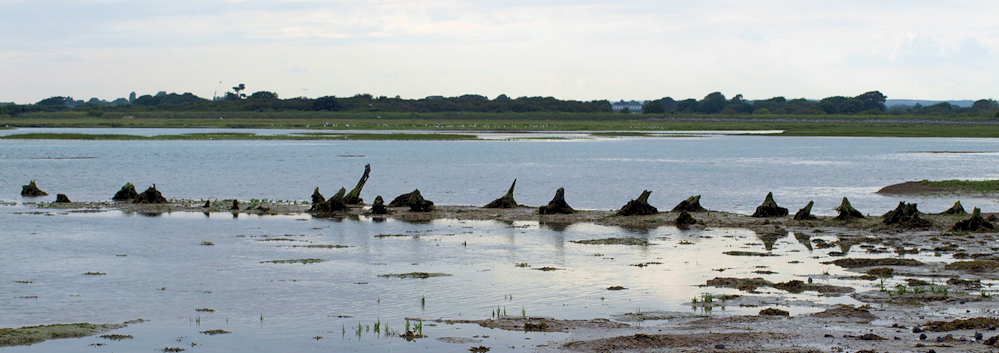
Past the lake, there is a caravan park and housing – but all set back in the distance. As a result of the bad weather, everybody else has vanished. I am totally alone for this part of the walk, as I follow the path along the muddy shoreline. Old, decaying wooden structures stick out of the mud, looking like giant, rotting teeth.

The rain stops but the light is fading fast. I hurry as best I can. Instead of shingle, there is mud to contend with now. I slip and slide.

Ahead I see a couple of bird watchers, sitting under umbrellas, by a ‘hide’. At this point, I am forced to walk along the muddy skirt of a protective wall. I wonder if I have lost the footpath entirely. The bird watchers watch me with blank expressions under their caps. They might be irritated by my stumbling intrusion. I wonder if I have scared any birds away.

At the end of the wall is a track. I turn inland, following the track, heading into the village of Pagham. Here I end my walk for the day.

14 - Pagham Harbour, Sussex, Ruth's coastal walk

Miles walked = 10


Route:


Posted in 06 Sussex | Tagged , , , , , | 2 Comments

56. Ferring to Littlehampton

Sunday morning and I set off from Ferring in good spirits. My husband drops me off at a small car park. I walk past beach huts and a little cafe. The cafe already has some customers, enjoying breakfast or a morning coffee.

Ferring, Sussex. Ruth's coastal walk.

The beach is shingle and, as I stumble and slide on the stones, I wonder how difficult the walk today will be. Rounding a gentle curve in the shore, I see there is a footpath running along the top of the beach. Ahead is an area of green grass and the footpath leads across this. I am grateful for the firm walking.

People begin to appear – dog walkers, hikers, joggers.

Kingston Gorse Estate, Ruth's coastal walk, SussexKingston Gorse Estate warning sign, Ruth's coastal walk, SussexThis is the Kingston Gorse Estate – apparently private property – but with a public footpath crossing it. The estate cannot resist erecting warning signs. All fun of any sort is strictly forbidden. Luckily, walking is allowed.

Further on, I pass by some very fine houses.

The sky is full of fair weather clouds and there is a haze on the horizon. It is warm, but not hot. There is a good breeze today and sailing ships are out on the sea. In the far distance, across the water, I see the curve of a shoreline. Is that Selsey Bill, I wonder?

The tide is going out and I walk down the beach to the edge of the sea. There are patches of firmer sand among the shingle and I walk beside the waves. Rows of wooden groynes run down across the sand. Their ends are under water and I can’t walk round them. So, I climb, jump or scramble over them. Every so often, if a particularly high one blocks my way, I have to take a detour up the beach to get round the top end of the obstruction.

Groynes across the beach, West Kingston, Ruth's coastal walk.

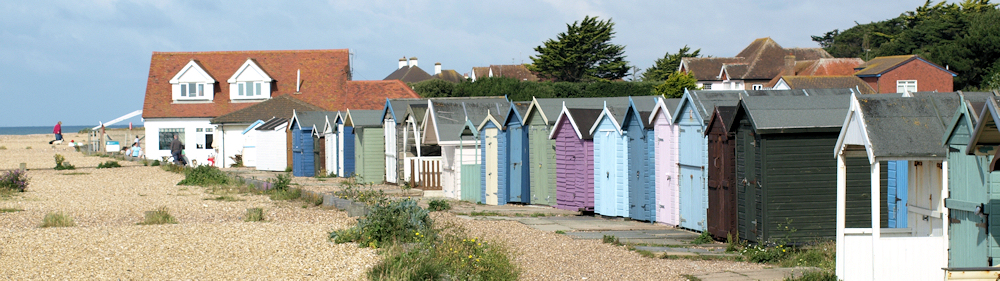
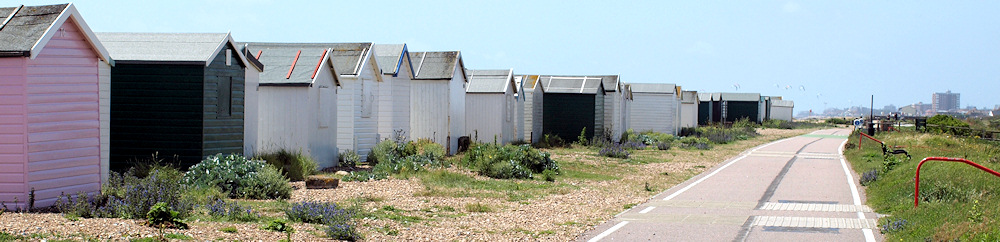
At top of the beach are rows of bright beach huts. Very few are in use on this fine July morning. I wonder if it gets busier here when the schools break up. But the beach is still mainly shingle and not ideal for family holidays.

Beach Huts, Rustington, Littlehampton, Sussex. Ruth walks the coast.

I am passing through an area called West Kingston and then head towards Rustington, on the outskirts of Littlehampton.

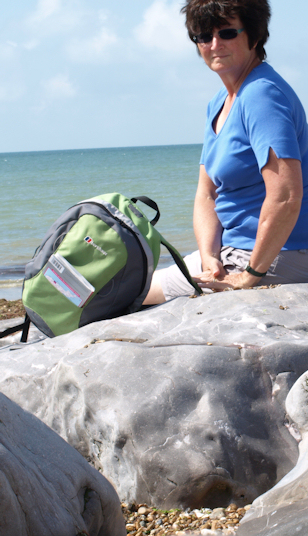
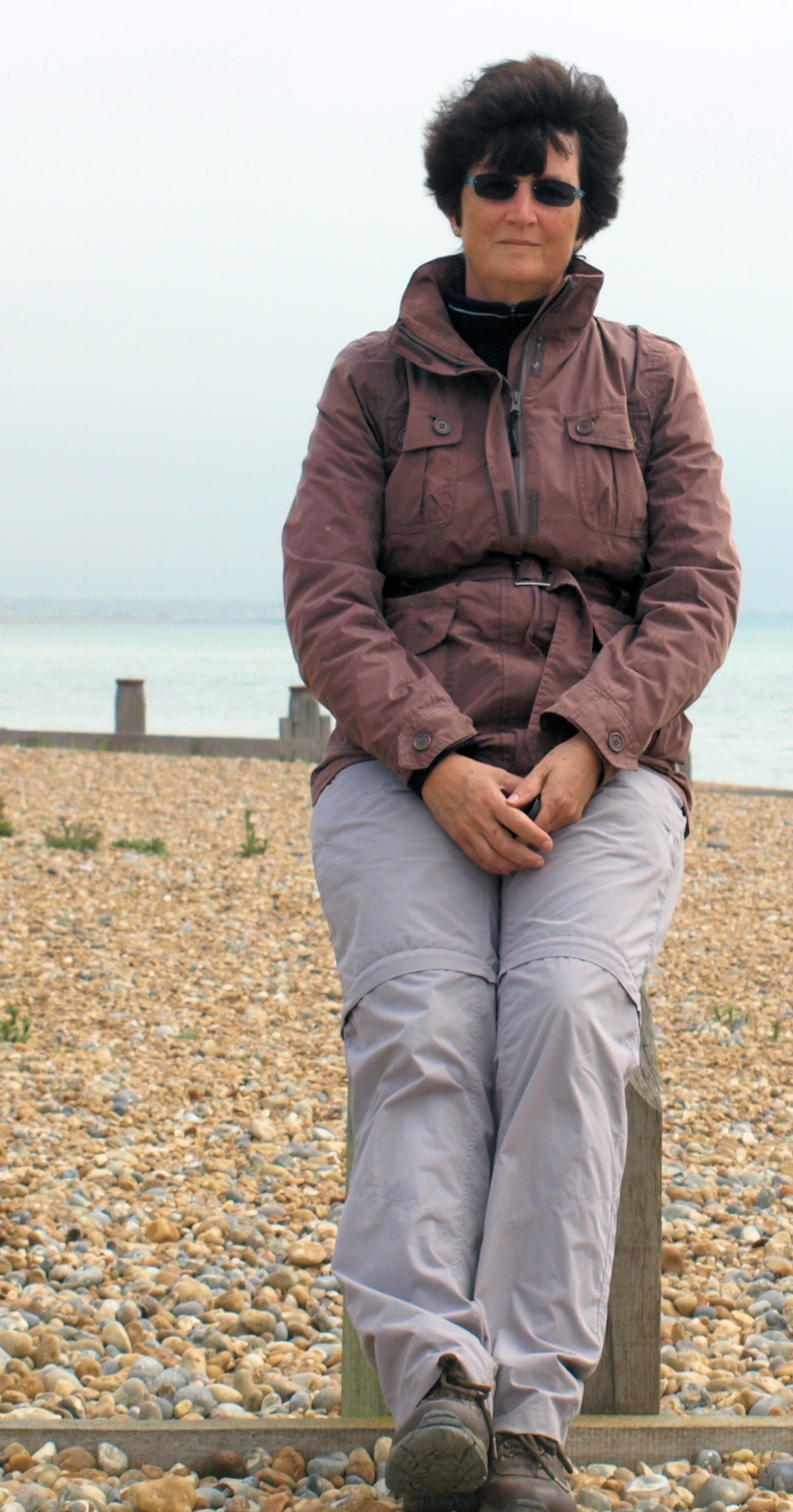
Self Portrait, Rustington beach, Ruth's coastal walk, through SussexI stop on some rocks and have a snack. I attempt a self-portrait. This involves balancing the camera on a stone and setting the timer. I use my rucksack to focus the shot. Then I run to perch, nonchalantly, beside it.

Unfortunately, the resulting shot gives a good view of the lower part of my body, but cuts off part of my head.

Later, with some further cropping of the photo on my computer, I manage to make the shot look more posed – as if the cropping was intentional. (Thank goodness for photo editing programs!)

As the day progresses, more and more ships appear. There are sailing races going on.

Ships in Sea, off Rustington, Sussex. Ruths coastal walk.

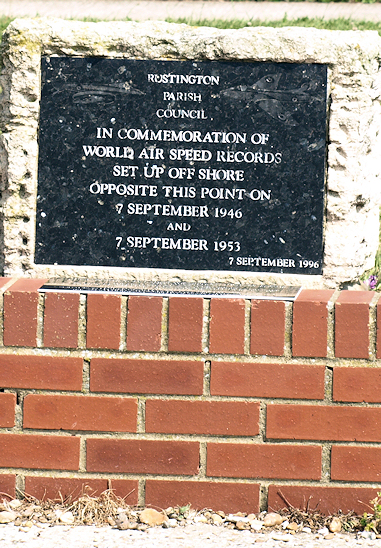
Speed records, plaque, Rustington. Ruth's coast walk in Sussex.As I walk along the top of the beach, through Rustington, I notice this plaque. Two world air speed records were set here; or, to be accurate, in the air just off shore from here. Both records were set about 60 years ago – before I was born – and have since been broken. But I am impressed. One was set in 1946 for an air speed of 616 miles per hour. The other was in 1953 for an air speed of 727 mph. I had no idea there were planes that could go so fast, all those years ago.

More information about air speed records can be found on Wikipedia. The official fastest air speed is now 2,193 mph, set way back in 1976 – when I was still at medical school. It is hard to believe that record has remained unbroken for the past 35 years.

(The fastest speed in air was actually recorded by the Space Shuttle on re-entry – a whopping 17,500 mph. The Space Shuttle program is about to end. I wonder how we will break the record in future?)

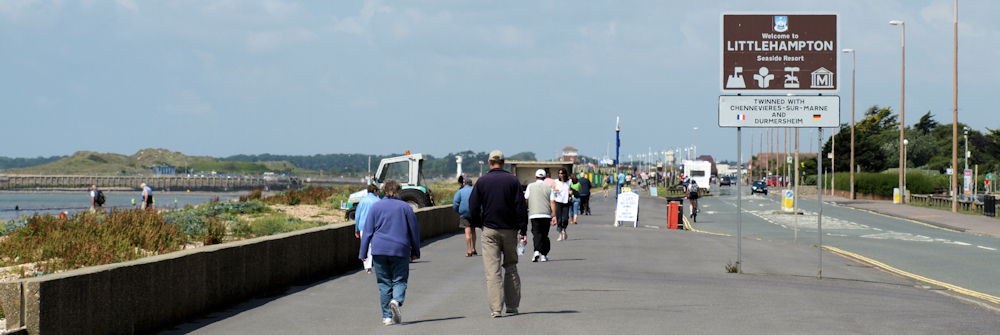
Approach to Littlehampton, Ruth walks round the coast.

As I approach Littlehampton, I walk along a wide pavement, just above the vegetated shingle bank. Later I see some weird benches and street furniture – a continuous, slatted bench, ‘the longest bench in Britain’, which loops in places to form interesting shapes. Unfortunately, I couldn’t take any good shots, because there were too many people about.

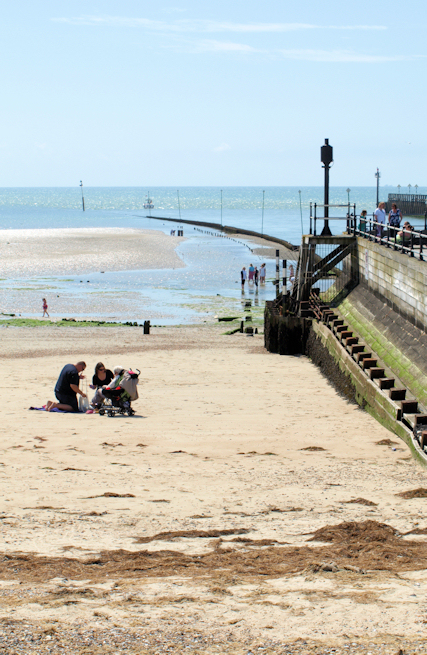
East Beach, Littlehampton, Sussex. Ruths coastal walk.Harbour entrance, Littlehampton, Sussex. Ruth's coast walk.Ahead, on the beach, I can see a small pier extending out to sea. This marks the mouth of the River Arun. The tide is out, and people are walking on the sand and along the pier.

I stop and have a drink and snack.

Across the river mouth, just 50 feet away, is the next part of my walk. But to cross the river I have to head into Littlehampton to find a bridge.


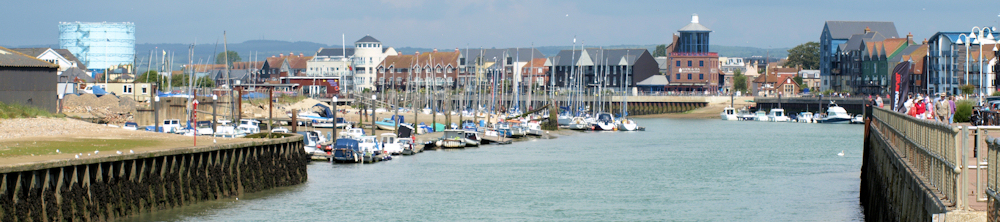
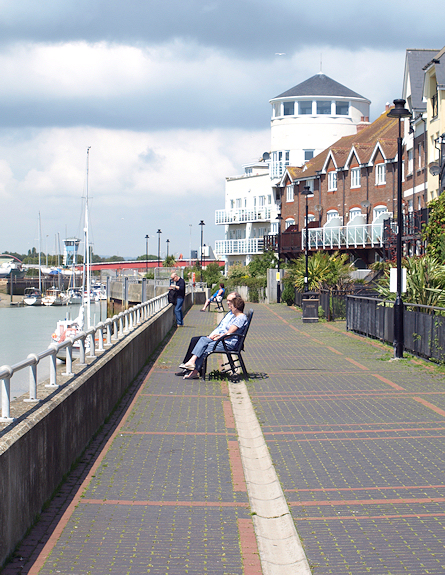
Beyond the narrow river mouth, the river opens up into a lovely harbour area. Walking into Littlehampton, following the riverside walk, is a joy. There are new buildings – cafes, houses, shops – and a new walkway along the river with seats and nice paving. This really enhances the town.

Littlehampton, Ruth's coastal walk, Sussex.

Riverside, Littlehampton, Ruth's coastal walkI remember how I tried to walk along the river at Faversham (North Kent) and how access to the riverside was barred, on both sides of the river, because the developers had been allowed to take over the bank as ‘Private Property’.

Faversham was a lovely market town but failed to make best use of one of its main assets – the river. Faversham’s planning committee should be ashamed of itself. Look what can be done. Look at Littlehampton. This is how to develop a river bank so that everybody can enjoy it.

I find a footbridge crossing the river. It appears to be resting on rails, as if it can be pulled back to allow larger ships to pass by. The rails are overgrown with weeds and I assume it is not in use. But later, I find you can ask the harbour office to retract the bridge if you need to get through.

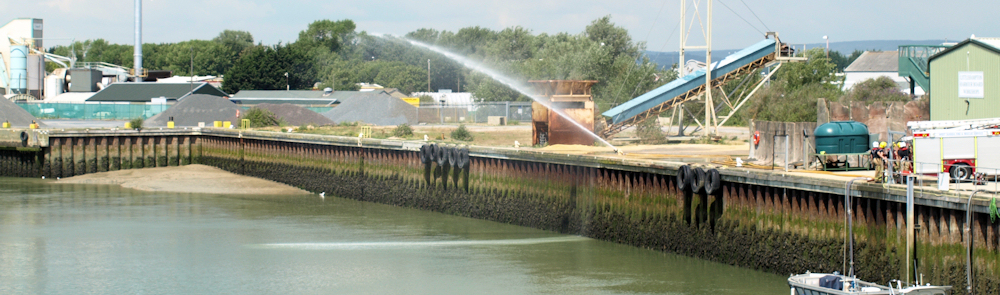
As I cross the bridge, I see something odd. There is fire truck on the quay and a group of firemen. Further along, there is a fire hose spraying water in a huge jet across the river. The hose is unattended. I wonder if they are practising or if there has been an incident.

Firetruck and hoses, Littlehampton, Ruth's walk round the coast

On the other side of the river, there is no lovely walk – just a footpath that follows the river bank. There are ships – some abandoned – lying in mud alongside broken down jetties and derelict wharves. I quite enjoy the run-down feel to the area.

Speed warning. Littlehampton Harbour, Sussex. Ruth's coastal walk.As I approach the mouth of the river, I see the place where I stopped for a drink and snack. I feel I can almost reach out and touch the seat I sat on; so close – but it has taken me almost an hour to get round to this side of the river.

I see something I couldn’t see from the other side. A speed restriction sign for boats. And a warning about speed cameras! No escape from the wretched things.

One reason for the speed restriction is the narrowness of the entry to the river. Another reason is the swans. There are hundreds of them along the shore and they form a crowd on the other side where people are walking, hoping for food.

This area is called ‘West Beach’. A narrow road leads up to the shore and ends in a small car park. There is a cafe here. People are sitting in the sunshine, eating lunch, talking and laughing. A sandy bank leads down to the beach. It looks lovely and, if on my own, I would have stopped here for lunch. But I have arranged to meet my husband in a pub further along the coast – at Atherington, Climping Beach – so I keep walking.

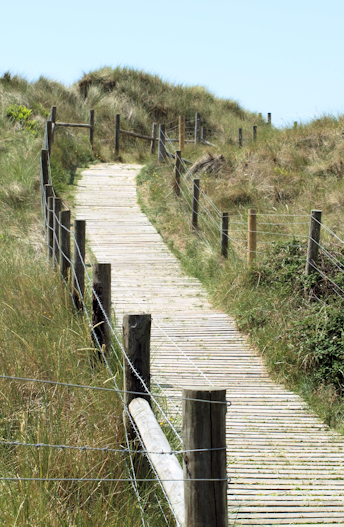
Dunes, West Beach, Littlehampton, Sussex. Ruth's coast walk.I follow the fenced footpath up through the dunes. The going is easy because the path consists of slats of wood.

The fencing is designed to protect this area of the dunes from wear and tear, preventing erosion. Signs explain why. The dunes are sustained by the plants that bind them and dune grass is very fragile.

I remember how the dunes in Norfolk were similarly protected.

Further on, the fencing disappears and it is possible to roam freely, if you wish.

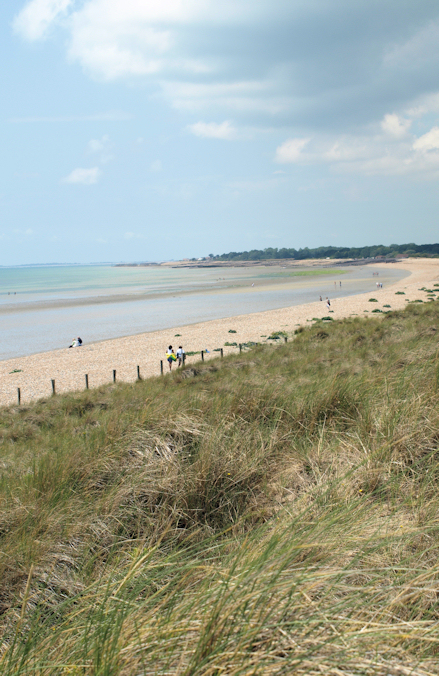
West Beach, Littlehampton, Sussex. Ruth's coast walk.When I reach the top of the dunes, I gasp. What a fantastic view!

Before me, a long, wide, curving beach with sand. Sand, glorious sand, as far as the eye can see. And, as the tide is out, there is plenty of it. The light is in my eyes, flashing off the far away sea, reflecting off the beach, dazzling me. In the distance I see other people out on the sand – walking, running, digging, playing, exercising dogs. This is lovely.

I walk over the soft sand at the top of the beach, heading for the firm surface below the high tide mark. Then I
walk further out, going into areas where the sand is still wet, splashing through shallow water and not caring if I get my feet wet. My walk is nearly over. And this is the best bit so far.

Inland are some old fortifications and, after a while, I come to a where a road gives access to the beach, ending in a car park.

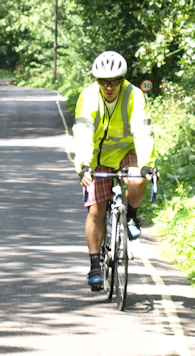
husband on bike, ruth walks around the coastAs I head inland, approaching the car park across the wide expanse of sandy beach, I see my husband waiting for me. I can tell it is him. He is in full cycling gear, has his bike beside him and is wearing a bright yellow fluorescent jacket. As I get nearer, he turns away and disappears. Where has he gone? When I reach the road, there is no sign of him.

I begin walking up the road towards the pub and text him, ‘where r u?’.

He hadn’t seen me walking across the sand. He cycles back down the road to meet me and we travel up to the pub together – he cycles as slowly as he can and I walk as fast as I can manage (which isn’t very fast). The pub is crowded but we find a table outside and enjoy a lovely lunch in the sunshine, before heading home.


Vital stats: distance = 8 miles.
Best parts of the walk: Littlehampton and its West Beach.

Route:


Posted in 06 Sussex | Tagged , , , , | 5 Comments

55. Shoreham to Worthing To Ferring

Shoreham Harbour Lighthouse - Sussex, Ruths coastal walk.I return to Southwick and start walking along the coastal A259 road, heading towards Shoreham. The road is busy and passes through areas of light industry.

I see the entrance to Shoreham Harbour and the lighthouse that marks the bifurcation of the harbour area, alongside a big, new lifeboat station.

To the east, the harbour has deep water and I see large ships moored, against the backdrop of Shoreham Power Station. To the west, the water is shallow and is only suitable for small pleasure ships, before it merges with the mouth of the River Adur.

Shoreham Tollbridge - Sussex - Ruth's coastal walkI reach Shoreham itself and the scenery undergoes a dramatic transformation. Gone are the industrial units and yards. Here are pleasant houses, shops and a fun fair by the water. And here is the narrow pedestrian bridge leading over the water to the spit of land that is Shoreham-by-Sea.

The bridge is busy – with cyclists, walkers, shoppers, families. It has an interesting construction. The middle section sits on rails and can be moved back to allow taller ships to pass through the channel.

I walk through the housing estates of Shoreham-by-Sea and reach the beach.

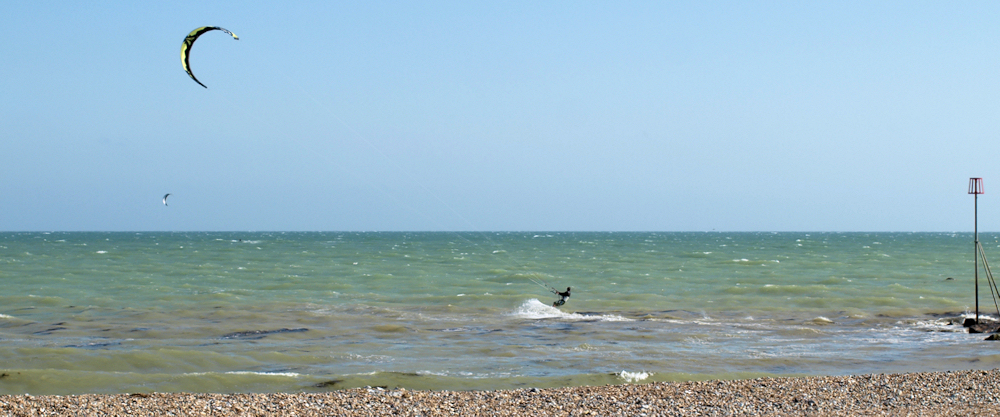
Kitesurfing - Shoreham Beach - Sussex, Ruth's coast walk

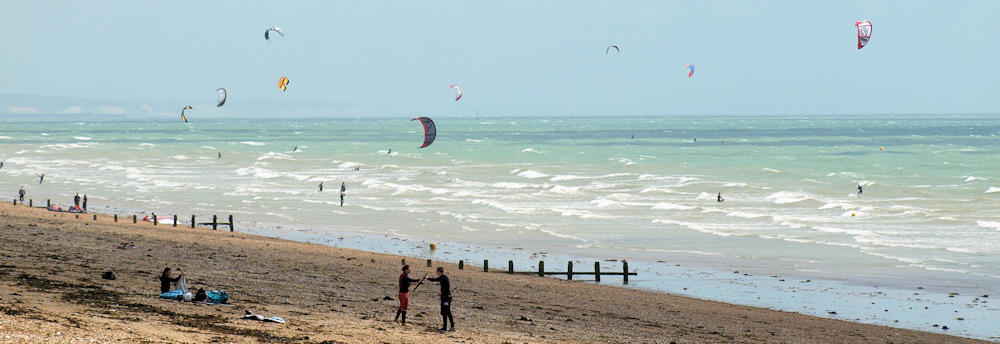
The wind is picking up and there are kite-surfers out on the sea. I stop and watch. Remembering the 30ft high leaps I witnessed at Camber Sands, I am disappointed not to see any huge jumps into the air today. Maybe the wind is not strong enough.

In the distant haze, across the sea to the east, I can make out the white cliffs around Cuckmere Haven and, just visible, the Seven Sisters beyond.

I begin walking westward.

Beach huts and walk, Shoreham, Sussex, Ruth walks round the coast

I decide not to try to walk across beach – deep shingle – too uncomfortable and tiring. (I am getting a little bored with shingle beach, I must confess.) So I walk on the tarmac path, along the shore, separated from the sea by rows of beach huts.

To my right is the town of Lancing and a waterway called Widewater Lagoon. This is a saline lagoon, formed by sea water filtering through the shingle bank and topped up by rain water. There are some fine houses lining the other side of the lagoon. This must be a lovely area to live.

Widewater Lagoon, Ruth's coastal walk in Sussex

A notice board tells me the lagoon was in danger of ‘dying’. Dry summers and natural evaporation had led to high levels of saline in the water and the death of many species. The lagoons are now artificially topped up with fresh sea water, if necessary, to create a less hostile environment.

The efforts appear to have paid off. The lagoon is very attractive. I see a heron and a couple of egrets, along with all the usual types of gulls.

I approach Worthing. There are pretty terraces of houses, a nice wide beach, boats drawn up on the shingle and a decent pier. What a nice town!

Worthing Beach - Ruth's coastal walk

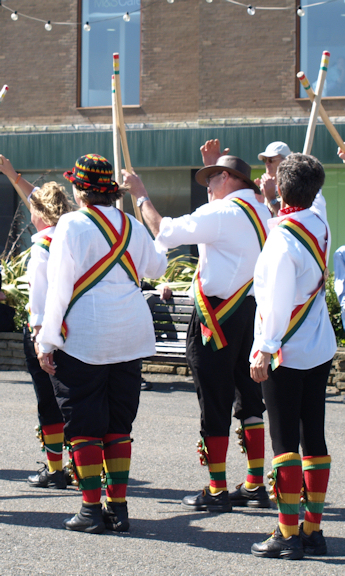
Morris Dancers, Worthing - Ruth's coast walkA crowd has gathered on the promenade by the pier. There is something going on. Morris dancing! And women Morris dancers too. There is enthusiastic twirling of handkerchiefs and banging of sticks. When they’ve finished, without injury, we all cheer.

The Morris Dancers move a little further down the promenade and start another dance.

I pop into the Lido for a drink and lunch. There is a cafe overlooking the sea. The food is very cheap, but it all seems a bit run down and the service is poor. When I arrive, there is a table with some ‘special’ people, presumably on an outing to the seaside. Their carers are very young and don’t expend any effort on entertaining or talking to their charges. They just sit and drink soft drinks, talking among themselves, marking time. The cafe is very hot. When I leave, the group is still there. I wonder how long they stay sitting in that stuffy cafe?

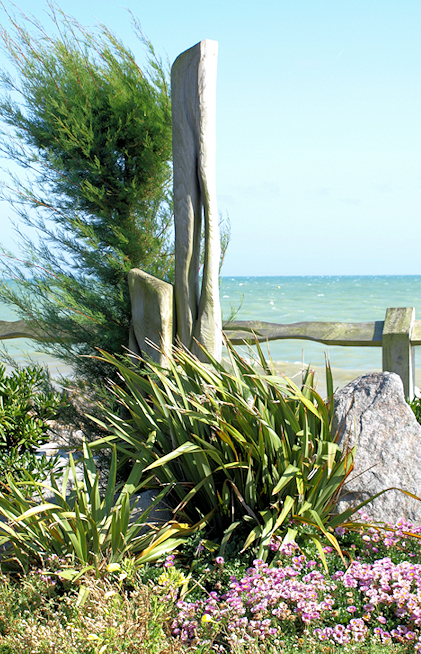
Worthing Pier - Sussex, Ruth on her coastal walk.I walk eastwards, heading along the Worthing promenade towards a place called Ferring. I pass a children’s play area and come to a place where a garden has been created on the vegetated shingle bank – the Waterwise Garden.

Waterwise Garden - 2 - Ruth's coastal walkWaterwise Garden 1 - Worthing - Ruths coast walkAs well as plants, there are constructions of carved wood and stone. Set among shingle stones, there is a tranquil, Japanese type feel to the garden. I like it very much and stop here for a drink and snack.

I am walking into the sun and further photography becomes difficult. I am getting near to the end of the promenade, and the end of Worthing, now.

I reach an area where there are people kitesurfing. The wind is strong and I see some great jumps. A group of photographers stand on an outcrop of rock. The kitesurfers head out to sea, turn, and come roaring in towards the rocks, leaping into the air as they come closer – creating great shots for the waiting photographers. Just beside the beach is a little cafe and people are eating and drinking in the sunshine, while watching the kitesurfers. Marvellous.

Kite Surfing - Worthing - Ruth's coastal walk

Ferring is separated from Worthing by an area of open land. There are many people out, enjoying a walk on this Saturday afternoon. I walk along a lane, close to the sea, passing behind houses and then along a shingle shore. Tired, but happy, I turn inland and find a stone to sit on, while I wait for my husband to pick me up.


This has been a great day of walking. Miles = 10

Route:
Posted in 06 Sussex | Tagged , , , , , | 3 Comments

54. Brighton to Hove to Southwick

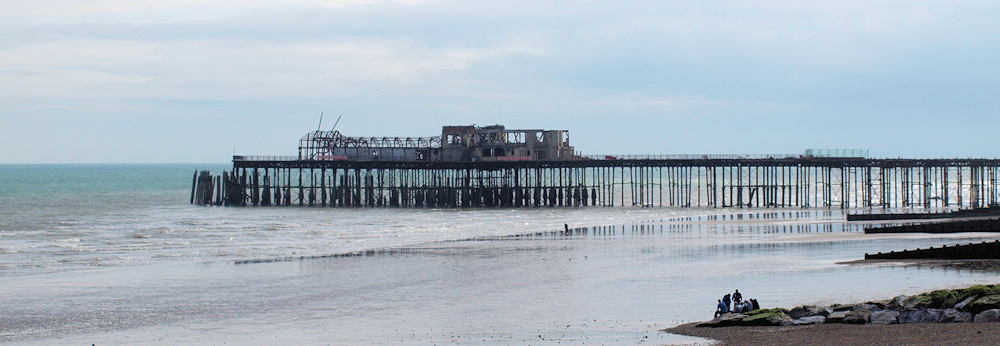
Brighton's other Pier - Ruths walk around the coast, in SussexI park on a road in a housing estate in Southwick, catch a bus into the centre of Brighton and walk down to the sea front. Here I discover something. Brighton has two piers. The second one is a burnt ruin.

I wonder why so many of our piers seem to burn down?

Heading west, my destination today is Hove and then Southwick Station – only 5 miles away. This is my fifth day of walking and I am tired. I have been alone for most of the time and I am looking forward to going home this afternoon.

I am determined to like Brighton today.

Beach, Brighton. Ruth's coastal walk, through Sussex.The sun is shining. At this early hour, the promenade is less crowded and the beach is empty.

I can’t resist snapping a few photographs of the colourful deck chairs, waiting on the empty shingle beach.

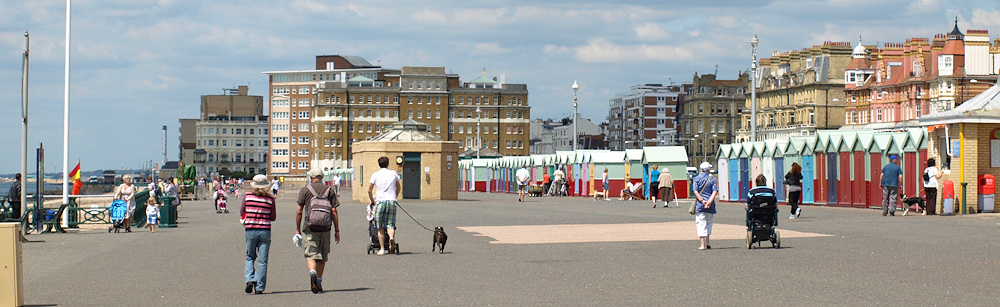
Walking at a good pace, I leave Brighton behind and arrive in Hove. Actually, there is no clear distinction between the two resorts. The promenade at Hove widens out. There are beach huts on the concrete – which seems a little odd. There are also some wide open green spaces with beach huts on the grass, in an area called ‘Hove Lawns’.

People are beginning to appear and the day is warming up. There are joggers, cyclists, dogwalkers, people in mobility scooters and some serious walkers with back packs.

Hove, Ruth walks the coast, Sussex

I stop at a strange cafe / bar on the sea front – I think it doubles as a night club at night. But the food is very good.

Just beyond the cafe is a swimming area. Flags are flying and life guards sit within an enclosure of windbreaks.

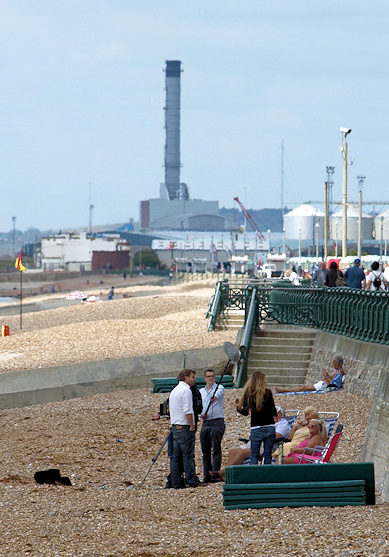
The view ahead is spoiled somewhat by the dominating chimney of the Shoreham Power Station. My walk will take me along a spit of land, right up to the Power Station.

Hove Beach, with power station beyond, Ruth's coastal walk, Sussex.As I stop to take photos of the beach, I notice a film crew down on the shingle, with a video camera and a big recording microphone. They must be recording something for the local news.

I hear them ask a woman, ‘So, are you disappointed the beach has lost its blue flag status?’
A rather leading question, I think.
The woman replies, ‘Well, yes, I suppose I am.’

Later I read that heavy rain may be responsible for the drop in water quality along these beaches.

Shoreham Power Station, Portslade. Sussex. Ruth's coast walk.Beyond Hove, a spit of land continues, separated from the mainland by Shoreham Harbour. I walk along this spit, down a road that runs alongside an industrial estate. The road and surrounding land is all owned by Shoreham Port Authority.

This is the final section of an offical long distance footpath – the Monarch’s Way. But it is a really boring walk. The road is new and, although not very busy, large lorries pass along it. I can’t see the sea – there is a high bank blocking the view. On the landward side are high metal fences and security notices.

At one point, there is a break in the wall and I can see people on the shingle beach. I walk through and stand at the top of the beach. The sun lights up the chalky cliffs in the east. There is a wonderful view of the white cliffs, stretching back to the mouth of the Ouse and beyond to the Seven Sisters in the far distance.

View from nudist beach, across to Seven Sisters, Ruth's coastal walk, Brighton.In a short while, I will be heading inland to find my car. I may never see this wonderful view again. Pulling my camera out of my rucksack, I begin to take photographs of the sunlit cliffs.

Suddenly, a fat man shouts at me, ‘F*** off’. I look round. Is he shouting at me? Yes. He shouts again. More obscenities.

Then I realise. It is my camera he is objecting to. Why? Because this is a nudist beach. The fat man is probably naked – although it is hard to tell through the rolls of flesh.

At first I am very embarrassed. I would hate people to think I had come here to spy on nudists and take photographs of people. (Actually, I approve of the principle of nudist beaches.) So I shout an apology. Later I feel unsettled and angry by this encounter. It spoils the afternoon, as I can’t help brooding over it. The man was unnecessarily rude and unpleasant. There was no need to swear at me. Asking nicely would have done the trick.

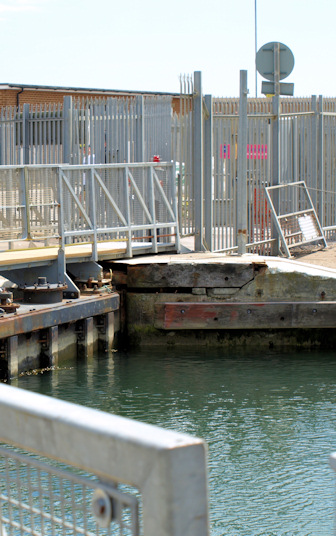
Locks, Shoreham Harbour - Ruth's coastal walk.I hurry along the road, wanting to leave the area. At the end of the spit of land is a small car park. A footpath leads inland, over some locks, across Shoreham harbour and onto the mainland again. I am pleased to find my car.

The journey back home is marred by heavy traffic and it takes me 5 hours to travel the 160 miles.


Miles walked = 5
Piers seen = 2 (1 in ruins)
Nudist beaches = 1
Rude men encountered = 1


Posted in 06 Sussex | Tagged , , , , | 5 Comments

53. Seaford to Brighton

Seaford sea front, with Martello Tower, Ruth's coastal walk, in Sussex.I start off from Seaford on a bright and sunny morning, heading for Brighton.

Today I plan to catch the train back from Brighton. I park near to Seaford station and walk through the town, down to the sea front, then along the promenade, heading westward.

As the crow flies, this would be a reasonable walk of 11 miles. However, my progress will be interrupted by the mouth of the River Ouse, leading to a detour into Newhaven to find a bridge across the river. So, I am anticipating a walk of 14 miles today. This is a long walk for me and I am hoping the walk will not be as strenuous as yesterday, when I went up and down, up and down, up and down – eight times – across Beachy Head and the Seven Sisters.

Yesterday, on the train, I saw kitesurfers along this beach. Today, with no wind, there is no sign of the surfers. There are young people around, school age children really, in large groups with a couple of supervising adults. What is going on? Why aren’t they in school? Then I remember. There is a strike of public sector workers today and some schools have closed. What a wonderful morning to have off school!

Ferry sailing into the mouth of the River Ouse, Newhaven. Ruth's coast walk.

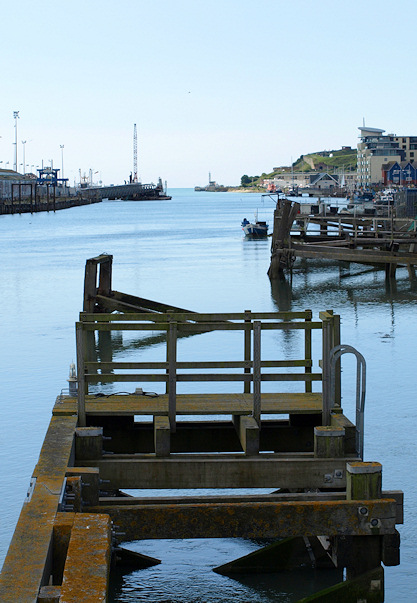
As I near the mouth of the river, I see the breakwater and the lighthouse on the other side, with a bright yellow ferry making its way into the river and heading for Newhaven.

Tide Mills, ruins - near Seaford, Sussex, Ruths coastal walk.This section of the coast is a nature reserve called Tide Mills. There are old ruined structures and a sign tells me this was a place where there was a tidal mill. When the tide came in, water entered lagoons and, when the tide came out, water ran out through water wheels, powering the mill. All around here was a village, with cottages housing people who worked in the mills.

When the mill shut down, the village simply died. All that is left is the footprint of ruined foundations.

Further on, I see groups of adults working on some of the foundations, as an archaeological dig.

Wheatear - at Tide Mills, near Seaford, Sussex. Ruth's coastal walk.I started my walking adventure knowing little or nothing about birds. Now I can name some common birds and can recognise when I see something unusual. So, I knew this little bird, with a white breast and black stripes across its cheeks, was out of the ordinary.

A signboard tells me this is a Wheatear. An unusual bird. Shy and rare. This one flits around with the sparrows. After much patient waiting, I manage to take a decent photo.

I walk through the ruins of the abandoned mill village, meeting a footpath that seems to double as the beginning of the Vanguard Way and the end of the Sussex Ouse Valley Way – both long distance footpaths.

Walking towards Newhaven, Ruth's coastal walk - Sussex Ouse Valley WayThis section of path runs along a waterway parallel to the Ouse. I am meandering, slowly, along the path when a voice says ‘excuse me’ in my ear. I nearly fall over with surprise. A very speedy walker – younger, fitter and faster than me, with soft walking shoes and noiseless footsteps, overtakes me.

‘Is this the path to Newhaven?’ I call after her rapidly disappearing back.
‘Yes. Just ahead.’

The footpath ends at a road and I am forced to walk along pavements, through a scruffy area of light-industry, past a couple of small railway stations, past the entrance to the ferry port, until I reach the bridge over the river Ouse.

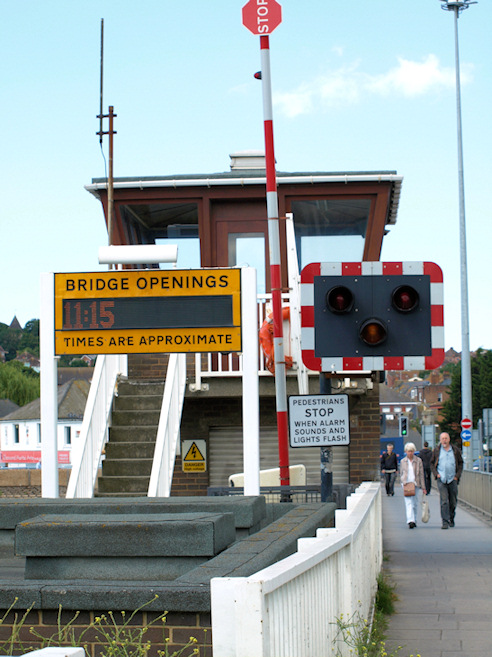
Swing Bridge, Newhaven, Ruth's coastal walk, Sussex.Looking down The Ouse, Newhaven, Ruth in Sussex on her coastal walk.This bridge is a swing bridge and shows the next ‘opening’ time on a board. I am tempted to wait for 20 mins to see the bridge move. But, mindful of the long walk ahead, I decide to keep going.

I stand on the bridge and look down toward the river mouth. In the bright light, I squint past jetties and, in the distance, can see the mouth of the river with the breakwater and the lighthouse.

I remember the beginning of my walk, 14 months ago, when I set off down another river with the name Ouse – The Great Ouse River – and walked the 16 miles from Kings Lynn to Hunstanton. That seems a very long time ago.

Sculpture1- Newhaven - Ruth's coast walk.Sculpture2 - Newhaven - Ruth's coastal walk through Sussex.Sculpture3 - Newhaven - Ruth's coastal walk through Sussex.


As I walk up the west bank of the river, I notice a number of sculptures. They all feature the cormorant, the large black bird, with a long snaking neck, that has become a familiar sight to me along this section of the coast.

This side of the river is in the process of renovation. There is an odd mix of decrepid jetties and decaying wharves, alongside smart new housing and a landscaped walking route.

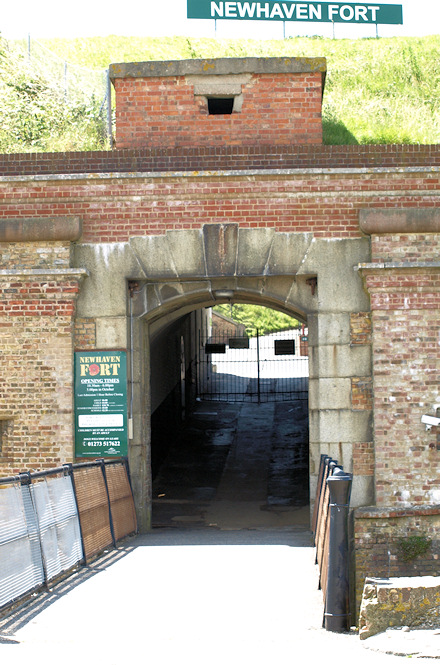
Eventually, I reach the marina area, with a multitude of boats of all shapes and sizes. I stop in a cafe and have a cup of tea and some cake. Now I head towards the Fort, standing on the hill, guarding the entrance to the river mouth.

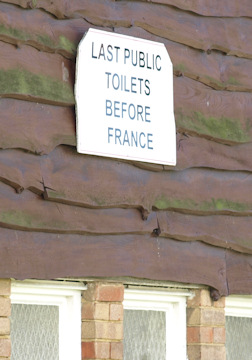
Last toilets before France, Newhaven. Sussex. Ruth's coast walk.On my way up to the fort, I pass some public toilets. Some joker has placed a sign on the side of the building, ‘Last Public Toilets Before France’. It makes me smile.

Newhaven Fort, Ruth's coastal walk, In Sussex.I walk up, past the fort – now used as a museum, and carry on upwards, along a path that leads to the top of the cliff.

There is a lookout station up here. To my left is bright blue sea. To my right is a sprawling caravan park and housing estates – the edge of Newhaven, a place called ‘Harbour Heights’.

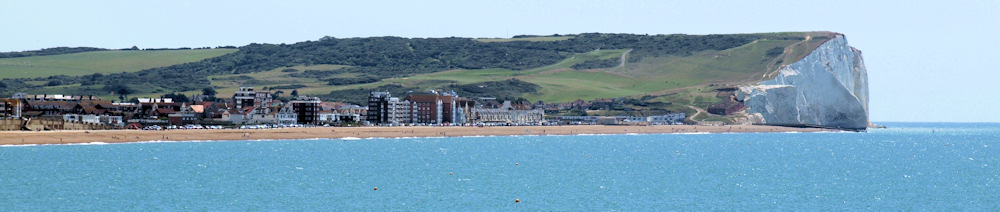
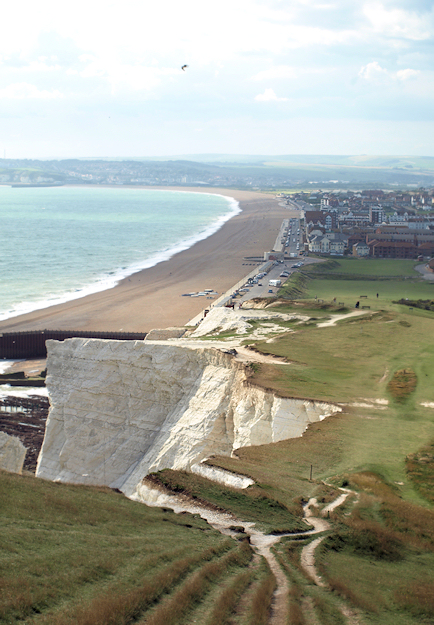
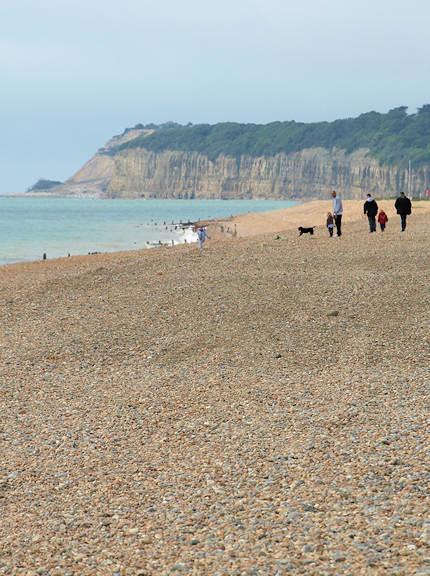
If I look back, towards Seaford, I see a beautiful sight. There is Seaford with the cliffs beyond – bright white chalk rising up from a deep blue sea, topped with a green open space and crisscrossed by the footpaths where I walked yesterday. Lovely.

View back to Seaford, Ruths coast walk.

Walk along Harbour Heights, Newhaven, Sussex. Ruths coastal walk.On this side of the Ouse, the path runs close to the cliff edge and some sections have crumbled away. I follow the pathway as best I can, heading along the green space at the top of the cliffs, towards Brighton.

I pass one walker and, much later, meet a man with a dog. Otherwise, I am alone for this, the best part, of my walk today.

Cliffs at Peacehaven, Sussex, Ruth's coastal walk.This section of cliffs is rich in fossils and is designated as being of ‘Special Scientific Interest’. Later on I will see attempts to hold back the erosive effects of the sea. But in this area, the cliffs are unprotected and it is evident, from the vanished sections of footpath, that the edges are falling into the sea.

Looking back, I can see the waves washing away material from the base of the cliff face, where the water is a creamy blue colour, as it carries away milky traces of chalk.

Now I am approaching a built up area called Peacehaven. Bungalows and houses, laid out in grids, stretch towards the sea. There is a narrow strip of green land and rough roadway, between the houses and the edge of the cliff.

Cliffs and sea wall beneath, Peacehaven, Ruth's walk Sussex coastBelow, I see a newly built promenade – a gleamingly clean, unblemished, wide, concrete walkway – winding around the base of the cliff, forming a protective buffer against the force of the waves. A flight of steps leads downwards. Although I see some construction equipment below, I see nobody working. Is it open? I hesitate. Should I go down? It would be nice to walk on that clean, flat surface, next to the sea, under the cliffs. But, how far does it stretch? After a few yards, the walk disappears behind the curve of the cliffs and I can’t see what happens next.

It is a long way down and I don’t fancy having to climb back up again.

In the end, I stay on the top.

Later, I learn that Peacehaven has an unusual and controversial history. The town appeared in 1916, almost from scratch, as a result of a land-selling scheme by a Mr Charles Neville. You can see an informal description of the history of Peacehaven at Peacehaven Online and a more considered history on the official Peacehaven Town Council site.

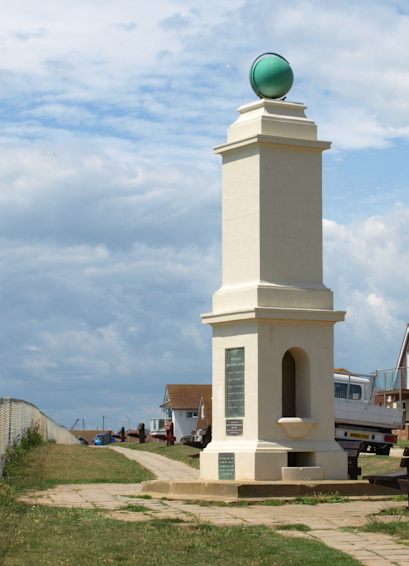
Meridian Marker, Peacehaven, Sussex, Ruth walks around the coast.I arrive at a monument and stop to have a drink and eat a snack. At first, I think the monument is a war memorial, but the decoration seems strange – it has a globe on top.

I read the information on the base and discover this monument marks the line of the Greenwich Meridian. Longitude 0 on the map.

This seems an important milestone in my walk, and I text the exciting news to my husband. He is in the middle of a busy working day and seems particularly unimpressed.

At the end of Peacehaven, I come across a nice pub and have some lunch. When I emerge to continue my walk, the sky had grown overcast and the clouds over Brighton look black and threatening.

Beacon Hill Windmill, outside Brighton - Ruth's walk round the coast.I walk along a busy road. The traffic is noisy.

Inland there are houses. I pass Saltdean and Rottingdean. There is a windmill on a hill. The path goes up and down across a gently rolling cliff top. Sometimes there are areas where you can access the beach and the sea below. I am never sure whether it is worth the climb down. Despite my recent stop for lunch, I feel hot and tired.

Monument with no name, Saltdean, Sussex Coast, Ruth's coastal walk.I reach an area of wide greenery and find another memorial. This one looks like a classic war memorial, but there is no inscription, no list of names, nothing to indicate what the memorial is for – or even if it is a memorial at all.

Later, I search the internet, but don’t find any information about this mysterious monument.

Heading towards Brighton, Ruths coast walkI see Brighton ahead, under a mass of dark clouds. The path continues, exposed, along the top of the cliffs. It looks like rain ahead.

Hoping for better shelter, I follow a slope down to the shore and join a promenade walk, winding along the bottom of the cliffs, heading for Brighton. There are families down here. Some sit at a little cafe. Others walk, jog, or bike along the promenade. The cliffs above are crumbly. I see the occasional rock that has fallen down. I wonder how safe this walk is?

The skies become even darker. People begin to disappear. Now there is just the occasional cyclist, pedalling back towards Brighton.

I reach a marina area, new and modern. But I decide to head back up and climb up a very steep slope to regain the high ground, walking alongside a very busy road, approaching Brighton itself.

Samaritan sign - Brighton Marina - Ruth's coastal walkThere are warning signs along the cliff here. Yet another reminder that these chalk cliffs act as a magnet for ‘despondent’ people.

I was really looking forward to arriving at Brighton. I know this is a lively, vibrant city. But, I have to confess I am not impressed. The time is around 5pm. The promenade becomes very crowded. Despite signs saying ‘no cycling’ and a clear cycle route alongside the road, people cycle at great speed along the crowded prom. I dodge cyclists, joggers, families with pushchairs, people with dogs and old people on mobility scooters. I feel tired and harassed.

Everyone seems stressed and joyless. This doesn’t seem like a seaside resort. Just another big, busy, bustling city.

Drummer, Brighton sea front - Ruth's coastal walk Below are the usual funfairs, amusements and a small train track. The beach is pebbly. The weather foul.

Then I see something that catches my eye and cheers me up.

Below is a young lad – maybe a student – sitting at a drum kit, beating the life out of his drums. A couple of teenagers, slightly tipsy, stand on the upper promenade and begin to dance and clap. The drummer finishes a particularly energetic session and, mindful of his audience, stands up and bows to the teenagers. They shout down, asking where the rest of his band are. He just laughs and continues thumping his drums.

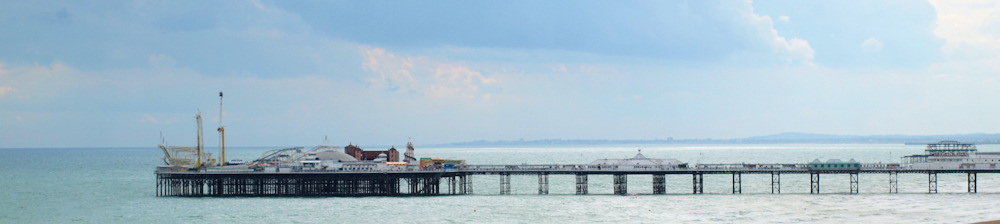
Brighton’s pier is disappointing. It appears to have construction works going on. I see a large crane at end of it. Later, I realise it is not a crane, but a fun-fair ride.

I head away from the seafront, towards the station. The road slopes uphill and the pavements are crowded. I walk behind a group of school aged children, early teens, who walk too slowly but don’t give me enough space to overtake them. I am thoroughly fed up by the time I reach the station and very pleased to arrive back in Seaford, where I collect my car.

It is late, and I stop at a restaurant in Seaford for an evening meal. The food is surprisingly good and the service is excellent.


Miles walked = 14

Posted in 06 Sussex | Tagged , , , | 8 Comments

52. Eastbourne to Seaford

West side of Eastbourne, Ruth's coastal walk.This morning is gloriously sunny. What a fantastic day to walk up Beachy Head! My hotelier tells me it is the first clear day they have had for weeks.

I walk up a long, sloping promenade, taking me westward from Eastbourne. I remember coming here as a child with my grand parents and I swear there were formal gardens here – with bright flowers planted in intricate patterns. Now there are a wonderful plants growing alongside the walk, looking entirely natural, but I am sure this apparent random arrangment was by careful design.

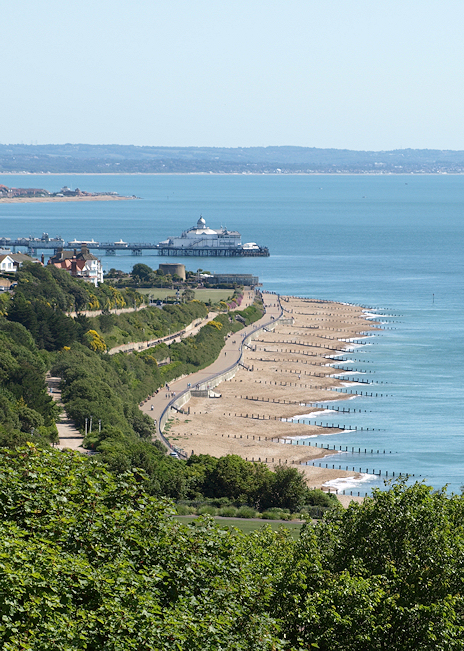
Ahead, in the distance, I can see the South Downs rising up. And there is a steep path winding up the side of the green slope. (You can see it in the photo.) I wonder if that is where I am heading.

I check with a gentleman who is standing admiring the sea: is this the way to Beachy Head? Yes, he says. Then he looks me up and down as if measuring my ability.
‘But it’s a steep climb. You have to be tough.’
Obviously, I don’t look tough enough.

View over Eastbourne, Cow Gap, Ruth's walk around the coast.When I reach the green hill, footpath signs point straight up – along the path I could see from the promenade below. This marks the beginning of the famous long distance foot path, The South Downs Way.

Feeling a bit of a coward, I decide not to head directly up the steep slope. Instead, I choose to walk around the edge of the slope, keeping close to the sea. I justify this to myself. After all, my quest is to walk around the coast.

I can’t escape the incline and find myself climbing higher. From here there are wonderful views back towards Eastbourne. I stop to catch my breath and take some great photographs.

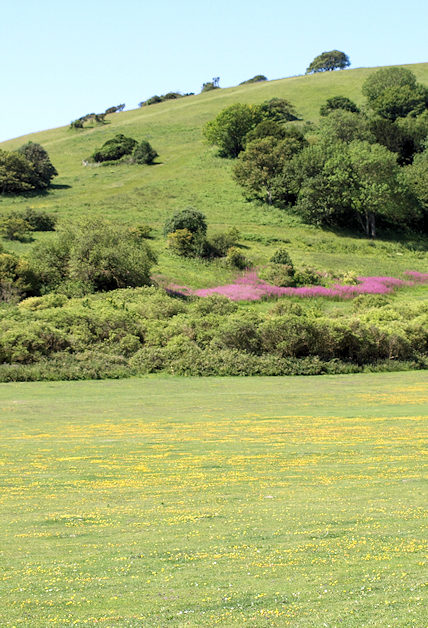
Up here the landscape opens out into a natural bowl. The grass is green and the sky blue. All around are beautiful wild flowers. High above me is the ridge of the South Downs. I can see the shapes of people, silhouetted against the blue sky, high up on the crest of the downs. It looks busy up there and I am pleased to be down here. Apart from a couple of solitary dog walkers, I am alone.

Wild flowers, Beachy Head, Sussex, Ruth's coast walk.Cricket Pitch, Beachy Head, Ruth's coastal walk.People on the ridge, Cow Gap, Beachy Head, Ruth's coastal walk.

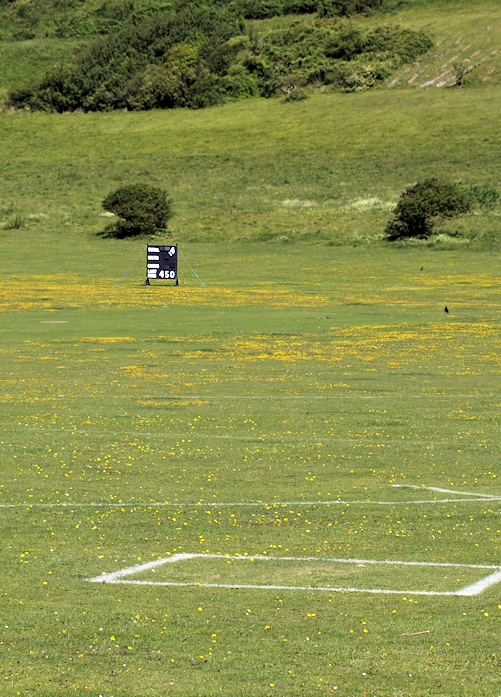
Somewhat to my surprise, I find a cricket pitch, with the boundary marked out in chalk and a score board.

Now I reach a section called ‘Cow Gap’ on my map. This is rather an ugly name for a beautiful place. Here the slope rises steeply and the cliff is crumbling. I am forced to turn uphill and end up climbing a very steep slope, up to the top of the Downs, joining the other sightseers at the top of the ridge. I hear excited voices and realise I am scrambling up towards a group of Italian children on a school outing. As I climb up to meet them, I have to climb over a fence. On the fence are signs telling visitors not to go down (the way I have come up) because the cliffs are unstable.

At the top of Beachy Head. Ruth's coastal walk. There are a lot of people around. I am surprised to see so many. Usually, few people stray more than 100 yards from a car park. Then I realise. There is a road up here – and a car park. That explains it.

I meet other walkers, women of a certain age – even older than me. They tell me on a clear day you can see the Isle of Wight.

I get out my binoculars. Looking back to the east, through the binoculars, I can see the white cliffs of Hastings, where I walked with my husband a few weeks ago. Beyond I can just make out the squat, grey shape of Dungeness Power Station. Looking eastwards, in the direction where I imagine the Isle of Wight to be, I can make out some land on the horizon. But I have no idea if this is the Isle of Wight or Worthing or Selsey Bill.

Beachy Head light house, Ruth's coastal walk.

Beachy Head, painting by Tim Baynes - Artist in Residence - Ruth's coastal walk

Original artwork, by Tim Baynes, derived from my photo.

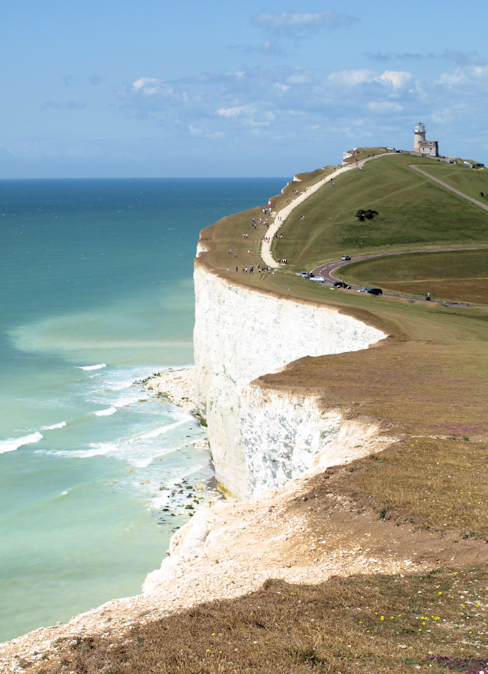
The view up here is truly magnificent. Chalky cliffs drop down to a pale blue sea. Far below is a lighthouse, red and white. It looks tiny – but its light can be seen for 26 miles out to sea. Today the tide is high. Waves are lapping against the cliffs and carrying away a chalky sediment. This turns the sea at the base of the cliff a beautiful pastel shade of light blue.

The land around is owned either by the National Trust or by the local council. There is free right to roam. This is an incredible place.

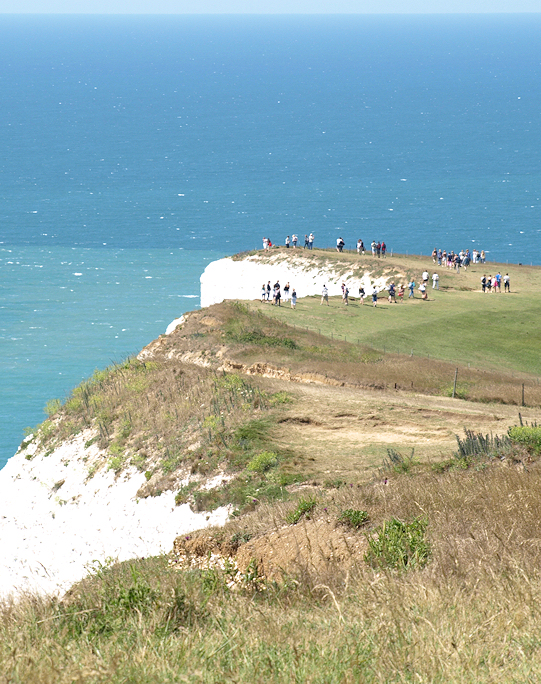
As I walk along the top of Beachy Head, following the well trodden path, I notice how little protection there is from the sheer drop. In places there is a rudimentary wire fence. In other places, there is no barrier between the path and the cliff edge.

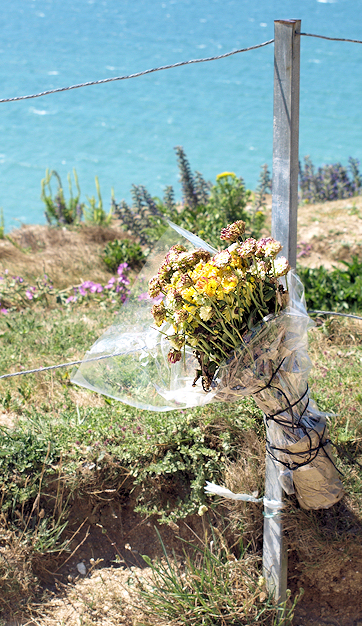
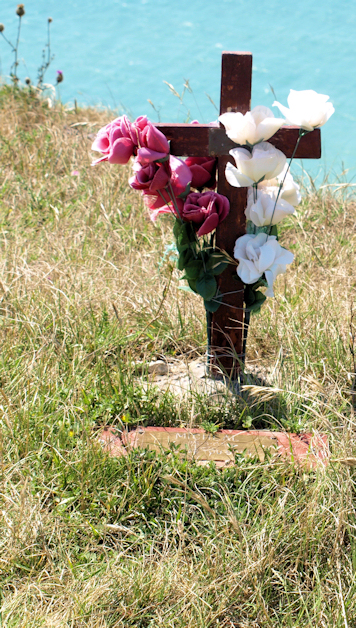
Memorial flowers at Beachy Head, Ruth's coastal walk.Memorial at Beachy Head, cross and flowers, Ruth's coastal walk.


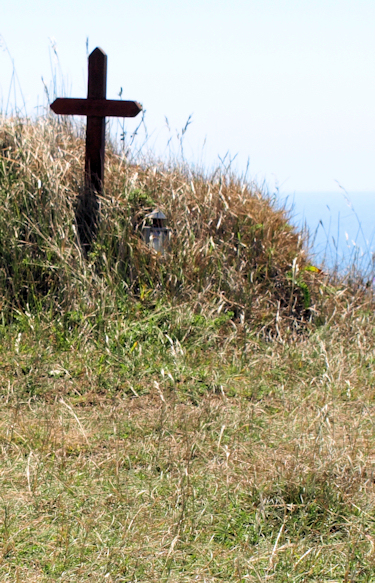
I come across a poignant sight. Shivers go up and down my spine. Here, along the crumbling cliff edge, are tributes to people who have died. There are bunches of flowers and little crosses – 5 or 6 little memorials. They are sited where the path comes very close to the edge of the cliff.

Perhaps this is where people scatter the ashes of loved ones? I hope this might be the case. But I know I am wrong.

I think back to my arrival at Eastbourne station. One of the things that struck me was the sign at the station exit with an advert for The Samaritans and a signpost. Usually access to the Samaritans is via a phone line but here they have an actual physical office for people to visit. There are signs up here too, with the Samaritans’ phone number.

On a beautiful day like this, it is hard to imagine anyone wishing to end their lives. But it happens. And this place is a magnet for the sad and desperate. Beachy Head – with cliffs towering 530 feet above a shallow sea – is the 3rd most popular place in the world for suicides. There are, on average, 20 a year.

From Beachy Head, the path continues along the top of the cliffs, dipping down a little and then rising again towards the old Belle Tout Lighthouse. The function of this lighthouse has been replaced by the newer lighthouse – the red and white one in the previous photo, perched in the sea just below the towering cliff face. The old lighthouse is in use as a residential building.

I read a signboard and learn of an amazing feat of engineering. In 1999, due to continual erosion of the cliffs, the old lighthouse was in danger of being lost. So it was picked up and moved 50 feet further inland. Sadly, as this cliff continues to be eroded at a frightening pace, it may need moving again soon.

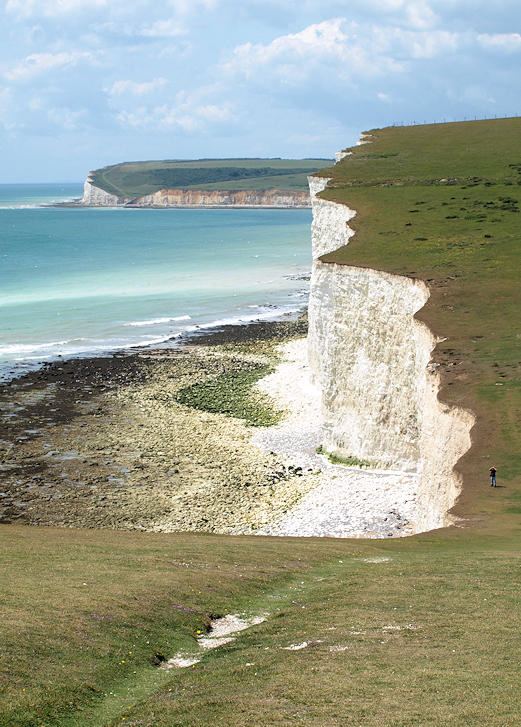
Birling Gap, Sussex, Ruth's coastal walk.The path detours around the lighthouse and ahead of me stretches a long, undulating walk. Naively, I believed once up here the walking would be flat. I had forgotten about the Seven Sisters. Dimly, I remember my grandfather telling me about the seven chalky cliffs that accompany Beachy Head. Here they are.

But first, it is lunch time. Down in a dip is Birling Gap. Here there is a car park, a small collection of houses, a visitors centre and a cafe. The houses look perilously close to the cliff edge. I wonder how long they will last.

Access to the beach is provided by one of those scaffolding type steps, the sort I first came across in East Anglia. The gangplank connecting the steps to the cliff can be moved as the cliff becomes eroded. There are school children (Italian I think) on the steps, coming up from the shingly beach and about to board their coach.

In the cafe, I have a surprisingly good meal, sitting in a small room with large windows overlooking the sea.

Walking over Seven Sisters, Ruth's coastal walk, Sussex.After lunch, I tackle the Seven Sisters. This is the official South Downs Way. Down goes the path, and up again, down and up. Seven times.

I meet a few walkers, but no tourists. There is no easy access to the Seven Sisters – you have to walk – up and down.

One walker is resting at the bottom of the dip between two of the ‘Sisters’. He is taking medication and swilling it down with his water bottle. Pain killers, he tells me. For his knees.

The peaks become progressively higher. It is like descending a giant roller coaster, but in reverse.

I mount the last ridge (I don’t realise it is the last ridge – I have lost count) and see a beautiful bay ahead of me.

Cuckmere Haven, South Hill, Ruth's coastal walk.

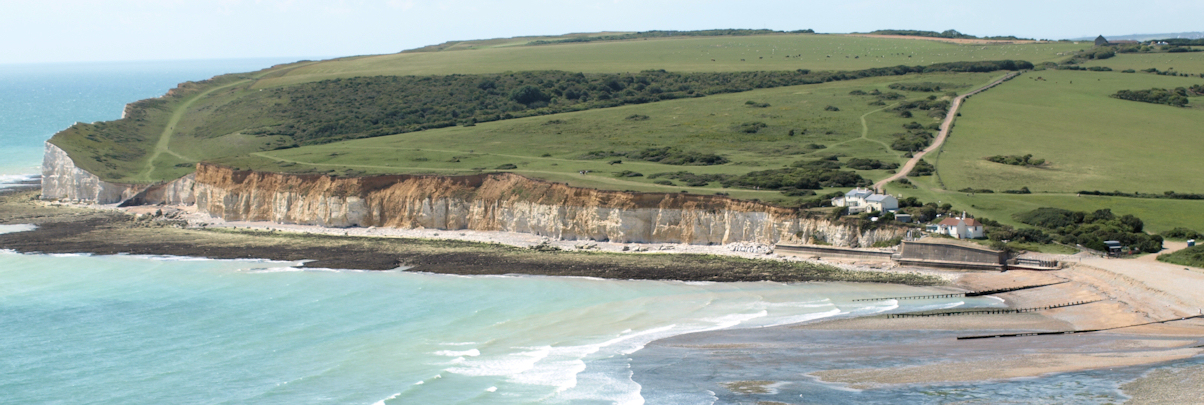
This is Cuckmere Haven. I wasn’t expecting it to be so magnificent. There is an extensive shingle beach and, on the other side, chalk cliffs again, stretching towards Seaford and Brighton beyond. All around is the rolling green of the South Downs. Perfect view. Perfect scenery. Perfectly English.

Japanese tourists are making their way up the slope towards me. The women are wearing thin soled ballet-pump shoes. They are, obviously, not serious walkers. Below, people are out on the exposed beach, enjoying the sea and this beautiful bay.

Cuckmere Haven, Seven Sisters Country Park, Sussex, Ruths coast walk.My intention is to leave the South Downs Way, which turns inland, and to cross over the bay, joining the Vanguard Way (another long distance footpath) as it heads over the cliff, following the coast to Seaford. But, as I suspected, a river intersects the bay. From up here the channel of water looks narrow. The tide is out. I wonder if I can walk across?

I see a man with a dog by the edge of the river mouth. Taking out my binoculars, I watch the man. He removes his shoes and wades into the river. He walks gingerly, hands outstretched for balance. The dog splashes at the edge of the water, but doesn’t join him. I watch for some time. He doesn’t make much progress across.

I want to scramble down the cliff and walk towards the river mouth, to judge for myself whether a crossing is possible. But the cliffs here are steep and warning signs tell me not to attempt the direct path down. I would have to go inland for a few hundred yards, descend the slope and then head back out to the shore again. I am reluctant to expend energy on a fruitless quest and, deciding the river crossing looks improbable, I turn inland.

Algae in lagoons - Seven Sisters Country Park, Ruth's coastal walkHeading downwards, I follow the river valley. Just beyond the shingle beach is a stretch of watery marsh and lagoons. The water is brightly coloured with, I assume, algae. It is a striking sight.

Following the valley, I am heading for the Exceat Bridge. This is the nearest crossing point to the river. The whole area is part of the Seven Sisters Country Park and there are a number of serious walkers and not-so-serious ramblers out, enjoying the sunny afternoon.

Towards Exceat Bridge, Seven Sisters' Country Park, Ruth's walk around the coast.I walk along the raised river bank. Progress is difficult because of vast amounts of sheep droppings. The sheep are cropping the grass nearby and a lamb bleats mournfully from beside a water bowser. I think it is calling to its mother, but another walker has stopped to watch and, in her opinion, the lamb is distressed because it can’t drink the water in the trough – the water level inside is too low for the lamb’s short neck to reach. I pause for a while. It has been very dry. Apart from the showers yesterday, we have not had any serious rain for more than 3 months. There is water around, but it is probably saline. For a moment I contemplate going down to the bowser and turning on the tap. Then I consider the farmer will round the sheep up shortly (it is late afternoon).

I continue walking and cross over the bridge, stopping for a drink and peanuts at a pub. Cheeky sparrows perch on the table, wanting some of my peanuts; they eat from my hand. I force myself to stay here for 20 minutes, knowing I will need energy to complete today’s long walk.

Following the river (now on the other side, of course), I walk back down towards the sea. By the time I reach the coast, the sky is overcast.

As the path leads up the gentle slope to the top of the cliffs, I find a man with a huge camera on a tripod. He is waiting for the sun to come out. The man tires of waiting, picks up his equipment and begins trudging up the slope, following the same path.
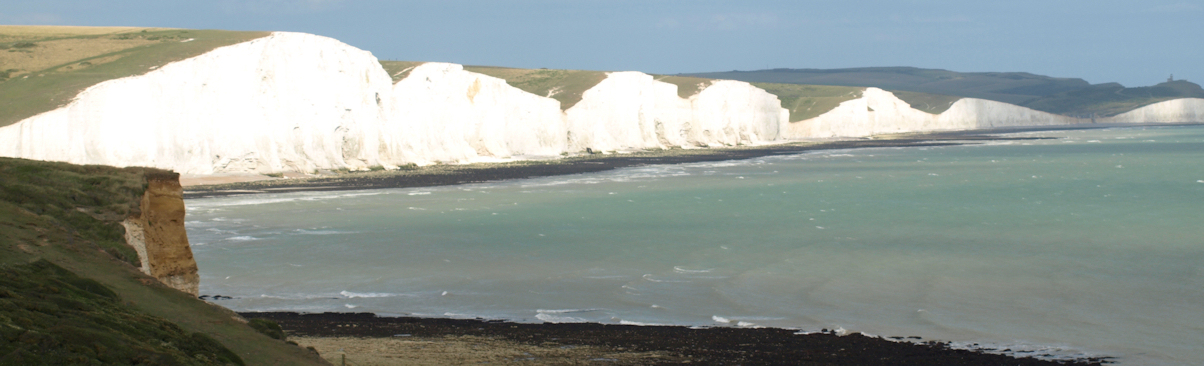
I turn to see what he was planning to shoot. And there are the Seven Sisters.

Seven Sisters, view from Seaford Head, Ruth's coast walk

For the rest of this section of the walk, I keep turning back to look at the white cliffs. The sun makes brief appearances between short breaks in the cloud and lights up sections of the Sisters. I manage to take a few great photographs of this dramatic view.

View towards Seaford, Ruth's coastal walk in SussexThe remainder of the walk is tiring but very satisfying. The sun slants across the landscape, flitting in and out of the clouds. The weather is warm. The scenery is beautiful.

Finally, I reach the crest of a slope and see Seaford spread out below me. In the distance, the shore line curves around to gap marking the entrance to Newhaven. Beyond that, barely visible as I look into the glare of the late afternoon haze, must be Brighton.

Seaford has a wide, empty promenade. There are ordinary houses, a few hotels, some restaurants. There is nothing pretentious about this town. It seems an ordinary place where people live and work, but with a great sea front. I find the station and catch a train back to Eastbourne, via Lewes.

“Which platform is the train leaving from?” I ask the young man at the ticket office.
He smiles.
“There is only one platform here.”
And he kindly tells me which platform I need to go to when I reach Lewes.


Beachy Head, painting by Tim Baynes - Artist in Residence - Ruth's coastal walk

Original artwork, by Tim Baynes, derived from my Photo of Beachy Head.

This wonderful picture was painted by my ‘artist in residence’ – Tim Baynes. Please visit his website. timbaynesart.co.uk.

Vital stats: miles walked = 13 miles, 1 new blister.

More information:
Beachy Head and Seven Sisters Country Park.
Beachy Head Chaplaincy Team with their tally of ‘despondent’ people rescued, week by week.


Posted in 06 Sussex | Tagged , , , , | 7 Comments

51. Bexhill to Eastbourne

Herring Gull, Eastbourne Station Platform. Ruth's coastal walk.Eastbourne station has noisy gulls that walk along the platform, bold in their approach, hoping for food. At first I think this particular gull has a piece of red meat (or blood) staining its lower beak. Later, I realise it is a coloured mark characteristic of Herring Gulls; a species in decline at the moment – although you would not guess it from their intrusive, noisy presence on this railway platform.

I catch the train to Cooden Beach, just to the west of Bexhill. The train trundles along, at a leisurely pace, past houses, lakes, countryside and then along the beach itself. Cooden Beach station is deserted and I am the only person making my way off the platform, down the gently sloping ramps, to the street. The beach is a short walk away.

I reach the beach, stumble over the shingle and head for the waterline. The tide is low, and there is a narrow band of sand close to the waves. I walk here, dodging the occasional incoming wave, where the ground is firmer and progress possible.

Beach Huts, near Bexhill, Sussex. Ruth's coast walk.
The beach is deserted apart from a lone dog walker. Ahead, at the top of the beach, I see a line of beach huts; empty on this Tuesday morning in June – with rain and thunderstorms forecast.

Further ahead, around a gently curving bay, I can just make out the squat shape of a Martello Tower. This is shown on my map as being the other side of Norman’s Bay. Norman’s Bay, despite its name, appears as a straight piece of coastline on the map. I have become so used to seeing curves in the coast where none exist on the map, I have given up wondering if this is my eyes playing tricks, a phenomenon to do with the earth’s curvature, or the result of a misleading straightening out of coastline curves by mapmakers.

Gulls in Norman's Bay, Sussex. Ruth's coast walkThe beach is empty, apart from the ubiquitous gulls. These are youngsters, with their mottled plumage. Will they grow up to be Herring Gulls or another sort of gull?

After a while, the strip of sand becomes covered by waves and shingle walking becomes too tiring. I move up to walk along the top of the beach, where the shingle is more impacted and the going becomes a little easier.
sign about oil, Norman's Bay, Sussex. Ruth walks round the coast.
Here I see posts with life rings. They carry, as usual, warning signs.

For some reason, councils seem incapable of simply putting up a post without attaching bossy signs of various sorts. In Kent, I became used to seeing signs listing the dangerous things to be found on the beach (slippery rocks, hidden obstructions, deep water, mud, etc), so the simplicity of these warnings intrigues me. Apparently, the only thing I need to worry about here is the possibility of oil on the beach. And, if I find any oil, it is definitely NOT the fault of the council. Jolly good.

Martello Tower 55, Norman's Bay, Sussex. Ruths's coastal walk.As I near the Martello Tower (number 55), I see that it is in the process of renovation. The external stone seems far too clean and new – so I suspect most of the tower has been rebuilt. These towers are covered by conservation orders and the outer shape has to be preserved with only a limited number of small windows allowed and, therefore, most conversions involve roof skylights to channel the light into the interior of the structure. This conversion seems to be following the usual pattern, with an intriguing top deck involving large amounts of glass. When it is finished, this will be a fantastic place to live – with wonderful panoramic views over the sea.

Cormorant, Beachlands, Sussex, Ruth's coastal walkI see a large, hunched bird – black and brooding – perched on one of the groin markers. This must be a cormorant. There is something both magnificent and sinister about these birds.

I have no real experience of bird watching but, with the aid of photographs and the wonderful RSPB Bird Identifier page, I am learning to recognise and name the common sea birds as I meet them.

After walking through Norman’s Bay, and past its scaffolding-clad Martello Tower, I approach a place called ‘Beachlands’ on Pevensey Bay. Pevensey Bay runs from Beachlands up to the beginning of Eastbourne.

There are more people around now, walking with dogs, sitting on the shingle, and walking along the top of the beach.

Meanwhile, the sky gets darker. Storm clouds are gathering and I wonder if it is going to rain. I pull my waterproof jacket, neatly packed into a roll, out of the bottom of my rucksack and stow it on top of my water bottles, just to make sure it is easily accessible in case the promised thunderstorms start. Although I don’t mind getting wet, I worry about my iPhone and my camera.

Martello Tower 61, Ruth's coast walk, Pevensey Bay, Sussex.Martello Tower 62, Pevensey Bay, Ruth's coast walk through Sussex. There used to be numerous Martello Towers on this section of coast and, although only a fraction of them remain, there are another two here; number 61 and number 62. Both appear to be in use as residential dwellings. One, although unfortunately positioned in the middle of a static caravan park, has a most amazing garden – full of ornaments and statues.

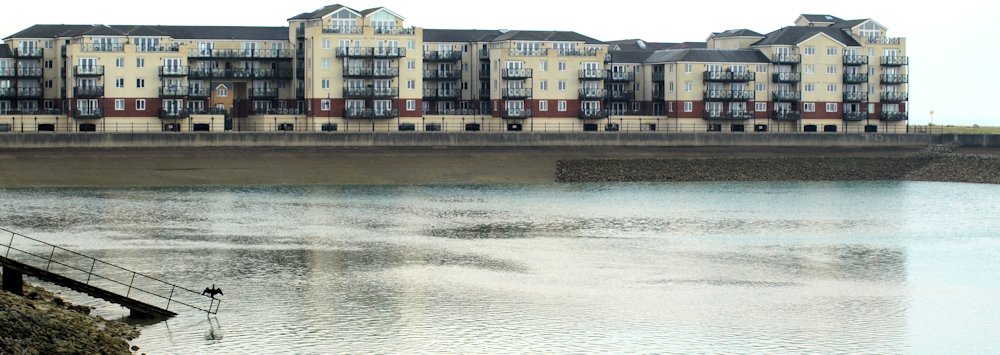
Martello tower 64, approaching Eastbourne, new development. Ruth's coastal walk.As I get closer to Eastbourne, I come across a new development. Tall blocks of apartments, with large balconies and fantastic views, line the beach. Behind these are even more apartment complexes. A whole new section of Eastbourne has sprung up here. It is all neat, tidy and organised. I even spot a bus, winding through the estate.

Martello Tower 64, East side of Eastbourne, Ruth's coastal walk in SussexAnd in the middle of this high-rise modernity is a lone Martello Tower (number 64), sad, dilapidated and falling into ruin. I imagine there is some grand plan for it. But at the moment, it looks very out-of-place with the modern buildings alongside.

At this moment, I hear a rumble of thunder and the heavens open. I pull out my rain jacket and seek shelter under one of the balconies. The rain thuds down with satisfying vigour. There is that wonderful smell of newly wet dusty earth. The world turns grey. The sky grumbles. My path becomes a giant puddle.

During this wait, under the dripping balcony, something surreal happens. I see another walker coming towards me. He is young, tanned and muscular, wearing shorts and proper walking boots, enveloped completely in a transparent plastic raincoat, which covers not only his upper torso but is stretched over his rucksack as well. So he has a strange appearance as if his upper body is swathed in clingfilm. I turn away for a moment and, when I look back, he has disappeared.

The rain lessens slightly and I continue walking. Passing a recess in the buildings I discover the young walker. He appears to be lying face down on the ground. Slightly alarmed, I begin walking towards him. Maybe he has been struck by lightning? Then I realise – he is doing press ups. He is using his knuckles (not the flat of his hands) to push up with. The ground is soaking wet, it is still raining, he is wrapped in his plastic rain jacket with his rucksack on his back. What an odd sight.

New development, Eastbourne, Ruths coastal walk.

Cormorant - Eastbourne - Ruth walks the coastThe path takes me round a rectangular harbour area, lined with the new buildings. It is very pleasant.

And there, in the midst of this modern developement, I see another cormorant at the water’s edge. It is standing with its wings outstretched, drying them. I can’t resist taking my camera out (despite the rain still falling) to catch a few shots.

Another mystery occurs to me. Earlier on, I saw a few boats pass passing into the harbour, heading for shelter from the weather. Although I saw them moving into the harbour, now I have a clear view of the harbour itself, I can’t see the boats. Where have they gone?

Locks, Sovereign Harbour, Eastbourne, Ruth round the coast A few minutes later the mystery is solved. There is an inner marina, crammed full of boats; mainly yachts and small motor craft. To access this inner waterway, you pass through a lock. In fact there are two locks. One of them is currently in operation, with a ship being slowly raised as water pours in, getting ready to dock in the safety of the protected marina.

I was anticipating a trudge around the marina area to reach the coast on the other side and to continue my walk into Eastbourne. This turns out to be unneccessary, as I can cross over the mouth of the marina using pedestrian walkways that run across the locks. A system of traffic lights controls where and when these walkways can be used. I linger here for a while, watching the locks in action and marvelling at the mechanical means by which large masses of water can be raised and lowered.

Amazingly, in this newly developed area, I see a small white egret on the edge of the water, seemingly oblivious to the high rise apartments, the cyclists, joggers and walkers who have emerged as the rain subsides. I wonder how long this area will continue to be attractive to the cormorant and the egret.

Martello Tower 66, Langney Point, Sussex, Ruth's walk round the coast.On the other side is Langney Point and here, in a dilapidated state, is another Martello Tower (number 66). Again it looks as though this is in the process of renovation, surrounded by scaffolding and draped in plastic.

By now the dark skies are lighter and the rain has cleared. We were promised huge thunderstorms but the whole event has lasted less than an hour.

(Later I learn some local houses were hit by lightning strikes and, in retrospect, I was lucky to have experienced little bad weather during this walk.)

As I round Langney Point, I can see Eastbourne ahead and Beachy Head rising beyond. My legs are tired and I am looking forward to ending my walk for today.

Water Treatment Works, Ruth's coastal walkNow I find I am walking past a large building with a modern design and nice, flowing shapes. A sign tells me it is water treatment centre. Really? It looks far too imposing to be a sewage works. But that is what it is. And I gather, according to the local news, all has not been smelling sweet in the locality. But today there is no whiff of sewage in the air.

Deckchair with your logo here - images of Eastbourne - Ruth walks round the coast.I head towards Eastbourne along a lovely wide promenade, with a cycle track and a pedestrian walkway. On my left is a patch of shingle with natural plants growing, including flowers and the shingle beach beyond. There are also fishing boats and tackle, sailing dinghies and windsurfers. It is a wonderful amble and, despite the grey skies, I enjoy it thoroughly.

Unfortunately, it is too dull for good photography and I am too tired to linger and struggle with the finer points of camera control. But I do snap these colourful deck chairs. How could you resist advertising your local business here?

Martello Tower 73, Eastbourne, Ruth's coastal walkBeyond the pier, at the Western end of Eastbourne, is another Martello Tower (number 73 according to the classification)

I am very impressed by Eastbourne. I expected a run down seaside resort, full of old people. Yes, there were many elderly people, but there were also middle-aged and young people with families. Due to the shingle beach, this will never be a bucket-and-spade resort for young children, but I found it attractive and pleasant.

Finally, here are two photos of the lovely pier. One is taken in the morning light and the second in the evening.

Eastbourne Pier, Ruth on her walk around the coast. Sunset, Eastbourne Pier - Ruths coastal walk.


Vital stats: miles walked = 9 miles, rainstorms = 1, Martello Towers = 6.


Posted in 06 Sussex | Tagged , , , , | 4 Comments

50. Hastings to Bexhill

Love the pier - Hastings - Ruths coastal walk, SussexI am staying in Eastbourne and I take the local train to Hastings to continue my walk. After stopping for lunch (fish and chips, of course), I walk through Hastings towards the beach and emerge by the pier.

What a sad sight this pier is!

Burnt buildings, roofless wrecks, timbers showing, seagulls perching on shattered planking – a blackened and rusting structure. Warning signs advise people on the beach to stay away and not to walk beneath the pier, in case timbers fall on your head.

But attempts are being made to save it. Although the entrance to the pier is closed and barred, bunting hangs across the gate and signs proudly declare that the pier is loved and can be saved. I am not so sure.

Hastings Pier, Ruth's coastal walk

Leaving the sad pier behind, I walk along the wide promenade, heading westwards. I sit in one of the shelters, in the shade, and have a drink. The sun is hot. I apply sun block before continuing.

Promenade at Hastings - Ruth walks the coast, Sussex
A hundred yards further along, I stop to check my phone and realise it is not in my pocket. With a sinking feeling, I empty out my rucksack and search through the maps, tissues, plaster, drinks bottles and various spare bits of clothing I have crammed inside. No sign of my phone. I must have left it on the seat when I stopped in the shelter. Surely someone will have picked it up and taken it. Who could resist a free iPhone?

It is hard to run in walking boots, but run I do – back to the shelter. On the black painted seat is my black iPhone – barely visible, black on black. What a relief!

Shingle beach with hut, Hastings, Ruth's coastal walkLeaving Hastings behind, I walk along a gravel path that runs along the side of the railway line, parallel to the beach and behind a jumble of huts, boats, fishing tackle, and sheds. I would prefer to walk on the beach itself, but the tide is in and there is no sand; I would be walking on rough shingle, too much like hard work, especially in this heat.

This track is not marked as a footpath on my map and I am not clear if I can make it from here to Bexhill without detouring inland. Knowing my route inland is barred by the railway line, I am hoping I don’t reach a dead-end. I don’t want to have to retrace my steps.

Hastings view, Ruth's coastal walk
I reach an area called Glyne Gap on my map. The tide has retreated and I can walk across wet sands. There is a great view across to Hastings. I stop and take photographs. Unfortunately, I don’t manage a self-portrait – I fail to get to the right place in the 12 seconds I am allowed. So I end up with a number of photos of an empty beach.

Apart from a dog walker and a cyclist (who has wobbled his way across the beach), there is nobody close by.

Now a mass of rocks bars my way. The arrangement of the rocks doesn’t look natural. I guess they have been placed here to prevent erosion. I am forced to turn inland. Luckily, I find a path leading up from the beach to a hill (Galley Hill on my map, where I stop for a rest on a bench and admire some great view). Then I follow a path along a low cliff, heading towards Bexhill.

Bexhill, Ruth's coastal walk, in SussexI see Bexhill ahead of me and the path slopes gently downwards, running alongside a quiet road.

Bexhill, motor racing plaque - Ruths coastal walkHere I come across a plaque commemorating the ‘First International Motor Race Meeting’, which took place in Bexhill-on-Sea in 1903. This quiet road must have been part of the race track.

I imagine a time, years ago, when racing cars were quieter, slower and you could race along a winding beach road. How exciting, and daring, such a race must have seemed.

Bexhill beach, Ruths coast walk, SussexThe beach in Bexhill is a mix of sand and rocks – creating an exciting playground of rock pools and beach for children to play in. This is a great beach for families – and a nice change from the shingle beaches at Hastings.

Bexhill promenade, Ruth's coastal walkI walk along the promenade, that narrows as I leave the busier part of Bexhill behind and I find I am walking alongside some very nice seaside properties. These houses have gardens that open directly onto the promenade.

I have a train to catch from one of the little stations that are dotted along the railway track. The station I am heading for is called Cooden Beach and, when I arrive, I find it is unmanned and deserted. I buy my ticket from a machine and walk up a long, covered slope to the platform. I find myself alone.

While I wait, a recorded message booms out over the announcement system. It tells me it is hot and I shouldn’t travel without a bottle of water – and then kindly informs me my train is about to arrive. I wonder where I should buy my water from, on this deserted station. And is it possible to buy water in the 30 seconds I am given between the announcement and the train arriving? For whose benefit is this announcement being made?

Later, I learn that trains broke down in North Kent earlier today. Passengers, overcome by the heat, forced their way out of hot railway carriages. The authorities shut off the power to the ‘live’ rail, causing further disruption. Sounds like a miserable time was had by many commuters trying to make their way home.

My train arrives on time. I am glad to rest my feet during the short journey back to Eastbourne.


Vital stats:
miles walked = 8
blisters = 0
sunburn = 0
lost phone = 1, found phone = 1

Posted in 06 Sussex | Tagged , , , , | 4 Comments

49. Rye Harbour to Hastings

Track from Rye Harbour, Sussex. Ruth's coastal walk.It is bank holiday Monday – the last weekend in May. I am looking forward to today’s walk. There is, apparently, no right of way along the sea wall, so I leave Rye Harbour following a track running just inland of the shoreline. I am walking through a nature reserve area, alongside lakes.

Unfortunately, this section of the walk proves to be not as scenic as I hoped. The nature reserve is in the process of being constructed. The lakes are hidden by tall bushes. Private signs force me to stick to the track. I see no birds, no water, no sea – this path is somewhat boring.

Doggie Bar, Winchelsea Beach, Ruth's coast walk.I approach Winchelsea beach and houses appear, lining the track. The track widens into a road. I meet young girls, in brightly coloured welly boots, taking dogs for walks. The girls wear shorts and thick jackets. The wind may have dropped, but the sky is overcast and it is not warm.

Somebody has created a doggies’ ‘organic’ drink bar by the side of the road. I find the sign amusing and stop to take photographs.

The track joins the sea wall.

Winchelsea Beach, looking back to Rye Harbour, Ruths coast walk.Here there is a wide shingle beach and a narrow walk-way along the sea bank. I look back towards Rye Harbour. I guess I could have walked along the coast after all.

Red flag on Winchelsea Beach, Ruth's coastal walk.Looking in a south-westerly direction, the shingle beach stretches round a point and beyond, towards distant cliffs. That must be the aptly named ‘Cliff End’, shown on my map. There is a high cliff in the distance, pale in the haze, and I wonder if this is Beachy Head.

A red flag is flying. I presume this means ‘no swimming’.

Ruth on Winchelsea BeachI sit for a while and have a drink, eating a snack. I remember how to take a self-portrait using my camera’s timer (I am getting better at this).

In the photo I look relaxed, despite having run across the beach to get into position.

I walk along the shingle beach – not on the shingle itself, but sticking to the path running along the sea wall.

I pass a low area where there is a green field and people playing football. An information sign tells me that this green space was the site of a New Harbour, built at great expense to replace Rye Harbour further up the coast, after the old harbour became blocked with silt and shingle. The New Harbour opened in the summer of 1787 but, after only three months of use, itself became the victim of shifting shingle and was also blocked. The New Harbour was abandoned in October 1787.

I am amazed to learn that the old Rye Harbour is still kept open, as a functioning harbour, by continual dredging to remove 55,000 tons of shingle a year.

Looking towards Cliff End, Ruths coast walk, Sussex.Below the sea wall is a road. A few cars pass to and fro. Sometimes a car stops, people get up and climb the bank, look at the sea for a few moments and then return to their cars.

While I walk, a truck stops in a lay by on the road below. The front passenger door opens and three men in yellow vests fall out. Literally, they fall out. The one on the bottom starts wailing in mock protest. The others hoot with laughter. Seeing me above them, he quickly gets up. One of the men takes the bag from the bin by the road, throwing it into the back of the truck. The three men pile back into the front seat and the driver, who remained in the cab, starts the truck up again.

A few minutes later, I see them repeat the exercise, in another lay by, further down the road.

Three men to empty one bin? I wonder why. Could this have anything to do with it being a bank holiday Monday? Overtime payments, perhaps?

View across Pett Level, Ruth's coastal walk.The clouds clear and the sun comes out. To my right, I look across Pett Level, across green fields dotted with sheep and up to a windmill on a rise. Somewhere, just before the land rises into a ridge, is the Royal Military Canal and the long distance path that runs along it.

Later I learn the Canal was built as a defensive ditch – to defend Romney Marsh from an anticipated invasion by Napoleon. This incredible project (the 28 mile ditch was dug by hand – using picks and shovels) was not completed until the Napoleon threat had passed. Embarrassed by the cost – the defensive ditch was converted into a navigation canal. Now it is used by fishermen, walkers and cyclists. Some sections are still open for boats.

Cliff End, Sussex, Ruth walks the coast.I expected to find the opening of the Canal, where it joins the sea. But I never did. Instead, I find myself walking along a promenade at a place called ‘Pett / Cliff End’. The promenade ends in a dead-end.

I retrace my steps and join the road. After a short while, I find a footpath off to the left. The footpath leads upwards, steeply climbing up the slope that marks the beginning of the cliffs. I walk along the back of gardens. In some places, the path is very narrow – high garden fences on one side, bushes and a steep drop on the other.

Fairlight Cove, Ruth's coastal walk, through SussexWhen I reach the top, I walk along the side of fields and can see the base of the cliff at an area called Fairlight Cove. It almost looks as though the cliff has been quarried here. But, in fact, the cliff has crumbled into the sea (the coast moving 100m inland in the past 100 years) and attempts have been made to pile earth and rocks at the base to protect against further erosion.

Later, I find out there is a naturist beach at Fairlight Cove – although access to the beach is deterred due to the dangers posed by erosion. There are great fossils to be found here. And dinosaurs’ footprints.

I see no fossils, no dinosaur footprints and no nudists.

But I do meet my husband in the village. He has walked along from Hastings to meet me. He has managed to find a pub for lunch and keeps me company for the rest of my walk.

John carrying rucksack, path goes up and down ahead. Ruth's coastal walk.Resting Ruth on her walk around the coast, Sussex.Ruth scrambling up path, Fairlight Glen, Ruth's coast walk through Sussex.

The walk from Fairlight Cove to Hastings is lovely. This is a Country Park, with free right to roam. Multiple footpaths criss cross over the top of the cliffs. And the going is not easy. We go down into dips, climb up steep banks on the other side, down again, up again.

The sky has clouded over and rain threatens to come but never actually arrives. Sadly, my photography is ruined by the poor light.

John contemplates climbing down to the beach, Ruth's coast walk.Signs tell us access to the beach below is not advised, although we do see narrow tracks leading downwards. We come to one such path and meet a family climbing up. My husband asks if we can get down to the beach below and a young man in the group says we can, if we don’t mind climbing a bit.

We head downwards, following a small stream, clambering over rocks, until we emerge on a natural ledge, 10 feet or more above the beach. The sun comes out. The beach below is invitingly sandy. It would be great to walk into Hastings along the sand. But the climb down to the beach is exactly that – a climb. In walking boots! It is impossible.

My husband is reluctant to give up the notion of getting onto the beach. Eventually I persuade him it is best not to risk broken bones. We turn back and scramble back up, the way we came, to rejoin the walk along the top of the cliffs.

When we reach Hastings, there is a lovely stretch of greenery at the top, with an ice-cream van, and people walking. From here we look down on the town and its pier. It is late afternoon. The clouds have broken. The sun is in our eyes, bouncing off the water, turning the sea silver.

Hastings, from the cliff, Ruths coastal walk.

We follow steps that lead down from the cliff, and emerge through a narrow alleyway onto the sea front itself. The beach here is very shingly. We see a family feeding seagulls – with much flapping and noise.

Seagulls on beach at Hastings, Ruth's coastal walk.

Ahead, as we walk along the promenade, we see the pier. It is a blackened ruin – broken and burnt. What a sad sight!

Just beyond the pier is our car. I am very tired, having walked many miles and up and down. My husband, much to my annoyance, is still full of energy and, even more galling, is completely and utterly blister-free.

Hastings Pier (burnt) Ruth's coast walk


Vital stats: miles walked = 12


Posted in 06 Sussex | Tagged , , , , | 3 Comments