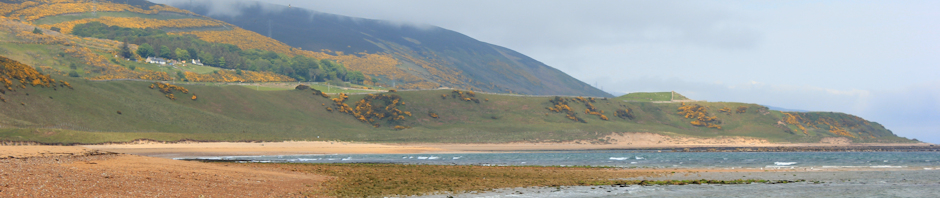
This turns into a day of unexpected drama and wild storms. But the morning starts quietly enough.
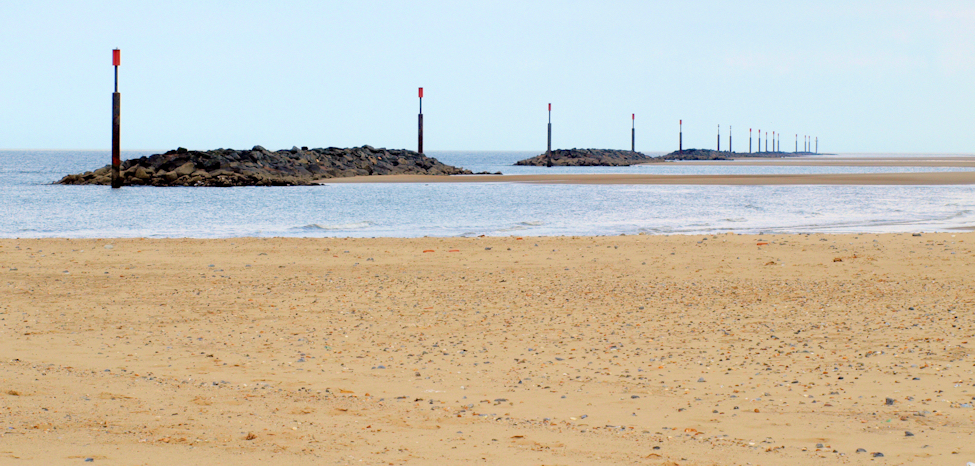
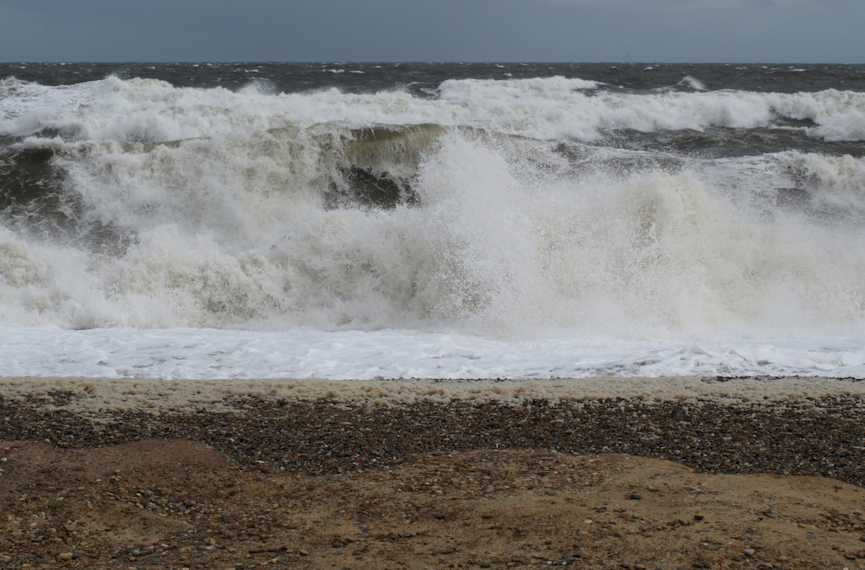
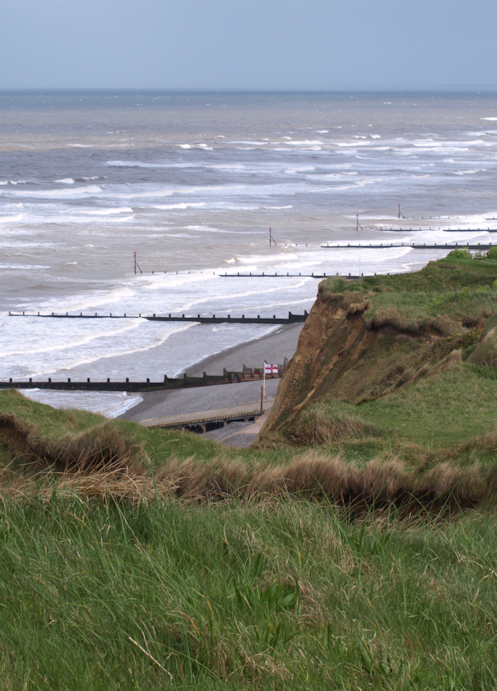
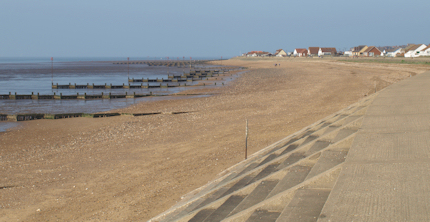
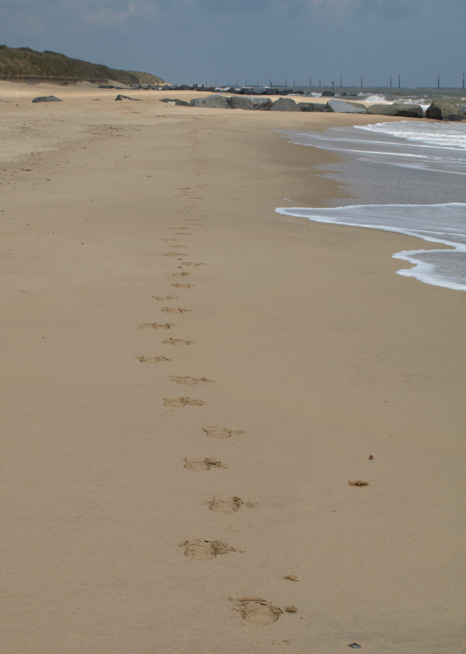 Bank holiday weekend and the weather is suitably unpleasant. The tide is high and Sea Palling sea defences are partially submerged, with only the tops of their artificial reefs visible above the waves. Our B&B landlord has a nephew who was involved in making these rocky walls. He described how huge boulders were ferried on a large barge from Norway and dropped painstakingly into the sea to form the linear array of sea defences standing just offshore from the beach.
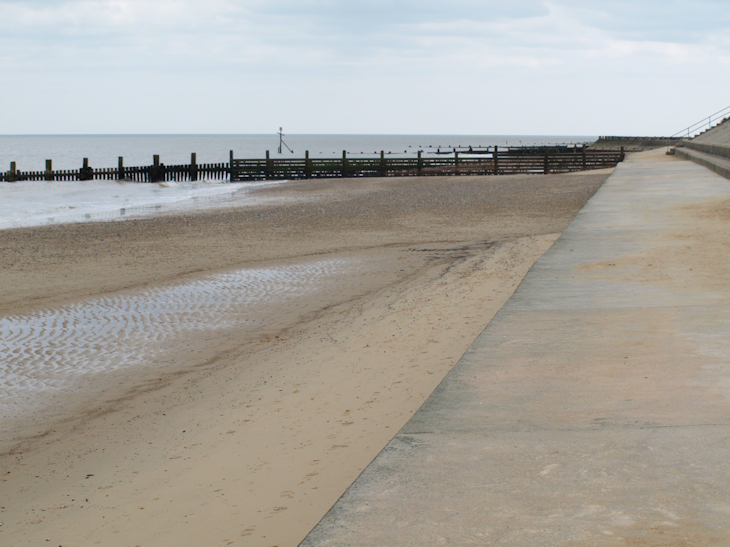
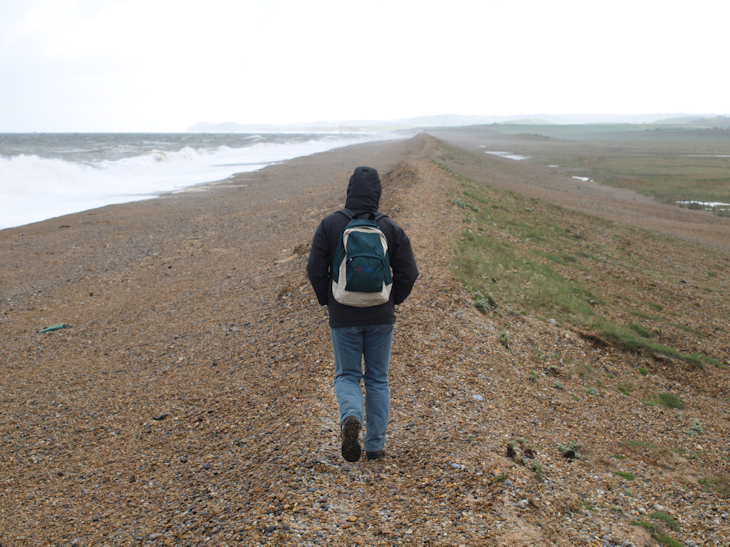
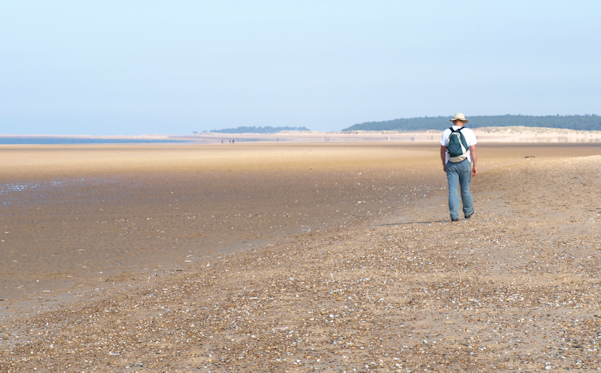
I walk south-eastward along the sand, glad to be here on this lovely beach – and looking forward to the day ahead. At this early hour, with the sky overcast, there are only a few families making their way onto the sands. I soon leave them behind and walk for the next two miles on empty beach with only my own footprints for company. I am loving this.
 Then, suddenly, I see a dog’s grey muzzle in the water – a labrador I think – about 20 yards from shore. Its muzzle is pointing upwards and, with hair sleeked back on it face, it seems to be struggling to keep afloat. Then it disappears beneath the waves. My heart stops. I believe I have just seen a dog drown. For one wild moment I contemplate plunging into the cold sea. I stand, helpless and agitated, close to the breaking waves. Why was this dog swimming alone in this cold sea? Suddenly a grey shape surfaces. I notice large eyes, small ears and whiskers. I realise, with intense relief – it’s not a dog. It’s a seal.
For the next half hour, as I walk along the beach, I am watched by seals. They pop up a few feet from the shore, faces turned towards me, large eyes watching. When I pull my camera out, they wait until I have it aimed and focused – then, before I can get a decent shot, they slip back under the choppy waves, laughing at me. Sometimes they are in groups of two or three. I see old ones and young pups. One young one becomes particularly nosey. Watching me, it comes too close to shore and gets caught in the breaking waves. I see its small body rolling in the surf and hope it is not too bruised by the tumble of waves against the shingle.
Ahead of me I see the distant figures of people – families out on the beach, people walking, young lads fishing, kite fliers and joggers. This must be Horsey Gap. Some people have spotted the seals swimming and are pointing and laughing with delight.
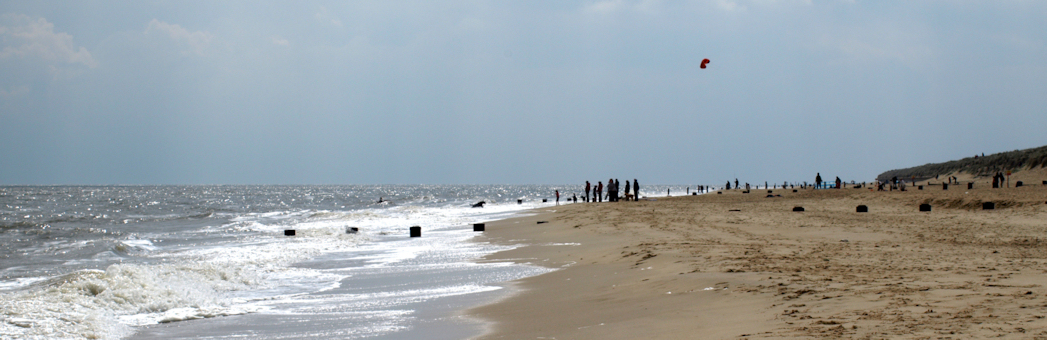
The wind is behind me and I did not notice the dark clouds until the first rain squall hits. I am glad I am wearing a rainproof jacket. I pull my hood up and bury my iPhone in an inner pocket. The rain is stingingly painful and, I suddenly realise, it is hailing. Hail stones bounce on the sandy beach around me. There is a flash and thunder rumbles across the sky. Almost by magic, the people on the beach disappear, running back from the sea through the dunes – probably to the dry safety of cars, parked unseen behind the sandy dunes.
The hail stops as suddenly as it starts. A few moments later the sun peeks out and, within a few minutes, my clothes are dry again. Enjoying the empty beach, I continue onwards and then another dark cloud covers the sun and stinging hail whips down across the sand again. Within a few minutes my trousers are wet. By now the beach has widened and, as the hail stops, I see people emerging from a car park ahead of me. I have reached Winterton-on-Sea.
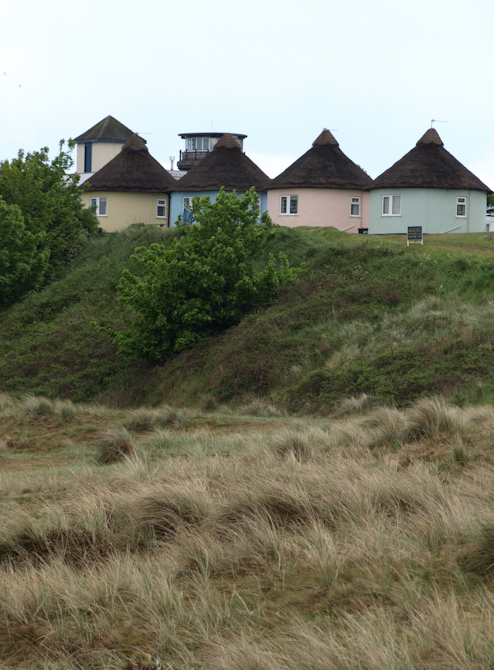 This is where I am meeting my husband for lunch. So, I turn landward, walking along a narrow lane. I notice some pretty little thatched cottages, pastel colours and circular in shape, on the low hill overlooking the sea.
Suddenly the sky darkens again and the wind picks up. I know what is coming – more hail. As I approach the outskirts of the village, I spot a phone box. Shelter! I dash towards it, feeling the first smatter of hail against the back of my hood. Just in time. From the safety of the phone box, I watch the hail lash down with stones as large as small marbles. Lightening flashes and thunder crashes. The hail sounds like machine gun fire on my metal box. There is a stampede back from the beach and people run past clutching picnic boxes, windbreaks, umbrellas, towels and other paraphernalia. They look longingly at my phone box shelter – I feel quietly smug.
Then I see a cyclist on the road ahead. Ah, my husband. “Get in the phone box!” I call to him. He is worried by the lightning. Should we be in a metal box in a lightning storm? He hesitates, holding the door open. Hail stones bounce in. “In or out. I don’t care which. Just shut the door!” I shout. He gets in. I am damp. He is drier. He escaped the first two hail storms.
When the storm lessens, we head to the pub. I have two glasses of cider and a very large plate of asparagus quiche and salad. Truly delicious.
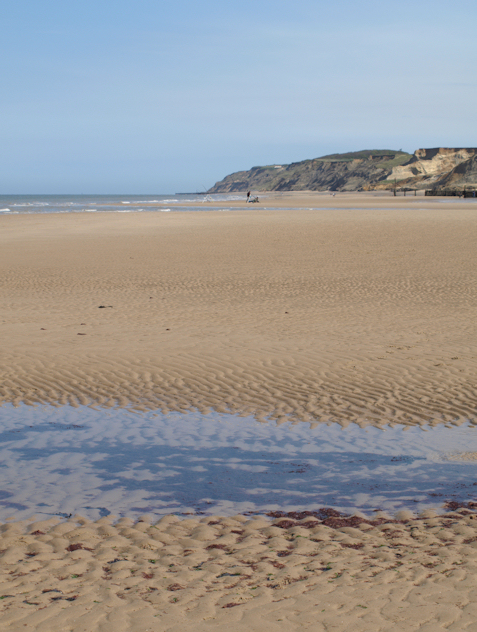
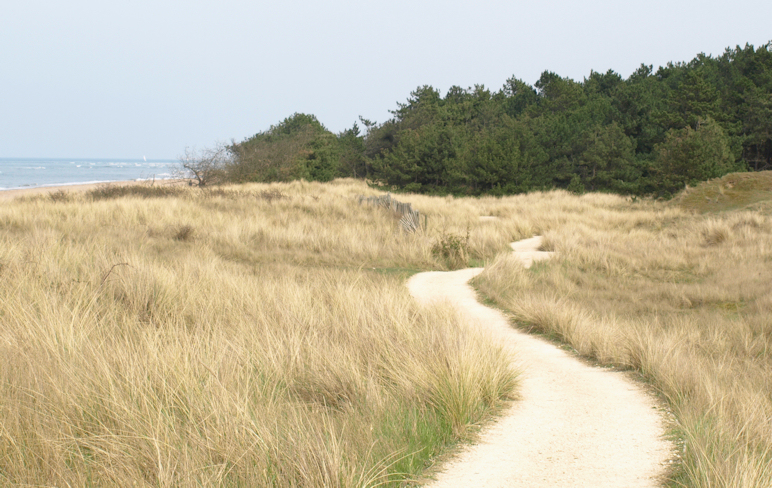
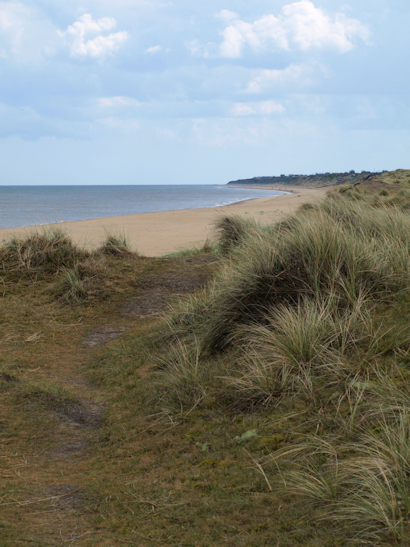 After lunch, I walk down the access road to the beach. Then, seeking different scenery, I walk on top of the dunes that line the coast between here and Hemsby. I enjoy the vantage of a higher view-point and take some great photographs. Ahead of me stretches the coast and I believe that I am looking at Scratby and California Gap. My map, as usual, shows a straight line; but my eyes show two gently curving bays. In the sea ahead is a line of wind turbines – rising gracefully out of the sea and showing off their turning blades against the skyline. There are a few walkers on the beach. The sky is constantly changing, with threatening black clouds giving way to fluffy white and blue skies, then turning black again.
I grow tired of the constant up-and-down of the dune path and make my way onto the beach again. I pass two elderly joggers in shorts, grimly beating a path along the firm sands and keeping close to the breaking waves. I see a man in shorts and bare feet, with rugged face and unkempt hair, saluting the sea. His trainers hang from the back of his rucksack. He passes me and I try to catch his eye, but he avoids contact.
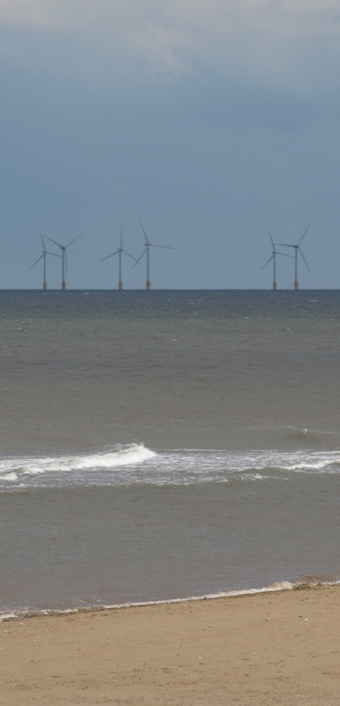 Then, suddenly, the sky is black again. I feel the familiar rat-a-tat of hail stones on my jacket. This time the hail is wetter than before and the wind drives hail stones and rain drops against the back of my legs. Like a miracle, everyone vanishes from the beach again. I walk alone through the pounding hail and rain. Soon my trousers are soaked, sticking to my legs in a very unpleasant manner. Now, worse, I can feel water running down my legs and realise there is water inside my boots. My toes are surrounded by soggy wetness. Yuck. I begin to worry. What will happen to my wet feet inside my boots – I dread more blisters.
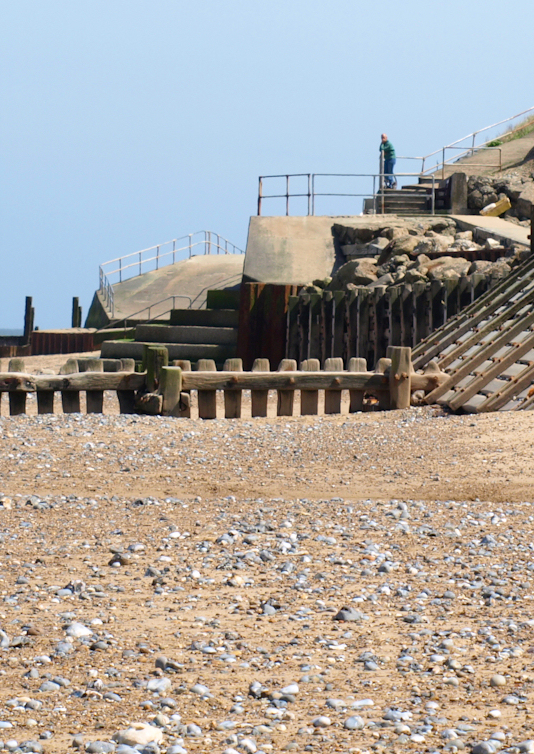
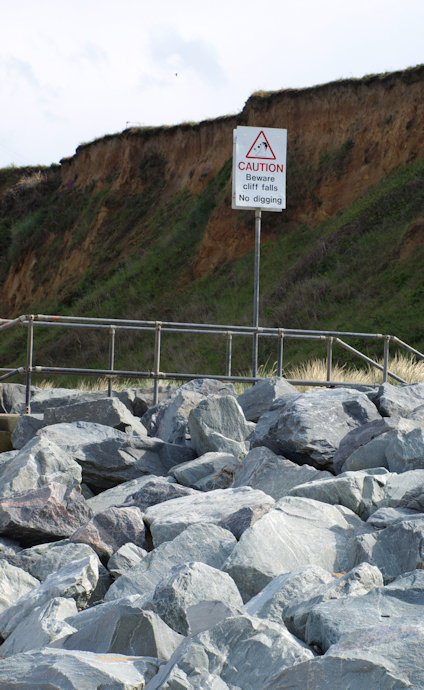 Twenty minutes later and it is all over. The sun comes out fleetingly. I know my trousers will dry quickly, but my feet and boots are another problem. I see some large stones ahead, close to steps leading down to the beach. In the wind and sun, the stones are already dry and I sit on them. People are beginning to come down the steps from the car park above me and are setting up camp on the beach, with windbreakers, push chairs, buckets and spades. Putting off the moment, I eat a chocolate bar and drink some water. Then, off come my wet boots. I expect to pour water out, but the lining has soaked it up. The boots are damp but OK. My socks are sodden. I peel them off, along with my blister protection plasters which have come adrift. I wring out a large amount of water from these socks. I am tempted to sit here and let them dry out, but time is pressing and there could be more hail to come. So, reluctantly, I put my wet socks back on and lace up my damp boots.
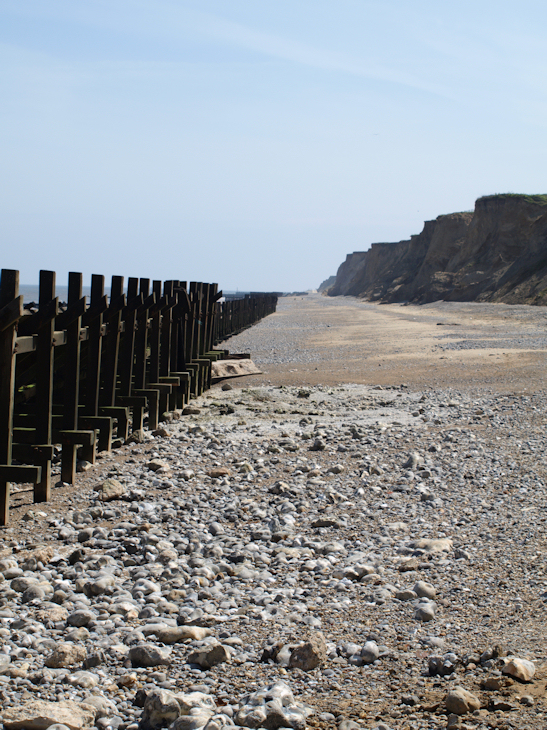
Walking on, I follow the beach, with the wind farm on my left and the beginning of Caister-on-Sea to my right. There is no development on the beach, which remains unspoilt, but I glimpse caravan parks on the shore line behind the dunes. The beach has more pebbles here, less sand. I see a family returning along the beach wearing bright red waterproof capes. From a distance they look like a flock of exotic birds.
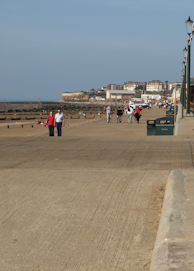
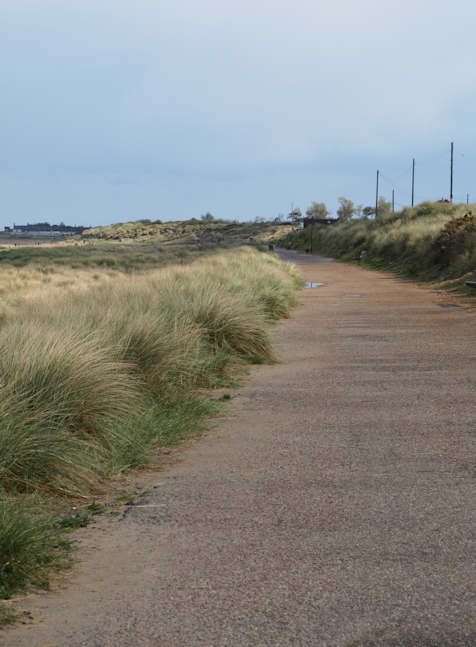 Now I am walking on a tarmac road, running along the beach. There are no cars and the walk would be pleasant, but I am worrying about my feet. They are still very damp and I have lost my blister protection plasters. There are benches along the road, may of them bearing memorial plaques and some with bunches of dead flowers as a tribute. I am not sure if this is sweetly sentimental or mawkishly morbid. I am tempted to sit down again, but hurry on.
At the end of Caister is a large lifeguard station and, behind this, a car park. I arrive at the same time as my husband. It has been an interesting day – hail storms in May and seals.
Vital statistics: 13 miles, 4 hail storms, 0 blisters.
High point: the colony of seals near Sea Palling.
Low point: wringing water out of my socks.




















 Ruth's Coastal Walk (UK)