Stage 6. Cley-Next-the-Sea to Sheringham

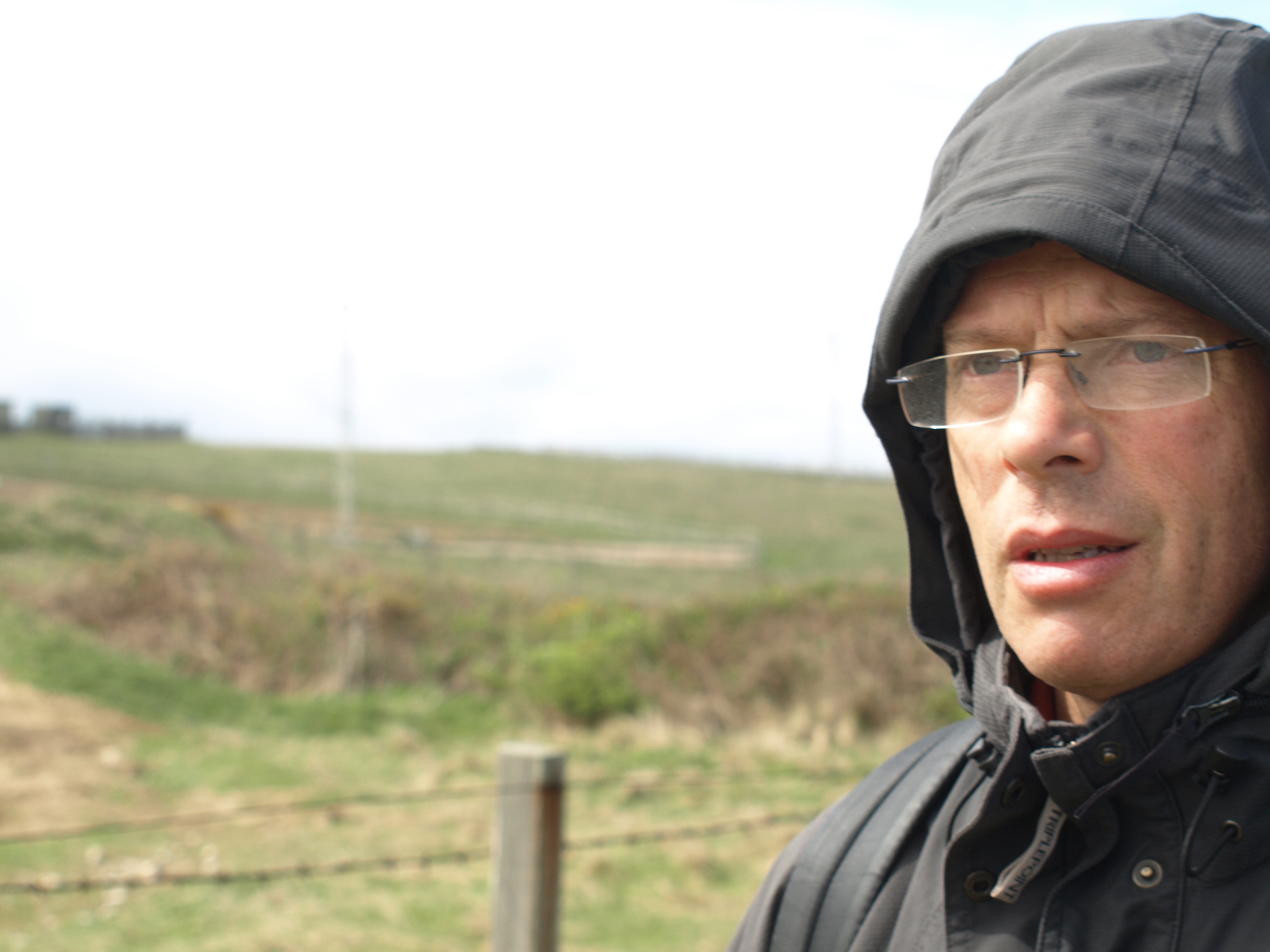
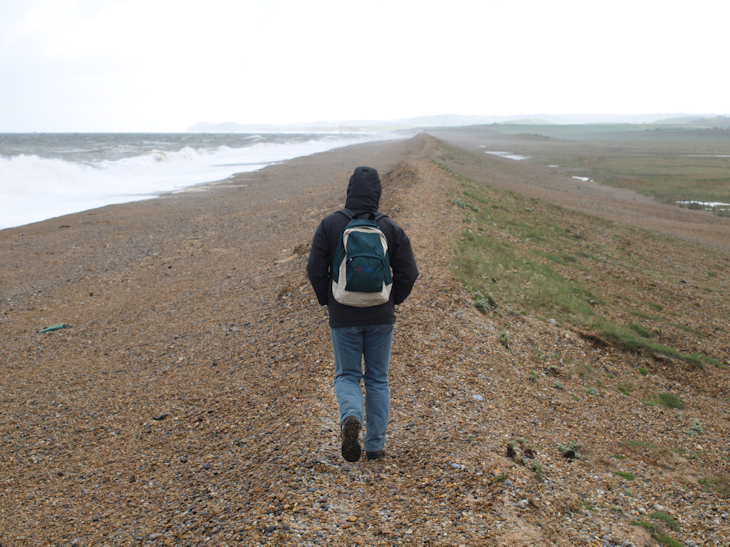
John with hood up, Ruth's Coastal WalkMonday is a bank holiday and, in keeping with the British tradition of foul weather on a bank holiday, the sky is threatening and the wind is whipping across the coast from the north. We drive to Cley, where we leave the car and pick up the coast path.

We walk along a raised bank heading towards the sea and into the furious wind, turning up our hoods for protection. In the distance, ahead, I can see the white tips of waves.

I have been looking forward to walking along the sea shore instead of marshes, which have grown a little boring. But, when we reach the shore, we find the sea is far from welcoming.

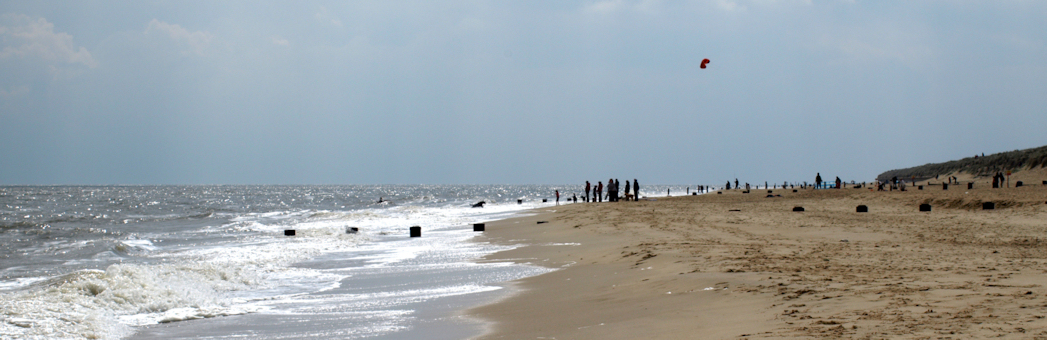
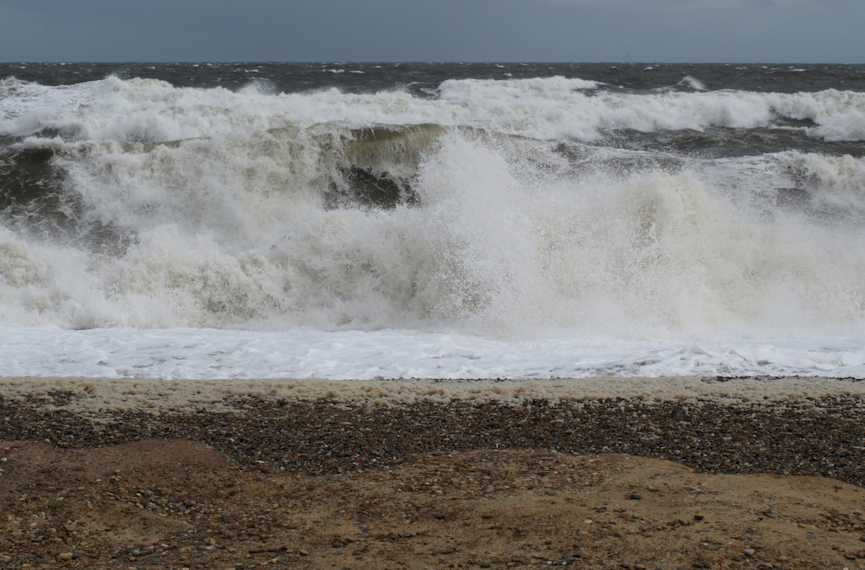
The beach is shingle and stretches on either side for as far as we can see. Huge grey breakers are crashing. The water roars and the wind howls.

Waves on shingle, Ruth's Coastal Walk, Norfolk, CleyWe begin walking eastwards along the shingle bank, while the  wind blows us sideways. The going is difficult, our feet sink into the pebbles and each footstep is an effort.

The path sometimes runs on the edge of the beach, sometimes on the raised sea bank and sometimes behind the bank. When it runs behind the bank, the ground is grass instead of shingle and we have some shelter from the wind. But the tide is high, and this area behind the bank is often flooded with what appears to be sea water that has seeped through the shingle.

In places the bank appears non-existent, with the shingle beach leading straight down to the low lying marsh land. The tide is very high and the waves appear to be only a few feet below the level needed to breech these defences and flood this area. I am reminded of how very fragile this coastland is and what little protection we really have from the force of the sea.

We pass a couple of bird watchers. They are struggling against the wind to get back to the car park. We continue onwards.

For a long stretch we walk along the top of the shingle bank. This runs a few meters above the height of the beach, while the waves crash beneath us and spray fills the air.

Walking on the shingle bank, Ruth Coastal Walk, to Sheringham The wind howls and tries to blow us off the bank. I am grateful for the traction of the shingle underfoot. And for my husband walking in front and acting as a windbreak.

Conversation is impossible.

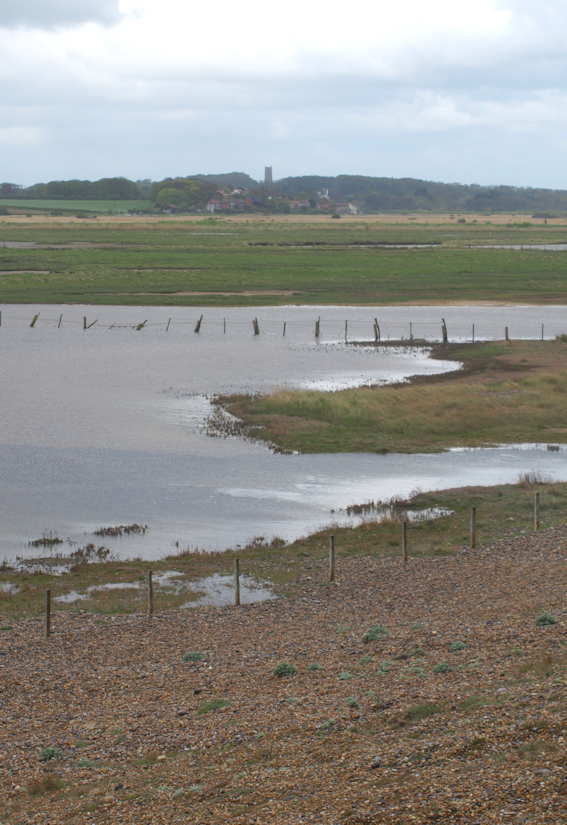
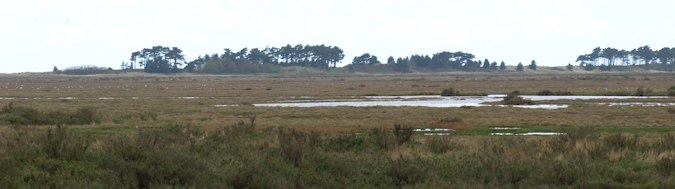
View over Salthouse Marshes, Ruth's Coastal WalkTo our right is Salthouse Marshes. After several miles, we reach a place where a track from Salthouse Village reaches the coast and ends in a car park behind the shingle bank. There are people here, struggling against the wind to get over the bank and to spend a few minutes braving the gale, looking at the sea.

A small van serves beautiful fresh coffee from a proper coffee machine. We buy a cup and carry it up the shingle bank to a small bench. We sit with our backs to the wind, facing inland. The coffee cools quickly, but is warming and comforting.

We continue along the bank as this rises into a hill, Gramborough Hill, with grass instead of shingle and a few gorse bushes. We have a good view of the beach, stretching ahead. We still can not see the end. The sky is darker now and threatening rain. We walk on.

Landwards, we pass the edge of Kelling Heath. This area of the coast is National Trust property and is called Kelling Hard.

A group of youn people have cycled down from Kelling Heath and are balancing on an old pill box (a remnant of our old WW coastal defences) which has been partly submerged by the sea. Clearly enjoying the huge waves splashing around them, they raise their arms and pretend to fly into the wind.

Fishermen on the beach, Ruth's Coastal Walk Beyond Kelling Hard we walk along the edge of a fenced off area of land. The map shows of this area marks a “wireless station” and airfield. It looks like an old army base. An army truck drives past in the distance. Signs say “Private Property” and “Keep Out”.

Here there are a few fishermen on the shingle beach. They stand looking cold, while their lines stretch into the sea.

When we  reach the car park that marks Weybourne Hope we meet a few people braving the sea wind for a Sunday morning outing.

View towards Weybourne Hope - Norfolk coastal walkWe turn inland, with the wind blowing behind us for a change, and follow the road into Weybourne to find a pub for lunch. On the way, the rain suddenly lashes down and within a few minutes the back of my trousers are soaking wet.

It is 12 o’clock and we arrive at the pub in a bedraggled state. Luckily there is only one other lone walker in the pub to witness are dishevelled look. We are hungry from the effort of our windy walk and order a large platter of food – one of the pub “specials”.

Luckily it has stopped raining by the time we leave. We walk along the main road for a few minutes and then rejoin the coastal path by going down a track, passing beside another windmill that appears to be converted to a private dwelling. There are a few cottages at the end of the track, standing bravely near the cliff edge.

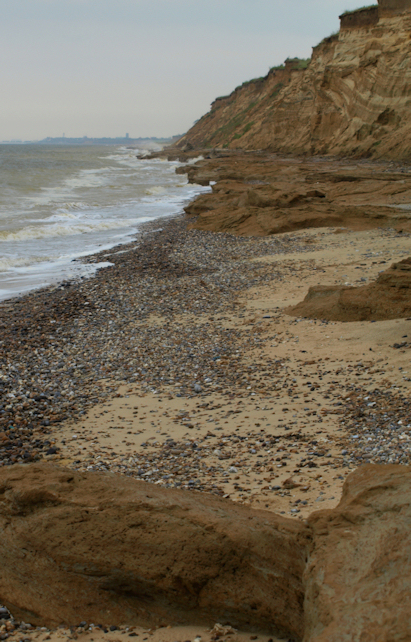
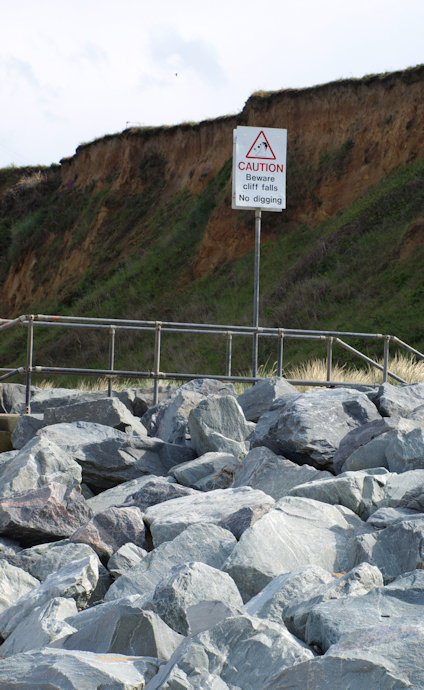
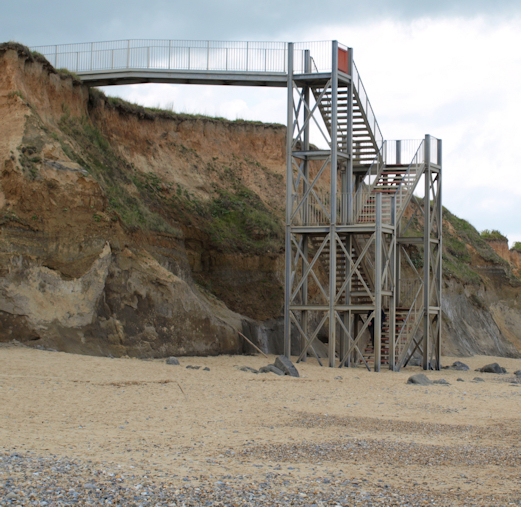
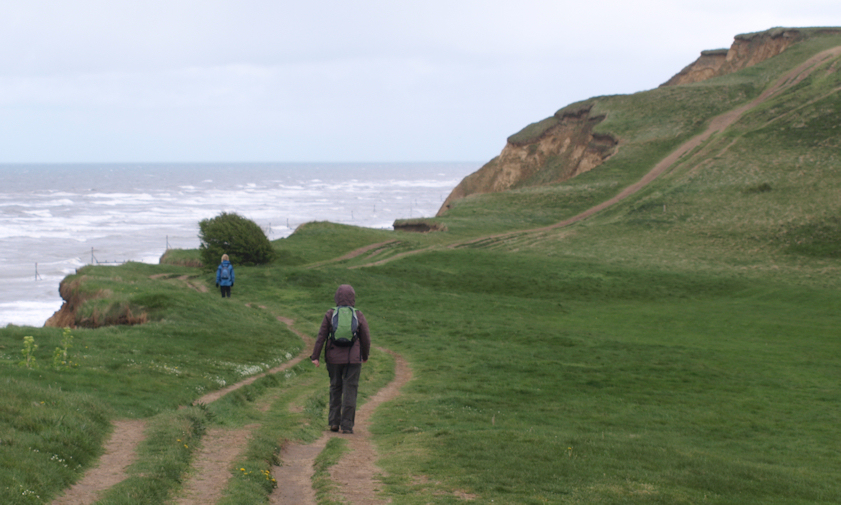
We turn right to walk along the raised cliff, with the sea below us to our left. The cliff edge is made of soft, red, crumbly soil. The edge is eroding and signs warn us to keep away from the edge. In places the path has disappeared altogether, lost into the sea. This area is open parkland. We meet a few other coastal walkers, the first we have seen all day.

The clouds are dark in the distance and we see a band of rain, racing across the sea towards us. We turn our backs as the squall hits. The rain is so hard and sharp against my back, I swear it must be hail. We shelter behind a small gorse bush. Within 5-10 minutes, the rain has passed and we continue.

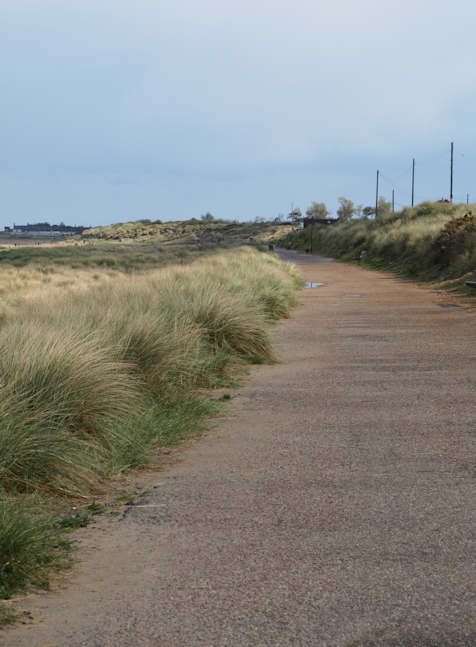
Now we can see Sheringham in the distance. The path runs along the edge of a golf course. A few golfers are out, swinging at balls, or sheltering in the gorse bushes.

path up Skelding Hill, Ruth walking the Norfolk Coast PathAhead of us the path rises steeply up Skelding Hill. We are overtaken by a youngish woman walker in a bright blue anorak. How does she walk so fast? I am sure I have seen her photo on a walkers blog somewhere, but cannot be sure. We struggle up the hill, legs tired now. At the top there are benches and we sit and drink water and I eat all my remaining chocolate bars. The view is beautiful. We can see the path we have walked along, stretching back into the distance, as far as the eye can see, with no end. The sea is covered with a patchwork of light as the sun shifts behind racing clouds.

It feels as if we have achieved a huge trek today and it is refreshing to have a change of scenery, now we have left the flatlands of the marshland country behind us.

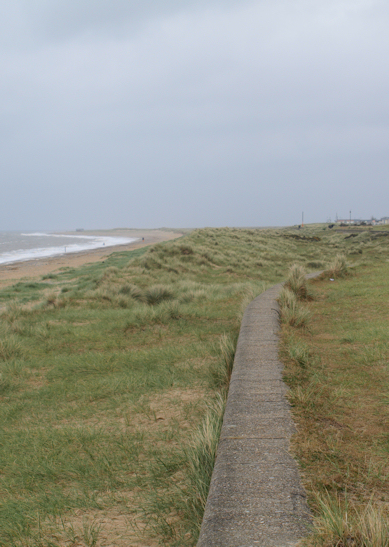
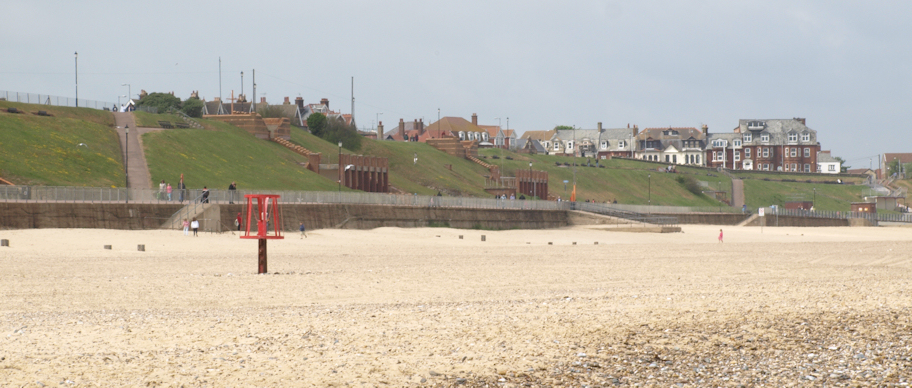
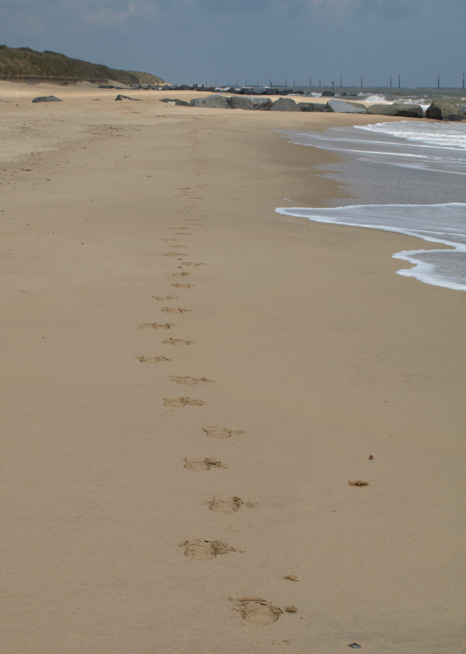
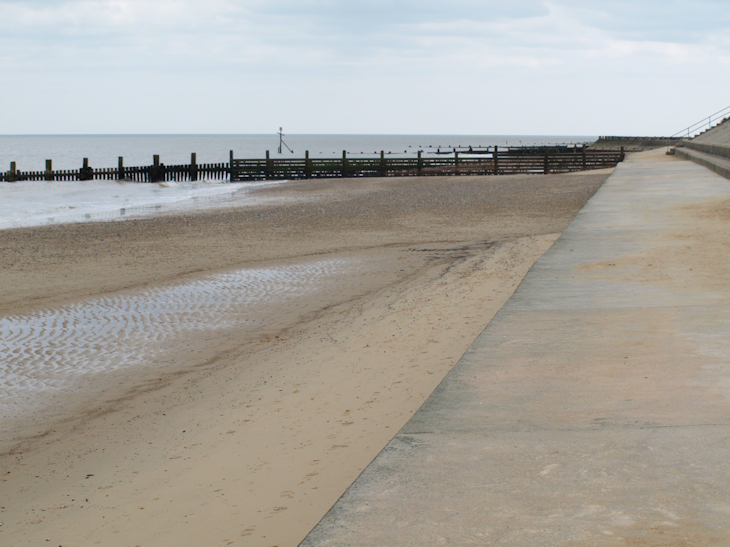
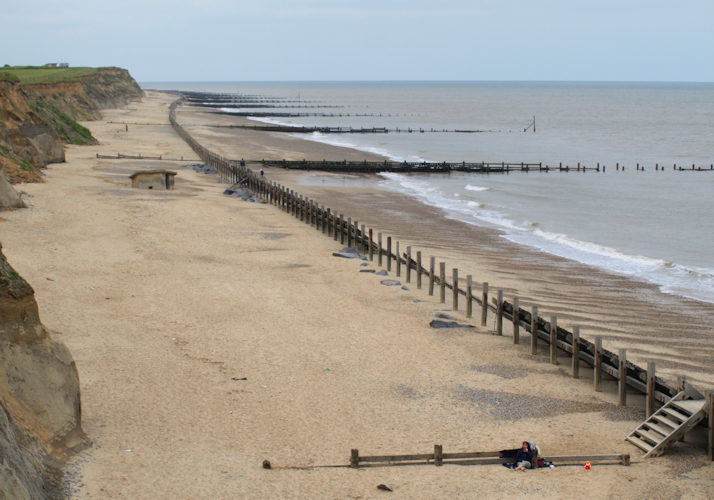
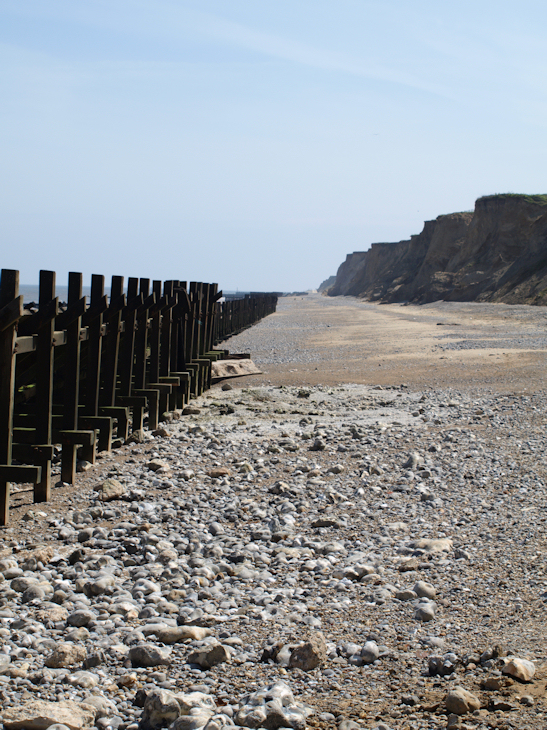
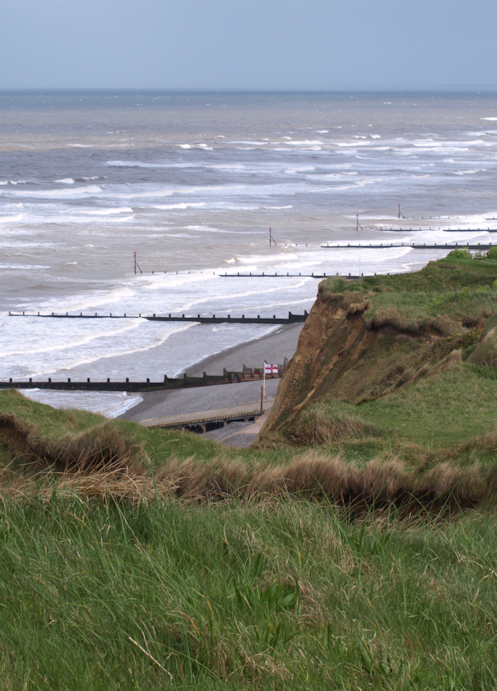
Groynes at Sheringham, Ruth's Coastal WalkWe walk down into Sheringham. We are the only people on the promenade, which runs above the beach. Shafts of sunlight light up the sea. Groynes stretch out protecting the shore below. The wind is still howling.

We turn inland to find the bus station. It is a relief to lose the wind. We see shops and people walking. Then we see a Coast Hopper bus on the street ahead of us, and sprint to catch it up at the bus stop.

Back at Cley we pick up the car.

Another great walk finished. This stretch of the coast was lonely, wet, wild and windy. The crashing sea and the relentless wind were at once awesomely beautiful and powerfully threatening. And the constant battle against the elements was exhausting. I am glad I had my husband with me.

Posted in 02 Norfolk | Tagged , , , , , , , , , , , , , , , , , , , | 2 Comments

Stage 5. Wells to Cley-Next-the-Sea

Sunday morning is dull and grey. The wind is fierce and cold. We leave Shipyard Cottage, turning left down the lane where the coastal path runs. At the end of the lane we continue, following the path along a raised bank. Marshes at Wells-Next-the-Sea, Ruth's Coastal WalkThere are marshes to the left and the sea is in the distance. With this biting wind, we meet few people – just a few hardy dog walkers. There are birds everywhere.

We reach Stiffkey marsh, where we find a campsite and more people are out and about on the path and wading in the marshes. This area of the path is called the “Green Way” and we are now on National Trust property. The tide is in, and sections of the path are very muddy. The path takes twists and turns as it hugs the edge of the marshland. Ruth with bright gorse bushes on Norfolk coastal walk Now there are bright gorse bushes and the sun begins to peep through gaps in the clouds. There are more walkers here. Across the marsh we see huge sea waves breaking on the sand banks that extend out from Blakeney Point. We stop and eat bananas, sitting on very soft, spongy tufts of grass. So soft, we could fall asleep here.

We pass Stiffkey fen, a small lake, on the right, and reach Morston Marshes, again a National Trust Area. There is a large car park and boats everywhere. We follow the path towards Morston village and find The Anchor Inn. This wonderful pub has soft leather armchairs, free Sunday papers to read, and good, cheap food. We sink into armchairs. I have fish cakes and John has haddock in a beer batter. I drink a glass of wonderful dry cyder.

Ruth's Coastal Walk, Norfolk marshesRejoining the coastal path we continue, skirting the marshes, until we reach the village of Blakeney. Lots of people are out, despite the cold wind. We sit on a bench overlooking Blakeney Hotel and the small harbour, while I adjust my blister plasters. Then the final stretch of our walk heads out along the raised sea wall, out towards the distant sea. There is no shelter and the wind tugs at us. Other walkers are out, most with dogs. We follow the curve of the sea wall, separating salt marsh on our left from freshwater marshes on our right. The sun comes out and the water gleams. Every inch of land appears to be covered in birds.

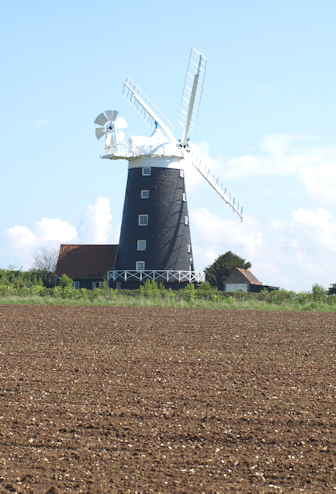
Cley-Next-the-Sea, Ruth's Coastal WalkAs we round the corner, we see Cley-Next-the-Sea in the distance. There are fields of rippling reeds and a large windmill behind the reed beds. The view of Cley, in the shifting sunlight, is lovely. While John braces me against the wind, I take far too many photos of the windmill. The coastal path leads into the village of Cley, where we end this part of the walk.
After a very short wait at the bus stop, we catch the wonderful Coast Hopper bus – back to Wells.

Posted in 02 Norfolk | Tagged , , , , , , , , , , , , , , , , , , | 2 Comments

Stage 4. Burnham Deepdale to Wells-next-the-Sea

It is May bank holiday weekend. Another weekend – another walk. This time, my long-suffering husband is coming with me.

Bird, Overy Creek, Norfolk Coastal WalkWe pick up the Norfolk Coastal Path at Burnham Deepdale. We walk past house boats stranded in the mud, along the raised sea bank. The sun is shining and people are out walking. There is a stink, which I think is coming from the marshes, until we discover a decomposing seal carcass. The bank stretches ahead of us in a slow, lazy curve. There are sea marshes to the left and fresh water marshes to the right. Birds are everywhere.

Windmill, Norfolk Coastal Walk, near Burnham Overy.The bank curves in a southerly direction and we can see Burnham Overy across the water and mud flats. Now there are boats everywhere, lying on the mud or bobbing on the water. We have to leave the sea wall (new grass seeding) and then the path leads over a farmers field, close to a picturesque windmill. We join the road for a short distance and come across The Hero pub. Time for lunch. We sit outside in bright, warm sunshine. The meal is good, but only standard pub fare and overpriced. I enjoy a cold, cloudy cider.

Boats and children, Burnham Overy, on Ruth's Coastal WalkAfter lunch we rejoin the Coastal Path. From the raised bank we look over a delightful scene – lots of boats and children playing – here there is sand, less mud.

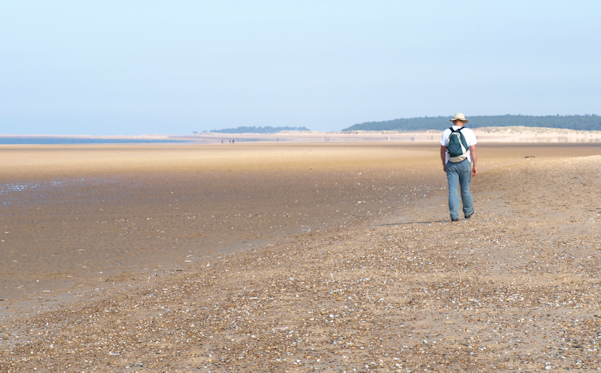
Now we are in sand dunes, and the path leads over a rise and – wow – here is a fantastic stretch of beach. Light sands, bright sea, sunshine and a few people, this beach stretches as far as the eye can see. The sea is blue. The horizon is clear, no haze. We walk out towards the sea – which is some way off – and then walk eastwards along the beach. The sand is firm in places, but soft and boggy in other areas. We are walking along firm sand some way from shore. I keep an anxious eye on the sea. The tide could easily cut you off quickly. People die here.

Holkham Beach, approaching Lady Anne's Drive, John on Ruth's Coastal WalkBehind the dunes are pine trees. This is a welcome change from the flat and open marshland. An area of the beach is fenced off. Signs tell us that little terns are nesting here. They nest in the sand and it is easy to tread on birds or eggs. We hear them calling, but they are hard to spot.

We reach a place where Lady Anne’s Drive leads to the beach. Families are here. The ground is marshy and people are struggling with pushchairs and young children, heading through the soft marsh to the beach beyond. We can remember coming here with our own children.

Now we follow the path inland, through pine trees. I am worried we are leaving the beach behind, but this is the route of the Norfolk Coastal Path. A wide open track leads behind the trees, running parallel with the shore. There are seats at regular intervals and there are cyclists on the track. The sun is getting low.

Wells Lifeboat Station - Ruth's Coastal WalkWe begin to see signs of a holiday centre. Pleasant looking static caravans are parked adjacent to the path and we walk past a boating lake and crazy golf. Family groups are walking slowly in the late afternoon sunshine. We cross a large car park and reach the sea again. Now we climb a ramp up onto the sea wall again. Looking westward, in front of us is a large lifeboat station, beyond that the bay and an island in the distance. I recognise the island. We have been here with the children, years ago. I painted that island, in a howling gale, in watercolour – a quick sketch while the children played. The painting still hangs on a wall at home, with grains of sands stuck into the paper.

The sea wall leads southerly, in a straight line for about a mile, towards Wells-Next-the-Sea. People are walking, with dogs and children, along the sea wall and the path that runs a little below it. The wind is fierce and cold. There are boats moored and Wells looks lovely in the slanting sunlight.

Shipyard Cottage, excellent B&B for Ruth's coastal walk.We stay at The Shipyard Cottage, in Wells. This delightful B&B is situated on the Coastal Path as it runs along the quayside in Wells. The owner, Janet Beckett, is warmly welcoming and our room has wonderful views across the sea. Shipyard Cottage does not have a website and is a secret treasure. If you are planning to do this walk, I can’t recommend this place highly enough – give Janet a ring on 01328 710 679.


Things I have learned

  • Walking with someone else is more fun.
  • 10 miles a day is enough for me – at the moment.
  • A few minutes spent on blister prevention really is worth it.
Posted in 02 Norfolk | Tagged , , , , , , , , , , , , , , , , , | Leave a comment

Stage 3. Thornham to Burnham Deepdale

What a difference a day makes. Sunday is the day of the London Marathon. Here in Norfolk, the sky is grey and the weather forecast says a band of rain is due at 10 o’clock.

I hang around at the hotel. On go the blister plasters. Water bottles are topped up. I watch the Andrew Marr show on TV in my hotel room. By now it is after 10 and still grey but no rain. I can’t procrastinate any longer. Continue reading

Posted in 02 Norfolk | Tagged , , , , , , , , , , , , , , , , , | 2 Comments

Stage 2. Hunstanton to Thornham

Today I walk from Hunstanton to Thornham. This is not a long distance, 8 miles or so, and my intention is to avoid blistering and walk a further 8 miles tomorrow.

I drive to Thornham, a pretty seaside village, and park my car at the Lifeboat Inn, where I have booked a room. Then on go the walking boots and my little rucksack. I walk to the main coastal road and wait at the Coast Hopper bus stop. Within 5 minutes a bus arrives and I buy a single ticket to Hunstanton.

Hunstanton Cliffs - Ruth's Coastal Walk
The sun is shining and Sunny Hunny is buzzing with people. I buy lunch (sausage roll and Americano coffee) and sit eating it on a bench, watching the world go by. Then I walk Northwards along the sea front. This walk is along the top of cliffs. The cliffs are crumbly and we are kept away from the edge by a fence and, in some places, 3 fences. The coastal path has clearly been moved a number of times, further inland, as the cliff erodes. Along the fence are warning signs. And various charities have placed various signs here too – “Choose Life, not death…” – that sort of sign.

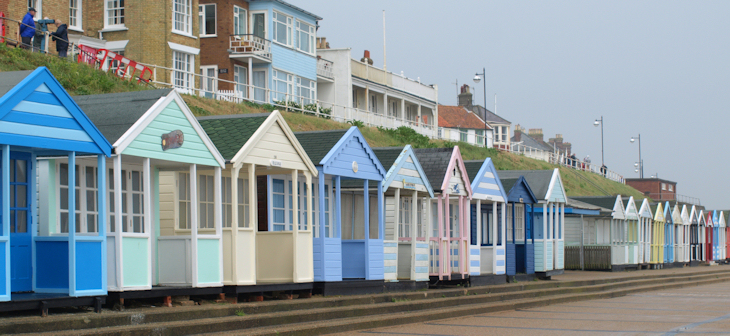
There is a strange lighthouse, now a house, and then the path leads alongside a carpark. Here there are a cliffs – a unique sight on the Norfolk coast. There are families, pushchairs, dogs… and the path leads beside dunes. There are people on the beach. Kites are flying. The sun is shining down. Beach Huts, Hunstanton, Ruth's Coastal WalkThe coastal path is separated from the beach by a line of beach huts. In places the huts are 2 or 3 deep. The inside layer of huts don’t even have a sea view. They are brightly painted and make compelling photographic subjects. I take far too many photographs.

The path is sandy and the going is difficult. I try to avoid getting sand in my boots – I understood from the boot-seller lady in Millets that sand in walking boots is bad and can lead to blisters. There are signs up saying private property, this area is leased to the golf club, but the coastal part continues through and is well marked. I pass alongside a golf course.

Twitcher near Old Hunstanton BeachEventually the golf course stops and the path continues through Holme Nature Reserve. The path is firm here and this makes the journey easy. In places there is a wooden walkway. To my left is the beach and, despite the distance from a car park, families are dotted around the beach. The nature reserve has attracted “twitchers”. They wear camouflage trousers and carry huge binoculars and telescopes. I ask if they are here for a reason – maybe a rare bird has been reported – but they tell me this is just a great time of year to see birds.

A group of young men in ordinary shoes are trying to get onto the beach. They discuss taking a short cut to the beach across the marshland that separates this part of the path from the shore. I advise them against this and direct them back to Old Hunsanton Beach, where there is easy access to the sands.

The path here is lovely, with water on both sides and a warm mellow sun.

Gore Point, North Norfolk Coast I reach Gore Point, the farthest northward point of the reserve. There are signs asking us not to disturb feeding birds on the shore. And not to disturb the fragile sand dunes. The path is running along the top of a sandune that is 150 years old.  I meet a young German couple and they wait for me to take photographs before continuing. I sit on the edge of the path and eat a banana, oranges and chocolate.  I check my feet. Two new blisters but nothing serious.

The path passes through a small pine wood. There is a visitors centre here and this section of the beach is populated with families. Then the path turns southward, following the coastline as it is indented by an estuary. There are birds everywhere here. Wading birds with curved beaks look particularly striking. The sun is slanting across the fields and the air is soft with summer sun. A wonderful day. I phone home to share the moment. The only sounds around are calling birds and the crashing of the sea on the shore.
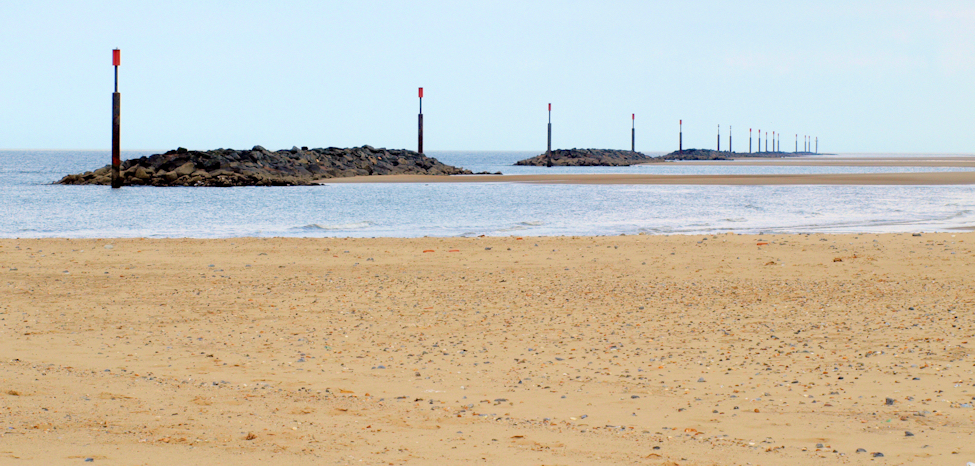
View towards Thornham, Ruth's coastal walkWalking towards Thornham is a joy in this magical light. The estuary has small boats, far sands, and lots of water.  I take even more photographs. Will I have any battery power left for tomorrow? Who cares.

Thornham looks attractive and I can see the white building of The Lifeboat Inn. The coastal path heads off to the East, but I continue towards Thornham and end up back at the carpark.

What a fantastic day. I can’t wait until tomorrow ….


Vital stats: 8 miles. no new blisters.

Posted in 02 Norfolk | Tagged , , , , , , , , , , , , , , | Leave a comment

Stage 1. Kings Lynn to Hunstanton

17th April: Unusually warm and sunny. Two days after the volcanic eruption in Iceland and all aircraft are grounded. There are no vapour trails and the sky is cloudless.

I mainly follow the route outlined by David Cotton, who did the coastwalk in 2002. For details of his route, consult his excellent website and look up walk #253.

I drive to Kings Lynn and park in a longstay car park. The time is 9:20 am. I ask a few people for directions to the tourist office, but they all seem to be Eastern European and don’t speak English. Then I meet a man with a dog and he directs me toward the Great Ouse River, but he did add “There is nothing much there.” He is right.

Wrecked boats, at mouth of the River Ouse I walk along the river bank and then down a track running alongside the river, passing various chemical factories and parked white vans, until I reach some rather nice houses and then the nature reserve at the end. I follow David’s route along the Old West Sea Bank and, ignoring a sign that reads “no public right of way”, walk along a bank and into Vinegar Middle, then follow farm tracks through Wooten Marsh. I am passed by a few 4×4 cars, but otherwise I see nobody. By now I am getting bored. With empty, flat farmlands on either side, and no sign of the sea, this is not the coastal walk I had envisaged.

So I decide to divert from David’s route by heading onto the sea wall at Wooten Marsh – this is the grassy earth bank that protects the low lying farmland from flooding. There are notices at access points to the sea bank which warn me that there is no public right of way along the bank, shooting is prohibited unless I am a member of a certain club and if I carry a gun then I must also carry my membership card at all times. Since I wasn’t carrying a gun, I decide to continue. Still no sign of the sea, only mud flats stretching out to my left – where the sea must begin eventually.

This part of the walk is long and hot. The sky is clear, the sun shines down and there is not even a sea breeze. The sea bank stretches relentlessly ahead with no “end point” in site. On my right are farmlands. On my left are the mud flats and the occasional strange wooden “shack”. I presume these wooden shacks belong to huntin’, shootin’ and fishin’ people and are probably the gun man’s equivalent of a garden shed – a home-from-home. I did hear gunshots in the distance, but this area of the coast is deserted and I see nobody during this stretch of the walk. I am pleased about this as I feel very exposed high up on the bank and I do not want to be challenged about my right to walk here. I startle a lot of birds. And I grow hotter and hotter, shedding layers of clothing, until I am in my T shirt and glad that I packed factor 25 sun block.

Eventually I reach a small creek and the sea wall turns inland. At this point I meet a locked gate – the first I have come across, and I have to crawl through a barbed wire fence to continue. I follow the raised bank around the creek and reached the far end of the Snettisham nature reserve. Geese on the sands, Snettisham Nature Reserve Here I see the first people since I left the Great Ouse River, nearly 8 miles ago. I had felt anxious walking along the sea wall, as this was clearly not a public right of way, so I was relieved to be on a public trail and to follow the paths of the nature reserve.

My feet are beginning to hurt and I am feeling hot and thirsty. Worse still, my iPhone is running dangerously low on batteries due to the Trip Journal app I am running. I am really worried that my phone is going to die – and with it goes my communication and escape route. So I am forced to switch if off, only turning it on again to mark various waypoints.

At the far end of the Snettisham reserve is Snettisham Scalp. Here are holiday cottages and caravan parks, with plenty of people – walking, cycling and fishing. I find a small shop in one of the caravan parks and buy an icecream. Apart from drinks of water, I have had nothing to eat since starting and, on switching my iPhone on, I am dismayed to see it is already quarter to three. I had no idea that it was so late or that my progress had been so slow.

I nearly give up. My feet are hurting, I am hot, and I don’t know if I will make it to Hunstanton. I ask the shop keeper about buses and, if there had been one available, I would have headed back to King’s Lynn at that point. However, she tells me I would have to walk into Snettisham village and that is “quite a walk”. My map confirms that by the time I arrive at Snettisham village, I could be 1/2 way to Hunstanton instead. So I decide to press on.

Despite my sore feet, I pick up the pace. Walking quickly, I pass everyone ahead of me, get licked by dogs, avoid cows, and walk along a raised bank running parallel with the coast until I reach Heacham beach. Here it really feels like a seaside resort – hot and sunburnt people are milling around with dogs, children, bikes, and I even saw a woman on a disabled scooter making it up a ramp and onto the beach. Groups of young people walk along the sand, speaking in Eastern European languages. There is a toilet and I wash my dog-licked hands and then settle down on the sand for a can of coke and a bar of chocolate. Then I cast caution aside and eat the rest of my food box!

Getting up is hard. My legs ache but my feet are really sore and I know I must have blisters. The map shows a coastal walk running all the way to Hunstanton – only 2-3 miles to go. The first part of the walk is a sandy track – really hard work. I am beginning to think I will need to take an inland path, when I reach another part of Heacham beach and find a wonderful paved sea promenade. Promenade between Heacham and Hunstanton, with groynesTo my right are beach huts and, later, holiday cottages. To my left is the muddy beach, stretching into the distance, with the sea shining in the sunlight some miles away. The beach has wooden sea defences, groynes, marching out from the shoreline. The raised promenade is busy with people walking, cycling, pushing babies and exercising dogs. I see many overweight people and feel very virtuous. Ahead of me, a biker strides in full leathers. I overtake him.

Approaching Hunstanton along the promenade from HeachamThe promenade curves gently round and I suddenly realise I am in Hunstanton. There is a fun fair, I pass the aquarium, ice cream kiosks, and watch a microlight pilot buzz a boat coming into the shore. The boat rises and begins rolling onto the sand – ah a hovercraft. No, it is a boat on wheels. It makes its way up the beach and docks.

I stop and ask an girl in an icecream kiosk for directions to the bus station. My feet are very sore now and I have to force myself to walk without a limp. I follow her directions and ask several more people en route, to ensure I am heading the right way. At this stage, I don’t want to have to walk any further than is absolutely necessary.

I arrive at the bus station at 5:20 pm and join the queue of holiday makers. The “express” bus to Kings Lynn pulls in and I pay my £3.50 bus fair with relish, slipping into a seat and falling asleep almost instantly. It took me 8 hours to make this journy, but only 45 minutes to return to Kings Lynn. I walk on painful feet through the closed shopping centre and find my car again. Then home.


Vital stats: Distance 16 miles. Time taken 8 hours. Av speed 2 miles an hour.

Things I learned:

  • I walk slower than I anticipated.
  • Despite prepartion and comfortable shoes 16 miles was too far for the first day.
  • I must not leave my tracking feature turned on, because it depletes my phone battery too quickly.
  • It is the edge of the blister that hurts, not the centre.
  • Blisters stop hurting if you pop them.
  • You can never carry too much water.
  • Chocolate bars are essential because they make you feel better.
  • All ice-cream sellers are kind and friendly people.

Oh and, depending on the route, the walk around the British mainland is 5-6,000 miles. At this rate, it will take me 6-7 years to complete!

This slideshow requires JavaScript.

Posted in 02 Norfolk | Tagged , , , , , , , , , , , | 29 Comments

Preparations

Yes, I am going to walk around the coast of the UK mainland. I am going to do it in stages. I am going to do it, despite never having walked long distances before. I am going to do it in stages. I will take my time. And I am going to enjoy it.

I have bought some basic equipment (see my Preparations page for details if this is the sort of thing that interests you!). I have done some research on the internet and discovered a few other people – some crazy and some sane – who have done this before me.

I have my first day planned. Yes, it is only one day and I will be coming home to recover.

And I start tomorrow.

If I survive, I will update this blog on my return.

Posted in 01 Start | Tagged , , , , , , , , , , , , | 7 Comments