Stage 19. West Mersea to Peldon to Old Hall Farm

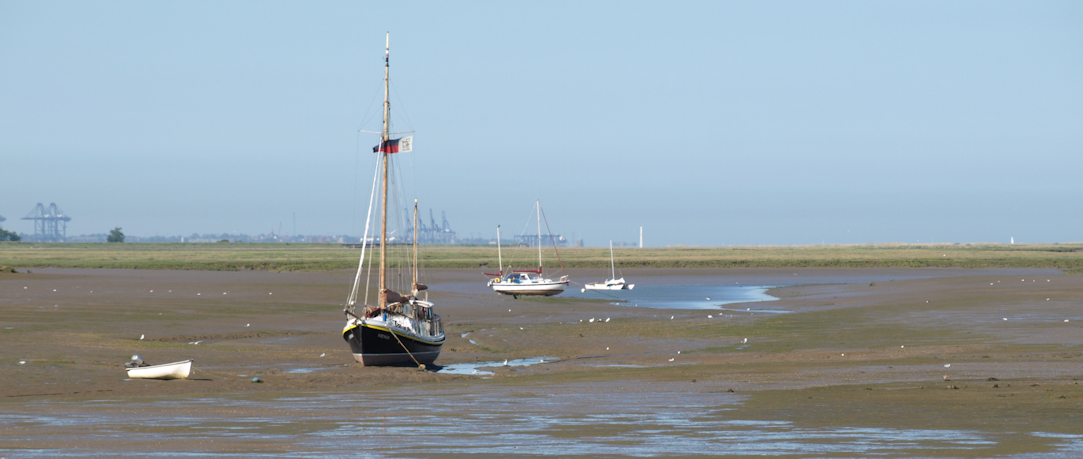
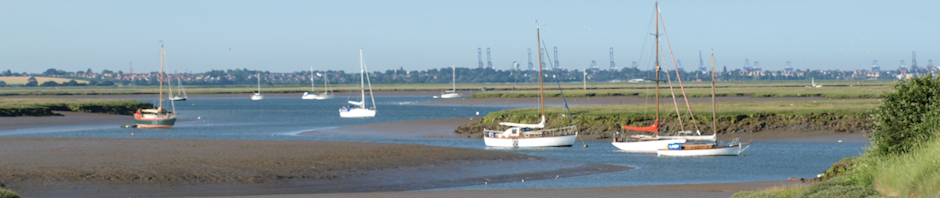
Boats in Strood Channel, Mersea, Essex - Ruths coastal walk It is a beautiful morning. I walk with a light heart along “The Hard”, passing the Oyster bar from last night – shut now – and walking along the quiet road as it follows the coast. The tide is in and the boats, marooned on the mud yesterday evening, are now bobbing on gentle waves. There is a Sunday morning feel to the air. And now I have the distinct impression we really are on an island. The houses are quaintly old-fashioned. I pass another shack with signs advertising fresh sea food, again looking distinctly unimpressive from the exterior. It is closed at this early hour but, I gather, sells wonderfully fresh, tasty food.
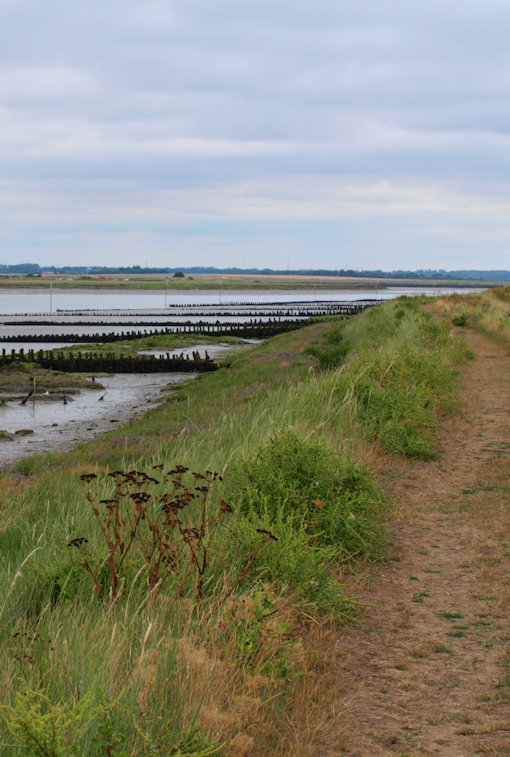
Path towards The Strood causeway, Ruth's coastal walk.

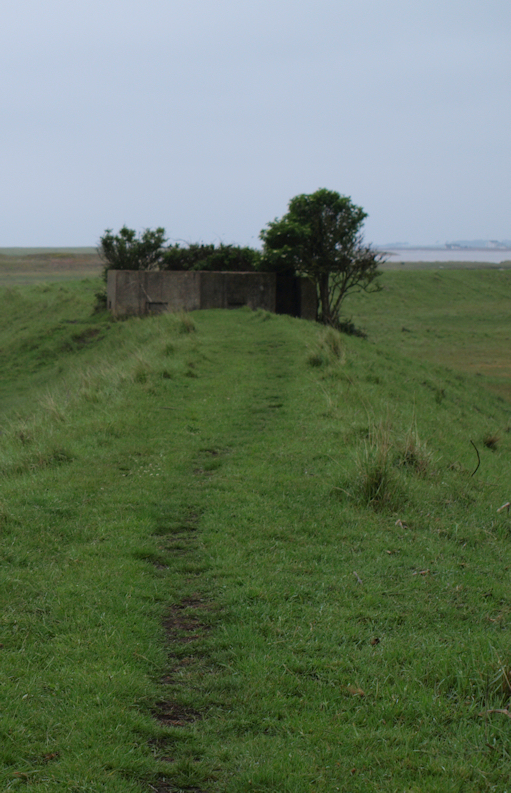
The road turns away from the shoreline and I pick up a footpath, continuing along the sea wall towards The Strood. The Strood is a causeway, covered at high tide, and the only road link between Mersea Island and the main land.

The first part of the footpath is wide and well trodden. There are dog walkers out, enjoying the soft morning breeze. I meet several cyclists and am nearly run over by a small boy, pedalling furiously ahead of his family. “Watch out!” they call, as he skids to a halt in front of me. I help him straighten his bike but he is embarrassed and scowls at me, keeping his face down. I walk on.

To my left is The Strood Channel with sailing boats moored. There are no jetties or docks here. To access these ships you would need to take a small boat from further up the shoreline.

View of The Strood causeway, to Mersea - Ruths coastal walk

The path becomes more overgrown and lonelier. Ahead I begin to see a dark block running across the water. Ah, this must be The Strood causeway. I can make out cars passing along it.

The footpath ends at the road leading out of Mersea and I am forced to walk along the tarmac until I reach the causeway itself, where a footpath exists. There is seaweed strewn across part of the path; a reminder that this road is covered at high tide.

Coming towards me is a young lady on a cycle. She is wearing a skirt, billowing out behind her. Looking hot and flustered she returns my smile with a nodding grimace. “He didn’t wait for me,” she wails as she struggles past. Who didn’t wait? Boyfriend? Husband? Brother? Whoever it is, there is trouble ahead.
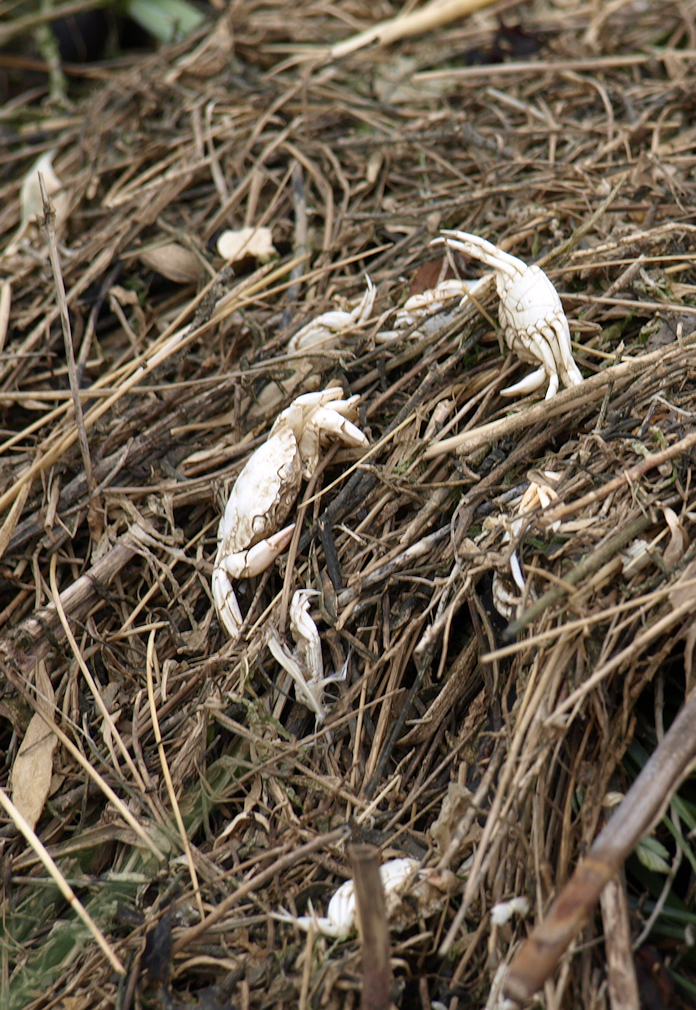
Dead crabs, along the causeway - The Strood, Ruth's coastal walk At the far end of the causeway I notice a curious sight. Along the side of the bank, adjacent to the footpath, is a mess of churned up grass, mud and dead weeds. I notice, amazed, that there are hundreds – no, thousands – of dead, small, white crabs in this debris. They lie on their backs with their little legs pointing towards the sky.

Why? What are all these crabs doing here? I wonder if the marshy area just adjacent to the path has been dredged. Maybe some machine scooped up the weeds and mud, depositing the resulting mess, crabs and all, on the bank. Or was it the tide, churning up the bottom of the muddy pools and throwing the debris up here? I don’t know. It is rather sad to see so many tiny crab carcasses displayed in this way. I take a photograph of their little white bodies.

At the end of The Strood, the next part of my walk takes me along a road towards the village of Peldon. There is no footpath marked on my map and I am not looking forward to walking on the road itself. Then I notice a path leading to the raised bank along the side of the marsh and, for a short time, I attempt to follow this. Unfortunately, the path ends up at the bottom of some private gardens and the bank ahead is fenced off. Here, where common sense dictates that there should be a coastal path, I find private property and no way through.

With heavy heart I retrace my steps and join the road. Cars hurtle past me and I am very glad to find where a quieter road forks off to the left, leading to Peldon. Luckily there is only light traffic along this road and, despite my bad-tempered mood, I find that I enjoy the walk.
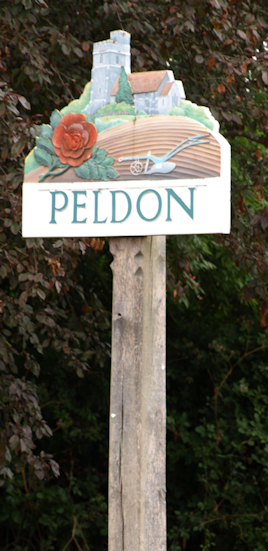
Peldon village sign, Ruth's coastal walk

Peldon village is not unattractive, but has no heart and no soul. I arrive early and hope to buy a Sunday paper to read in the pub before my husband joins me. There is no shop in Peldon. I walk around the village in a great circuit. Nothing. Just the pub. This, conveniently, has some papers outside and I sip a cider and read, waiting for my husband. He has been caught in a rain storm and has had to shelter. In Peldon, we had a few spots of rain, but it is now fine and sunny.

The food at the pub is excellent and after lunch we linger, reading the papers and enjoying the warm sun.

The next part of my walk follows the road. I need to reach the coast again, but have to detour inland because of the absence of footpaths. This is unpleasant walking. Cars hurtle past me and the road is busy. There is no pavement and no grass verge – just ditches and tall hedges.

I walk on the righthand side of the road, facing oncoming traffic, as advised by the Highway Code. This is somewhat terrifying. The drivers in the approaching cars appear to stare straight through me and swerve at the last moment, or slow down if they are forced to give way to oncoming traffic, glaring at me. I begin to feel I am playing a game of “chicken” with the cars. They wait until the last moment to swerve or brake, hoping that I will jump into the ditch or into the hedge. Eventually, I decide to walk on the left, with my back to oncoming traffic. I can tell the cars are coming, because I can hear them. But I no longer have to eyeball irate drivers.

Great Wigborough village sign, Essex, Ruth walks the coast I walk through Little Wigborough and through Great Wigborough. Sometimes there are pavements, but mainly I am forced to walk on the tarmac itself.

Stopping regularly, whenever there is a piece of grass to stand on, I keep checking my map. Joining this road on the left, somewhere, is the footpath that will take me towards Salcott-cum-Virley and I don’t want to miss the beginning of this path.

A young man towing a jet ski is forced to slow down in his giant 4×4 monstrous car. He winds down the window and delays his journey further by telling me that I should be walking on the other side of the road, then roars away. Of course I should be walking on the other side. But was he imparting this bit of walking wisdom for the sake of my safety? I think not. He was simply irritated because I was on his side of the road and he had been forced to slow down.

I curse all Essex drivers and carry on. I have no choice.
Footpath to Salcott-cum-Virley, Ruth's coastal walk

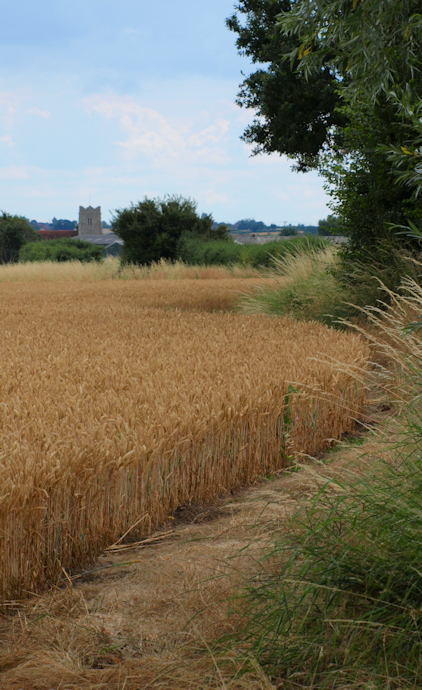
Finally, I see the footpath sign. What a relief! It is a good job there is a sign, because I would have missed the footpath otherwise. The verge at this point is shoulder-high with nettles. Wishing I had a stick, I force my way through the nettles to the hedge and discover a dilapidated style. Over the style, and to my surprise, I find the kind farmer has created a wide footpath along the edge of his field.

It is wonderful to be off the road and I enjoy this walk through the fields. I see a church spire ahead of me – Salcott-cum-Virley church, I presume.

The footpath ends in a farmyard. I walk between large barns. There is a great noise – pigs squealing and cattle bellowing. There is also a very strong smell of manure. Unlike the outdoor pigs in Suffolk, these pigs have a much more crowded and, probably, unpleasant life. I see some young pigs in one of the barns. They are charging around in great groups – squealing and grunting – butting into other pigs and generally behaving badly. It reminds me of something. What? Ah, yes. A secondary school playground.

Coming out of the farmyard, I meet an elderly couple. They are consulting a map and we stop to chat about the large number of footpaths that lead into this village, Salcott-cum-Virley. I wonder if this village was once a place of some importance, to have so many foot paths lead here.

The couple was keen walkers. The man tells me about some of his expeditions in his youth, when he followed long distance footpaths for miles on end. Now they confine themselves to exploring villages.

Salcott-cum-Virley, walk to sea wall.

I walk through the village and am passed by a lady on a bicycle with a dog on a lead running alongside her. At the end of the village, I find the footpath leading to the sea bank. The path leads through a field and I notice the bike against the hedge at the entrance to the field. The sea bank is deserted apart from a figure in the distance, coming towards me. I realise it is the lady, returning with her dog from a short walk along the bank.

For the rest of my walk along the bank, I see nobody. After the hustle and bustle of the road, I am relieved to be alone again – just me, the mud and the distant sea.

View back to West Mersea, Ruth's coastal walk

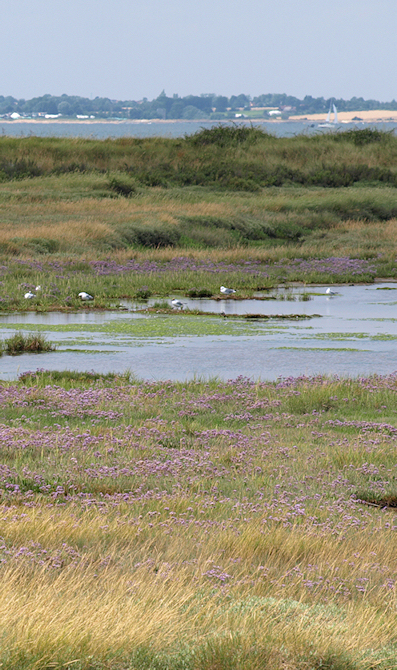
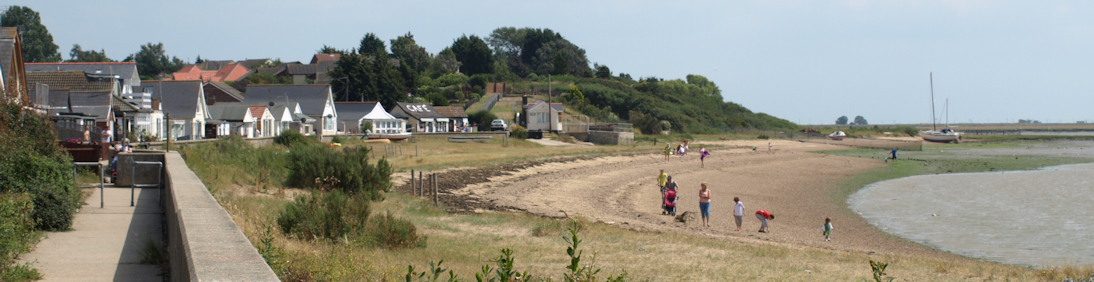
Now I get a good view across the marshes towards West Mersea. Strange to think I was there a few hours ago, walking along The Strood Channel. I am only a few miles away from the beginning of my walk. Just a few minutes if I was a bird and could fly. But on two feet, forced to detour around the estuary and thwarted by the lack of footpaths, it has taken me many hours to get here.

Bradwell Power Station, from across the marshes

As I head eastwards I notice a large structure some distance away. Separated by some miles of marsh and farmland, I am not sure what it is. Squat and bulky, it hovers on the horizon. Perhaps my walk will take me there?

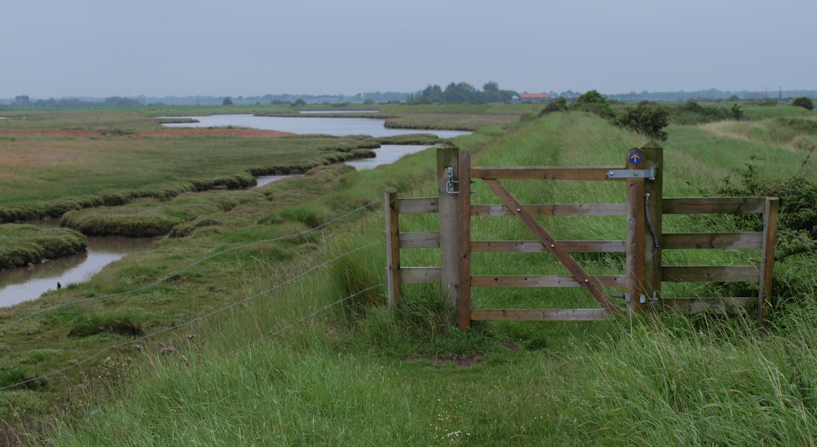
I consult my map and turn off the sea bank along an established foot path, leading towards a building and a track that connects to the road again. The building is marked as “Old Hall Farm”. Beyond this there are Old Hall Marshes and there the walk continues for many miles around a peninsula. But, it is time for me to finish this walk.

Passing through the beginning of a nature reserve, some of which is closed to public access, I follow the track to Old Hall Farm. Here the track widens and I leave the nature reserve. Passing some isolated residential building, I follow the roadway until I see my husband’s car approaching. Time to stop.


Vital stats:

  • Blisters = 0
  • Miles travelled = 12
  • Dead crabs seen = several thousand
  • Close encounters with cars = too many!
Posted in 04 Essex | Tagged , , , , , , , , , , , , , , , , , , , | 9 Comments

Stage 18. Jaywick to West Mersea

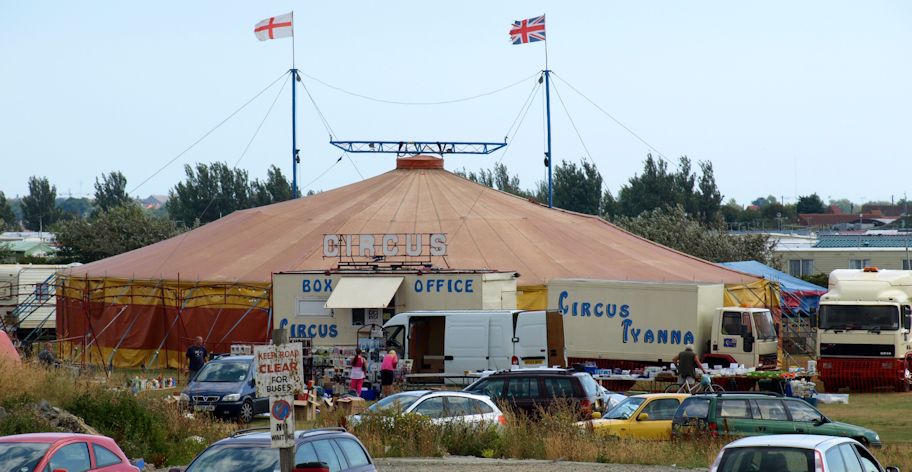
Circus at Jaywick - Ruths coastal walk

St Osyth Beach, Jaywick, looks better in the morning light. The karaoke pub is not functioning at this hour and there are young families and older couples enjoying the early morning seaside air. There is a circus here today – with tents laid out in a nearby field.

I walk along the seawall, heading westward to a place marked on the mark as Lee-over-Sands, at Colne Point. The foot path follows a raised bank, someway inland from the beach. Between the beach and the path is a marshy area. Then I notice some signs informing me this is a naturist beach. I see a few distant figures on the sand, but cannot make out if they are wearing clothes or not.
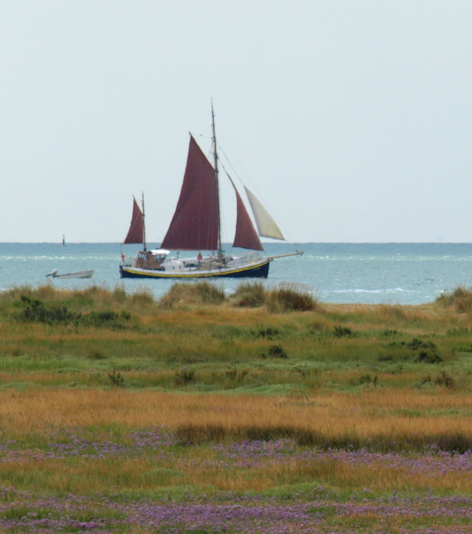
Red sailed ship, Essex coast. Ruth's coastal walk
Beyond the beach, out to sea, I notice a beautiful red-sailed boat, making slow progress in the light wind. As I walk, I keep pace with this ship and it becomes my constant companion on this stage of my journey.

Across marshes, looking towards Mersea Island - Ruths coastal walk, uk.The sea wall path is well-kept and I make good progress. But Lee-over-Sands is a disappointment. The houses are rundown with an unloved feel to them and gardens cluttered with broken toys and discarded furniture. There is an abandoned house, collapsing in ruins, just adjacent to the path. At Colne Point there are signposts declaring this is a nature reserve. Maybe it is the time of year, but I see little evidence of anything interesting in this dismal place. There is a solitary car in the car park with a woman reading a newspaper. Otherwise there is no sign of life. I am glad to leave Lee-over-Sands behind, as I follow the bank and head northwards.

Now the path is overgrown with grass. I cannot see where I put my feet and I suffer my usual anxiety about snakes and, the more real danger, of twisting an ankle. To my left is reeds and marshes with water birds and, beyond the marshes, I notice the red sailed ship has rounded Colne Point and is sailing parallel to my path again. To my right are farmers fields and, as my nose identifies before I actually see it, a sewerage works.

Path through the corn fields - Ruths coastal walk.

The path becomes even more overgrown. I come across a sign giving information about the nature reserve and showing a map with various walking routes. I was expecting to leave the bank at this point, but the nature reserve map indicates that the way ahead along the bank is a “permissive footpath”, meaning that I could continue along the bank, even though this is not an official “public footpath”. I would like to continue, but the path at this point is very overgrown with grass and I realise my progress would be very slow and difficult. I make a decision to leave the bank and follow the official public footpath as it heads inland across fields.

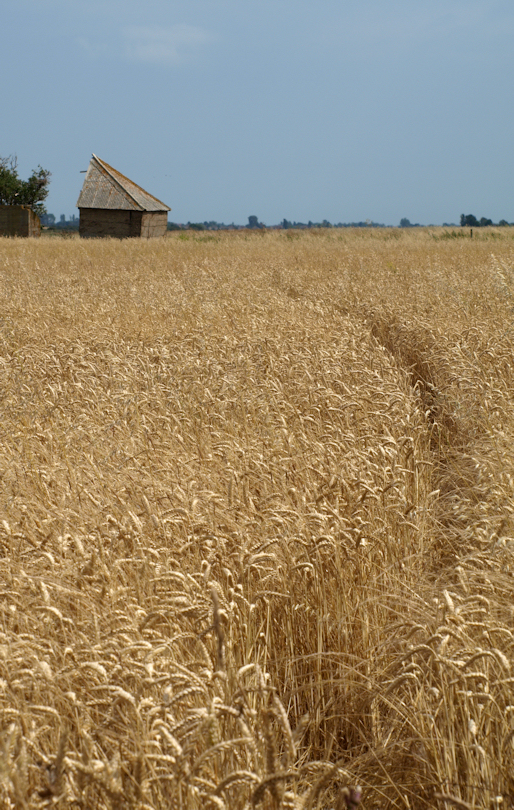
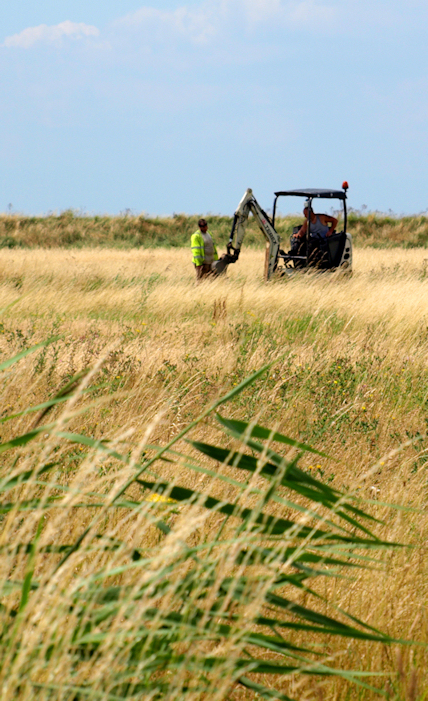
Cleaning out ditches - Essex, Ruths coastal walk, UK.I pass men clearing out a ditch, the first people I have seen since the woman in the carpark. My footpath becomes a narrow trail through high corn. Luckily, people have passed this way before and the route is visible – just. After a while, I realise I have lost the path. No matter. I follow wide farmers tracks along the edge of fields and end up, eventually, rejoining the official path at Wigboro Farm. I smell the farm before I see it.

Now I walk along tracks and join the road that leads into Point Clear. Point Clear is a largish village and there is no sight of the sea, until I round a corner and find a footpath that leads down to the shore.

Here is a small beach with families out enjoying the sun and sand. Houses line a narrow promenade that runs along the edge of the beach and signs indicated that this is private property, over which the owner allows right of way. I am grateful to the owner for this privilege, but I am forming the firm opinion that sea access should always be a public right. I know there was legislation planned to create a coastal walk around England and I hope the new coalition government will continue this scheme and allow this legislation to pass through parliament.
Point Clear - Ruth's coastal walk
Growing tired, I am looking forward to finding the pub, marked on the map – the Ferry Boat Inn. The path rounds a corner and here is Stone Point, with a muddy beach, a car park and an estuary with moored boats. Across the water is Brightlingsea, where I see modern houses have been built and there is a buzz of activity as boats come and go and holiday makers wander close to the shore.

Eventually I find the pub. It is a low, rather unattractive building. But the garden is pleasant with shady umbrellas and the food is very cheap. My husband joins me, having cycled here.

After a leisurely lunch, we make our way to the shore. From my research on the internet, I know there is a small passenger ferry that will take us across to Mersea Island – and it will take bikes too. I have been instructed to phone up when I need the ferry and they will come and collect us – a wonderfully informal system. I hope it works.

I find the number on a piece of paper in my rucksack and punch the number into my mobile phone.
“Ferry,” says a male voice.
“Can you come and pick us up please?” I ask. “There are two of us and a bike.”
After a moment’s hesitation, the man says in a somewhat irritated tone, “I am not a taxi service you know.”
My heart sinks. This dial-a-ferry notion seemed too good to be true.
“I’m sorry,” I say and hang up.
Now what do we do? It is a very long walk by land and we have bed and breakfast accommodation booked on Mersea Island.
Then I look at the paper again and realise my mistake – I phoned the Ferry Inn Pub – not the real ferry.

I dial the right number and get a far more helpful reply. Yes, the ferry is on its way.

We watch the ships coming and going as we wait on the shore. There is nothing to indicate that this is a ferry stop and I hope we are in the right place. A small boat chugs by with a man in brown uniform sitting at the tiller and the words “Harbour Master” painted on the side. Later it returns towing a small sailing ship with a man and his son aboard. The young lad is looking in admiration at the harbour master. His father is sitting sullenly with arms folded, obviously wishing he was somewhere else. I wonder what calamity befell this outing and resulted in this unwanted rescue.
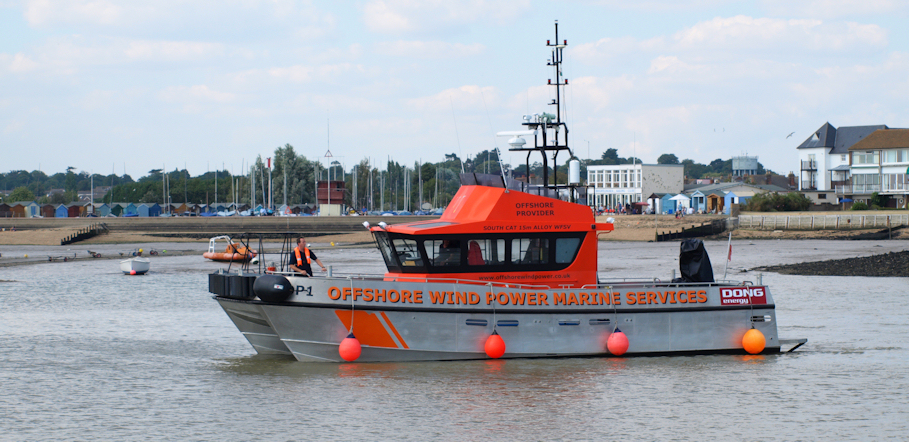
Offshore Windfarm Boat - Ruth's coastal walk.
A large boat appears. It has come from the offshore wind farm and carries workmen wearing safety helmets. They yell at a yacht moored on a wooden pier – “Hey, that is our berth.” The young men on the yacht ask how to secure a berth and one of them takes out a mobile phone as the workmen dictates a number. They cast off and move away, allowing the tug to dock.

We watch as a small motor boat comes alongside an elegant yacht. The man on the boat throws a line to the crew on the yacht. With the line stretched taut between them, the small boat begins to move backwards from the yacht, its small motor churning up the water in a frenzy of effort. What are they doing? Then we realise – the yacht is listing badly and appears to be stuck on a submerged sand bank. After a brief period of straining, the yacht suddenly lurches and then glides gracefully forwards. Success. It is free.

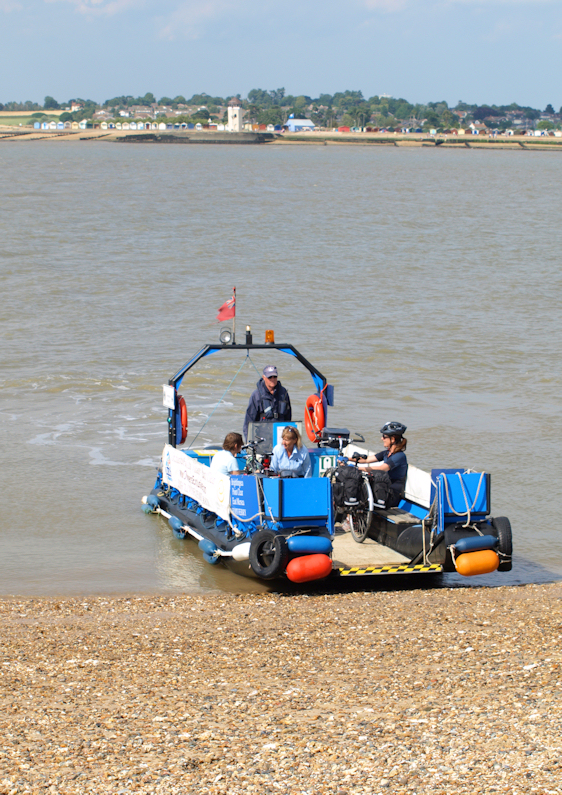
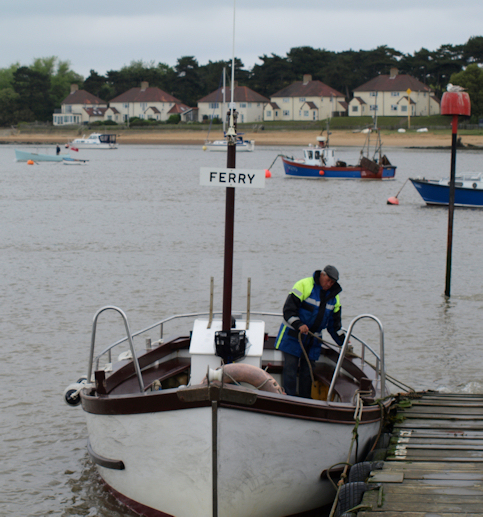
Ferry, Brightlingsea - Point Clear - Mersea Then we spot a small craft heading across the channel from Brightlingsea. Ah, here is the ferry. It is an ugly little beast of a boat, but we are pleased to see it. The ferry manouevres so that its back end is beached on the muddy sand. Then there is a whirr of motors and the back panel of the boat lowers itself downwards and outwards to form a ramp. This gives access to the inner part of the boat, an uncovered area with two benches facing each other.

We take our seats, my husband balancing his bike across his knees, and head off. There are 8 other passengers and, strangely, there is a “stewardess” who ushers us onboard and sits with us. The pilot is perched high above us and concentrates on piloting the ferry through the mass of moored ships. To my surprise, we head back to Brightlingsea, instead of towards Mersea. I gather from the “stewardess” that there were more people waiting on the jetty than could be accommodated in the ferry. Why are we going back? As we approach, I see a queue of people waiting. They look at us with anticipation, but their faces fall when they realise the ferry is full.

“What is going on?” The stewardess realises we have made a mistake. The captain assumed we wanted to cross to Brightlingsea.

We pull away from the crowded jerry, leaving the disappointed would-be passengers behind. We head out across the open water and the sea becomes rougher as we leave the shelter of the river mouth. Waves splash up over the edge of the boat and we dodge to try and avoid getting wet, laughing as we get soaked by spray.

As we draw near to Mersea Island, I see we are going to pull up on a beach, where the sand rises steeply up from the waters edge. There are a number of people on the beach, enjoying the late afternoon sunshine. They seem surprised to see this strange little ferry rise up onto the beach. We disembark quickly and I take some photographs as a couple of cyclists wheel their bikes up the little ramp and sit in our empty places, ready for the journey back to Brightlingsea.

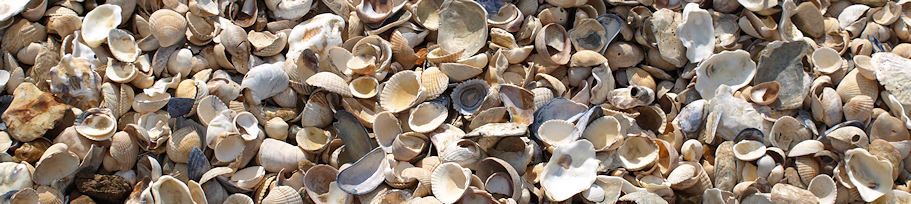
We are excited to be on the beach of this unfamiliar island. I notice the beach is covered in shells.
Shells on beach, East Mersea - Ruths coastal walk
When we reach the grass at the edge of the beach, I part company with my husband. He follows the path inland to resume cycling. I continue following the beach, heading westwards along the shore toward the town of West Mersea.

There is a low cliff, crumbling, to my right. To the left, the beach turns into mud and I see a network of groynes stretching out towards the distant water. Another attempt to prevent erosion. This area is a nature reserve with free access for roaming.
Sea defences, Mersea, Ruth's coastal walk
For the next few miles I see very few people. In the distance I see large tents in a field. Drawing closer, I walk past a camp site where young people are marching and shouting. I am surprised by the noise and the chants – but it becomes clearer as I draw near.
“Who do we love?” shouts a young man at the head of a group of younger teenagers.
“Jesus!” they shout back.

I walk along a concrete sea wall, past the religious youth camp, then past a caravan site and finally reach the outskirts of West Mersea.

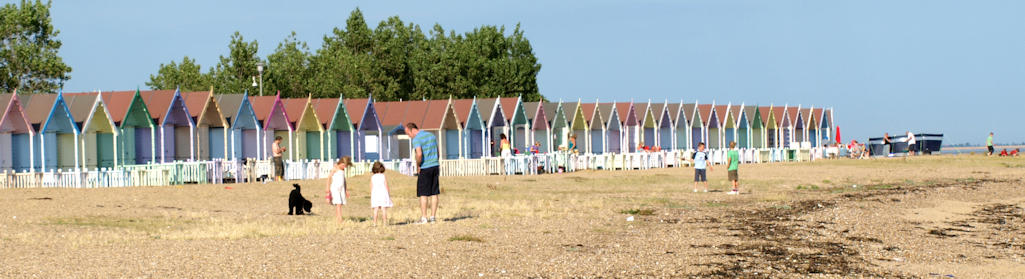
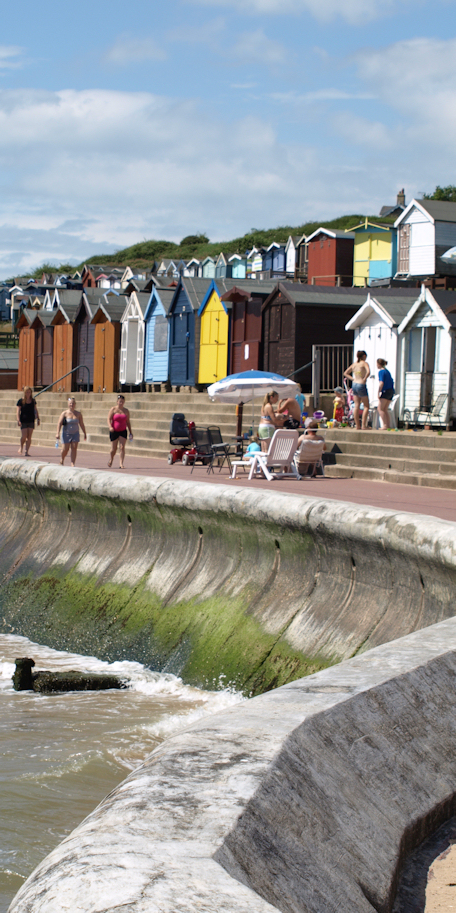
Here there are the most attractive beach huts I have yet seen. They are painted in pretty pastel colours and have small balconies. In this beautiful, late afternoon sunshine, most of the huts are in use. Children are playing while the adults are lounging in chairs. There is plenty of eating and drinking.
Beach huts, West Mersea, Ruths coastal walk.
I feel tired and hungry now. The sun is sinking lower. There is no esplanade, just the huts and a glimpse of houses behind the huts. Am I in West Mersea? I consult my GPS app on my iPhone. Yes, I am adjacent to the street where our B&B is situated and, reluctantly, I leave the beach and head into the town.

That evening, my husband and I walk along the road that runs beside the sea, the “Hard”, and find an unprepossessing shack that offers sea food to eat in or take out. We sit outside and watch the sun set over the estuary and the moored yachts. We eat crab risotto and scallops, washed down with dry white wine. Just after the sun sets, a full moon rises. Moonlight glimmers on the water and lights up the rigging of the boats. Magical.


Milestone! This is the first walk I started and completed with no blisters.
Posted in 04 Essex | Tagged , , , , , , , , , , , , , , , , , , , , , | 3 Comments

Stage 17. Kirby-le-Soken to Walton, Frinton, Clacton and Jaywick

This is a glorious day of hot sun, blue sky, warm sea – and noisy crowds.

I walk along the busy road from Kirby-le-Soken to Walton-on-the-Naze. This is the hottest day of the year so far. Temperatures are going to soar into the 80s (that is the high 20s if your mind works in Centigrade). Luckily there is a pavement along this stretch of road. The marshes are to my left, behind a high hedge. Through gaps in the hedge I can see the distant sea and, beyond that, the cranes of Felixstowe. It seems a long time since I left Felixstowe – yet still so near.
View across marsh towards Felixstowe, Ruth's coastal walk
Ahead of me I see a car stop. Two young people get out and begin searching the grass verge for something. She points to various spots and he, hot and agitated, stomps through the grass – looking. Then he shakes his head, she points to another spot and the search begins again. As I draw near they both begin to shout in triumph as he emerges from the hedge holding a hub cap. They grin at each other and at me, then climb into their car and roar off.

As I approach Walton, I see smart people wearing dresses and suits – looking hot, sticky and uncomfortable as they walk purposefully onwards. They are going to church. It is Sunday.

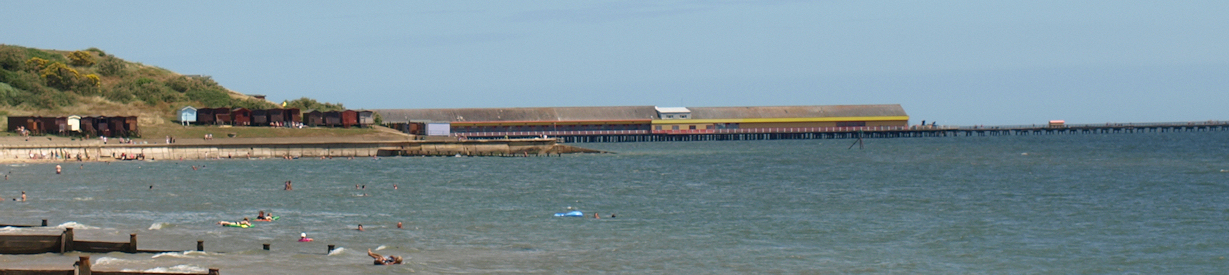
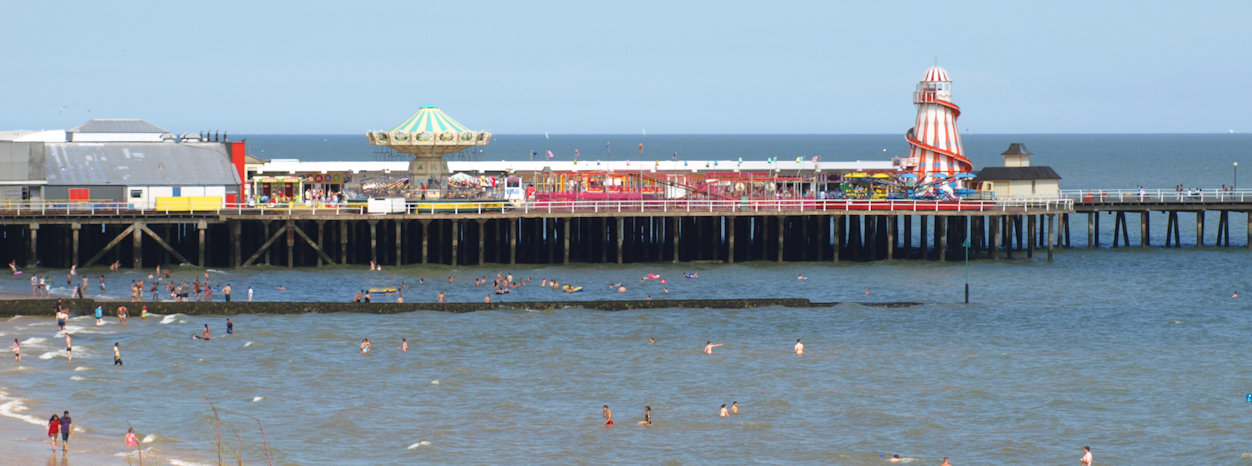
Walton Pier is the 3rd longest in the country. I suppose I was expecting something spectacular; and am disappointed by the reality. The beginning of the pier seems to consist of a shed and, as I draw nearer, I realise that this shed houses a number of tacky amusement arcades, children’s roundabouts, dodgems, and some cheap looking cafes and bars.
Walton's ugly Pier - 3rd longest in the UK - Ruth's coastal walk
I am very hot and go into the shed area and walk through, looking for a cafe or a stall selling drinks. At the end of the covered area the pier stretches out to sea. There are fishermen and people walking. But no nice cafe and no cold drinks to be seen. I head back to the entrance of the pier and buy an orange drink in an unpleasant looking self-service restaurant. I want to sit outside, but am driven back inside by the clouds of smoke. Smokers – now banned from the indoors – have taken over the outdoor seating area.

Walton sea front - Ruths coastal walk

Refreshed by the drink, I head southwards toward Frinton. On the promenade are people enjoying this wonderful day. The tide is high and the beach is covered with water, making the promenade the main area for walking, sitting and playing. There are beach huts, doors open, with chairs and tables out on the promenade.

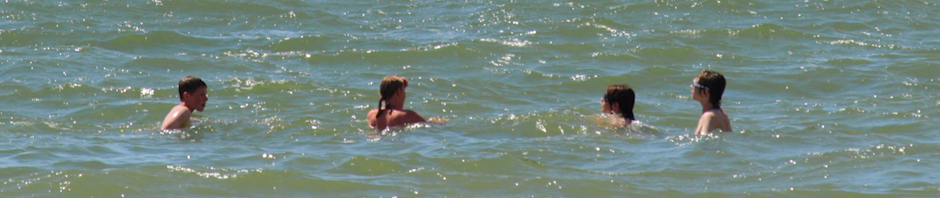
Further on I see people swimming in the sea. The sky is cloudless and the sea is a beautiful, bright blue – a tropical hue rarely seen in this country.

The rest of my walk follows the promenade as Walton passes and I head into Frinton. To my left is the sea with a wind farm in the distance. To my right is an endless parade of beach huts. The walking would be easy – but the promenade becomes increasingly crowded as the day progresses. I am forced to dodge tables, chairs, barbeques, toddlers, dogs, pushchairs, wheelchairs and the occasional, powered, mobility scooter.

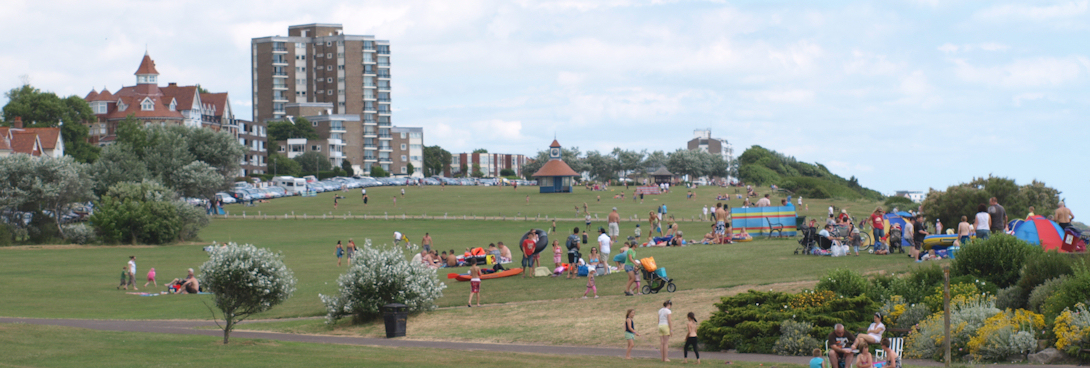
Frinton's Greensward, Essex part of Ruths coastal walkThen I reach an area of open space – Frinton Greensward. Here people are out having picnics on the grass, overlooking the sea. And I am glad to find some convenient (and very clean) public conveniences.

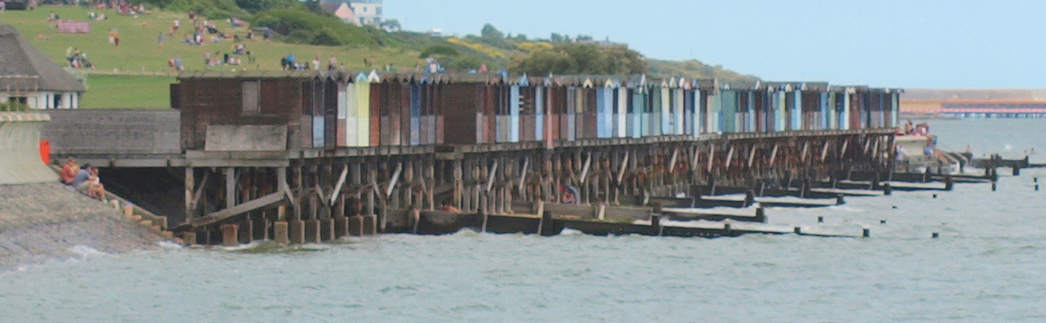
Leaving Frinton and heading on to Clacton, I walk along the high sea wall. On the edge of Frinton are some amazing beach huts – accessed from the sea wall via small front decks, they are built on stilts and jut out over the beach with waves sloshing underneath. The windows at the ‘back’ of these huts look directly over the sea. Wonderful.

Amazing beach huts at Frinton-on-Sea, Ruth's coastal walk

Now I follow a quiet stretch of sea wall, between Frinton and Clacton. There are a few dog walkers and some cyclists.

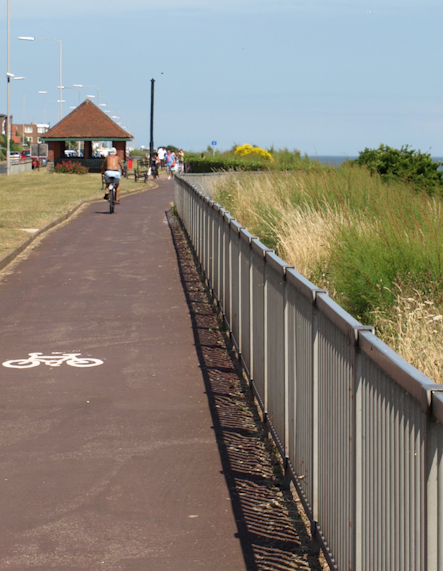
When I reach Holland-on-Sea, the promenade becomes crowded again, with beach huts and people. I am tired and want to find a pub for lunch, having pre-arranged to meet my husband here. So, I leave the beach and climb upwards to a wide promenade that runs above the beach. There are houses to my right, but no sign of a pub. The promenade is also a cycle way. I wonder if I will meet my husband cycling along?
Holland-on-Sea, cycle way - Ruth's coastal walk

I walk for miles, growing thirsty and feeling hungry, passing some nice looking houses – but no pubs. Eventually I stop in a shelter and eat a banana and drink most of my water. I text my husband to let him know the bad news – there are no pubs in Holland-on-Sea. Then I set off again and, consulting my iPhone Trip app, I realise I have passed through Holland-on-Sea and am now in Clacton.

Then, ahead, I spot some umbrellas. That must be a pub. Please let it be a pub.

Striding quickly onwards, I am overtaken by a cyclist. Ah, here is my husband. We reach the pub together and sit outside in the shade. We have a roast dinner; perhaps not the most sensible thing to eat in the heat – but we are both starving. We watch people walk past. There are girls in white trousers with astonishingly large amounts of gold jewelry. This is Essex, after all.

After lunch, I carry on towards Clacton Pier, descending down to the beach again and walking along the sea wall for a while, before, tired by the noise and crowds, I climb back up to the promenade. Clacton is surprisingly pleasant. There is a park up here, with gardens and benches to sit on. And here there are good views of the pier and its small amusement park. It may be shorter than Walton, but this is a much nicer pier. Clacton Pier, Ruths coastal walk

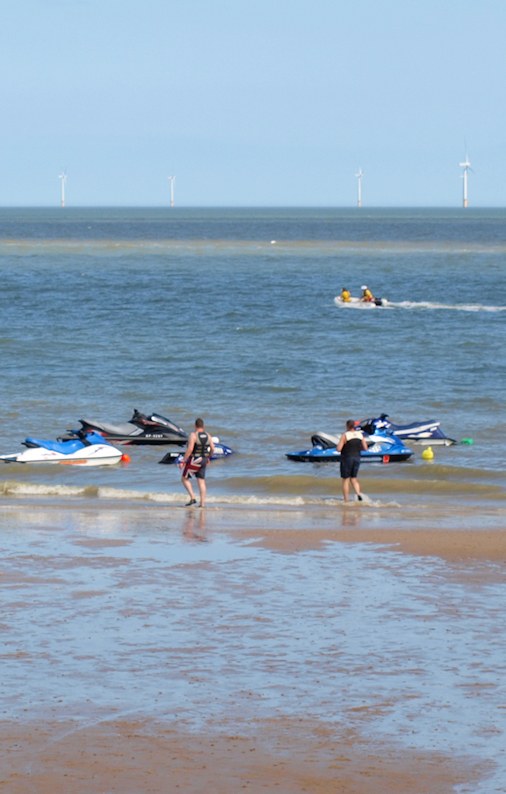
Jet skis on Jaywick beach - Ruth's coastal walkCarrying on, I leave Clacton behind, passing another Martello tower and head towards Jaywick. The beach becomes wider with more shingle. There are jet skis buzzing on the sea. On the path, the people become fatter and have tattoos. The dogs become larger, straining on leashes. Cars drive past pumping out loud music. Instead of beach huts, there are small, tatty beach houses. Their gardens are untidy with broken toys, old furniture and discarded rubbish. I see broken windows, boarded up windows, and windows open with music blaring out.

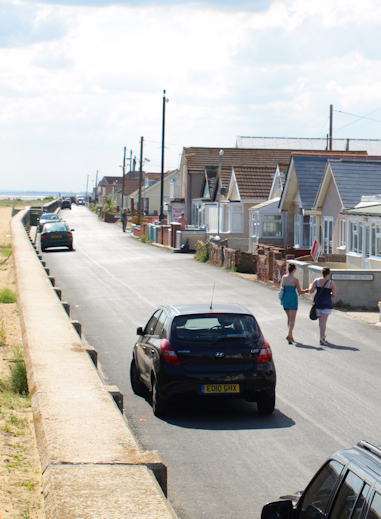
Jaywick, road along the beach - Ruth's coastal walk
The sea wall becomes a wall, instead of a walkway, and I am forced to walk along a narrow road, flattening myself against the wall every time a car drives past. There is broken glass on the road. This is not pleasant.

Two large women in leggings and t-shirts are approaching. They are accompanied by two skinny men who have dogs on choke chains. One of the dogs keeps lunging towards the garden of a beach house, where another large dog is standing against the fence on his hind legs, barking. The dog on the chain pulls his master with each lunge, causing the man to lurch across the road at regular intervals. As I pass, one woman says, in an Essex accent made for a comedy show,

“You’d only lick ‘im to deff. I dunno why you bovv-arrh.”

I keep a straight face. Just. Welcome to Jaywick

I pass some of the last of the Martello Towers on this stretch of coast. Further on, there is a commotion ahead. I am approaching a place called St. Osyth Beach. Here people are sitting on the beach wall. There is music playing. As I approach, I realise there is an open-air karaoke bar in full swing. It is 6:30 pm.

This is where I have arranged to meet my husband. There is no escape. I sit on the beach wall and watch three young women singing tunelessly on a small stage.

My husband arrives in the car. What a welcome sight. I am glad to leave this place behind.

Swimmers in Essex - Ruth's coastal walk


Vital stats: 12 miles, max temp 82 F, 1 new blister.

Posted in 04 Essex | Tagged , , , , , , , , , , , , , , , , , | 3 Comments

Stage 16. Harwich to Kirby-le-Soken

It is hot today. The weather forecast says it will get even hotter – maybe reaching 32 degrees. I have lathered on the sun block cream in anticipation. This gives me a white and slightly greasy appearance.

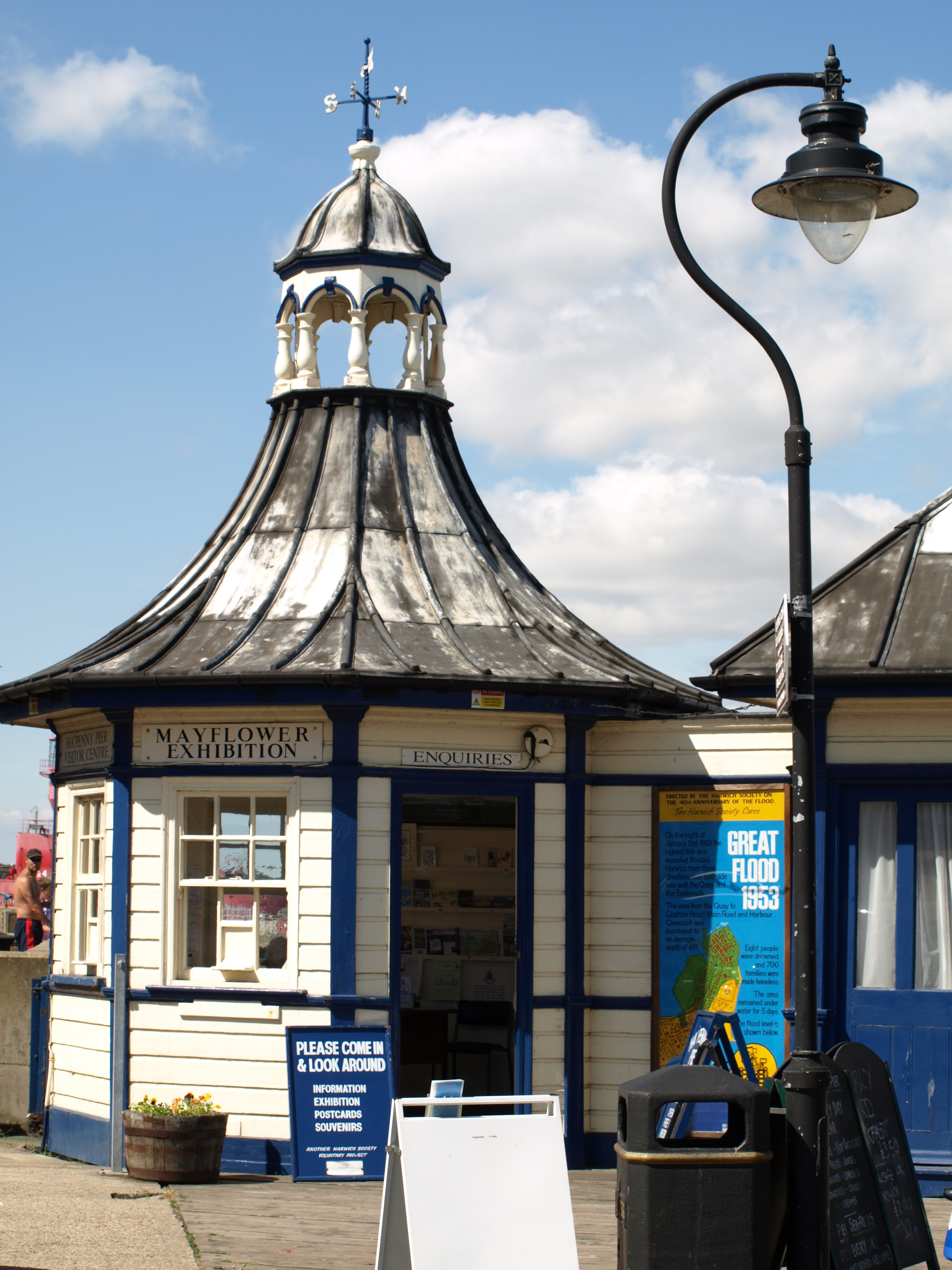
Half Penny Pier, Harwich - Ruth's Coastal Walk

The Felixstowe to Harwich ferry crosses Harwich Harbour and arrives at the Halfpenny pier. We arrive by car, having decided to drive there directly. The pier is quaint but I unable to take a good photograph due to the cars parked around it.

The sea front of Harwich is pleasant, with an old lighthouse and a promenade with strollers and beach huts. Bright coloured dinghies sail across the harbour, with the cranes and container ships of Felixstowe as a backdrop. A long breakwater marks the entrance to the harbour area. Despite signs that forbid this, there are fishermen out.

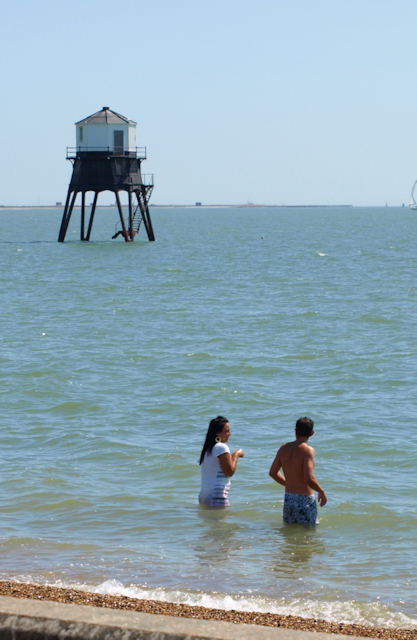
Dovercourt Lighthouse, in sea, Essex - Ruth's coastal walk

Further along are some interesting, old, renovated lighthouses; one on the shore and one rising out of the sea a few hundred feet offshore. They were restored in the 1980s.

Past this is “beach hut land” – mile after mile of beach huts. Unlike my previous walks past huts, and perhaps due to the wonderful weather, many of these huts are in use today.

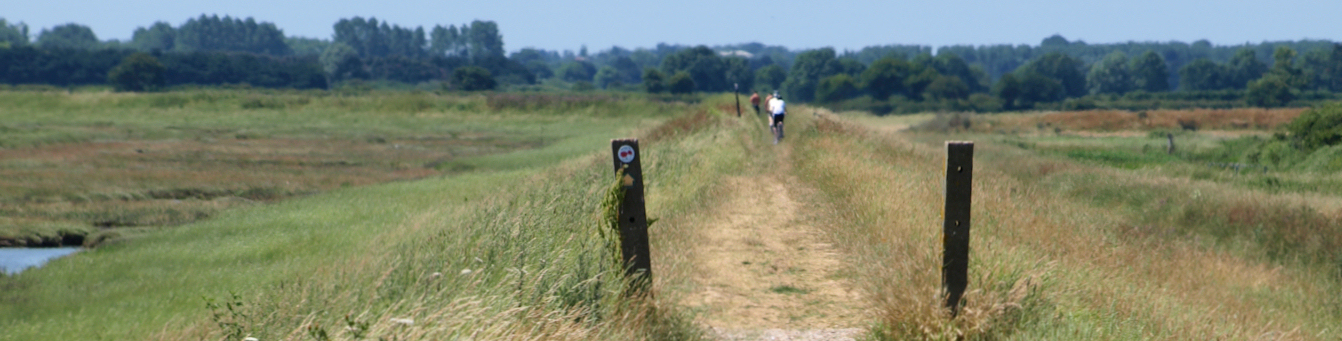
Some distance along the coast and I reach a marshy area. The path follows the sea defence wall around the edge of the marsh and the way ahead is long, flat and straight. I meet a few dog walkers and some cyclists, but no serious walkers.

Long walk on bank, marshes near Dovercourt - Ruth's Coastal Walk

The path stretches ahead. The sun shines down. I am sweating. I get out my hat, which shades my face, and take frequent sips from the water bottles I am carrying. My face begins to take on the texture of sandpaper. Momentarily worried, I realise this is due to the wind-borne sand, sticking to my coating of sunblock. To be honest, I am a little bored after 10 mins of this walk – in the heat and with the monotonous landscape as my only company. I am reminded of my very first walk along the, seemingly, endless sea wall to the east of Kings Lynn.

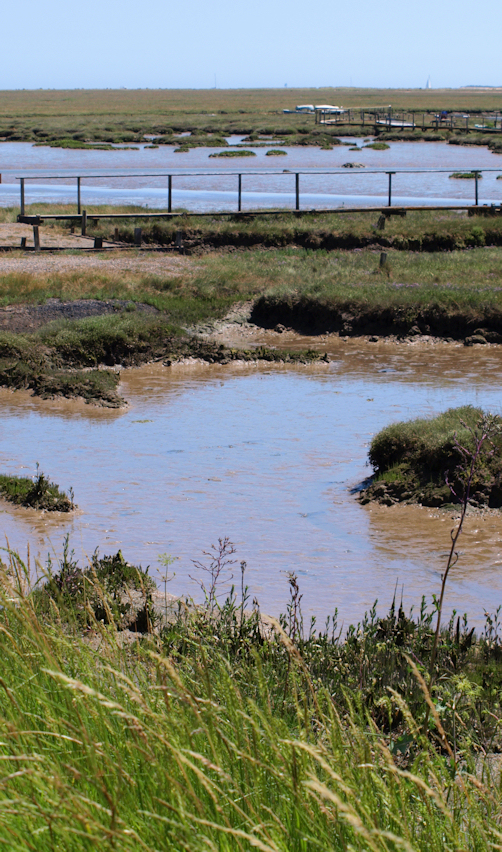
View across marshes to sea, near Dovercourt, Essex - Ruths coastal walk

I walk fairly quickly. Mindful of the advice of John Merrill I concentrate on finding a natural rhythm. Having worn MBT footwear (Masai Barefoot Technology) in the past, I try to emulate the natural bushmen walking style that forms the basis of the MBT product. This involves allowing my foot to strike the ground beneath my body – rather than in front – with each stride. Rather surprisingly, I notice that this is now my normal walking pattern.
Hamford Marshes, Essex - Ruth's coastal walk
The main coastal path heads back inland, but I walk ahead along the footpath at the top of the sea bank, now running along the shoreline again. Here there is a small beach – pleasantly isolated due to its inaccessibility – with only a couple of fishermen. The sea bank curves round and heads inland again, skirting the marshes. This is the beginning of Hamford Water estuary. I will be seeing more of this estuary later today, as I need to detour around its mud flats and marshland in order to pick up the shore line again at Walton-on-the-Naze.

A couple of cyclists pass me, bouncing uncomfortably over the uneven terrain of the bank pathway. They look hot and sweaty. A few minutes later they return – looking even hotter.

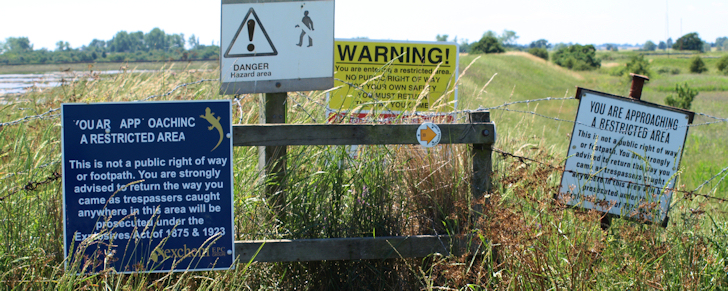
David Cotton recounts how he was unable to follow the sea bank around this section of the estuary – because of the barrier warning you must detour around an explosives factory. Sure enough, I come to some fierce warning signs threatening prosecution under the Explosives Acts. I am not usually deterred by “Private Property” signs, but this is the strongest warning sign I have met up till now.
Signs warning of explosives - Ruths coastal walk UK

So, leaving the sea bank, I follow a track leading up a hill towards the B1414. Away from the sea breeze, the heat is relentless – more like Spain than England – and the air is hot and close around my face. My chest feels tight and I am having trouble breathing – the air feels heavy. I am relieved to get to the top of the hill and I rest for a few minutes in the shade of some trees by the roadside.

I was hoping to pick up a footpath here, or a cycle route, but there is no sign of either. Now, I turn left and am forced to follow the road into Great Oakley. There is no footpath. The road is busy with traffic heading to the coast. Cars travel past me at high-speed, some giving me wide berth but some passing within a foot of my body. I marvel at how inconsiderate car drivers can be. Do they expect me to jump into the ditch? I pass a driveway leading to, I presume, the explosives factory. There is no sign to indicate what the factory is, or, indeed, where the drive leads to, but there is a sign saying all matches, cigarettes and other inflammable materials must be left at the guard-house.
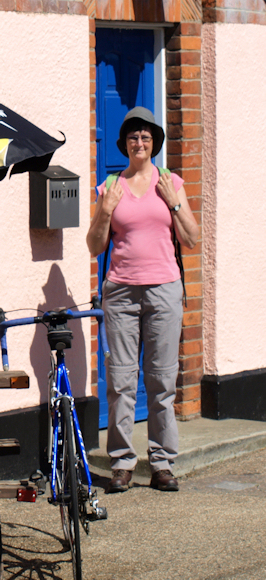
Ruth outside pub, Great Oakley - coastal walk
The pub is a welcome sight, just off the main road and near to the war memorial. It is very stuffy – and a little old-fashioned – within. The publican is sweaty and finding the heat trying. I order a cider, taking it outside to drink in the breeze. My husband, on his brand new racing bike, joins me. The food is very good – although our meals arrive at different times as my order is somehow lost.

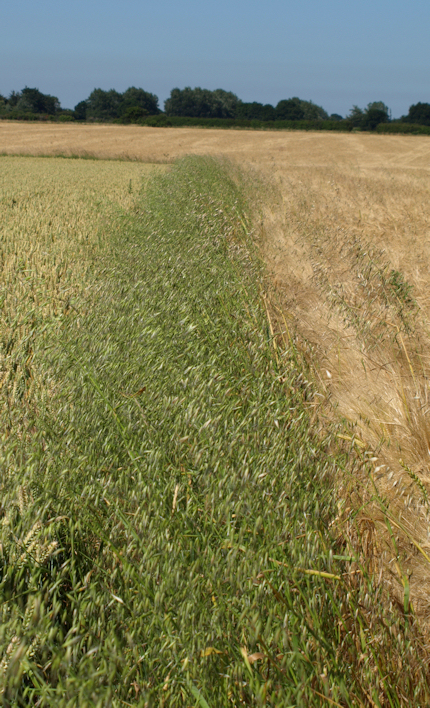
Poorly maintained footpath, near Great Oakley, Ruth's coastal walkAfter lunch, I head downhill towards the estuary again. I follow a shady lane and then take a footpath across fields. The first section of the footpath is very badly maintained – being marked by a ridge of tall grass between two corn fields. I am sure this is the correct route and spot some flattened areas where other people have walked. It is hard going. The grass is even higher than the corn and the ends of the grass whip around my face. I develop a grass rash on my arms – the first time this has ever happened to me. I am hoping that there is no pollen left in the grass heads, dreading the onset of severe hay fever. I cannot see where I am walking. The ground is very uneven and I am fearful of stumbling and twisting an ankle.

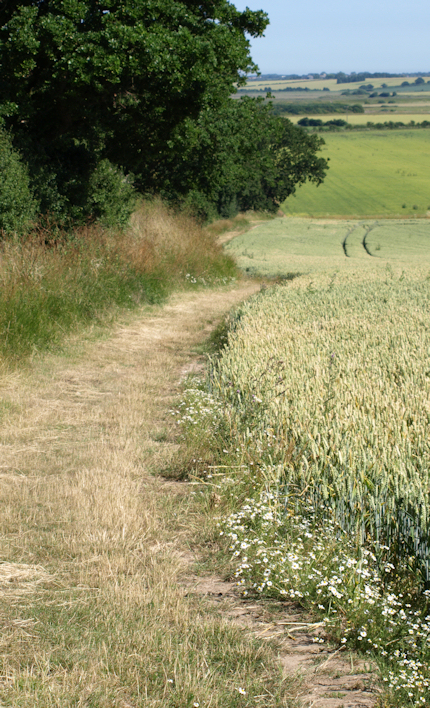
Well maintained footpath - near Great Oakley, Ruths coastal walkAcross another road and into different farmland. Here the footpath is well maintained – the farmer has cleared tracts of land – and the going is much easier. I mentally thank this farmer for his kindness and common sense.

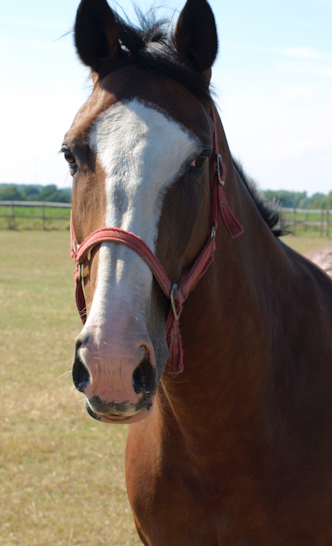
My thanksgiving is abruptly ended when I find myself in a fields of horses. Horses are marginally less fearsome than cows – but only marginally less. One of them snorts and comes towards me with a determined look in her eyes. Her two companions now begin harumphing and start a slow canter towards us. Oh dear. I am hot, tired and unlikely to be able to outrun these creatures. I stand still, heart pounding, then deciding to be firm, I say – in what I hope is a clear, strong voice – “I am not afraid of you.” The lead horse stops a few yards away. Her companions stop behind her.

Disappointed horse - chases Ruth on her coastal walkI continue following the path towards a style on the far side of the field. I hear the sound of horse hooves behind me and have to force myself not to stop. There is horsey breath coming over my shoulder. From the side of my eyes, I see the long nose of the first horse, perhaps a foot behind my shoulder. She stays there, walking behind me, all the way across the field. When I climb, somewhat triumphantly onto the style, she gives me a disappointed, accusatory look.

Later, I realise she probably thought I was coming to ride her, trotting meekly behind me as though she was on a long rein and hoping for an outing. How silly of me – to be frightened of a friendly horse.

I pass down tracks that run past some buildings. This must be Beaumont Quay – a mixture of farm buildings and small low-tech industrial units. There are trees and I enjoy walking in the shade.

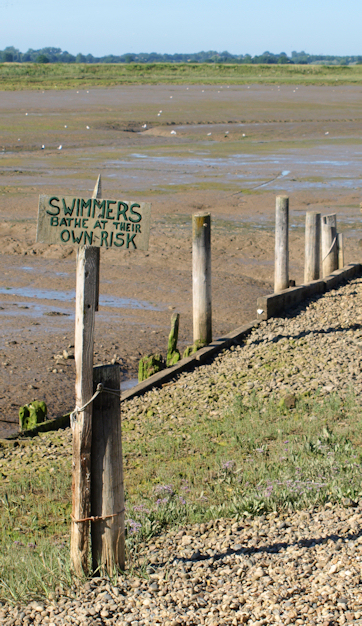
Swimmers bathe at their own risk, sign, Hamford Marshes, Essex I reach the marshy edge of Hamford Water. This is, apparently, Swallow and Amazon country. Arthur Ransome lived around here and based his stories on these watery marshlands. I was excited about this but am strangely disappointed.

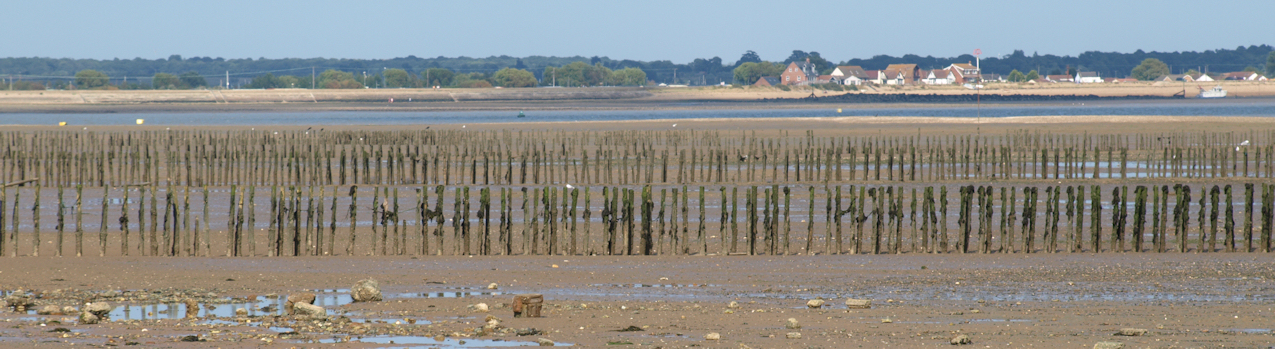
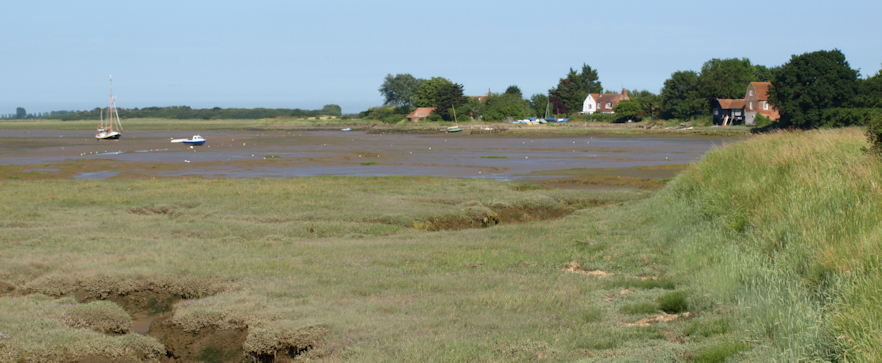
The tide is out. The marsh is flat, empty, muddy and – (well, what else did I expect?) – fairly marshy.

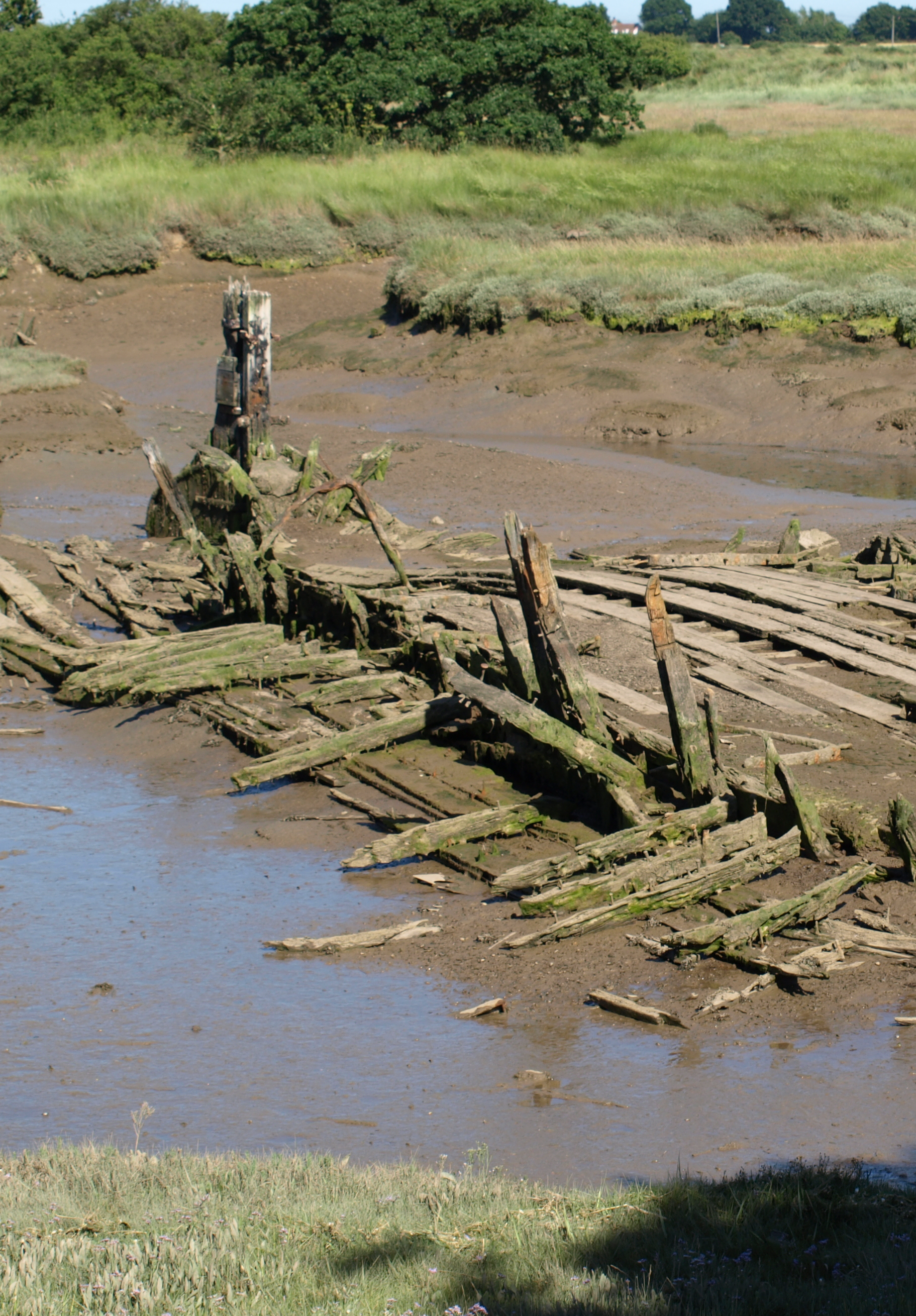
old boat in mud, Hamford Water marshes, Essex - Ruths walkAfter a short distance, I find the decaying shell of an old boat, quite a large boat, in an area where the sea no longer reaches. This area must have silted up. This is a change from the Norfolk and Suffolk coast line, where the sea is eroding the land. Here in Essex, the sea is being forced to retreat.

I pass through a butterfly sanctuary.

The path runs along the top of a bank, skirting and overlooking the marshes. In the distance I can see the sea and the cranes of Felixstowe. Not many people walk here. The path is overgrown and I cannot see my feet. I am grateful the grasses are dry. The walk twists and turns, following the edge of the marsh.

As the sun sinks, I become concerned about making my rendezvous in time. The meandering of the marsh bank creates a longer route than the map suggests. I quicken my pace to jogging rate; and I pray that I wont twist an ankle on the uneven, and still obscured, path. I feel surprisingly fit and well.

Meeting a farmer, I stop to talk to him. He is interested in my coastal walk and tells me Essex has a lot of shoreline because of all the twists and bends of the coast. After I leave him, I find it hard to get going again. My pace drops. My legs feel wobbly. My feet ache. This is hard work. My husband texts me – he has already reached our meeting place and is waiting for me.

Approaching Kirby-le-Soken, The Wade - Ruth's coastal walk.

Finally, I arrive at a place where the footpath is well trodden. There are people here, standing on the bank and looking across the marsh towards the sea and distant boats. A family is on the bank, enjoying the evening sunshine and having a picnic tea.

I leave the marsh bank wall and head down a track towards Kirby-le-Soken. The track is longer than I expected and I find this last 1/2 mile really hard work. When I reach the main road I look anxiously up and down. I don’t want to walk the wrong way – my legs are too tired for mistakes – and I can’t see a pub. I decide to turn right and, luckily, this is the right decision. Around a bend I see a pub sign and a man waiting for me. So nice to see my husband and I am very grateful for the comfort of the car.

Hamford Water - Ruths coastal walk, Essex


Vital stats:
Miles walked = 15
Av speed = 3 miles an hour
Blisters = only one!
Posted in 04 Essex | Tagged , , , , , , , , , , , , , , , , , , , , , , , | 12 Comments

Stage 15. Boyton Marshes, Bawdsey to Felixstowe

Today begins as a day of gloom, sogginess and thirst.

I am dropped off in Boyton and walk down a public footpath to meet the Suffolk Coastal Path along the river bank. The sky is grey and it is drizzling. The first thing I notice is that my back pack seems very light. Then I realise I have left my water bottles and snacks behind. Too late.

Old Pill Box, Suffolk Coastal Path, Boyton Marshes - Ruths coastal walkThe coastal path is a narrow track, following the course of the River Ore as it meanders parallel to the sea, before emptying into Hollesley Bay. This area is a bird sancturary, the Hollesby Marshes, managed by the RSBP. There are numerous old pill boxes here, in various stages of decay. To my right is farmland with cows. On the river are a couple of small sailing ships, overtaking me and heading out to sea. Beyond the river is the shingle bank, running all the way down the coast from Aldeburgh and, effectively, cutting of the village of Orford from the sea.

On the drive here, we noticed all roads lead to Orford. This was once an important port. But the shore line changed, as the shingle bank extended itself and rendered the harbour useless. Now, Orford is a tourist destination with a fine castle and a little quay, according to my husband. My trail has not taken me there, as the Suffolk Coastal Path effectively bypasses Orford to avoid the dead end of coastal land it has become isolated on.

Two miles of walking on the grassy bank; my lower legs are soaking wet. The sodden grasses, gently leaning over the path, are lovingly stroking my legs and depositing lashings of water on my trouser. And, worse still, I can feel my feet becoming damp. The dampness starts at the top, just beneath the laces, but then tracks down to my soles. My boots, now water-sodden, feel very heavy.

Oxley Marshes - Suffolk Coastal Path - Ruth's Coastal Walk

I meet no other walkers. There is just me, the river the grey sky and the wet grasses. It has stopped raining.

Shingle Street, Suffolk Coastal Path - Ruths coastal walk
I look forward to reaching the mouth of the river. Here is marked a place called “Shingle Street” on the map. I hope to buy water and a snack. Shingle Street deserves its name. The beach is wide shingle with a few clumps of plants. The houses look directly onto the shingle and my path runs in front of them. These are holiday cottages, many empty, but some with people sitting in their windows. I see an artist’s studio; all cluttered debris downstairs with empty wine bottles and unwashed plates, all organised and serene upstairs with easels set up facing the sea.

Sadly, there are no shops and not even a cafe. I walk on.

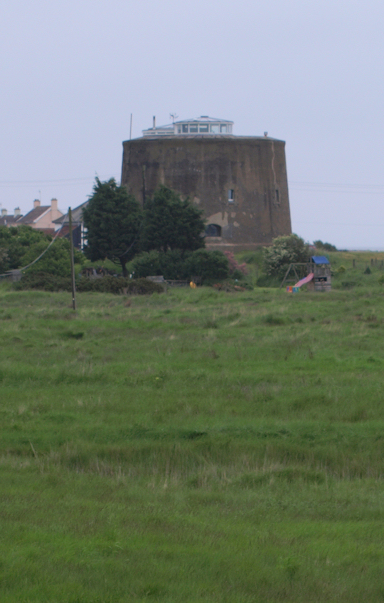
Martello Tower, Shingle Street, Suffolk Coastal Path - Ruths coastal walk, UKThe path takes me off the beach and I walk along the raised bank that borders the shingle beach. To my left is marsh and then shingle and sea. To my right is farmland. I pass a number of the round Martello towers, built to defend the coast during the Napoleonic wars. Many of them appear to be converted into dwellings. What wonderful – and unique – residences they must make.

The path reaches an area where the sea wall is being repaired. New fencing is being erected to protect the walker from a new sea defence of concrete slabs and boulders. I wonder how long it will last. There are a couple of workmen in yellow jackets and helmets, with a van.

I reach an empty car park. Here the path turns inland, following a track to the village of Bawdsley. I was hoping to find a tourist cafe or ice cream van here. Why is the place so deserted? Perhaps the grey sky and low clouds has kept people away. Perhaps the car park was built in hope that people would come. Whatever the reason, there is nobody here today.

On my way into the village I pass a primary school. A coach has just returned from an outing and the excited children are jumping out. Once out of the coach, they form a guard of honour, greeting each new coach leaver with a line of hearty “high fives”. They must have organised this themselves – the teacher hovers in the background but looks disapproving and is not encouraging the line up.

I turn left into the village. Surrounded by water, and with wet feet, I am very thirsty. I have been walking for three hours and have another hour before lunch time. In hope, I walk through the village. Surely a place with a primary school must have a village shop? I am disappointed to find nothing but houses. And annoyed that I extended this walk by an extra mile for no benefit.

I do find a bench, the first proper seat I have come across since I started this walk. I sit down and remove my sodden socks. I have dry ones in my rucksack and enjoy their feeling of soft dryness against my skin. Using tissues, I try to soak up some of the moisture inside of my sodden boots. Reluctantly, I put my newly dried feet back into the boots and continue. I enjoy a blessed 10 minutes of dryness, before the dampness creeps back in.

The path returns to the sea bank. But I decide to continue on the road, avoiding the wet grass. This is an official cycle route and I am passed by a number of single cyclists. I envy them their speed.

Then I reach Bawdsey Quay. This lies at the mouth of River Deben, separating Bawdsey from Felixstowe. There are numerous small boats dotted on the river, mainly moored. I know there is a small passenger ferry here and, as I see a small boat picking up a family from the jetty, I break into a run. But it is a river cruise, not the ferry.
“Just wave the bat,” says the captain. “And the ferry will come.”

I look. Attached to one of the wooden posts, and tethered with string, is a pole with a round end. This must be the bat.
I check my watch. It is two o’clock. My husband has not responded to my text messages and I suspect he is not waiting for me at the pub across the way, as planned. And the pub is probably about to stop serving food. While behind me is a welcoming cafe.
I head for the cafe. Access is by way of unmarked steps behind the building and an unmarked white door. The cafe is small and friendly. The food looks excellent – a limited menu but homemade and fresh. I have a wonderful cup of tea and a delicious scone.

Then, back at the jetty, I pick up the bat. Feeling a bit of a fool, I wave it wildly. Who am I waving it at? Where is the ferry? How do I know if I have been seen. I continue waving for a minute or so.

Felixtowe Ferry, Ruth's coastal walkThen I see it. A small motor boat, heading towards me. It fights against the fierce river current and appears to be going past me up river. Ah, I have made a mistake, this is not the ferry. But then, the boat turns inland and, with practiced certainty, butts up to the jetty. There is space for about 10 people and a bike. For this journey, I am alone. It costs £1.80 one way, £2.50 return.
The captain smiles at me.
“You didn’t think it was going to work – waving the bat – did you?”
“No, I didn’t.” I reply.

We weave across the river, avoiding moored boats, to a jetty on the other side. What a marvellous service. I thank the captain and take his photo.

At the pub I meet my husband. Yes, it has stopped serving food. We eat crisps and enjoy a drink.

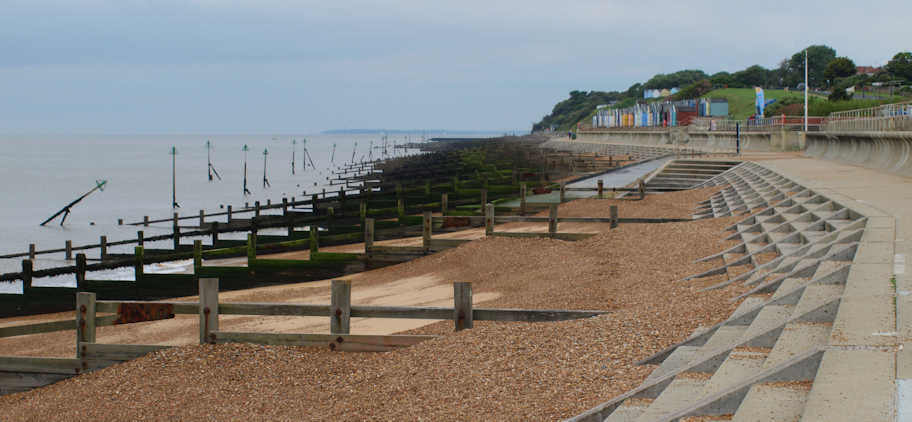
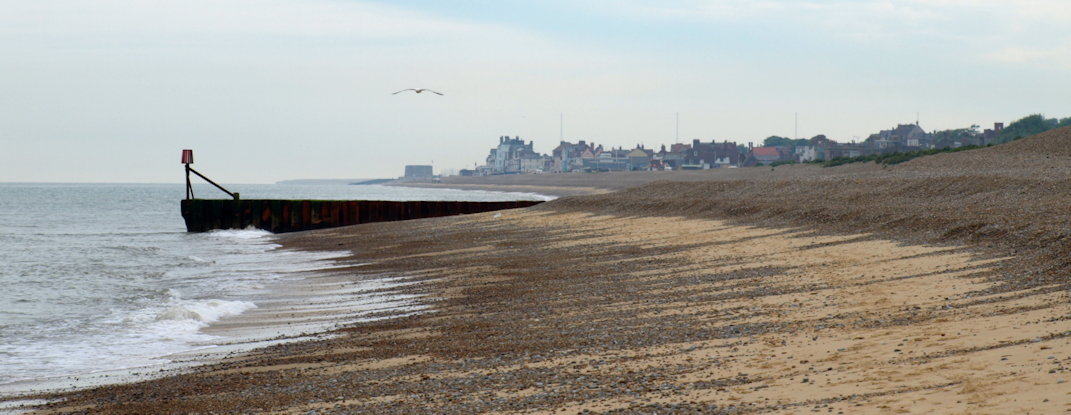
The path leads along a wide promenade, running by the sea towards Felixstowe. I am not expecting much of Felixstowe and am pleasantly surprised. There are painted beach huts, fine houses with ornate balconies and a very long promenade -around four miles in length.
Felixstowe Promenade - Ruth's coastal walk UK

The beach itself is punctuated with high groynes, fixed onto the promenade wall in most places. This is an attempt to keep sand on the beach and appears to be moderately successful. There are people out, enjoying the promenade. A group of youngsters are doing complicated back flips, launching themselves off the promenade and rolling down the sandy beach as they land.

My feet are tired now. I stop and have some water – kindly supplied by my husband – and a muesli bar. Then onward, past the pier. The pier has very long, thin, supporting legs but very little appears to be happening on it. Compared to Cromer and Southwold, this is a boring pier to look at.
Felixstowe Pier, Ruth's coastal walk
There are English flags flying on the pier, and from most of the pubs and bars on the seafront, to celebrate the beginning of the football world cup in South Africa. The sun is beginning to break through the clouds. The sea is calm. In the near distance, sailing boats show white sunlit sails against the grey clouds on the horizon, while, in the distance, huge container ships make their slow progress out to sea.

At the end of the promenade, I head inland. Later I discover I could have stayed by the sea, walking on heathland, and this would have been a much more pleasant walk. Instead, I follow the official cycle route, through some residential streets and then down a long, boring road that runs behind the dock area, ending at the passenger ferry terminal. Here there is a stretch of shingle beach with a tea shop, seats to sit on and a great view over the estuary to Harwich. Felixstowe dock and the harbour extends up the river. This is a busy port

I would like to take the ferry to Harwich. There lies the next stage of my journey. But today, enough is enough. We are heading home.


Vital stats: miles walked = 14, new blisters = 1,
discomfort level = moderately high (due to lack of water).

Things I have learnt:
I must always check my kit before starting off.
And, Felixstowe is much nicer than I imagined it would be.

Posted in 03 Suffolk | Tagged , , , , , , , , , , , , , , , | 7 Comments

Stage 14. Aldeburgh through Chillesford to Boyton Marshes

Today is a day of forests, fields, pigs and hay fever.

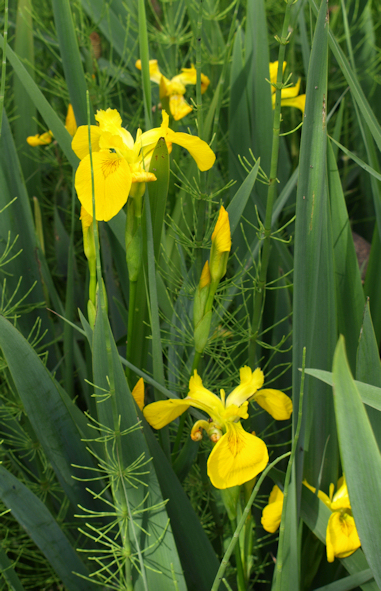
Flag Irises, in marshy area - Ruths coastal walkUnable to follow the coastline today, I begin my walk along the official Suffolk Coastal Path, as it leaves the main A1094, leading out of Aldeburgh. This takes me through forest and across marshland. The sun is filtering down through the clouds as I pass through the trees. Squirrels race away from me. The marshland is aglow with yellow flag irises and, in some places, pink rhododendrons.

The path is well-maintained – grassy floor and just wide enough for a coach and horses. I feel I could be walking along a medieval road. The coast, on the other hand, is wilder, older – primeval.

I meet one solitary male walker, of a certain age, walking back close to the Aldeburgh road. From then on, I meet nobody for the next couple of hours until I reach The Maltings at Snape.

Pottery art works, Suffolk Coastal Path, Ruth's coastal walkAlong the path are pottery structures – art works – which I admire in the mottled light of the forest. They seem both modern and ancient. Further along, in Snape Warren, I see lines of cones on the ground. Apparently, these cones mark out giant drawings and were laid by school children at the instruction of an Artist. I cannot make out what the drawing is. Perhaps I need a helicopter.

I approach The Maltings across a marsh. This should be a good place for birds, but I see none. The sky has grown dark and I decide to wrap my camera in my fleece jumper at the bottom of my rucksack. As soon as I do this, a couple of beautiful swans appear.

The Maltings, Snape, Suffolk - Ruth's coastal walk
At The Maltings is a bridge, the first point across this river estuary from Aldeburgh. Some old sail boats are moored and the place is very scenic. I meet some people with binoculars and camera on tripod, heading out to the marshes. If they are looking for birds, they are going to be disappointed.

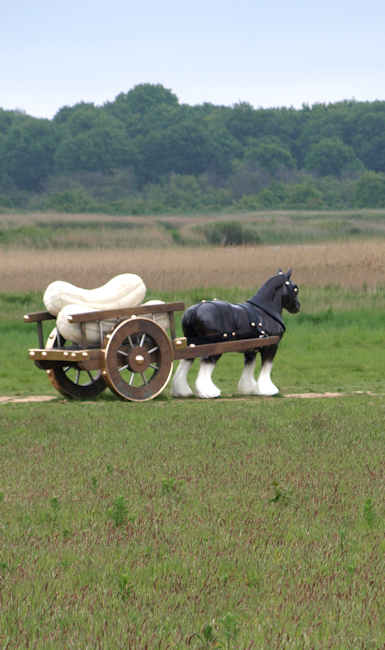
Art work - life size horse and cart - Ruth's coastal walkBeyond The Maltings, I see a huge cart horse and its loaded cart, standing patiently looking out to the marshes. It doesn’t move. After a while, I realise it is a statue – very realistic and slightly larger than life.

The path leads along the estuary itself. I enjoy being back alongside water. Then the path heads inland and I miss the first turning, but pick up the path again by heading inland along another footpath and trip back along a road. From here, the path is not so well-maintained. I follow signs down the side of a farmer’s fields. He has set up a low fence to protect his crops, but has not made the path obvious. I end up following a rutted, muddy track and realise I am in a field of pigs. Not sure if I am on the right track or not, I wander around the pig farm for a while.
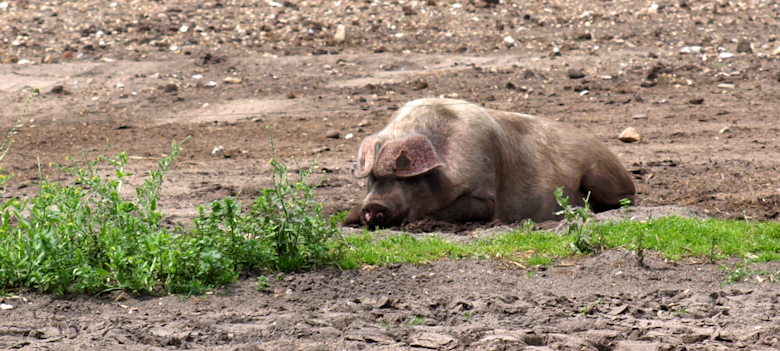
Large pig on pig farm in Suffolk - Ruth gets lost on her coastal walk

Pigs are large. They make small burrows in the mud and roll in this, so they take on the colour of the ground. They are mainly sleeping, but as I pass the edge of their field, the nearest ones wake up with grunting snorts and stand, menacingly heads down, watching me. I notice the only thing that separates me from them is a single strand of electrified wire fence. Pigs are clever. Haven’t they learnt to jump this fence yet? I am even more concerned when I notice piggy footprints on MY side of the wire.

I spend some time walking in circles around the pig farm. Finally, I notice a coastal path sign again, and head in the right direction. The trail is still not clear, and at every fork in the track I am forced to consult the map and agonise about the right direction to take. This is not necessary. If the farmer resents people walking on his land then, surely, it is much better to keep the path properly marked. Otherwise, walkers have no choice but to bumble all over the place, trying to find their way.

I have seen nobody during my walk round the farm – just pigs. There is nowhere to sit down – the tracks consist of dried mud, churned up – possibly deliberately – by huge wheels. I am hot and thirsty and running late. My mobile phone signal is very poor, but I send my husband a text to tell him I am going to be late for lunch.

Forest path - Suffolk woodland - Ruth's coastal walkGoing across an arable field, I find a road and cross into forest. This forest walk should be enjoyable, but I am hurrying now and everything aches. John Merrill was right about finding your own walking rhythm. By pushing myself to go quickly, I accentuate every ache in my body and feel fatigued. Across another road and through woodland, I pick up a track. A snake slithers across the path and disappears into bushes. It is long, 2 or 3 feet, with a thick body. I think this is too large to be an adder and I hope it is a harmless grass snake.

The track leads straight to Chillesford and I feel relieved when I reach the pub. This turns out to be a rather nice restaurant. I feel embarrassed arriving in muddy boots, straight off a pig farm, but the young waitresses make me feel welcome. There is no sign of my husband. My phone is not working. I order a cider and wait for him. He turns up, just in time to order lunch – from a wonderful hot buffet with a great choice of main meals.

Ruth on her coastal walk, meets a spooky figure in a Suffolk field - scarecrow on tree stump?
After lunch, I continue along the Coastal Path, starting along a quiet lane and ending up along farm tracks. There are fields on either side. I see a strange shape in one of the fields – is it a tree trunk, a sculpture, or a scarecrow? I don’t know, but it looks really sinister.

This part of the walk is deserted and boring. Farm tracks lose their charm after the first mile or so. The sky is very grey and the light is too poor for photography. Rain could start at any time. However, I cheer myself up with thought I am heading back to the sea again.

I pass through a village called Butley Low Corner – really just a few houses at the end of a track road – and then reach a point where the path passes over a stile and tracks head straight up a hill. This must be Burrow Hill. I cross the stile and realise, to my horror, that I am in a field of cows. I hate cows. They are large and scary. I hurry up the hill, heart pounding from exertion and anxiety. The cows ignore me completely.

At the crest of the hill are wonderful views. I can see forwards towards the estuary and the Butley Ferry point, behind me is the route I have come along and inland are fields and distant farm buildings. I feel a sense of elation and achievement. It is only a shame that the weather is too bad for great photographs.
Boyton Marshes - view from hill - Ruths coastal walk

Butley Ferry Crossing - Suffolk, Ruth's coastal walk
Down the hill, I reach Butley Ferry crossing point. This is an ancient crossing point and now consists of a rowing boat – big enough to transport a bike – and is manned by enthusiastic volunteers at weekends. Today is Thursday and there is no ferry running. I knew this would be the case, hence my inland detour along the official Suffolk Coastal Path – running nowhere near the coast.

The official path now follows the top of the bank of the river. It is very overgrown here, just a narrow passage through the long grass. I cannot see my feet and hope there are no snakes. The river is to my left and Boyton marshes to my right.

I have discovered another hazard of field walking. I am sneezing and my eyes are itching madly. I could scratch them out. My one remaining tissue is soaking wet. Yes, hay fever has struck. I had been blissfully free of symptoms during my walks along the beach and carelessly not taking my medication. Now I am feeling the consequences.

There is a path leading inland from the riverside route. I come down off the river bank and follow this, leading through a wonderful marshy area, alive with birds. I see a heron, swans, geese, seagulls, wading birds with huge long, ridiculous beaks and rabbits. Then, passing up a farmer’s tracks, I reach a road. This is narrow with no pavement – only wide enough to allow one car – and, incongruously, I notice the back of a large white bus disappearing down it, brushing the bushes on either side. This narrow road leads into Boyton. Nervously, I start walking along the edge of the road and hope I don’t meet another bus.

Telephone kiosk in Boyton - Ruth's coastal walk
I reach the small village of Boyton and find the telephone box. This is my designated meeting place with my husband. Telephone boxes have become a useful meeting place as they are always marked on the maps and offer shelter from rain and hail.

I am 5 minutes late. My husband is nowhere to be seen. I manage to find a signal on my mobile and contact him. He is lost – the roads are short on road signs in this area. I sit on the grass – sneezing and crying – with hay fever in full spurt. Half an hour later he arrives.

This has been another great day of walking through varied scenery. Apart from the pig farm and my hay fever, it has been thoroughly enjoyable.


Vital stats:
Miles travelled = 12.
Average speed = 2 miles an hour
Wrong turnings = 2
Injuries from animals = 0

Posted in 03 Suffolk | Tagged , , , , , , , , , , , , , , , , , , , , , , , , , , | 4 Comments

Stage 13. Dunwich, Sizewell, Thorpeness to Aldeburgh

The car park at Dunwich is deserted this morning, apart from a solitary dog walker. The dog bounds onto the beach, all enthusiasm and wagging tail, then dashes back towards his master. “He wants you to keep up,” I remark, innocently. Affronted by this comment on his agility, the man tells me how he has Achilles tendonitis and is still under doctor’s orders to rest but is fed up with resting. I allow him to walk ahead of me.
translucent light on sea - ruth's coastal walk
The morning is beautiful. The sea is calm, dead flat and light grey. There is a milky haze on the horizon and I cannot tell where sea ends and sky begins. The light is pearly and the word “opalescence” comes to mind. It is the kind of light you see in Venice. Magical.

Shingle beach - makes walking difficult - Ruth's coastal walkI walk along the beach. It is all shingle – big loose stones – and the going is very difficult. On my right is a low cliff. Officially, the Suffolk Coastal Walk follows the line of the cliffs, but there is no sign of a path. I walk as close to the waves as I can, where the wetness of the stones seems to make them firmer. After a few minutes I am sweating. I overtake Mr Achilles and his dog. The dog bounds ahead with me for a while. When I look back, later, they have gone.

A few other dog walkers appear ahead of me and pass me, heading back to Dunwich. Now I am alone.

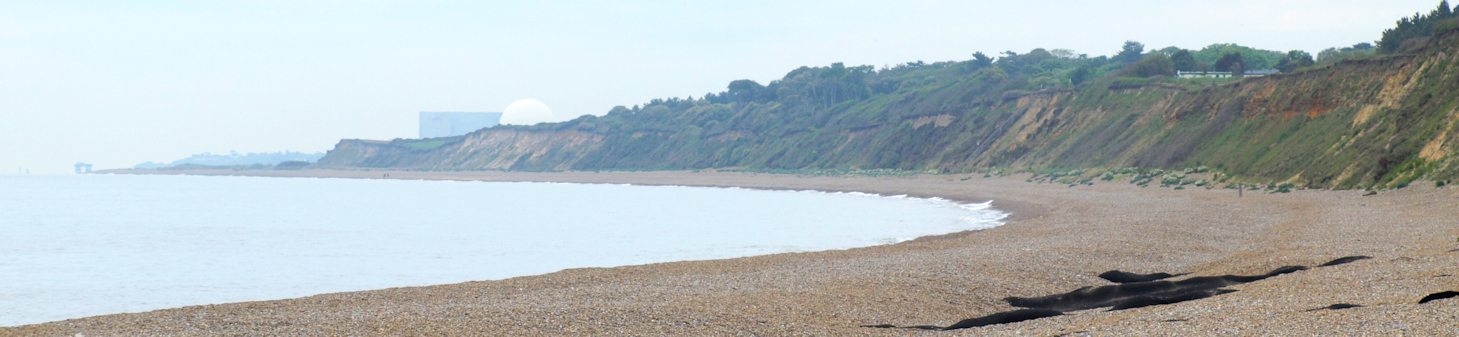
There is a sailing boat to my left, far out to sea. In this strange milky light, it appears to be floating in the sky. Ahead of me, the bay curves towards the ghostly outline of the dome of Sizewell power station, in the far distance. Behind me, the bay curves back to Southwold, becoming fainter behind me as I continue walking.

View along beach, Sizewell in distance, on Ruths coastal walk
I have been walking for an hour and seem to have made little progress. To cheer myself up, I have a drink of water and eat some chocolate.

I begin to think about my aches and pains. There is an ache on the outer aspect of my left hip. Because I am walking on slanting shingle, I put more pressure on my left leg. Walking slightly pigeon-toed helps to relieve the discomfort. Then I notice the blister under my right fourth toe is still troubling me. I popped it last night, which usually solves the problem, but it must have reformed with fluid overnight. I begin to notice a discomfort in the joint of my big toe, right foot, too. This gives a stabbing protest every time I walk over a big piece of shingle.

Being a medical doctor carries a penalty – hypochondria. My hip pain must be due to tronchanteric bursitis or early onset of severe osteoarthritis. My toe joint is obviously developing gout or, at the very minimum, bunion trouble. My mind dwells on all the problems that can interfere with mobility – plantar fasciitis, Achilles tendonitis, ankle arthritis, knee arthritis, hip problems, low back pain. Even shoulder problems, such as shoulder tendonitis or the evil frozen shoulder, could handicap me as I would be unable to swing my rucksack onto my back easily.

While I ponder the miracle of my apparent fitness, despite a multitude of possible ailments, time passes and I make my slow progress along the shingle.

I notice the remnants of buildings on the cliff. At one point, I see a whole section of roadway dangling down the slope – further evidence of the power of the sea.

After this, the cliff becomes lower and disappears. I see there are people ahead on the shingle, the first people I have seen since I left the dog walkers behind. I notice a “visitor centre” is marked on my map and I am coming to an area of inland marshes called Minsmere Level.

Path closed sign - coastal erosion - Ruth's coastal walkI leave the shingle beach and head inland, finding the track of the official Suffolk Coastal Path. Here a mystery is solved. There are notices saying the path to the North is closed due to cliff erosion. This explains why I couldn’t find an easy route along the beach. But now the path is welcomingly broad and the going is easy. My aches and pains improve.

Minsmere Level - bird watching paradise - on Ruth's coastal walk I meet people out walking, most of them armed with binoculars for bird watching. I notice that most people are elderly. This could be because it is June and everyone else is at school, work or university. Or maybe the hobby of bird watching only attracts a certain generation.

There are a number of hides around the inland lake. I sit in one, grateful for the rest, and watch the birds for a while. They are very noisy – squeaking and shrieking and calling to each other.

I follow the path just behind the dunes that line the edge of the shingle beach. Sizewell nuclear power station is looming ahead of me. After a while I draw level with the first large building of the power plant. Sizewell B. The white and blue colour – with the pale gleaming dome – are strangely appealing. The sun comes out. A sign informs me of the variety of wild life in the area. Also, it warns me, if I hear a siren sounding, I am to leave the area immediately. Just then I hear the jangling noise of an alarm bell coming from the plant, followed by a loud-speaker. Is this a siren? The voice on the loud-speaker says “Attention all personnel..” but I can’t make out the rest. After a moment’s hesitation, I decide to risk radioactivity and continue onwards.

Platform in sea, near Sizewell - Ruths coastal walkOut to sea are two platforms. They rise, surreally, out of the milky, dead calm sea. I have no idea what their purpose is, but the nearest one is a gathering place for seagulls.

After Sizewell B, I pass Sizewell A. This is a much less attractive building. My husband has told me the power station has been broken since March, but I can hear the hum of machinery. The buildings look clean and well-maintained. There are no windows and I can’t see any people working – they must be hidden deep within the buildings.

Beyond the power station is a small village and a car park. There are groups of walkers in the car park. They are all wearing the right gear, carry rucksacks and have poles. I wonder where they are going; the map here is crisscrossed with footpaths.

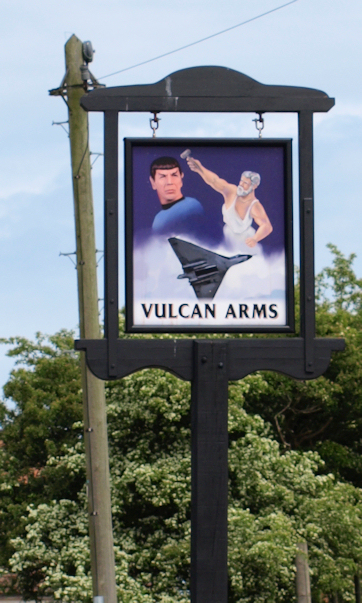
Vulcan Arms - pub sign - Sizewell, on Ruths Coastal WalkAt the pub I meet my husband and we have a surprisingly good lunch. The pub is called The Vulcan Arms and the sign is amusing – as it features the only three things in the universe called “Vulcan”. The pub is quiet. Apparently Sizewell workers are regularly, and randomly, tested for drugs and alcohol. This may not be good for the pub trade but is very reassuring for the rest of us.

After lunch, I walk along the top of the low cliff, following the Suffolk Coastal Path and overlooking the shingle beach.

I see swimmers in the sea and stop, along with a couple of strollers, to watch them. They are not young – fifty or sixty. Brave people.
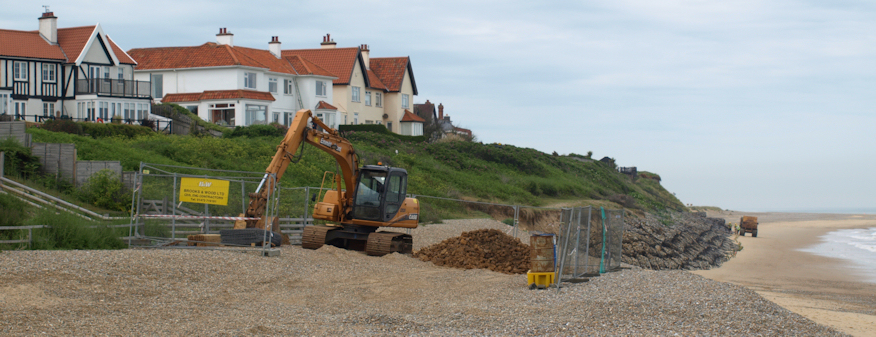
Thorpeness, houses under threat as coastline erodes - Ruth's coastal walkRound the corner, I arrive at Thorpeness. This is a strange name for this rather upmarket seaside resort, sounding as if it should belong on the wild coast of northern Scotland. The first few houses, elegant and large, are being threatened by the sea. A tractor is out on the narrow beach and workmen in yellow jackets are inspecting manmade sea defences – huge blocks, rocks and wire. I wonder how long they will last. Beyond this, the bay stretches out in front of me and I can Aldeburgh in the distance.

I walk along the beach. There is sand below the shingle, firm enough to make walking enjoyable. A family is out and the youngsters are flying a kite while father builds a sand castle. To my right, the shingle rises into a low bank and I cannot see what lies on the other side, but , from time to time, dogs come bounding over, closely followed by their owners.

Groyne, altering beach shape between Aldeburgh and Thorpeness - Ruth's coastal walkI come across the first groyne I have seen for miles. This appears to be some sort of outflow pipe, rather than a true groyne. I notice how this single, manmade structure, alters the coast line. What would be one, wide, curving bay between Thorpeness and Aldeburgh, as a result of the concrete obstruction interrupting the natural drift of sand, becomes two gentle curving bays. I sit on the edge and eat the rest of my chocolate.

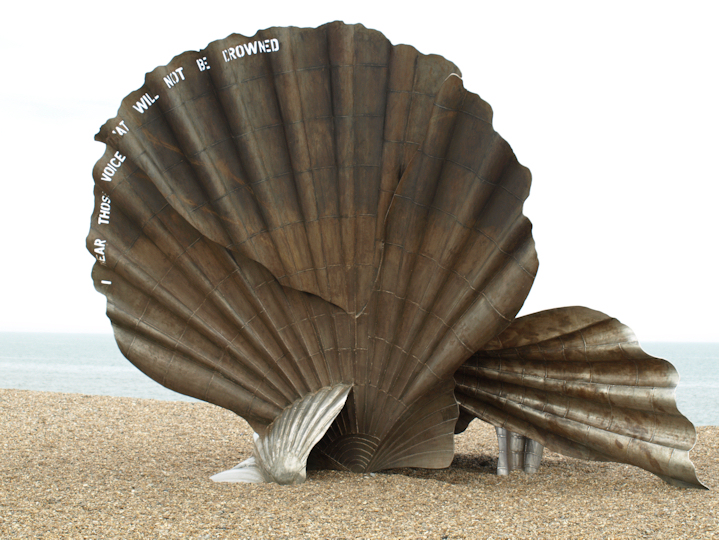
Sculpture on beach, Aldeburgh - Ruths coastal walkApproaching Aldeburgh, I see a strange object on the sand. Ah, this is a sculpture – featuring on the cover of the Ordinance Survey map of the area – and, apparently, loathed by the locals. I walk across the shingle to take a closer look. It is beautiful. I photograph it from every angle. There are words punched into the curving edge on one side. You have to walk around it to read them.

I walk along the path at the edge of the shingle. There is a car park here and a number people out enjoying the late afternoon sun.

Dog statue in Aldeburgh, Memorial to local doctor - Ruth's coastal walkWalking into Aldeburgh is a wonderful experience. The buildings are painted different colours and have weird, quaint architectural features. This town must have been built by people with a sense of fun. By a little boating lake, I notice a statue of a dog. This turns out to be a monument honouring a local doctor, who died in 1959, and his wife, also a doctor. I assume they were GPs. I wonder how many modern GPs will have a stature erected by their patients. Our society has become less appreciative and more demanding.

The main street is virtually traffic free. I stroll along it and take photographs – but unfortunately the light is not right to capture this place at its best, the sun is behind the town now. Standing on the sea wall, I notice a man on a bike coming towards me – ah my husband.

We walk to the end of the town. At this point, there is a Martello tower and then a huge, long spit of land – shingle and marshes – leads southwards. Access to the spit is denied and, in any case, the spit is a dead-end. There is no way to access the coast further down, as the coastal route is interrupted by the mouth of the River Alde, which turns into the River Ore, and runs behind the spit until it eventually turns and empties into the sea.

Tomorrow, I will be following the official Suffolk Coastal Path and taking an inland route.


Vital stats: 11 miles
Manmade Radiation exposure: 0
Solar radiation exposure: 8/10 – mild sunburn.

Posted in 03 Suffolk | Tagged , , , , , , , , , , , , , , | 4 Comments

Stage 12. Covehithe, Southwold, Walberswick and Dunwich

Today I wear my bright pink fleece jacket. If the beach is not wide enough to walk on, I may have to clamber on rocks. Bright pink should be highly visible against the brown rocks and grey sea – just in case I need to be rescued. What is the one thing more embarrassing then being rescued by the coastguards? Drowning.

Thatched church built in ruined abbey, at Covehithe - Ruth's coastal walkCovehithe has a strange little thatched church built, literally, in the arms of a ruined abbey. It is pretty, but there are a few houses here and no real feeling of a village community. With the sea encroaching every year, this little village is slowly dying.

The road comes to a dead end and signs warn me there is no access to the sea straight ahead. A man in rubber boots ignores the sign and walks on. I hesitate, tempted to follow him, but don’t want to find a dead end, so I follow the marked coastal footpath. This detours across fields. I see nobody but I notice fresh footprints – there are walkers ahead of me.

Swan cleaning its plumage, Covehithe Broad - Ruth's coastal walkThe path skirts marshland and lakes, Covehithe Broad, – the swans are busy cleaning their plumage in a methodical and dignified manner.

The shingle beach is wide and almost deserted. I notice the man in boots has emerged behind me. I see ahead of me – and eventually overtake – a group of 3 walkers with poles. Do poles make walking easier? I would like to know other people’s thoughts.

I walk past crumbling cliffs and fallen trees. I can’t resist taking photographs, wanting to capture some of the drama and sadness of this doomed area, as the land gives way to the tides and the greedy sea. Now I am alone on the beach. The tide is going out and leaves a small sliver of sand to walk on below the shingle. Like a misty ghost in the distance, I can just make out Southwold Pier. Ahead of me is a gently curving bay with cliffs at the edge. Will there be enough beach beneath the cliffs to walk on? I hope so. If my way is blocked, it is going to be a long, tiring trek back to my starting point.
Beach at Benacre - Ruth's coastal walk, Suffolk
I walk easily, only the sea for company. I feel a quiet joy. John Merrill, that great walker, advises you find the right rhythm of walking and walk without stopping. Stopping breaks the rhythm. I believe he is right. For this section of the beach, I walk without taking photographs and make good progress. I feel I could walk forever, without effort.

The beach narrows as I approach Southwold. The cliffs become higher. I reach a point where there are landslips lying in my way, leaving only a narrow stretch of sand between fallen rocks and the waves. Grateful for the way through, I walk onwards. There are a few houses perched on the edge of the cliff above me – only a matter of time before the inevitable happens. Already there is debris from fallen buildings at the foot of the cliff. I notice a couple of people on the beach, picking their way through the ruins.

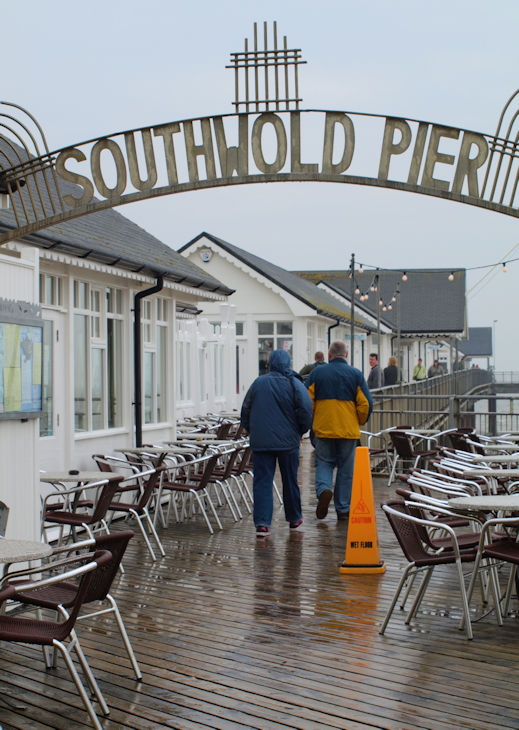
Southwold Pier, in the rain - Ruths coastal walkNow I meet the beginning of Southwold promenade. It begins to rain. I shelter behind the brightly coloured huts that line the promenade until the worst is over. Walking onward I reach the pier. Here I stop to have a cup of coffee and, in this dry place, I phone my husband. He is out cycling and is thoroughly wet.

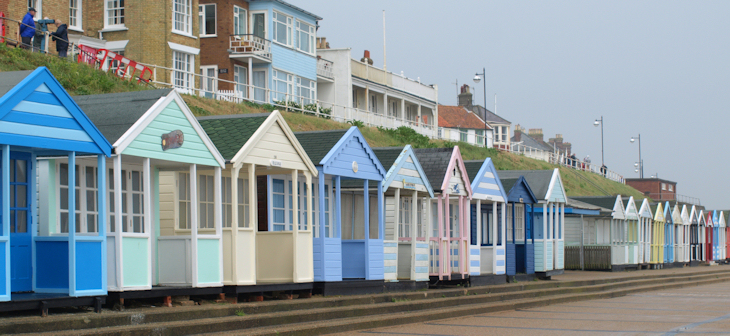
The rain stops and I spend a few moments enjoying Southwold pier and promenade. This is a very elegant, unspoilt resort. There are no amusement arcades, no tatty souvenir shops, no crazy golf – and the houses are very pretty. I walk along the promenade, passing a long line of cheerful beach huts. They have amusing names painted on them – “Lovely Jubbly”, “Gin in It”, “Ma’s Place”, “Nap Time” and, my favourite “Expensive Third Shed”.

Southwold promenade and beach huts - Ruth's coastal walk

When the promenade ends, I walk across dunes towards the river. Here I find Southwold harbour. I had wondered where all the fishing boats and sailing yachts were – and now I find them. The harbour is full of small craft and is beautifully untidy – clearly a busy, working port. There are sheds selling fresh fish and, further on, small cafes and a pub.
Southwold harbour - Ruth's coastal walk
My map showed a passenger ferry across the river, but the sign says the ferry stops between 12:30 and 2:00pm. It is, of course, 12:35 pm. I continue down the harbour road, knowing there is a bridge ahead. It takes me some time – I stop and take too many photographs of boats and boatsheds.

The bridge is a narrow pedestrian bridge; not pretty, just functional. There are fields on either side and I enjoy the walk back along the far side of the river. There are some jetties and a few boats on this side of the bank, but the main action is on the opposite bank.

Ahead I see the beginning of Walterswick and arrive just in time of lunch. I wait at the pub for my husband. He is, of course, at the other pub in the village. We meet up eventually. Sitting in the garden, the sun comes out. We dry out and enjoy huge platefuls of food – I have fish and chips with extra vegetables. And of course, a lovely cold glass of Aspell’s Cyder. Full of enthusiasm, I decide to extend my walk for a few miles further than planned and discuss a new rendezvous with my husband.

After lunch, I begin to follow the Suffolk Coast Path. It winds through some marshland, but I stick to the beach for the moment. Ahead of me the bay curves – despite the coast appearing as a straight line on the map – and I can see a distant dome. That must be Sizewell, tomorrow’s destination.

walking in woods, Dunwich Forest - Ruths coastal walk in SuffolkThe sun is hot and the beach is made of difficult shingle with big pebbles. Walking becomes hard. I decide to cut inland and follow the official Coast Path. This crosses some marshy area, with nesting birds on either side, and then enters woodland. The cool woods are a welcome change and, as the sun filters down through the trees, I take some photographs and enjoy the play of light and shade.

The path becomes a track. I see the occasional farm and, through the trees, glimpse a wonderful modern house – all light wood and huge glass windows. I disturb rabbits and, as the track skirts woodland, I pass fields of cows and sheep. The track takes me up a hill and I find the incline to be hard work. I am used to walking on the flat. I think ahead to how I will need to deal with hills and cliffs in Devon, Cornwall and, later, maybe, Scotland …..

Cafe at Dunwich beach - Ruth's coastal walkEventually, I reach the road and follow this into the village of Dunwich. I have read that Dunwich has lost most of its land into the sea and I was expecting to see some evidence of this, but there is no wreckage – just a low crumbling cliff when I reach the sea. Here there is a car park and I notice my husband’s car is here – our original rendezvous point. I am hot, thirsty and my feet are aching. So, I stop at the cafe and buy a cold coke. The cafe is just behind a shingle bank and I can see the beach and the wide bay curving back to Southwold.

Sitting outside, enjoying the view and the sunshine, I decide I won’t continue further today and I text my husband to let him know – I am ready to end today’s trek.


Vital stats: 11 miles in 6 hours.
Blisters: 1 new. 1 old
Rainstorms: 1

Things I learnt today: Southwold is a very pretty seaside town and is also the home of Adnams Brewery.

Posted in 03 Suffolk | Tagged , , , , , , , , , , , , , , , , , , , , | 9 Comments

Stage 11. Corton to Lowestoft to Benacre

Corton, finally I find a footpath to the beach, Ruth's coastal walk in SuffolkWhere is the beach access from Corton? I wander through a caravan site, perched on the cliff. If there was a way down to the beach from here, it has disappeared – dropped over the edge and fallen into the sea itself. So, I walk along the road. Although it is only 3 miles to Lowestoft, and the road is quiet, I am disappointed to be forced away from the coastline.

Warning signs, near Corton, Ruth's coastal walkI walk past a wooded nature reserve on my right and come across a small car park with a lane leading to the beach. As I reach the beach, I find two signs. One warns me that the path northwards is impassable. The other signs says “no longer designated as a naturalist/clothes optional area”. This is a bit ambiguous – does it mean that clothes are no longer an option here? I keep a good lookout but, disappointingly, I see no nudists.

The sky is overcast, but I feel joyful. My feet are comfortable and my rucksack feels surprisingly light. I must be getting fitter and stronger. Then I realise – I forgot my water bottles and, worse still, my chocolate.

The beach here is wide and I make my way across soft sand to the sea edge, where I walk along the firmer sand, making good progress until I reach the outskirts of Lowestoft. The northern approach to Lowestoft is not a pretty one. I pass derelict building on my right, set in what seems to be unkempt and partly-concreted wasteland. Then I realise it is an old, abandoned, static caravan site.

Battered sea defences, Lowestoft north shore on Ruth's coastal walkBeyond this, I come across destroyed sea defences and, eventually, warning notices telling me I cannot walk along the beach at this point. I take steps up to a wide, but featureless, promenade. This stretches out into the distance. I see a few people walking, with dogs. Nobody strolls along this promenade for any distance – except me.

I see a seal bobbing in the water.

Now I pass the outskirts of Lowestoft and, close to the promenade, there are ugly industrial buildings. Steps descend to a lower wall. I ask a couple of strollers if the path continues round. “Yes, and the man adds that I am about to reach the most Eastern point of the British Isles . Ah, I remember now, David Cotton’s website told me of this feature – I had forgotten.
Euroscope, the Eastern Cardinal point of the Britain and of Ruth's coastal walkRuth, standing at the Eastern Cardinal Point for the UKAnd here it is. A circle set in the floor, at the most easterly point of the UK. I take photographs and, setting the timer on my camera, even manage to get a photo of myself.

The coastal path is marked with street signs. It turns inland from here, through the streets of Lowestoft. I pass through the industrial area first. Workmen in yellow jackets and hard hats wave to me. I wave back. I come across the most Easterly Church in the British Isles and then I am at the top of a shopping street. I buy water and chocolate and continue down the street until I reach the bridge across the River Waveney.

Raised bridge, Lowestoft, with held-up fire engine, on Ruth's coastal walk.As I approach the bridge, a siren sounds and red lights flash. Startled, I realise that the bridge is about to close. I run across and make it to the other side before the barriers close. Cars and pedestrians are now queuing on both sides of the bank, waiting. I have barely time to get my camera out before the roadway is nearly fully raised. A different siren sounds. A fire engine is approaching, blue lights flashing. It has no option – it has to wait too.

Fountains on Lowestoft Promenade, South - Ruth's coastal walkI walk on and find myself on a very pleasant promenade. There are nice buildings, monuments and one of those fountains that spurts out from the ground. Children are running through the jets of water, shrieking as they get soaking wet. I use the public toilets – luckily I have 10p. Then I set off along the promenade, heading south. I see coastguards setting up flags on the beach. I pass under a very unimpressive pier structure.

Staying close to the waters edge, leaving the promenade and Lowestoft behind, I walk along an deserted beach, stretching out before me in one of those long deceptive bays. There is nothing much between here and Kessingland, my lunch stop. I meet a few walkers with dogs. To my right are low, crumbling cliffs. In one area, the cliff disappears into a gully, and I believe this must be a place endearingly called Crazy Mary’s Hole on my map. The beach is otherwise featureless and I experience that familiar feeling of disorientation.

Wide shingle beach near Kessingland - Ruth's coastal walkThe beach widens. The cliffs grow greener and lower. I come across a fenced off area of nesting terns between the sea and the cliff – I hear their calls. Now the beach curves convexly ahead. There is a narrow strip of sand to walk on. To my right is a wide shingle bank, high enough to prevent me seeing what lies beyond.

I walk in a confined world of sea, sand and shingle – unable to see far ahead as the beach curves away, unable to see what is happening landwards as the unforgiving shingle bank obscures the view.

Over shingle bank, towards Kessingland, on Ruth's coastal walkWhen will I know I have reached Kessingland? I check my Trip Journal App on my Iphone. With a GPS reading of my position, I can pull up a map. When this shows I am approaching Kessingland’s access road, I strike inland, struggling over the shingle and across an area of dunes. There is a promenade ahead with buildings and then I spot my husband, leaning against a fence waiting for me.

Unfortunately, the pub stops serving at 2.30pm, and it is now 2.45. We are unable to persuade them to change their minds and we have to snack on crisps and chocolate. At least I enjoy a good cider.

Setting off again, I walk along the Kessingland promenade until this ends and I follow a track along the edge of the wide beach. I reach an area called Benacre Broad. Signs warn me that I can only walk along the beach to Southwold at low tide. I believe the tide is high at 6 pm and it is now 4pm. The omens don’t look good. But the beach looks passable and I decide to risk it.

Fallen trees, near Benacre, Ruth's coastal walk and coast erosionThe walk is difficult now – narrow shingle beach and low, crumbling cliffs to my right. I come across drowned trees and fallen trees. There are clumps of fresh grass on the beach, newly fallen from the cliff. I pass an elderly couple, but otherwise see nobody. I reach an area where there is an inland lake and a bird hide.

The coastal path along the top of the cliff has disappeared and warning signs tell me the cliff is impassable. I later learn that this part of the coast is disappearing at the rate of several feet a year. I view the beach ahead of me –in the distance I see the beach becomes even narrower and the cliff grows higher. I can see spray splashing up onto the cliff face in the distance.

Cliffs towards Covehithe - nearly defeat Ruth on her coastal walkI hesitate. But I have come so far, I am reluctant to turn back. So I continue.

I am alone now. There is a narrow spit of rock between my path on the shingle and the cliff. The shingle narrows and disappears beneath waves. I climb onto the rock at the foot of the cliff. This “rock” turns out to be soft and, almost, feels like mud beneath my boots. It is sticky and slippery. I walk determinedly onwards.

Then I reach an area where the rock/mud bank has been washed away for a stretch of a few yards. There is no beach – only water and waves splashing up against the vertical cliff face. My mud/rock pathway continues a few metres away.

But, between me and the path is a few feet of nothing but cold water and surging waves. It might as well be a hundred yard gap.

There is nothing I can do. I can’t go forward.

Reluctantly, I turn back. My phone finally finds a signal and I let my husband know. I won’t be making it to Covehithe this evening – not by foot.

Back in the Benacre area, I pick up the coastal path as it heads inland. My husband is waiting with the car and my walk, for today, has ended.


Vital stats: 12 miles (2 of them in the wrong direction!), blisters = 1
Things I have learned: on the coast, the wrong time of tide can make the difference between success and failure.

If you are interested in coastal erosion and in finding out about the plans for sea defences in this threatened area, you can read the local Shoreline Management Plan.

Posted in 03 Suffolk | Tagged , , , , , , , , , , , , , , , , , , , , , , | 13 Comments

Stage 10. Caister to Great Yarmouth to Corton

Independent lifeboat station, Scroby Sands, Caistor on Sea - Ruth's Coastal walk Caister lifeboat station is an independent lifeboat service, manned by volunteers. Hopefully, I will never need their services. But the size of their station is impressive and reassuring. The wind is strong and the skies are dark. I walk past the station and begin the next section of my coastal walk.

Leaving Caister along the sea wall - Ruth's coastal walkI walk south along the top of the dunes, and then along the top of the sea wall. This is easier than walking on the soft sand, although I must keep my balance – a fall down to the dunes below could be nasty. I would like to reach Lowestoft today. I know it is the traveling that matters, not the destination, but I want to make good progress this weekend.

The sky is dark and it threatens to rain again. I really hope there will be no hailstorms today. The weather keeps people indoors and I travel undisturbed along my wall, past dunes and then past static caravan parks on my right. I can see the cranes of Great Yarmouth in the distance.

I pass a look-out post and reach the beginning of a tarmac road. Now there is a large holiday village on my right and people are beginning to emerge with children and push-chairs. There are bus stops along this road and in the distance I see a large red bus. After a while, the traffic on the road increases and I decide to head off to the coast again. There is a long stretch of dunes between the road and the sea. I walk across the dunes, following tracks that other walkers have made. There is fragile grass trying to grow on the dunes and I am surprised the public are allowed to roam freely on this delicate surface. During my walks along the North Norfolk coast, my route was often confined to paths to protect and preserve the dunes. I gather it only takes a few footfalls to destroy the roots of these fragile dune plants. Without the grass to bind the sand, the dunes are washed away. Without the dunes the coast is battered by the sea. And I have seen what erosion can do to the coast line.

Ruth's walk, approaching Great Yarmouth Britannia pier, from the NorthReaching the beach, the tide is still high and there is only a narrow strip of firm sand just above the water line. I walk carefully, keeping my eyes on the waves. I would rather not have wet feet again today.

There is a walker ahead of me. We near a pier and I notice the far end rises above the sand, high enough to pass under. The walker ahead appear to have disappeared and must have gone under the pier. Hesitating for a moment, I duck under the pier’s supporting beams.
Under the pier at Yarmouth - Ruth's coastal walk around the UKNow I am in a dark and private world. Beneath my feet the sand is wet, with a strong smell of salty sea. Above my head are dark timbers. To my left are angry waves, sloshing through the struts supporting the end of the pier. To my right the dark underside of the pier stretches above me and the sand rises steeply to up meet it. Ahead, through the timbers, I can see bright stretches of sea and beach. I linger here. The only sound is the crash of the sea as it rushes and sucks at the pier supports.

When I emerge from the underbelly of the pier, startling a fisherman on the beach, the sky seems much brighter. This is only an illusion. The weather is still dark and threatening rain. The beach is empty, apart from a couple of young girls and an elderly man with a paunch and a metal detector.

Great Yarmouth sea front - Ruth walks the UK coastI head across the beach to the sea front, stopping to take a photograph of the building lining the promenade. From a distance, the sea front looks elegant. As I get nearer, I see the usual mixture of ice cream stalls, souvenir shops and amusement arcades. There is the ubiquitous “train” carrying cold-looking people along the sea front. I admire the most elaborate crazy golf course I have ever seen – complete with pirate ships.

Great Yarmouth lies on a peninsula with the sea on one side and the River Yare on the other. In order to continue my coastal walk, I must cross the river at the Haven Bridge. I walk through the town, through a busy shopping centre. After so many miles of isolated beach walking, it seems weird to be walking with shoppers in this bustling situation.

The Haven Bridge is a lifting road bridge. I stop to take photographs of boats on the River Yare.
Boats on River Yare, from Haven Bridge, Great Yarmouth - Ruth's Coastal Walk
Now I have to walk along the far side of the river. This is impossible to start with, because this section of the river bank is given over to dock yards. I walk along a busy road and find it hard to enjoy this particular section of the walk. I am tired and resentful of my forced detour. Eventually, I find a path down to the dock side, where I can walk along the river towards its mouth. The rather brutal architecture of the docks begins to change. Here there are residential houses and ahead I can see attractive buildings ahead of me. I must be approaching Gorleston Point.

Body surfers on Gorleston beach - Ruth's Coastal Walk around the UKGorleston Point is lovely. There is an impressive Victorian-looking hotel with a bar and restaurant. I call my husband on my iPhone. I am hungry. While I wait for him to arrive, I sit on Gorleston promenade, watching people body surfing in the waves. Young men are trying to launch sailing dinghies, difficult with a stiff wind blowing on shore from the North Sea. Reassuringly, I notice a small, inflatable, rescue boat is drawn up on the beach.

We eat our lunch. My husband has excellent fish and chips. I have a disappointing hamburger.

After lunch, I walk along the velvet sand of Gorleston beach. This is the finest sand I have encountered, soft and pale. To my right is a wide expanse of pebbly beach, with a long promenade at the edge, behind this a low green bank with houses above. I walk past the end of the promenade and continue along the shore.
Gorleston beach - on Ruth's Coastal walk in Norfolk
When I reach Hopton-on-Sea, I begin walking along a stretch of concrete walkway running along the sea wall at the edge of the beach. This is easy. I will be Lowestoft shortly. Then I see a warning sign and a barrier- the walkway beyond Hopton is closed. The cliff is slipping and the walk is unsafe. The sign advises a detour. On my map, I find there is a public footpath marked along the top of the cliff and I scramble up a sandy area of cliff face. At the top there is a path, along the edge of a green meadow, and I set off along it.

Looking north from the cliff top, Hopton. Ruth's coastal walk.The views up here are wonderful.

But, before long, I come to an area where a whole section of cliff has slipped down, forming a V shaped hole in the cliff edge. The path has disappeared into this void. A group of youngsters are sitting on the grass and I ask if it is possible to continue walking to Corton along the top of the cliff. They assure me it is.

I walk around the gaping hole in the pathway. Further ahead there is an area of fenced off countryside and the coastal path runs along a narrow strip of land between the fencing and the cliff edge. Another sign warns me this path could slip at any moment. Very helpful! I stick close to the fencing and continue. At some point I notice my foot is getting sore. Today is the first day I have walked without applying blister plasters in advance. Worried that I might be brewing a blister, I remove my shoes and socks and apply a padded dressing to the sore area.

Now I reach a caravan park. A putting green separates the caravans from the cliff edge. Warning signs are spaced along the cliff edge. I notice a strange mounted platform with a bench, very close to the edge of the cliff and clearly intended for admiring the views. “That is not going to last long,” I think. Then I notice the platform is mounted on wheels and can be moved. Clever.

Disappearing path, towards Corton - Ruth's coastal walk, into SuffolkAfter a few hundred yards I leave the caravans behind and reach a field. This farmer must be losing parts of his land, slowly, as the edge of the cliff crumbles. I can see freshly fallen areas. In some places the path leads straight over the edge of the cliff. I stay as far away from the edge as I can, walking close to the growing crops. Then the path stops completely. Here is the edge of someone’s garden, fenced off, and the path used to continue around it. Now there is no way past the fenced off garden. The route has disappeared entirely. I am forced to turn inland, following a well beaten path along the edge of the field, back to the road.

Now I am walking down the main street in Corton. This is not a hardship as the road is very quiet. Corton has some rather up-market holiday properties and there are holiday makers strolling along the pavements. I am irritated by their slow pace. As I reach the end of Corton, I decide I have had enough walking for today. Lowestoft is still a few miles away. But I telephone my husband – dial-a-ride – and then wait for him to pick me up. He finds it difficult to identify the turn off the main road to reach Corton. As I wait, I finish my remaining bar of chocolate, eat the rest of my banana and empty my water bottles. Belatedly, I realise I have left Norfolk and am now in Suffolk.

Another eventful walk with an element of danger and uncertainty to it. Another milestone as I cross a county boundary. Another great day by the coast!


Vital Stats: distance = 11 miles. blisters = 0. counties walked in = 2.
Landslides = lots.

Posted in 02 Norfolk, 03 Suffolk | Tagged , , , , , , , , , , , , , , , , , , , | 5 Comments