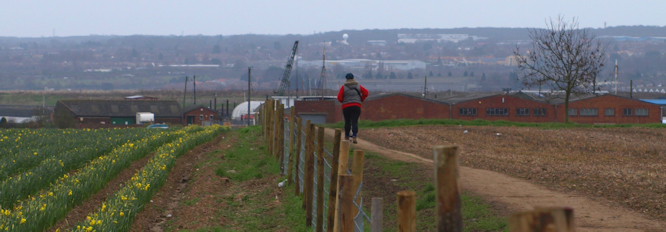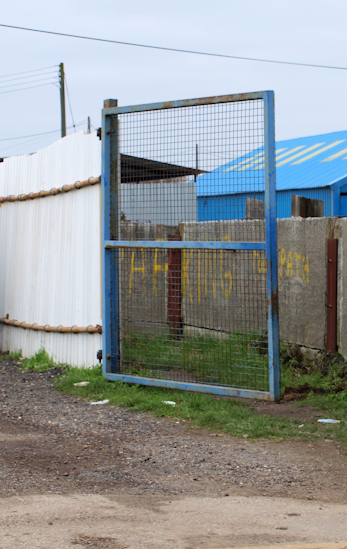
Stage 35. Gillingham to Upchurch

Cat with weird eyes, Gillingham, Ruth's coastal walk.Gillingham station is horrible. I walk behind an oversized girl, with a homemade tattoo on her bulging spare tyre, trying to get past the ticket barriers with a child’s ticket. She is stopped and, as I leave, she is being cross-examined by three ticket inspectors.

The only thing of interest I see during my walk down towards the shore, is an amazing white cat with different coloured eyes.

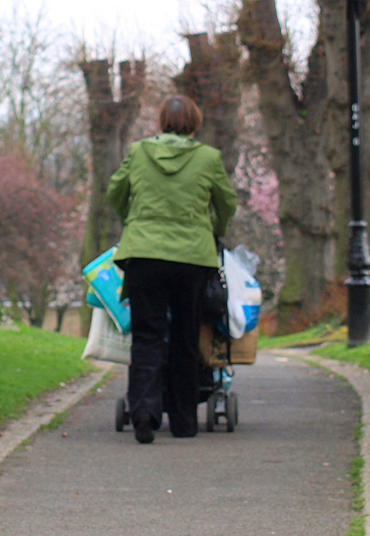
Woman with laden pushchair, Gillingham, Ruth's coastal walk
I walk behind a middle-aged woman pushing her grandchild (I assume) in a push chair. She has so many bags hanging off push chair, if she let go of the handles it would surely topple to one side. To be fair, most of the bags are full of disposable nappies.

Today I am carrying enough in my rucksack for an overnight stay at a B&B. This took a great deal of planning, as I try to travel as lightly as possible, so I have a change of clothing and some wash things, that’s all. At one point, I realise I am being eyed up by a fellow walker, walking on the other side of the street. Stealing glances towards him, I realise he is a real tramp – disheveled and with a dirty rucksack on his back.

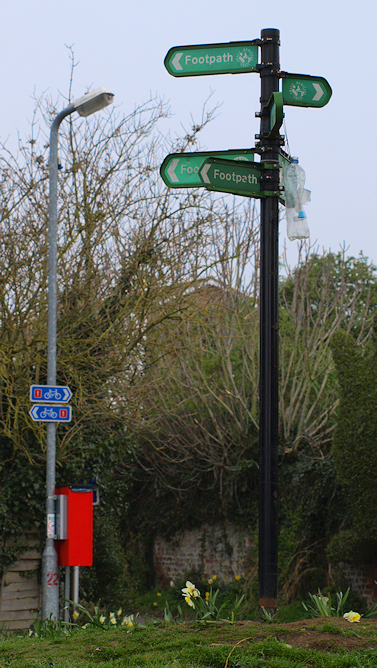
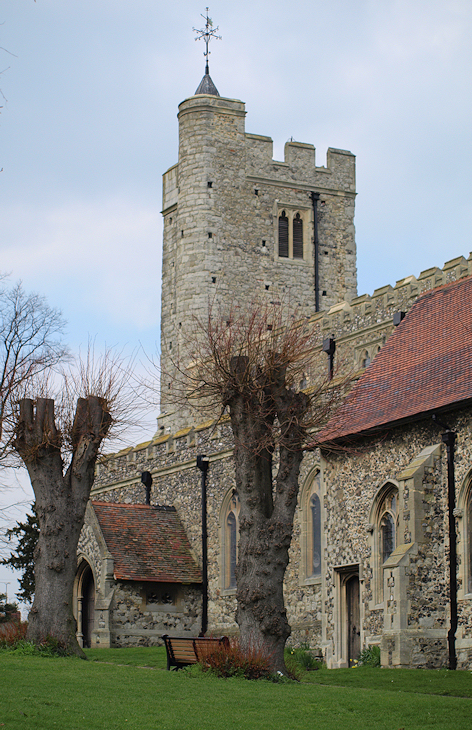
St Mary Magdalene Church in Gillingham Green, Ruths coastal walk.Partly to avoid walking too closely to him (and I am slightly ashamed of this), I linger in a church yard and get my camera out. A man, putting out the bins, motions me over and lets me into his garden, where there is a better view of the church. The churchyard is nice and just below it there is a green park (Gillingham Green) where, finally, I find some signposts for The Saxon Way.

I duly follow the signs, leading me down a nice lane until I reach a busy dual carriageway. Then the signs stop. Which way do I turn down the road? Left or right? The Saxon Way runs parallel to this road, on the far side, but how do I get access to it?

Then I remember my last visit here and see a familiar landmark.

Yes, I turn left and head for gasworks, a landmark I recognise. (Later I realise I could have joined Saxon way by going right – this would have been shorter but I would have missed excitement of The Strand).

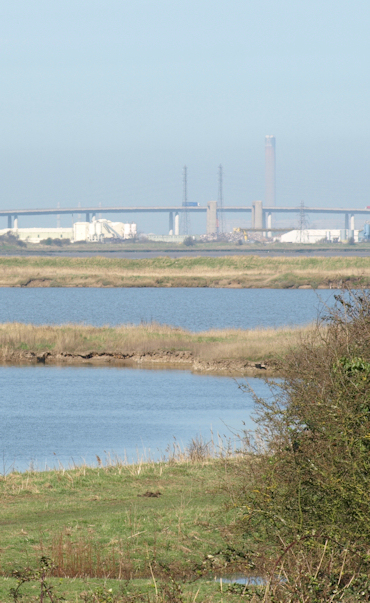
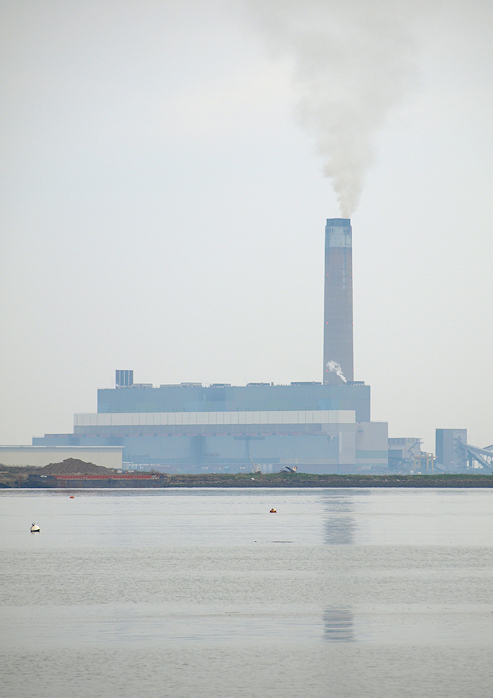
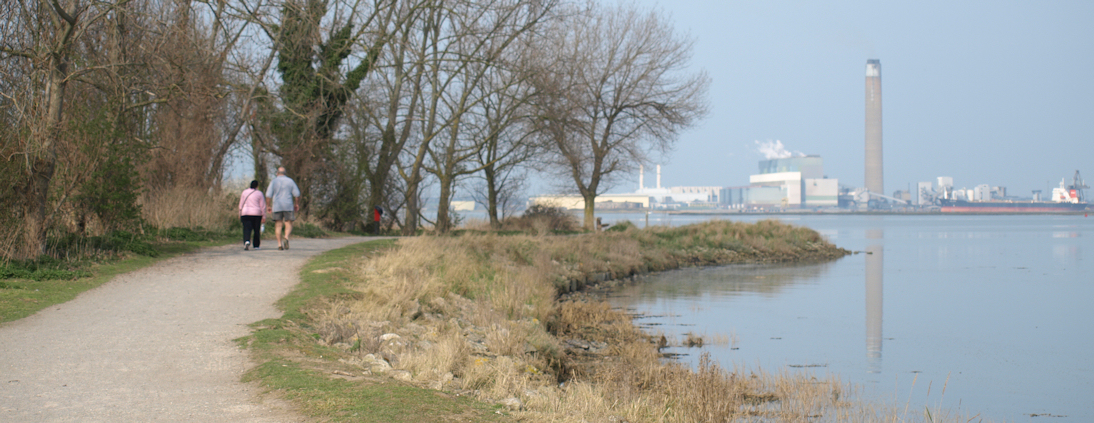
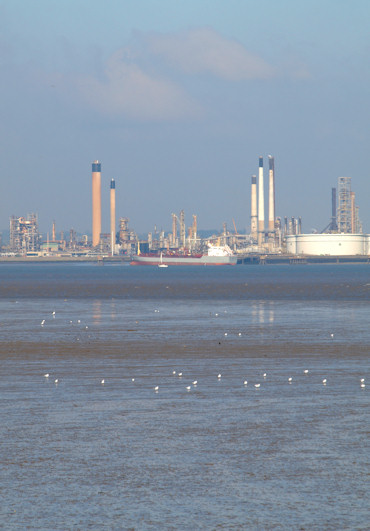
Kingsnorth Power Station, in morning mist, Ruth's coastal walkThere are people in The Strand and, unlike my last visit, the toilets are open. Still no snack bar or tea shop – shame. There is a low mist hanging on over the near horizon and I take some spooky snaps of Kingsnorth power station and the industrial structures on the Isle of Grain behind.

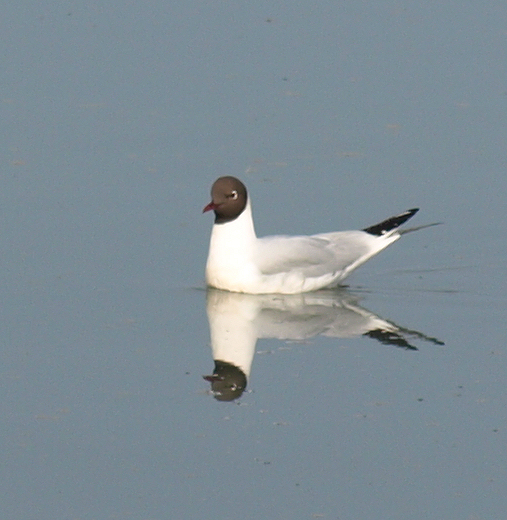
Little Gull, Ruth's coastal walkThere are some very noisy gulls with black heads. I am getting better at recognising wild life. I believe these are called Little Gulls.

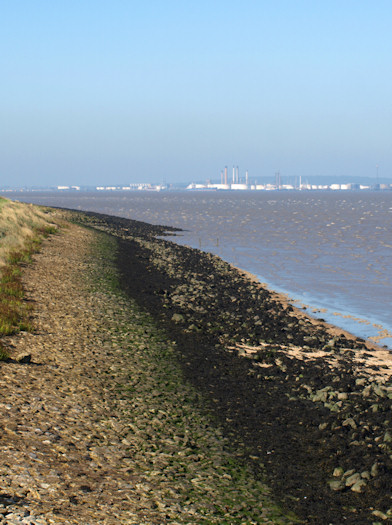
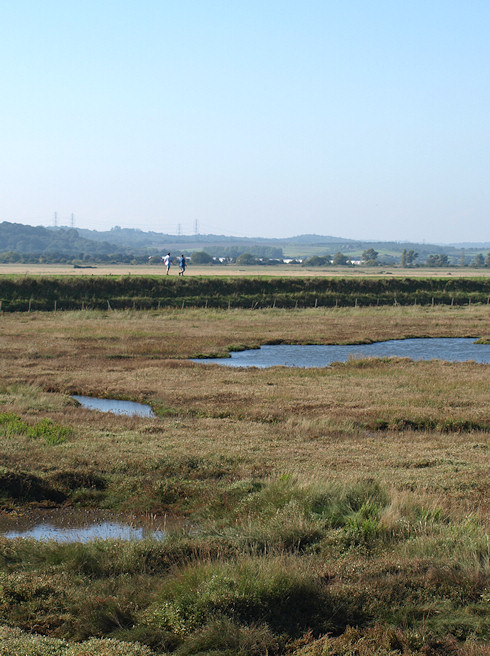
Now the sun comes out and, as I walk eastward along the shore, the area suddenly appears more attractive. Some time and effort has been spent here, turning the waterside into a scenic area (despite the surrounding industrial landscape). After walking past some houses and industrial areas, I come across a couple of lovely nature reserves – including the Riverside Country Park.

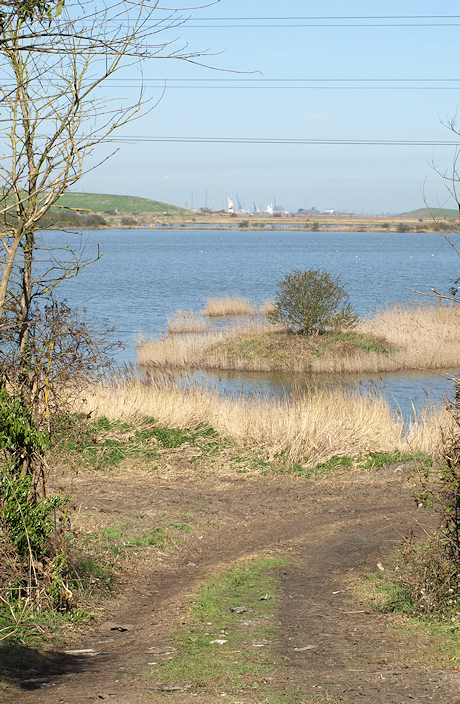
Riverside Country Park, Gillingham, Kent. Ruth's coastal walk.

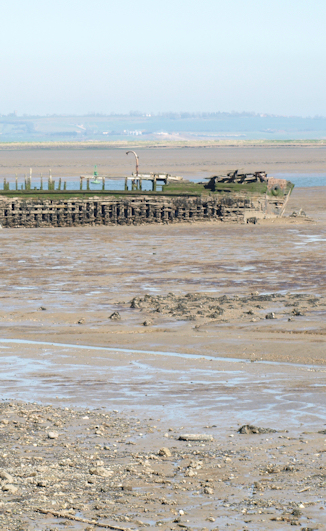
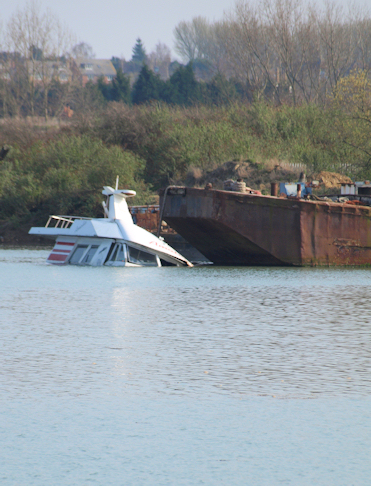
There are sunken barges in water. Kingsnorth Power Station remains a presence in the background. And, strangely, I notice ducks – dabbling – in the sea!

I see a notice about interesting flora and fauna. One thing that strikes me is the phrase “… grass snake, this is one of two species of snakes found here” – what is the OTHER one? There are only three species of snake in Britain, so it must either be the smooth snake or adder? (Later, I look up ‘smooth snake’ on the internet and discover these are rare and not resident in Kent. It must be adders.)

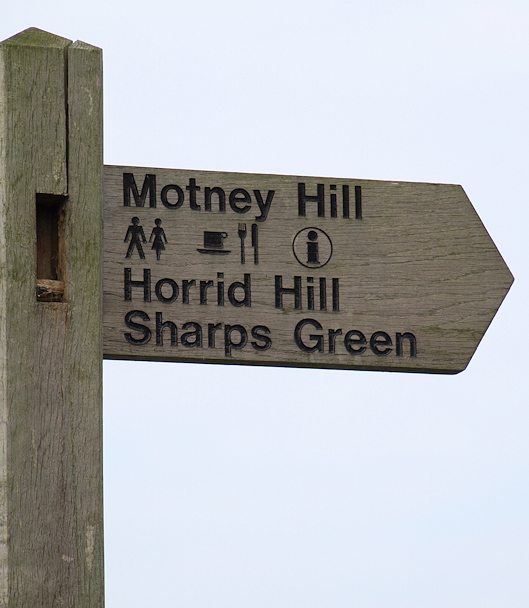
Sign with interesting names, Gillingham, Kent. Ruth's coastal walk.There are wonderful place names here. Horrid Hill is a small peninsula – with not much of a hill. Motney hill is a larger peninsula with a definite hill. The path leads here and joins a road. Not many people seem to walk this way. I wonder why.

The first clue is a tanker, passing me along the road, with “non dangerous waste” on its side. The second clue is the smell.

Yes, Motney Hill is a pretty peninsula but houses a sewage works.

Sewerage works, Motney Hill, Kent. Ruths coastal walk.

So, the far end of the peninsula is inaccessible and the shore is screened off by large fences. I wonder how people can work and live with such a stink – there are residential houses here with children’s play equipment in the gardens. But, after a while, I don’t notice the smell anymore. I guess you can get used to anything.

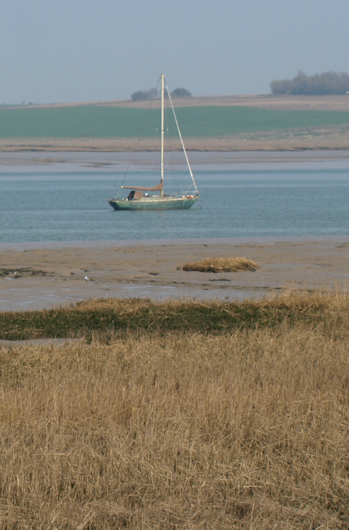
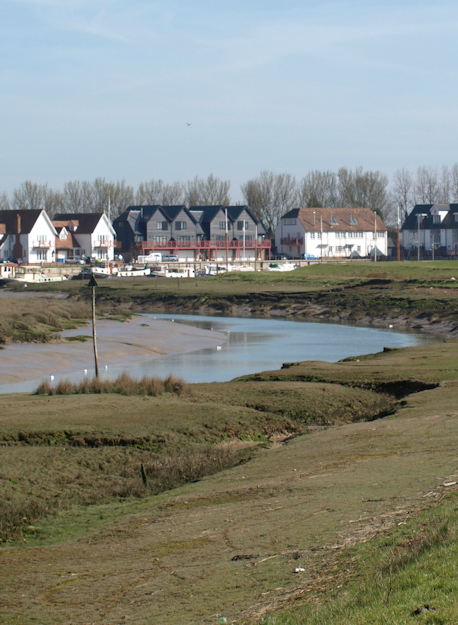
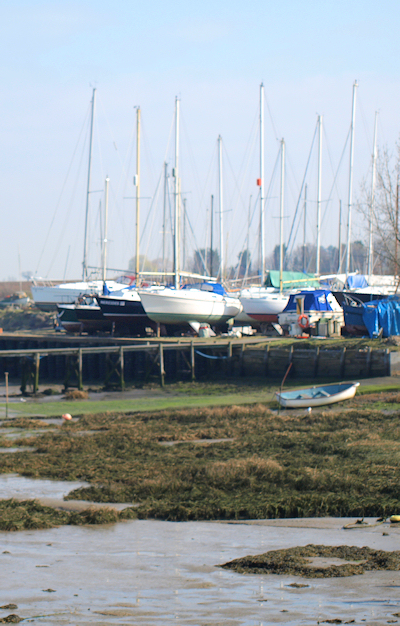
Otterham creek with sunken boats, Ruth's coastal walkI follow The Saxon Way as it winds along the edge of Otterham Creek. Moored in the creek are a motley collection of old houseboats, sunken ships and decaying wharves.

After that, Saxon Way turns inland and I walk along quiet roads and footpaths, up Windmill Hill, through orchards. I catch a glimpse of a man skinning and gutting rabbit with no sign of a knife – in a field beside his open 4×4. From the glimpse I have, he appears to be deftly removing fur and innards with his bare hands. He must have a knife! I don’t linger to find out.

After that, I am forced to follow a road. Although there is not much traffic, the road is dangerous for walkers, barely wide enough to allow two cars to pass and certainly not wide enough for two cars and a pedestrian, there are no pavements or verges. The map shows the footpath branching off to the left. I see a likely looking track, but it has ‘private’ signs and a barrier (albeit raised to allow access). Continuing on, I realise that this must have been the footpath – the official Saxon Way. By this time it is too late and I have climbed a steep hill and am in the village of Upchurch.

I resolve to report this to the council. Up until this point, this section of The Saxon Way was well signposted. Someone has removed the signs.

I stop at a busy little village co-op and buy some coke and snacks for tomorrows walk.

Hawthorn blossom, March 22nd 2011, Ruth's coastal walk.Then, walking onwards, I arrive at my booked B&B., where I am given a warm welcome, a cup of tea and a huge slice of cake in the garden. A robin joined me for tea, perching on the back of the garden chair.

In the fading sunshine of this warm day, I notice the garden birds very noisy. It must be spring.

Already I am worrying about my walk tomorrow. I feel exhausted, have had trouble finding the correct footpaths, and yet I have only walked 7 miles today. Tomorrow’s walk will be 14 miles to Sittingbourne.

I was right to be worried. Little do I realise what a mission this will be!


Posted in 05 Kent | Tagged , , , | 9 Comments

Stage 34. Hoo St Warburgh to Rochester

Church at Hoo St. Werburgh, Kent - Ruth's coastal walk.I walk through the graveyard of the church at Hoo St Warburgh. There are fresh graves with real flowers and little windmills. On a child’s grave there is a teddy and balloons. I refrain from taking photographs – it seems too intrusive on other peoples’ grief.

It may be a grey day, but I am glad to be alive.

I cross the road and join the Saxon Way. In front of me, Kingsnorth Power Station is belching steam, but I am not heading back towards it. Instead, I follow the path as it turns to the South and I walk briskly down the hill to the shore.

I am going to find a river, not the sea. Oh, I long for the sea but I have the River Medway to navigate first. I have only seen this river from the M2, whizzing over it on the way down to Dover or Folkestone, on family holidays.

Saxon Shore Way, near Hoo, Kent - Ruth's coastal walk.

According to the OS map, There are 2 Saxon Ways – one running close to the river, the other further inland, running along the top of a slight ridge. My husband advised me to take the top path as the views would be better. I am inclined to take the route closer to the shore – following my self-imposed rule of sticking as close to the water as possible.

Spot the foot path? Saxon Way, Kent. Ruth's coastal walkWhen I reach the river bank, turning right to follow the shore, I wonder if I have made a big mistake.

The path winds through unfriendly semi-industrial spaces and is, at times, hard to spot. Oh, here it is, hidden behind this fence and with unappealing barriers making sure I keep to the straight and narrow. Narrow it might be. Straight? I wish!

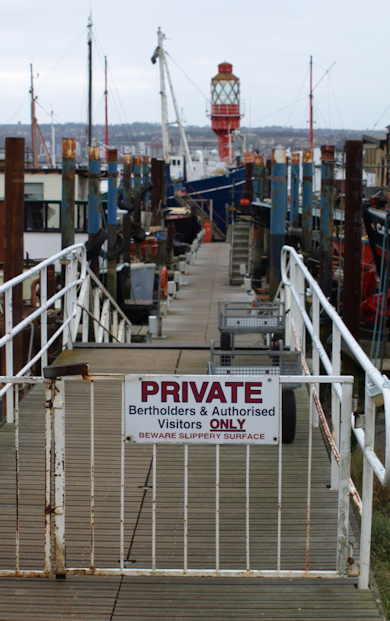
When I emerge from this unpleasant alley way, I find I am walking round the edge of a marina. Fences line my path and there are many signs telling me not to trespass, private property, keep off. There is a strange jumble of boats; some large ships that appear abandoned, a collection of houseboats, a few yachts and an assortment of small tugs and motorboats.

The marina has a slightly run-down feel to it, but at least it is used.

Marina and Private sign, Saxon Way, Ruth's coastal walk.Houseboats, Saxon Way near Hoo. Ruth's coastal walk.Hosing down in the Marina, Saxon Walk near Hoo. Ruth's coastal walk.

Emerging at the other end of the marina, the walk stretches ahead of me, hugging the shore line. This is the most pleasant part of the walk so far and, indeed, the most pleasant part of the walk for the rest of the day.

Saxon Shore Way, from marina at Hoo towards Rochester, Ruths coastal walk. The shore is typical estuary – a mix of mud and shingle. There are obvious signs of erosion along the bank. In some places I can see, above my head, large, exposed tree roots. Here parts of the bank (trees and all) look as if they could come crashing down at any moment.

Now I realise why there are two Saxon Way’s marked on the map. At high tide, this path would be covered.

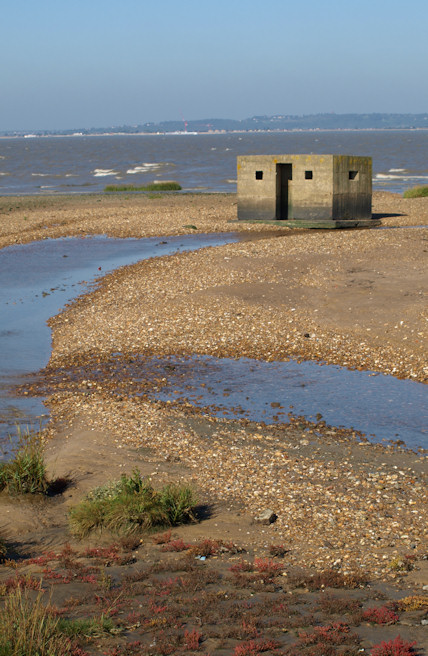
collapsing pill-box, Ruths coastal walkThere is the obligatory, and collapsing, pill box.

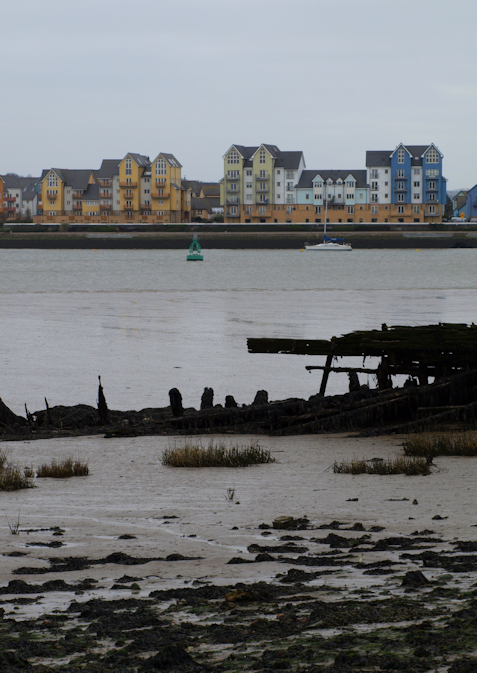
Across the water are some nice looking, modern houses.

Looking at my map, I realise this must be a new residential development on St Mary’s Island, part of the town of Rochester. The brightly painted houses look somewhat surreal against the muddy estuary and the hulks of wrecked and abandoned boats.St Mary's Island, Rochester, Ruth's coastal walk.

As I approach Lower Upnor, I see ahead of me a castle on the river bank. It rises, imposingly above the water. The light is too poor for photography. Later I learn this is Upnor Castle built in the 16th Century to protect the Medway, on the orders of Queen Elizabeth the 1st.

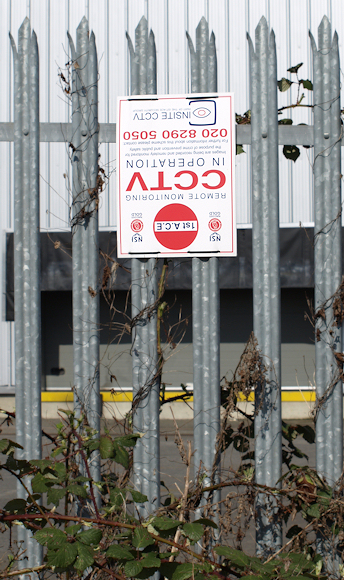
My path now winds around the edge of an industrial area, some parts of which appear to belong to the Ministry of Defence. There is the usual assortment of unfriendly notices, telling me to “Keep Out”, “Beware, Guard Dogs”, “CCTV in operation” and, while I’m at it, “No parking”.

Path behind Upnor Castle, Ruths coastal walk. A climb up some steep steps and I find I am walking around the back of the castle.

There is a high wall to my left, marking the perimeter of the castle grounds, while on my right are steep wooded slopes with glimpses of a road below. When I emerge from this leafy pathway, I find I am in a very pleasant village, Upper Upnor.

Lion guarding a doorstep, Upnor, Medway, Ruth's coastal walk.Interesting buildings, Upper Upnor, Ruth's coastal walk in Kent.

The street I am on is very pretty and the houses are well cared for. Lions guard some steps. There is interesting architecture.

I pass the front gates to Upnor Castle, but resist the temptation to go in.

Time is pressing and I have arranged to have lunch with my husband in Rochester.

Upper Upnor High Street, Saxon Way, Kent.Upnor means, literally, “at the bank” in Old English. The High Street is perched above the river and is, really, just a footpath – leading down to the shore.

The shore itself is very muddy. I see a family walking down towards it. The children run ahead and begin shrieking with delight as the mud grasps their boots and they begin to slip and slide. The parents stop, horrified, and shout to them to come back. Too late! Mud – glorious mud – everywhere.

I am glad I have my walking boots on.

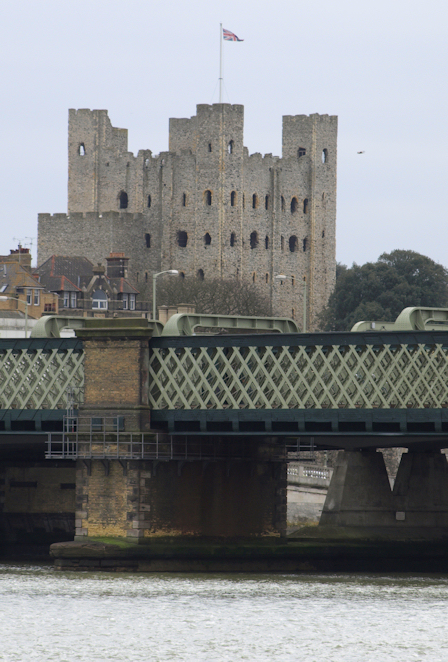
Rochester Castle, Kent. Ruth's coastal walk.From here the path turns inland and I see the busy dual carriage way that lead to the Medway Tunnel. I begin to worry about crossing this road, then, to my delight, I see there is a set of traffic lights for walkers and cyclists.

Once safely across, I scramble up a steep hill and walk along a road, approaching Rochester. From this high vantage point, there is a good view of Rochester. I see the bridge across the river, a fine-looking 12th century castle and a Cathedral.

As I near the bridge, I realise there are actually two bridges across the river; the nearest bridge being more modern with an attractive older bridge, guarded by imposing lions, on the far side.

Bizarrely, I spot a submarine in the river. It is badly rusted and listing to one side. I am surprised to see a hammer and sickle on the turret. Later, I tell my husband there is a Russian submarine in the Medway. He laughs and says someone must have painted the Russian emblem as a joke.
Russian submarine, Rochester, Ruth's coastal walk.

Later I find out it is, really, a Russian submarine; a Hunter Killer Class sub, called The Black Widow.

After lunch, I walk through Rochester (or is it Chatham), heading for the shore at Gillingham. I wish there was something nice I could say about this part of the walk. It is not possible to follow the shoreline (due to docks, wharves, industrial units, etc), so I follow the Saxon Way as marked on the OS map.

“It must be scenic, if it’s the Saxon Way,” said my husband. There was a shorter route I could have taken, but I believed him.

Chatham / Gillingham is a deprived area with massive unemployment following the closure of the naval base at Chatham Dockyards in the 1980s. Despite a marina and a new business park, there seemed little sign of prosperity. The Gillingham railway station is one of the scruffiest I have ever seen (come on Southeastern Railway – how much does a tin of paint cost?) and I walked along neglected and unloved streets with sad-looking houses with peeling paint, broken windows and concreted front gardens. The only nice, new building I saw belonged to Medway Council.

Maybe I am being unfair. Maybe it is the grey weather and the low clouds. Maybe.

Eventually, dispirited, I arrived at The Strand – a newly developed, much trumpeted, leisure area. I am looking forward to a cup of tea and a visit to the toilet. If I follow the signposts of the Saxon Shore Way, they should me lead here. The problem is, the signage is poor. I reach a main road and don’t know whether to turn left or right. I walk in both directions but see no evidence of a leisure park. Eventually I phone my husband, who is sitting in the car park at The Strand, and he directs me.

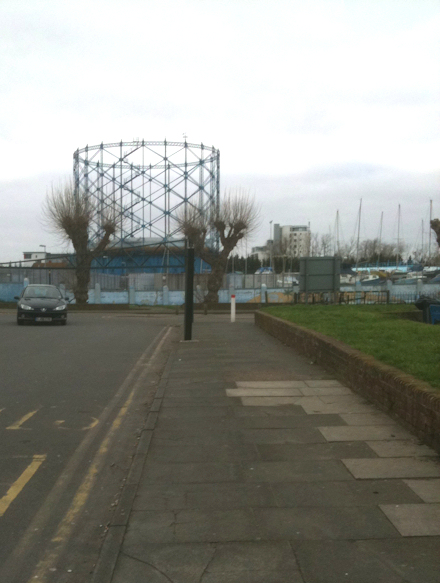
Gasworks, Gillingham, Ruth's coastal walk. “Head for the gasworks,” he says.

I do.

Here, in the shadow of the gasworks, is the Strand. There is a car park with a few people sitting in their cars, eating takeaways. Beyond some children’s play equipment, I can see the shore and the waters of the estuary in the distance, with Kingsnorth Power Station as a backdrop.

There is no cafe.

The toilets are shut.


Vital stats:
Miles walked = 10
Submarines spotted = 1


Posted in 05 Kent | Tagged , , , | 6 Comments

Stage 33. Allhallows-on-Sea to Hoo St Werburgh

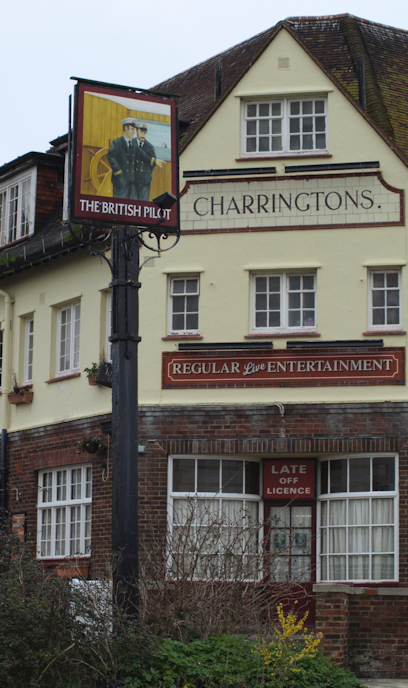
The British Pilot, pubFinally, a Saturday with no rain forecast and the temperature above freezing. Here we are, in the car park of “The British Pilot” pub in Allhallows. It is 5 months since I last walked the coast and I am dying to get on with my trek.

It is a grey day with low cloud. I take the footpath across the field towards the bank. Here I stop to admire the view – scenes of where-I-have-been-before are spread out on the other side of the Thames estuary. Looking left, past Allhallows itself, I see the refineries of Canvey Island. Across the water is Southend-on-Sea. To my right, my path for today extends Eastwards along the deserted bank.

I set off with water on my left-hand side and small waves lapping against the bank. Is it a sea bank or a river bank? I am not sure. This is the junction between river and sea, the in-between area.

Beacon and London Stone beyondI have not gone far before I turn southward, following the bank as it follows the course of Yantlet Creek. On the other side of the Creek is the Isle of Grain (misnamed now, as no longer an island, just a peninsular – the gap between has silted up – although there was a time when you could sail a ship through here, avoiding open sea).

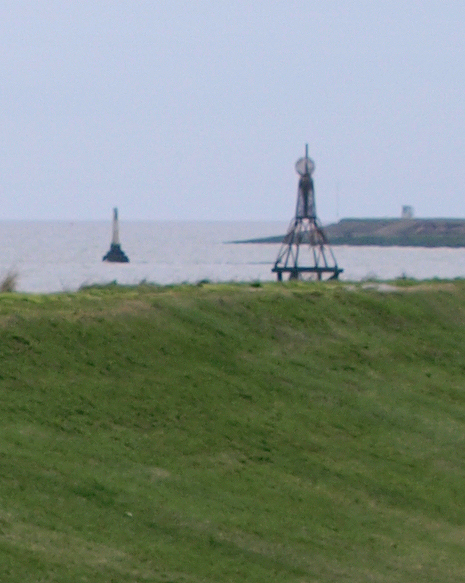
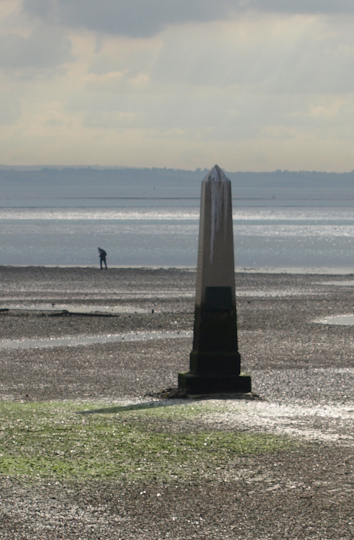
I notice a beacon out in the water and beyond that a stone monument. Later I learn this is one of the ‘London Stones’, marking the boundary of the jurisdiction of the City of London.

The Crow Stone, Southend (Yantlet Line)Across the water in Southend is another London Stone, the Crow Stone. (I photographed it in September, when I walked through Southend, not knowing what it was.) The line between the two stones, running across the mouth of the River Thames, is called the Yantlet Line and defines the limit of jurisdiction of the Port of London Authority. I suppose this is the line beyond which the River Thames officially becomes the North Sea.

The sun comes out. There is nobody around. Across the fields I see the distant industrial structures of the Isle of Grain.

There is nobody around. I wonder why. Allhallows-on-Sea hosts a large holiday camp and I would expect people to be out, walking dogs, etc.

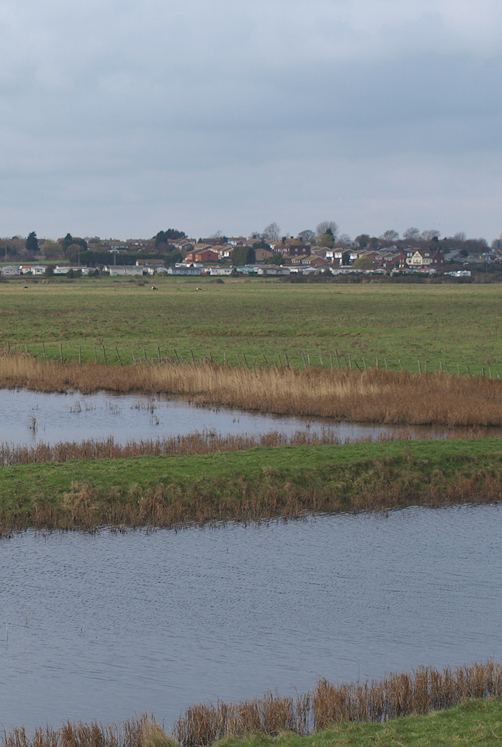
View across Allhallows Marshes to Isle of Grain, Ruth's coastal walk.

I have done my research today. The footpath follows the bank ahead but ends abruptly. I couldn’t find any ‘right of way’ connecting the path to a track or road. So, I have decided to strike off inland, following a footpath to Binney Farm and then into Allhallows itself.

I nearly miss the footpath, the signs are destroyed. And the path is very muddy. Obviously hordes of cattle have travelled this way. The bank is covered in cow pats but, worse still, the footpath itself is churned up by hundreds of deep footprints. I make my way, with great difficulty, across the marshy field. I wish I had my poles, I think, as I leap from one muddy area to another

Allhallows Marshes, Ruth's coastal Walk Then I reach a section where I must cross a narrow spit of land, surrounded by water on either side. I know this is the footpath – I can see Binney Farm ahead. But the crossing consists of deep, sticky mud. Worse still, it is pockmarked with huge, water-filled, cow footprints. I can’t go forward. On either side are watercourses. There is no way around. Mud has reached past my laces to the tops of my boots. With each step, I feel my boots being tugged downwards. I am in danger of sinking to my knees – or ending up barefoot.

I crisscross the muddy field, trying to find an alternative route, but water ditches impede my progress, too wide to jump.

Eventually, with considerable frustration and a heavy heart, I admit defeat. There is nothing else to do. I turn round and retrace my steps back to Allhallows-on-Sea, back to The British Pilot pub.

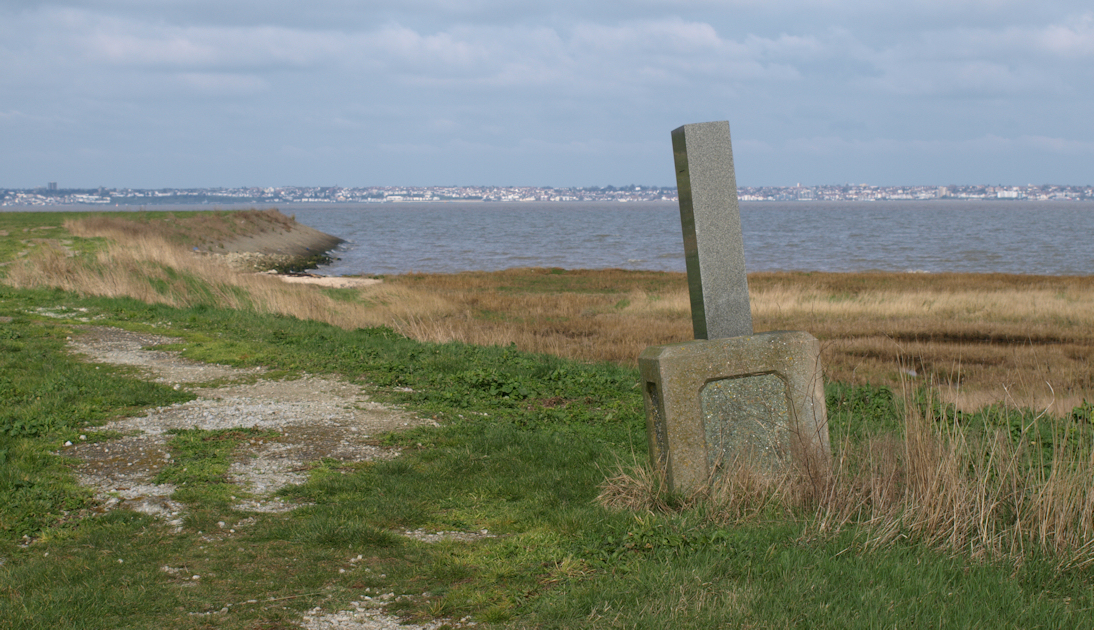
Monument marking completion of Thames Flood Defences, Ruth's coastal Walk On my way back, I pass a monument that I failed to take much notice of first time. This is a grand monument, erected by the Southern Water Authority, Kent, to commemorate the completion of the Thames flood defences (1975 to 1985).

The monument is leaning at a rakish angle. The river refuses to be tamed and is already claiming victory. Nature is having the last laugh.

From the pub in Allhallows-on-sea, I follow the road to Lower Stoke, where I am meeting my husband for lunch. I leave a trail of muddy footprints along the pavement.

Isle of Grain, across fields, Ruths coastal walk.Luckily, the road is quiet with very little traffic. It follows a slight rise to the land, and I have a good view of the Isle of Grain across the fields.

I worry about lunch. It is too cold to sit outside, but my boots are very muddy. I needn’t have worried. The pub is run down, unloved and uncared for. There are a couple of old boys at the bar, otherwise the place is empty. It is Saturday lunchtime but they don’t do food. However, the bartender is happy for us to buy food from elsewhere and eat it in his pub. A nearby convenience store is staffed by a Chinese Lady who cooks hot food to order! How wonderfully convenient.

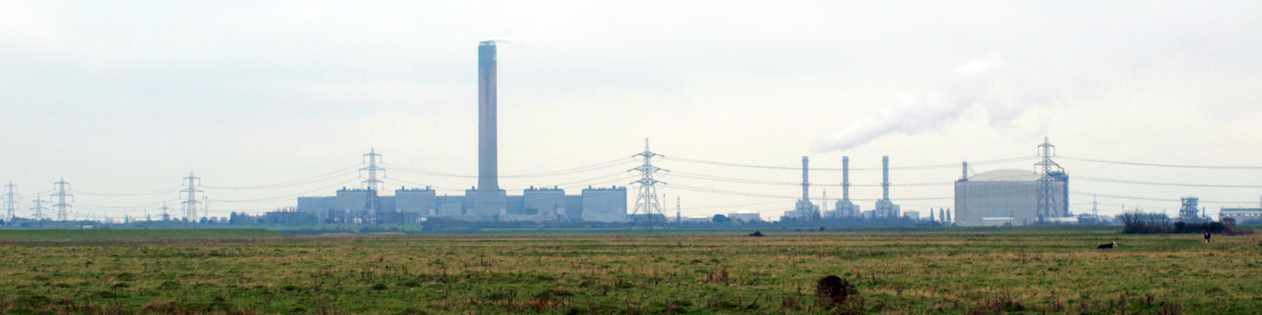
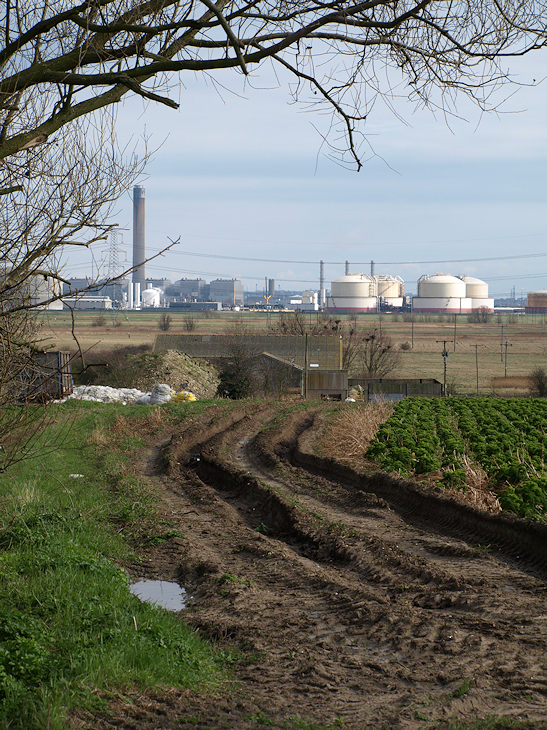
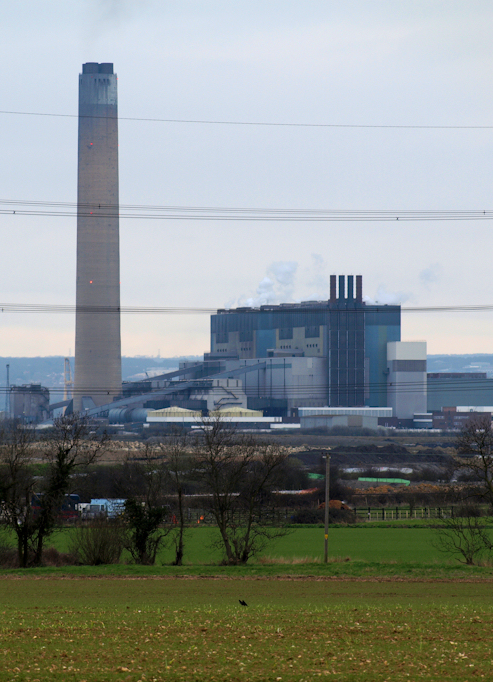
Kingsnorth Power Station from 'North Street', Ruth's coastal walk.From here onwards, I stick to footpaths, crossing fields to pass by the small village of Stoke, on to Tudor Farm and continue via a bridleway, grandly called North Street on the map. In the distance, Kingsnorth Power Station comes into view and grows steadily larger as I walk southwards.

Now I cross over railway lines. As I hesitate (stopping, looking and listening – as instructed by the signs), I see ahead of me a path with a tall hedge on one side and just get a glimpse of a figure; a man appears to leap into the hedge, just out of sight.

I feel a momentary flash of anxiety. Why is a man hiding in the hedge?

But I have braved cows, snakes and mud. And, I have no choice but to continue. So I do.

As I walk along the path, he comes into view, standing on the side of the track, almost in the hedge. He is youngish, and he has a shot-gun slung over his arm. After another flash of anxiety, I realise he also has a sheepish look on his face. He doesn’t look menacing – he looks guilty.

I nod and say ‘hello’ and he returns my greeting. I feel slightly uneasy as I pass and walk onwards. With my back towards him, I can no longer see him or the gun. But I notice the ground on either side of the path is full of rabbit holes and I am pretty sure that explains his purpose today.

There is a line of pylons on my right. I can hear electricity crackling in the air around them.

Approaching the power station and surrounding industrial estate, the footpath becomes littered with the debris of untidy humans – crisp packets, tissues, empty bottles, cigarette butts, etc. But, apart from the man with the gun, I meet nobody. It is Saturday and the place is a ghost town.

I walk past one entrance to the power station, manned by a bored looking guard. The footpath continues onwards across fields, under another line of marching pylons and towards Hoo St Werburgh.

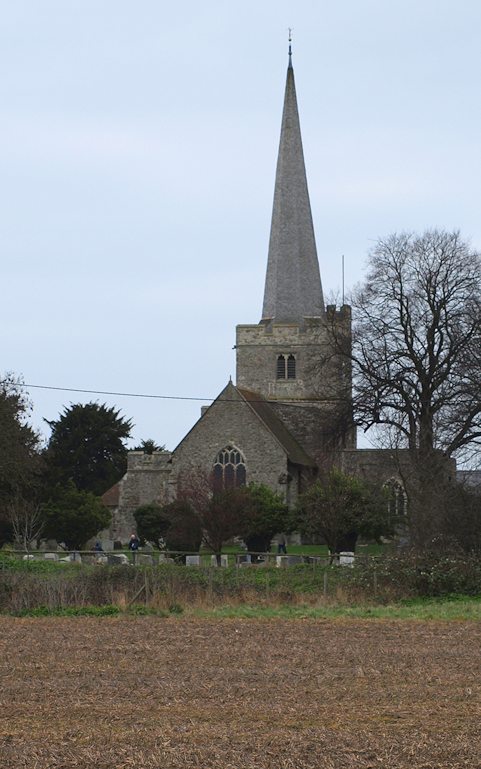
Church at Hoo St Werburgh, Ruths coastal walkThe light, already dull, is fading further. I am tiring and looking forward to the end of this walk. I can see the church spire ahead of me.

Looking at the map, I realise I am on the official Saxon Shore Way, one of our long-distance footpaths. Now I meet more people, walking dogs and riding horses. I cross a road and walk through the church yard to the front of the church.

I am early and my husband is late. It has been too muddy to stop anywhere for a snack. Now I sit on a wall and drink my water and eat all my chocolate bars.

This has been a day of ups and down. For the first time, I have been defeated by mud. Walking along rivers and estuaries can be very frustrating, with constant detours inland. Having started off so close, I am now, it seems, some way away from the sea.

But at least I am making progress. And tomorrow is another day ….


Vital stats:
Miles walked = 10 miles
Interesting sights seen = The London Stone, man with a gun, Kingsnorth Power Station, industrial landscape, tons and tons of mud.

Posted in 05 Kent | Tagged , , , | 10 Comments

Stage 32. Egypt’s Bay to Allhallows-on-Sea

Style to Halstow Marshes, Hoo Peninsula, Kent. Ruth's coastal walk. I start my walk at Swigshole, climbing over the style and walking up the potholed track to reach Halstow marshes. Walking along a raised bank, I am back on the riverside footpath once more.

Egypt Bay looks different this morning. The gulls have gone.

Canvey Island, view over the Thames, Ruth's coastal walk, Kent.I walk with the River Thames on my left. Across the blue-grey water are the storage tanks and chimney towers of Canvey Island.

Large freight ships pass up and down, carrying containers.

I walk along the endless river wall. To my right is marsh and farmland, stretching inland to where the land rises into a gentle ridge.

I see nobody.

I walk, making good progress and following the raised bank, around another inlet, called St Mary’s Bay. Now I am in the area called St Mary’s Marshes.

The tide is coming in. The river wall disappears and becomes a simple raised bank. The shore is free of litter but is rough, with seaweed strewn rocks. The river widens and the far bank looks, well – far.

Looking towards Canvey Island, Hoo Peninsula, Kent. Ruth's coastal walk.I look back along the River Thames to Canvey Island, disappearing behind me. I am beginning to feel I am making good progress and will soon be near the open sea; something to look forward to after days of river walking.

Rounding a curve in the river bank I see, across marshland, Allhallows-on-Sea ahead of me. This is where I am meeting my husband for lunch. There is a little bay between. The tide is in and, although there is an area of sand bank running just off shore, I can see no easy, dry, route across the bay.

I consult my map. The official footpath runs parallel to the river, round the bay, but keeping just inland, along a bank that runs along the edge the marsh. As I search for the footpath, I come across a wide track and am tempted to follow it, but this would lead me too far inland. Allhallows is my destination and that is ahead of me, across the bay.

Then I spot the footpath through the marsh, following the top of one of the many banks running between waterways. The path is not signposted, but other people have trodden the long grass down, creating a visible track. I follow the path with confidence, but it soon becomes lost in a maze of bramble and hawthorn bushes. Sticking to the beaten route as best I can, I bend down to crawl through clumps of hawthorn and I constantly fight off the thorny embrace of bramble branches.

St Mary's Marshes, Kent, Ruth's coastal walkLooking back, I see two young walkers have crossed the bay, using the sandbank as a path. They have come from the direction of Allhallows. There must be a way across the bay, avoiding the marshes and keeping close to the water. I am tempted to go back and retrace their steps, but I have come so far along here now, and the route back is through thorny brambles. So I decide to continue my trek through the marsh.

In retrospect, this was a mistake.

But for the moment, it seems like the right decision. The path becomes clearer and leads along the edge of a farmers field. Here the ground is very muddy, churned up by cattle, and I am glad to come across a style, leading back over into the marsh.

Where to go now? I see some planks of wood lying in a line across the ground. Everywhere else is mud and bog. This must be the path.

Now I reach a bank, slightly higher than the surrounding bog. It looks like people have walked along here. But, as I follow it, the bank meanders, taking right-angled turns, so that I am constantly doubling back on my route and making slow progress. The path becomes less obvious and the tracks disappear. Now the top of the bank is narrow and obscured by long grass. There are no thorny bushes but the ground is rough and uneven. I am grateful for my poles. Progress is painfully slow.

As I jump across a ditch, landing on a bed of flattened grass and reeds, something long and thick slithers away from close to my left foot.

It is a snake.

The colour of the snake was a uniform, dull brownish green colour. I know this means it was a grass snake and, although I am no longer fearful of grass snakes, I do worry about something worse – adders. I would like to put my gaiters on for protection, but the ground is too uneven for me to balance while I do this and I can’t bring myself to sit down in this damp, muddy, snake-infested bog.

My meanderings have brought me closer to the shore and I see there is a narrow, shingle “beach” by the water. I abandon the path, if it was a path, and stumble across spongy, wet vegetation to reach the shore. Now I walk on shingle and am grateful to be off the marsh.

But ahead I see a bank of soft earth. The tide is in and the beach is covered with water up to the bank. The bank is boggy with water trickling down it and marshy plants visible on top. Although it is not very high, I realise I can’t climb up easily. I would have to scramble up on hands and knees and, even then, may not be able to make it up the soft, slippery surface. And I have no idea what sort of foothold there is at the top.

Reluctantly, I turn back and, where the ground is flatter, make my way back onto the wet marshland.

Bridge over ditch, St Mary's Marshes, Kent, Ruths coastal walkFollowing a raised bank, I come to a dead-end. The bank ends and there are water-filled ditches on every side.
I am faced with the awful prospect of walking back the way I came, or trying to find another way across the marsh.

Then I see a plank across one of the dykes. Is this a proper path? Or has someone just put it here to get access to an area for fishing or hunting?

I don’t know and I don’t care. I am running out of choices. I walk the plank.

The bank stretches ahead from this point, one of a number of banks, all running parallel and separated by stretches of green water and mud. I have no idea whether I am on the right bank and I worry that I will come to a dead-end and have to retrace my steps back through this boggy marshland.

All thought of following the official footpath has long since gone. I just want to get to the other side of the marsh; in one piece and before the end of the day. So I continue, balancing on the top of the bank, using my poles to support me and praying I don’t twist an ankle or meet an adder.

After some time, and to my surprise, I see people walking in the distance. I am approaching Allhallows. In my world of water, mud and bogs, I had forgotten another world existed. The people ahead are walking in a line that takes them across the end of my bank, far ahead of me. Even at this distance, I can see there are children in the group. So there must be a dry route ahead and it must be relatively safe.

The bank continues straight and, eventually, ends when it meets a flowing waterway; a narrow river. By the time I reach this point, the group of people have long since gone. I realise they weren’t on this bank, but on a far bank, on the other side of the waterway. My forward progress, once so hopeful, is now halted. Luckily, there is a bank along my side of the waterway, and I follow this towards the shore.

Pill Box, Allhallows-on-Sea, Kent coast - Ruth's coastal walkAhead of me, the shingle beach comes into view. The sun comes out and shines on the sea, the beach and one of the ubiquitous pillboxes that dot the countryside.

My bank dips sharply downwards, towards the beach and I head downwards at a run. Now there is a shallow stream of water separating me from the shore. Compared to the watery wastes behind me, this barrier is a trivial inconvenience. I splash across it.

From here the going is easy, with the narrow beach taking me up to a wall with a promenade. There is a holiday park here. People are out with their families.

The promenade is being eroded by the sea. This end is narrow with signs warning the route may be impassable at high tide. But I am just grateful for solid concrete beneath my feet, albeit cracked and broken.

After my lonely trek across the marsh, it is strange to be here, with people.

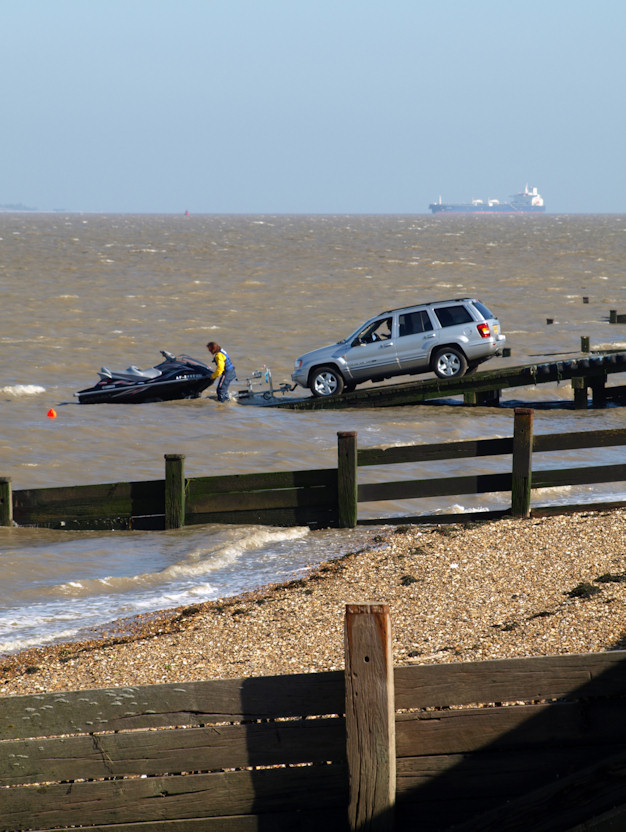
Jet ski being unloaded, Allhallows-on-Sea, Ruth's Coastal WalkAround a corner of the promenade and I come across a slipway where a large car is unloading a jet ski into the water. The skier sits astride the machine, shooting water up into the air, before he sets off in a bouncy ride across the waves.

It is windy. There are people fishing off the promenade and, further along there is a wide green spaces with benches. I am feeling very tired and sit on one of the benches for a while.

I am hungry and need my lunch.

The last mile of the walk is hard going. My legs ache from the strain of my journey across the marshes and I am still feeling the effects of yesterday’s 15 mile hike.

As I leave the shore, heading inland towards the pub, I walk between static caravans and holiday cottages, past a fishing lake.

Fresh Mushrooms, Kent. Ruth's coastal walkFrom the door of one of the cottages, an elderly lady calls out to me. Would I like some mushrooms? No, thank you, is my first reaction. I am tired and groceries are the last thing on my mind. But she has picked them today, far more than she needs and, if I don’t take some, they will be wasted. She had a huge plate for breakfast and can’t face anymore.

I take the proffered plastic bag. The mushrooms do look lovely. All different sizes and with creamy, pale tops and warm, brown gills.

My husband is waiting in the pub and Paolo Nutini is playing through the speaker system. We have a large roast dinner, with cider, and talk about ways to cook mushrooms. I have another cider. My aches and pains begin to fade but are replaced with a wonderful feeling of sleepy relaxation. I tell my husband I will walk no further today.

I have another cider while he fetches the car and fall asleep on the way home.


Miles travelled = 7 as crow flies, but considerably more in reality.
Snakes seen = 1
Low point: getting lost in the marshes
High point: a bag of fresh mushrooms

Posted in 05 Kent | Tagged , , , , | 24 Comments

Stage 31. Gravesend to Egypt Bay

Tilbury Power Station, in mist, from Kent. Ruth's coastal walk.Today is damp, dark and misty.

I start my walk at a crossroads in the Milton Industrial Estate, Gravesend. Last time I was here, in the fading light at the end of a long day, I was uneasy and unhappy. Now, in the cold, grey light of day, the place has lost its sinister menace. There is nobody around. It is Saturday.

My husband is interested in the long, flat cycle route, stretching from here, inland, through an area marked on the map as “Danger Area”. But I am not taking that route. My route is the Saxon Shore Way. This starts as an unpromising alleyway, running between industrial wharves on my left and storage yards on my right, through an uncared-for looking pub forecourt and then passes through a high metal gate.

Industrial jetty, south bank of Thames, Kent. Ruth's coastal walk Now the path rises up, I am past the wharves and am walking on the river bank itself. There is a wonderfully spooky view of Tilbury Power Station, rising as a pale ghost on the other side of the River Thames. Last time I was in this area, the power station was glowing in the light of the setting sun. Now, in the daylight, I can barely see it through the murky mist of this October day.

To my right, just inland of the bank, is a power relay station; I don’t know what the technical word for the structure is. This is where, I presume cables carrying electricity from Tilbury emerge after their journey under the Thames. From here pylons march across the fields, carrying their electric charge to homes and businesses.

There are a few fishermen out today but this bank of the Thames is otherwise deserted. I notice some burnt patches in the grass where people have lit fires, surrounded by makeshift seats of breeze blocks and old wooden planks. Scattered around the burnt areas are old beer cans, plastic bags and cigarette butts. Whether it is fishermen enjoying the results of a day’s fishing, or groups having impromptu parties, it is unclear who has left this mess.

The further I walk, the less signs of human litter.

Pony on River Bank, Thames, Kent. Ruth's coastal walk.Up ahead are a group of ponies. They come charging down an incline, towards me. I am no longer afraid of horses. This is what I tell myself. There are young ones among the group. They are very skittish and give me a wide berth.

After circling around me, the ponies disappear off into misty fields, heading inland.

I am using my poles today and making rapid progress. Although I know I am moving quickly, I am surprised to see an old fort, rising out of the gloom ahead. This must be Cliffe Fort, the twin to Coalhouse Fort across the Thames, invisible in the mist. I have arrived an hour earlier than I expected.

Old Battery, Hoo Peninsula, Kent, Ruth's coastal walkI climb up a grassy incline to the fort structure. There is a semicircular wall with gaps where guns would have sat. On top, there are remnants of larger gun placements. Behind the fort are ruined buildings.

Believing I am at Cliffe Fort, I spend some time looking round and taking photographs.

Then I see a sign. The sign tell me this is Shornemarshes nature reserve and the fort is Shornemead Fort, unmarked on my map – not Cliffe Fort. There has been a fort here since 1796 but the structure I am standing on now was built in the 1870s to provide cross fire with Cliffe Fort and CoalHouse Fort, to defend against new iron-clad French warships.

Large screw, with copper colour, Hoo Peninsula, Ruth's coastal walk.There are some huge metal screws on the inside of the gun placements. These are the width of my forearm, or wider. Some of the metal work here must have been made of copper, because there is beautiful copper staining on the old stonework of the fort. I can’t resist taking photographs.

Behind the fort are ruined brick buildings, blown up in the 1960s by the army for demolition training. I wonder if this is why the area is marked “Danger Area” on the map and the fort itself is unmarked.

Realising I am now running late, I leave the fort and walk as rapidly as I can along the river wall, heading for Cliffe Fort. A wide road leads up to the wall and I pass some old plank structures on the river side. Apparently, there was an embarkation area here, built in the preparations for D Day, but never really used.

Path along Thames bank, towards Cliffe Fort, KentLater, I learn that Dickens set his wonderful story, Great Expectations, in this area of Kent – the Hoo Peninsula. The book mentions a “battery” on the bank of the river and several scenes from the book are set here.

Most people believe Dickens’ battery was Cliffe Fort. But I like to believe it is this smaller fort, Shornemead Fort, where Pip brought food to the convict, Magwitch, on “a rimy morning and very damp”; somewhat like today.

Cliffe Fort itself is almost invisible from the river bank when you get close, so overgrown is it with bushes and trees. The fort is not open to the public and has fencing around it, but people have piled stones against the fencing to make steps over. There are a father and son climbing among the old fortifications.

Because of the overgrown bushes, I cannot take good photographs. I wonder halfheartedly whether I should climb over the fence for a closer look. But I am tired and running late.

For those interested, there are some great photographs of the Fort on the Derelict Places website.

Wrecked boat near Cliffe Fort, Kent, Ruth's coastal walkAs I neared Cliffe Fort, I come across the wreck of the Hans Egede schooner. This old ship was used to transport goods as a barge. After it ran aground and its hull was breached, it was towed here – out of the main river thoroughfare – and abandoned, probably in the 1960s.

There is another amazing relic to be found here; the remnants of the launch slipway for the Brennan Torpedo. This was one of the first ever “guided missiles” and would have been launched to intercept any invading warship coming up the Thames. Installed here around 1885, it was decommissioned by 1905.

I was unable to take a decent photograph of the rails because of the poor light, but there is a great one on Flicker by Richard Best.

Neither the fort, nor the torpedo, ever saw real action here. The only ship that was sunk was a cargo ship, sunk by mistake. And the only deaths have been due to accidents; young people playing on the abandoned site.

Path going under gravel conveyor belt, Kent, Ruth's coastal walkContinuing along the river bank, skirting round the fort, I come across an industrial yard with huge piles of gravel. There is a wharf where barges can come alongside and a long conveyor belt to carry stuff from the boats onto the site. Initially I believe that there is gravel quarrying here, but then I realise the boats are bringing gravel here, where it is piled for storage.

There is nobody working here today.

The footpath, with fencing on either side, runs through the site, crosses a road and passes under the conveyor belt. This seems really surreal, to be walking under this huge industrial structure.

Pile of Gravel Cliffe Creek, Kent, Ruth's coastal walkAs I walk further along the bank, past flooded pits (old gravel pits, I wonder?), I can look back and see the far end of the conveyor belt, rising into the air with a huge pile of gravel beneath it. Beyond is the fort. In front are green pools of water.

Now the path turns inland. I walk along wide tracks that run, straight, between large, featureless pools of water. This turns out to be a RSPB nature reserve Cliffe Pools, an important site for migrating birds. There are not many birds here today.

I am heading for the village of Cliffe, where I am meeting my husband for lunch. It is obvious where the village got its name. Just beyond the featureless marsh area, rises a chalky looking “cliff”.

Walking along a potholed road, I am constantly having to make detours to avoid water filled holes in the surface. This makes the going difficult. I meet a group of walkers, the first I have met all day. They are all male, of different ages, from elderly to young. One of the young boys seems to have had enough. He is standing near the edge of the road, crying, and his dad is examining his ankle.

I pass the group and reach the pub. The door is locked. Through the window I can see the bar with pumps. It is after 12. Why is the pub shut? Then I realise, it is no longer a pub, despite the misleading bar visible through the window. It is a private house. Probably a good idea to keep the door locked as, otherwise, I would be sitting in their living room demanding a cider.

Is this the only pub in the village? If so, I am going to remain hungry. Telephoning my husband, I discover he is in a real pub, further up the road. There is good news and bad news. The good news; the pub is open. The bad news; it does not serve food.

We buy sandwiches from the village shop (just in time, it closes at 1pm) and the barmaid is happy for us to eat our picnic lunch in her pub. So we do.

The only other people in the pub are some smartly dressed men in suits, who are already rather merry. Then we realise. There is a wedding in the neighbouring church. Suddenly, a siren sounds and keeps sounding. I go out to see what is happening. The bridal car is arriving but there is a fire engine blocking her access to the church. The firemen wave at the car. The bride laughs. It is all a joke.

I wonder if she is marrying a fireman. Or do the local fire crew always play this prank on wedding days in this village?

After lunch, I head off back into the Cliffe nature reserve to rejoin the river bank. I know this walk will be long. I didn’t realise quite how featureless it would be.

Cliffe Marshes nature reserve, Kent. Ruths coastal walk.
The rough road stretches endlessly ahead. There are featureless pools of water on my left and featureless open fields on my right. I see someone else in the distance walking ahead of me and, after a little while, I meet him as he walks back. I carry on.

A post office van passes me, bouncing along the rough track. The sight of the red van, so far from anywhere, seems strangely incongruous. Later I pass a small farm-house and, I guess, this is where the van has come from.

After that, I meet nobody for miles. I pass some farm houses, but they are deserted, boarded up and decaying.

It is a relief when this track comes to an end and I meet a steep bank, leading up to the edge of the river. At the top of the bank is a wall. Beyond the bank is a rough, muddy shore and the river itself. This is the mighty Thames, wide and deep, as it empties into the sea.

Behind me, the village of Cliffe is 2 miles away. In front of me lies a 10 mile walk before I reach the next village on the coast, Allhallows-on-Sea.

River Wall, Hoo Peninsula, Kent. Ruth's Coastal Walk.

Now I have a dilemma. Do I walk along the top of the bank, looking over the wall at the river, despite the fact the ground here is rough and there may be snakes? Or do I walk along the flat, easy track at the bottom of the wall, with no river view and only marshes and farmland for scenery? In the end, I do a bit of both. Staying up at the top of the bank whenever I can, but walking along the grass track at the bottom if the going becomes obscured by bramble, the bank too narrow or the way too overgrown and treacherous.

I pass a small light point, called Lower Hope Point. Just beyond, in the field, are rows of symmetrical, rectangular buildings. So orderly do they look, I am sure it must be a military structure. As I get nearer, I see this place, whatever it is, has long been deserted and the windows are empty holes with roofs missing in places. Maybe it was a pig farm? I don’t know. The only sign of a life is a large 4×4 car, parked alongside one of the buildings, with no sign of the driver.

Buildings in Cliffe Marshes, Ruth's coastal walk

That is as exciting as it gets.

Across the grey river, through the grey mist, I see the grey buildings of a grey industrial complex. I realise I am opposite the oil refinery near Fobbing. Strange to think I was over there, only one day of walking ago, on the other side of the refinery and trying to make my way to Tilbury, but lost in the fields because I was denied access to the river bank.

I carry on walking. It is getting late and I will not make Allhallows this evening. I am planning to cut my walk short by coming off the river wall and heading through Halstow Marshes to meet a track, leading to a road, where, hopefully, my husband can drive the car and pick me up.

Then I round a corner and come across a beautiful sight.

Here is a perfect little horseshoe bay. Across gleaming mud, long slow waves are flowing gently inland, with graceful white crests. Standing in the mud, facing the incoming tide, is a mass of sea gulls; standing still and quiet. This is Egypt bay, as marked on the map, and it is beautiful.

Egypt Bay, Thames estuary, Kent. Ruth's Coastal Walk

Beyond the bay, I head inland, following a poorly signposted footpath and having to fight my way through bramble bushes. I put on my gaiters to protect against snakes and I am grateful for my sticks, as I stumble through long grass and weeds, trying to keep out of marshes and narrowly avoiding hidden rabbit holes. The light is fading and I am worried I won’t find the path out of the marsh.

But then I spot the track, clear and wide and recently used by horses. The gravel hurts my tired feet. I see nobody. After a mile, I am at a farm, unpleasantly marked as “Swigshole” on the map. The track is barred by a locked gate. I had thought this was a public bridleway, but the landowner is obviously determined that no other horse riders should enjoy his property.

To the side of the gate is a style and I climb over. Further down the road, too far for my tired feet, I meet my husband. There are no turning places on this tiny road. He has to drive along, taking me back to “Swigshole” and we turn around in their driveway.


Old Forts = 2
Sunken boats = 1
Torpedo slipways = 1
Weddings = 1
Miles walked = 15

Posted in 05 Kent | Tagged , , , , | 13 Comments

30 (cont): Tilbury to Gravesend

There is a sign to the ferry and this directs me across a short wooden bridge, just wide enough to take a small car, and onto a large wooden jetty. There are cars parked here and a small kiosk. My heart sinks as I see the kiosk is closed. There are no signs telling me where, or when, the ferry will arrive.

I find a bench and sit and wait. This is the first seat I have come across since the pub many hours ago and I am grateful for the rest.

Tilbury Ferry Boat, Thames. Ruth's coastal walk. Then I see the ferry-boat. It leaves the far bank and is carried down stream, rapidly, by the flowing river. It turns to face upstream and struggles back up the river, heading towards the jetty. Larger than then any of the ferries I have been on so far, this boat has a small deck and a larger, enclosed cabin. It ties up alongside, close to where I am sitting. I am in the right place after all.

As the doors of the cabin open, I realise the ferry is full. I wait at the gangplank as the passengers disembark. There are older people, wrapped up against the chill of the evening, holding each other for support. Among them are a few families, with excited children pushing their way to get past the slower people and being chastised by their parents. And, almost last to disembark, are young party-goers, wearing high heels and smart dresses, and surely showing too much flesh for warmth. Following the young women are young men, in smart suits, lurching down the gangplank, laughing and showing off for their girlfriends benefit; clearly they have had a few drinks already.

Ferry, Gravesend to Tilbury, Ruths coastal walk. Crossing the Thames For the journey back to the South bank of the river, I am alone. The man in the boat takes my money. He has grimy skin and long, unkempt, flowing hair. The captain sits, invisible, in an area somewhere above the cabin. The grimy man casts off and resumes his seat at a little desk inside the cabin. We head off into the river and are immediately picked up by the current and borne downstream. The boat chugs gallantly, facing upstream and making slow progress.

We reach the other side and there are a few passengers waiting on the wooden planking as we dock. I wonder what the attraction is in Tilbury; the passenger traffic seems one-way only today.

This little ferry stop has a run-down feel. I walk along a fenced off walkway, across a small jetty, through a derelict looking building and, eventually, emerge onto the street.

This is Gravesend. I have, finally, left Essex and I am now in Kent.

I am no longer in an area covered by my ordinance survey map (Landranger number 178). However, by heading Eastward, I will reach territory that is shown on the map, the eastern edge of Gravesend. By prior arrangement, I am meeting my husband at the end of a road, from where it will be easy to pick up the Saxon Shore Way for the next stage of my walk.

I phone him and learn he is running behind schedule and will be late.

Walking along the bank of the river, I reach another fort – Chantry Fort – the twin to the fort I have just seen on the northern bank. The fort is open to walkers and, beyond, the land opens up into a pleasant green park with wonderful view over the river.

Tilbury Power Station, from Gravesend. Ruth's coastal walk.
Tilbury Power Station looks lovely in the setting sun. I take photographs of the power station, glowing in the yellow light of the low sun. I sit in the park and enjoy the last of the sun’s warmth. There are a few people out and they appear to be heading home; mainly solitary walkers, a single fisherman and one lone man with a camera. He takes photographs of the boats moored close to the river bank.

Tilbury Power Station, with Thames. Ruth's coastal walk.

As the sun sets, I resume my walk. The Saxon Way is signposted. It begins here, at the far end of this park. But, to my dismay, I see the walk would take me behind derelict wharf buildings and through unfriendly alleys with high walls on either side. In the gathering gloom, the area seems decayed and unkempt. I notice the photographer is ahead of me. He has stopped and is taking photographs of something on the ground. I would have to pass him and he would see me heading down this unlovely path.

Hesitating, I am reluctant to take this route. I feel vulnerable and alone.

So, I decide to avoid the path and stick to the main roads. Hoping that I am heading in the right direction, I pass through a small marina and find a road just inland that appears to run parallel to the river.

I walk along the pavement. The road is quiet. I am walking through an area of light industry, with builders’ yards, a bus depot, distribution yards and shabby offices in Portakabins. I am passed by a few small cars, driving towards me and heading back into Gravesend. Their drivers look tired and I suspect they are heading home at the end of a long working day. Sometimes a white van passes me and sometimes the occasional decapitated lorry (just the cab, minus its container) heading out towards the industrial area. There are no houses, no residential buildings and no other pedestrians.

The light is fading. In my walking boots, and with my rucksack and poles, I stick out like a sore thumb. I do not belong in this area.

Reaching the point where I am supposed to meet my husband, I stop. He is nowhere to be seen. I phone him but there is no reply and I assume he is driving. I am waiting on a patch of untidy grass and mud, where a number of roads meet. There is a train line nearby and I can see the fence that protects the railway track. I put my rucksack down. I would like to sit down, but there is nowhere to sit except the dirty grass.

I wait. The sun has nearly set. It is getting darker and there are no street lights here. Another lorry cab passes by. It seems that the driver stares at me for just a little too long.

Eventually, before the light fades altogether, I give up waiting and head back into Gravesend, walking back the way I came. This is difficult. I am tired and it is unspeakably frustrating to be retracing my steps at the end of such a long walk. In addition, I am worried that my husband will not be able to find me. He is driving, at night, in a strange town and he has a lousy sense of direction.

I arrive back the Fort and stop in the small car park and wait, near the road.

Then I think I see his car go by. If it is his car, he hasn’t seen me – the car doesn’t stop. A few minutes later, he phones me. Where am I? In a car park, somewhere near the Fort. I would like him to pick me up, soon please. Near me there is a stationary car; a souped up hatchback with blacked out windows and loud music pumping. The driver is sitting inside and the engine revs menacingly. There is no one else around.

Then I see the photographer. He is walking through the car park and is examining the photos on his camera. I can see the screen is lit up. I am keen for some company as I am feeling increasingly nervous

“Any good photographs?” I ask him.

He has an Eastern European accent and shows me a pretty yellow flower on the screen. That is what he was bending down to do, earlier, – taking this photograph. I make admiring noises.

Just then, I see my husband’s car pulling in and, saying a hasty good-bye to the photographer, I forget my fatigue and sprint across the car park to meet him. In the safety of the car, my earlier fears seem exaggerated. I am so pleased to see him, I forget to be cross with him for his tardiness.


Miles walked = 15 miles,
Miles walked in wrong direction = 1
Wrong footpaths taken = 2
Broken poles = 1
Forts seen = 3
Ferries taken = 1
Fear factor = moderate.

Posted in 05 Kent | Tagged , , , , , , , | 5 Comments

30. Fobbing to Tilbury

The Church at Fobbing is peaceful this morning; no bells are ringing today. Despite the tranquility, I should have taken the bell ringing of yesterday as an omen. This day was going to be more eventful than I anticipated.

I have had to choose my route with care. According to the OS map, a number of footpaths lead away from Fobbing and it would be easy to go in the wrong direction. I walk down the road and find a footpath sign. This seems to go the right way and, hoping this is the correct path, I set off. The route winds behind the gardens of residential houses and then follows a raised bank through farmers fields.

It is still early, just after ten o’clock on this Saturday morning. The sky is overcast and the light is dull. I meet nobody.

Fobbing and oil refinery, Ruth's coastal walk, Essex Ahead, between clumps of hawthorn bushes, I can see the oil refinery in the distance. Pylons surround me, carrying electricity to the industrial complex, where the refinery spreads itself along the river bank. It is this oil refinery that blocks my coastal route. There is no public footpath along the estuary here. So, I am heading southwesterly, hoping to rejoin the Thames further along, where a path runs uninterrupted along the river bank, all the way to Tilbury.

The ground is a little muddy. I use my poles and am surprised at the rapid progress I make. My balance on the slippery ground is improved, the poles seem to take pressure off my ankles and the muscles of my arms propel me forward at increased speed. This is wonderful!

It is some time before I realise I am on the wrong footpath.

Pylons everywhere, near Fobbing, Essex I reach a dual carriageway that leads to the oil refinery. Luckily, this road has a good pavement alongside it and the traffic is surprisingly light, with only an occasional tanker or lorry rumbling past. I would like to take a side road off to the south, cutting across countryside to meet the bank of the Thames. But the roads all carry warning signs – no access and closed circuit TV in operation. I walk back along the side of the road, feeling a bit foolish walking with my poles on the firm surface of the pavement.

Eventually I find the footpath I am looking for, near a building called “Old Hall” and set off down a track that leads to Oak Farm. There are a few dog walkers out now and I feel slightly self-conscious about my poles. Any embarrassment I may have about looking a bit eccentric soon wears off, as I make rapid progress.

Flooded path, Ruths coastal walk, Essex Then I come across a large puddle, flooding the track from hedge to hedge; more of a pond than a puddle. A friendly cyclist passes, waving to me and sailing through the puddle with ease. I envy him his two wheels. Sticking as close to the shallow edge as I can, I fight off the hedge with one pole, while keeping my balance with the other pole, and manage to make my way along the side of the puddle. My boots get a little wet, but not wet enough to dampen my socks. I thank my useful poles.

This track, if I continued along it, would lead straight to the river bank. But, according to the map, there is no continuous right of way along the bank at this point. Instead, the footpath loops back on itself, heading inland again. So, unable to take the direct route, I have planned an alternative route along footpaths and tracks. It seems a long time since I left the sea behind at Southend and I am still a long way from regaining my coastal route.

Now, I cut across fields, following a public right of way, to meet another track, taking me under a railway line. I find a well signed path, leading off to the right, passing a fishing pond and leading down a wide, gravel road. I have gone some distance along this route before I realise that I am on the wrong path, again.

Doubling back, I find the right path; an overgrown footpath, hard to spot, that leads to a lovely broad walk, running through a nature reserve. The fishing pond is on my left, with marshes to my right. I see no birds but meet a couple of bird watchers.

I reach the village of Mucking and the footpath runs alongside some rather nice houses until I reach a tarmac road. Past the church and over a railway crossing, I reach a busier road and turn left towards the village of Linford.

There is no footpath and the road is narrow with tight bends. I walk facing oncoming traffic, except when approaching a blind bend, when I cross over to the side that gives the maximum visibility. A couple of workmen on the side of the road warn me to be careful of the traffic. This is pretty pointless advice – I am being as careful as possible.

I am passed by a boy cyclist. He cycles with one hand in his back pocket and the other on his mobile phone, which he is using to send text messages. He looks very stylish. But he is not touching his handlebars and wobbles dangerously when he comes to a bend. Later, I am overtaken by a young man travelling much too fast in a small hatchback car. I hope the cyclist ahead is OK.

When I reach Linford (without coming across any squashed cyclists on the way), I turn left again along the road, walking on the pavement. Feeling a bit foolish with my poles in my hand, I fold them away and stow them on the back of my rucksack, where they poke out at the sides, threatening grevious bodily harm to anyone who gets too close to me.

Ahead is a pub. It is early, only just twelve o’clock midday, but this is where I intend to have lunch. There are CCTV cameras in the pub car park and warning signs about violence; not a very reassuring welcome. I go in the door marked “lounge” and find myself in a large, empty bar with a couple of enormous flat screen TVs showing a football match. There are no customers and no bar staff. I come out again and go in another door marked “bar”. Now I am at the other end of the same large, empty bar; still nobody but, as I stand and wait, a barmaid emerges. She is a little flustered to have such an early customer.

The only food they do on a Saturday is “roast dinner”. I order lamb. It is off. The butcher has not arrived yet. But the cook, who is round and plump as a good cook should be, offers me an off-menu alternative of lamb pudding. This is tasty and I enjoy it very much, while watching the football match.

Having made good progress so far, I decide to lengthen my walk by heading eastwards to pick up the river bank footpath before it winds round to meet the end of this road at Coalhouse Fort.

First, a disappointment awaits me. One of my poles is broken. It telescopes out, but doesn’t stop lengthening and comes apart. When I reinsert the bottom half of the pole into the upper segment, the mechanism for locking the pole at the right length appears to be broken. The other pole is fine. I stow away the broken pole. Now the rhythm of my walking is altered; I am lopsided.

Planning application, Mucking Tip. Essex. Ruth's coastal walk. The path to the river bank winds around the back of a housing estate, passing through a narrow avenue of blackberry hedges, until I reach a fenced off area. This is Mucking Tip. Somewhat bizarrely, given the remoteness of the site, there is a planning application stuck to the fence. From reading this bright yellow sign, I gather the old tip has machinery to harvest gas from the decomposing rubbish. The eventual plan is for Essex Wildlife Trust to turn this disused tip into nature reserve . I hope, when they do so, they will restore a proper coastal walk to this area of Essex.

I reach the river wall; a high bank with a concrete wall on top. I climb up, relieved to be back near water again; although I have to stand on my tiptoes to see over the wall.

The view is not entirely scenic. There is litter on the river bank, brought ashore by the tides in the estuary.

To my left I can look towards the mouth of the Thames and the open sea. There is an old jetty and large cranes. Here is where rubbish was unloaded from large barges, at Mucking Tip.
Old jetties with cranes, Mucking Tip, Essex. Ruths coastal walk.

To my right, the wall winds around, following the north bank of the River Thames, leading towards Tilbury docks and London beyond. There are large ships making their way up towards the docks. I can see the far side of the river.

River wall, Thames Estuary, Ruth's coastal walk, Essex. One day, I shall be walking along that far bank.

Now, I walk along the concrete platform that runs at the base of the wall, next to the river itself. I pass a couple of fishermen and some bird watchers. The pathway is narrow. Walking past people is somewhat awkward, involving a sideways shuffle, as I try and avoid their fishing tackle while simultaneously trying to avoid stabbing them with my pole.

Coalhouse Fort, Essex, Ruth's coastal walk. After some time, round a long, curving bend of wall, I see Coalhouse Fort ahead of me. Here the wall disappears and there is a pleasant open area of greenery and an inland boating pond. Families are out. Fathers are sailing boats on the pond while their children watch.

The Fort itself is closed. But the small information office is open.

I am looking for Peter Caton’s book, Essex Coast Walk, and I believe it is for sale here. Proceeds go to the Essex Wildlife Trust, who are planning to renovate the Mucking Tip landfill site. So I am keen to buy this book, not only to support the Essex Wildlife Trust, but because I am really interested to find out more about Peter’s adventures walking the Essex coastline.

The little office is hot. There is a fan heater going at full blast. I am wrapped up in a fleece and jacket with my rucksack on top. It is chilly outside and, at first, I welcome the feeling of warmth. An elderly gentleman is in the middle of the room and is talking about his war adventures. After waiting 10 minutes, during which time I become hotter and hotter, I decide to leave, having been unable to spot Peter Caton’s book in the little display area. I am tired and thirsty and, with the heat in this place, I feel I am about to faint.

The attendant, perhaps seeing my impatience despite my trying to hide it, puts his hand on the old gentleman’s elbow.

“Well, we are here every day and you are welcome to come back and tell us more about it,” he says, gently and tactfully. With great grace he opens the door, ushers the elderly gentleman through and closes the door behind him. Reaching up he flicks off the heater.

I suppress a sigh with relief. He apologises for the delay, but, no, he doesn’t have Peter Clayton’s book. He kindly gives me a number of leaflets and brochures, explaining the history of Coalhouse Fort and offers me a very useful little map of local walks. I explain my journey round the coast. He tells me I can walk to Tilbury ferry crossing from here, passing by the power station on the way.

“Or, if you walk into the village, you may be able to catch a bus.”
“I am not allowed to travel by bus,” I tell him.

If he thinks this is a little odd, he is too polite to say so.

I leave the shelter of this friendly office and head back along the river Thames, walking westwards towards London.

Coalhouse Fort, Thames, Ruths coastal walk For a moment, the sun comes out, and lights up Coalhouse Fort and the fields around it. The current Fort is not old, most of its construction dates from the 19th Century and was added to during the World Wars of the 20th Century. There has, however, been fortifications on this site for many hundreds of years, starting in the 15th Century. You can view a timeline for the fort and see that this was always an important defensive area, overlooking the mouth of the Thames.

To my left, flows the mighty Thames; with its water a greenish grey under the overcast sky. There are more fortifications and a look-out post. To my right are fields and I see a tractor ploughing with a huge flock of seagulls following behind it.
Tractor and sea gulls, near Tilbury, Essex. Ruths walk round the coast.

Around Coalhouse Fort there were families on outings. Now the path becomes lonelier. I meet a cyclist and he asks me where I am heading. Tilbury Ferry? Then I can walk along the river by the power station.

“It is not a public footpath,” he tells me. “But everybody walks along there.”

Ink Cap fungi, near Tilbury, Essex. Ruth Livingstone The path crosses wasteland. I notice some rather fine ink cap fungi growing and take photographs. I wonder if they are edible.

Now I find something odd. The ground I am walking over is rough and there is broken glass strewn over it. At first I wonder if there has been an illicit party here – maybe a “rave” event. But there is no other signs of party goers, no beer cans or other rubbish; just broken glass and occasionally a smashed piece of crockery. Some of the glass fragments, near the shore line, have been worn smooth by the river tides. I walk for hundreds of yards, over land covered in smashed glass. How very strange!

Tilbury power station, Ruth's coastal walk, Essex. Ahead looms the Tilbury power station.

I am looking forward to this section of the walk. I enjoy industrial scenery. This is one of a number of power stations I have come across on my coastal route; Sizewell and Bradwell were the others.

The official public footpath deviates inland, around the power station. But there is another path, well trodden, that leads down to the riverside.

Wall by the Thames, Tilbury Power Station, Ruth's coastal walk round the UK. Here the path runs along the edge of the water, a concrete walkway along the tall, forbidding wall that marks the edge of the power station itself. I feel a little like a trespasser and am relieved to meet nobody on this narrow path.

David Cotton was interested by some of the graffitti he saw on this wall when he walked this section of the coastal walk. I love good graffitti as a form of art work. Sadly, there is nothing to see today; it must have been power-cleaned away.

Jetty at Tilbury Power Station, Ruth's coastal walk, Essex. There is a noise, a kind of low-pitched hum.

I round the corner and see a jetty with a large ship moored alongside and a connecting structure linking it to the power station. I pass under this structure. There is something happening on the ship; machinery is operating and there are workmen around. I suspect they are unloading fuel for use by the station, but am not sure.

I continue along the narrow walkway and around the edge of the power station boundary. Now I see a green, open space ahead. Having walked alone since I met the cyclist an hour or so ago, I now meet fishermen, dog walkers, and a father on a quad bike with his son behind him.

A chatty fisherman asks me where I have walked from. Then he explains I have walked across an area where there used to be an old glass tip. A glass tip! That explains the mystery of all the broken glass on the ground.

Gun at Tilbury Fort, Ruth's coastal walk, Thames Estuary.

Beyond here is another coastal fortification, Tilbury Fort.

I see large guns and people wandering along the walls. I would have stopped to look, but I am growing tired and am anxious to find the Ferry crossing before it closes for the evening.

No time to rest ….


This was a very eventful day and I have split the walk into two sections.
a) Essex – before the Ferry.
b) Kent – Ferry crossing and Gravesend.

While trying to find out more about the glass tip, I discovered this blog Rambling on by an American, Mary Kadzielski. She describes the same walk and says the tip was a Victorian dump and, as it is gradually eroded by the Thames, is delivering up its hidden contents, including human bones. I must say, I did not come across any bones – but then I wasn’t looking for bones.

Posted in 04 Essex | Tagged , , , , , , , , , , , , , , , , , , , , , , , , , , | 3 Comments

29. Southend to Basildon to Fobbing

[Note: since I wrote this post, this section of the path has become much easier to navigate. Please see the update at the end of the blog.]

You may not think that Basildon would feature on a coastal walk. But, as I consult the map, I realise that is where my route must take me.

Walk from Southend towards Basildon, Ruth's coastal walk, Essex From Southend, I walk along a well trodden footpath, following the coastal bank that runs along the side of Benfleet Creek. This creek leads inland to Basildon. On my left I pass Two Tree Island, a great bird spotting place, and then Canvey Island.

The path becomes a wide track, gravel to start with and then grass. The walking is easy and pleasant. I meet dog walkers and some serious backpacking walkers with maps dangling from their necks in waterproof pouches. There is no need for the waterproof pouches; the sky is overcast but the clouds are light in colour and there is no hint of rain.

Wild geese and ducks fly past me, flying low across the marshes and heading up the creek. I take a photograph, panning the camera to keep the geese in focus while blurring the landscape.
Geese flying up Benfleet Creek, Ruths coast walk in Essex

Across the creek, on Canvey Island, I see residential buildings and some industrial buildings beyond.

View of castle on ridge, and train. Ruth's coastal walk, Essex. To my right is a good view across marshes and fields to the railway line. Frequent trains rumble past – carrying commuters, shoppers and sightseers. Beyond the railway, the land rises to become a ridge. I see the ruins of a castle.

As the creek narrows, the path runs through a pretty marina, where small sailing ships are moored.

The public right of way is not very clearly signed, but crosses the marina and emerges along the bank at a point where there is a barrier across the creek. The barrier is part of the flood defence system and, just beyond, a very busy road crosses the river. The change from countryside to urban environment is sudden and takes me by surprise. This is South Benfleet.

Marina, Benfleet creek, Ruth's coastal walk.

I cross the road and continue along the bank of the narrow creek. The water looks dirty – complete with floating plastic bags and sunken shopping trolleys; more like a river than a creek. Although the footpath continues alongside the water, I can see from the map that it comes to a dead-end further along. I need to find another route. Turning inland, I pass under the railway line and find a nicely paved footpath that runs along the edge of playing fields, hugging the north side of the railway.

Overgrown path, Benfleet. Ruth's coastal walk, Essex. Beyond the playing fields I see, with some dismay, that the footpath disappears into a narrow alleyway, running behind garden fences and bordered on the other side by overgrown bushes marking the edge of the railway. The path is narrow, two to three feet wide at most. The fencing is in various stages of decay. The bushes arch across from the gardens, meeting the overgrown growth on the railway side and forming a dark green tunnel.

I hesitate outside the dark mouth of this gloomy path. I can see dog excrement, plastic bags, discarded crisp bags and cigarette butts. A few yards inside and there is a bend, beyond which the path disappears into an even darker tunnel.

For the first time on my whole journey, I feel very uneasy. For a change, I am not concerned about tides, or mud, or even snakes. It is the thought of meeting other human beings in this unpleasant, dark place that worries me.

Well, I have to continue.

So I walk, as quickly as I can, into that dark, green, gloom.

After a few bends the ground is cleaner – less dog excrement and less litter – but the path becomes more overgrown. There are nettles and brambles reaching across the narrow walkway. I wish I had a stick. But at least I am making progress. And I meet nobody.

Emerging, blinking, into open land, I am relieved at having passed unscathed from the gloomy alleyway. I find myself in a field. How wonderful to be out in the open, in a familiar, rural environment.

Then I see the horses. I am nervous of horses. Or should I say, I was nervous of horses. In my relief at my safe passage through the alley, I greet them like old friends. They wander up to see if I carry anything interesting in my rucksack and then, disappointed, wander away again.

Horses, Ruths coastal walk

At the end of the field, I cross broken styles and find a track leading under a busy road, the A130. There are a number of footpaths to choose from. My plan is to arrive in Basildon for lunch. I try to find a path with a signpost for Basildon, but can’t find one. Eventually, I choose a path that runs along the righthand side of the railway track. This should be the right way, according to my map. I am a little confused because this path is signposted as leading to a church, not to Basildon.

St Margaret's Church, Bowers Gifford, Essex, Ruth's coastal walk After a mile or so, the footpath emerges into a small churchyard. The sun comes out and I find myself in a wonderful place. St Margaret’s Church is very ancient, full of history and nestles in a beautiful, peaceful setting. I sit on a bench, in the sunshine, and have a drink and snack. What a fantastic place this is.

From the church, the footpath continues along the railway line, through fields with more horses and behind the back gardens of more residential houses.

I can hear the roar of traffic. This must be Basildon.

Emerging onto the A13, I am surrounded by noisy roads, flyovers, slip roads and rushing cars. Telephoning my husband, we find each other in an underpass. He has been unable to find a pub nearby and, therefore, we head for the large M of a MacDonald’s sign. On the way we spot a small cafe. We sit inside and have a good lunch.

After lunch, finding the footpath again is difficult. I walk back and forwards along the road near the station. Finally, I realise the path runs through a yard. There are parked lorries and vans. I feel distinctly out-of-place, marching through this yard with my walking gear on.

Crossing the railway line, Basildon, into Vange marshes. Now the path winds through wasteland. Signs tell me this is not public land, please keep to the footpath. The belly of a large flyover rises to one side of me. There are workmen up on a platform, inspecting the underside of the flyover. I wonder what they are looking for. Cracks? We always assume these structures are safe and solid when we pass over them in our cars.

Crossing the railway line, I emerge into a large open space. This is a huge nature reserve, spread across Vange Marshes, the marshy land at the end of an estuary leading up to the edge of Basildon and finishing here. There are public footpaths crossing the marshes and free right to roam.

Vange Marshes, Essex. Ruth's coastal walk. I stick to the edge of this marshy area, following the footpath that runs around the perimeter. As I continue further, the footpath signs become increasingly faded and the styles become increasingly decrepid. Eventually, the path disappears altogether – and I wade through long grass, following what I hope is the general line of the footpath.

Worried about snakes, I put on my gaiters. These make my legs hot, but will protect me from adder bites – I hope.

Finally, I reach a track. Good. This is on my map. Now I am looking for a footpath that crosses farmland, leading to Fobbing Marshes. I can see no sign of the footpath I am searching for, although another footpath is marked, leading along the track and then into marshland – but this is not the one I want.

Walking courteously around the edge of the field, I find the point at the far side of the field where the footpath should emerge. Here there is a stream running through a deep ditch and a rotten plank is laid between the banks and gives me a means of crossing the water. I assume the presence of this wobbly “bridge” means I am on the footpath. But there are no signs indicating that my assumption is right.

I continue along more ploughed fields, heading south and keeping parallel to the ridge of high ground I see running to my right. I can see the church spire of Fobbing church, my final destination, ahead of me. I can even hear the church bells ringing. But the footpath, so clearly marked on the map, is still invisible to me. The fields are intersected with long hedges and ditches. Walking in a straight line is impossible. Growing tired, I become reluctant to walk farther than absolutely necessary.

Now I see a tractor and trailer coming up behind, heading towards me. There is a young man driving it. My spirits lift. He will be able to tell me where the footpath is.

As he draws near, I wave to him. He waves cheerily back – and passes me. Disappointed, I set off after him. He stops the tractor ahead and maneuvers it around so it is at right angles to me. Ah, he is waiting for me to catch up. I break into a jog.

But I made a false assumption. He hasn’t seen me running up behind him. Now the tractor sets off at high-speed across the field and a spray of brown material comes from the back of the trailer.

Manure! He is spreading manure!

The brown stuff is blown by the wind and heads straight towards me. Luckily it is dry powder, not wet mulch, but it coats my sweaty face and arms in a brown dust. Yuck!

I watch the tractor disappearing to the far end of the long field and make a decision. I have had enough of agriculture. I have had enough of tramping around trying to find a non-existent footpath. I have just had enough.

Following the edge of the field, I turn westwards and make for the ridge of high land. I can see residential houses here and the flash of a car passing along a road that runs along the top. Luckily I find a track with a bar gate at the end. The last part of the walk is easier, albeit uphill, and I can climb over the gate into the road.

Oil Refinery across Fobbing Marshes, Ruth's coastal walk, Essex The walk along the pavement is easy. There are great views over the valley and the marshes, with the distant structure of the oil refinery in the distance providing a dramatic backdrop to the open green ground in front of it.

I stop and take some photographs. Unfortunately, the light is poor. I notice very clear signposting of footpaths from this road to the West, but not to the East – where my path was supposed to run.

The church bells are still ringing and this joyful sound becomes louder and louder as I walk, until, with relief, I arrive at Fobbing church. My husband’s car is parked by the church, but the car is empty. I can see his car alarm is flashing, but the noise – if there is one – is drowned by the sounds of the bells pealing.

I walk round one side of the church to the entrance porch. The is no sign of activity outside the church; only the noise of the bells inside. No sign of my husband either. I try to phone him but, although I know he has answered, we cannot hear each other because of the noise. I text him. “I am at the church”. He texts back, “So am I.” I continue walking round. Still no sign of him. Are we both circling the church in the same direction trying to find each other?

Eventually I text him “Stand still!”. Walking around the corner of the church again, I find him.

My husband has had a problem with his car alarm. It sounds continually as we drive off, passing a police car on the way. Luckily the noise of the faulty alarm is drowned by the pealing bells.


Later I try to report the problem with the footpath.

Who is responsible? The footpath crosses from Essex into an area controlled by Thurrock Council. As the point at which I lost path is just inside the Thurrock area, I report it to Thurrock council and give them a map reference. Unfortunately, they take the map reference as a single point, rather than an area – and deny responsibility as this point lies in an area for which Essex County Council is responsible.

Perhaps I should have pursued this, but life is too short and I have walking to do ….


Vital stats = ?
For the first time, my Trip Journal app lets me down. It reports a 5.8 mile walk. I know I have walked farther this this. So out comes my piece of string and the OS map.
According to the map, miles walked = 10


September 2014 Update: Basildon to Fobbing

This section is now covered by the new Thames Estuary Path. I haven’t been back to walk the route, but would expect it to be well signposted.

Poor Basildon gets bypassed altogether!

Posted in 04 Essex | Tagged , , , , , , , , , , , , , , , , , , , | 11 Comments

28. Great Wakering to Southend to Leigh-on-Sea

No Entry sign, Shoeburyness. Ruth's coastal walk in EssexFirst task of the morning is to ring the MoD hotline to find out what sections of the coastal route are open and what sections are closed for artillery practice.

The person on the end of the line is a bit vague about geography but, unfortunately, I discover the coastal path near Foulness is closed today. It will open tomorrow, we are informed, but that is too late; I need to walk today. I resign myself to an inland detour.

The weather is glorious. The sun is hot in a cloudless sky. There is a heat haze on the horizon.

MoD warning sign, Ruth's coastal walk, Shoeburyness I set off along a road from Samuel’s Corner and find a footpath that runs along the outside of the MoD fence. Dire warning signs forbid entry to this dangerous territory. I hear no shots and see no smoke. Whether any real shooting takes place today, I don’t know. Interestingly, the MoD territory is guarded by the private company, CinetiQ. Am I the only person to find this odd?

The footpath ends and I am forced to follow the road to Shoeburyness. Workmen are out mowing the roadside verges. I meet cyclists, walkers and the inevitable dogs.

Today I am scratching my upper arms, following the mosquito attack I suffered near Potton Island yesterday. They managed to land seven bites before I could deploy the repellent spray. I don’t mind mosquitoes biting me. I am happy to share my blood – in small amounts anyway. What I do mind is the itching they inflict.

Yellow sign on Shoeburyness beach, Ruths coastal walk, Essex As soon as I can, I head towards the sea, skirting round fenced off MoD property, and reach the beginning of Shoeburyness beach. There is a long breakwater, stretching out to sea, marking the barrier between prohibited, MoD beach and the beach where public access is allowed. Signs forbid entry to the public beach unless a yellow diamond sign is being displayed. I am relieved to see the yellow sign is up.

The sea is calm with long, lazy waves; just rippling the surface. The sky is blue. The sun is warm.

A young woman and child walk gingerly across the pebbly beach. They appear relaxed together but the child maintains a certain distance from the woman, who is very young. I suspect, from her age and from the child’s slight shyness, she is a nanny or au pair. Shoeburyness beach, near MoD barrier, Ruth's coastal walk

The beach is flanked by an open green space. There are people walking, cycling, jogging – and some people just sitting and enjoying the morning sun. I walk along, enjoying the weather and the pleasant, relaxed feel of this pretty, green area. Shoeburyness beach, Essex, Ruth's walk round the coast

At the end of the beach is a large derelict property, in the process of being renovated and with a tall fence of boards around it. My way along the sea wall is interrupted by this building site. But after the long inland detour I have just made, I am determined to follow the coastal path.

So, I ignore “No Entry” signs, and climb over some barriers, to follow the crumbling sea wall as best I can. The wall runs along the bottom of a steep bank, with the building looming ominously above me. I have to skirt around thorny blackberry bushes – hanging over the wall in places – by clambering up and down the dangerously steep, grass bank to find a way through.

I come to a place where the wall is interrupted by a stairwell of old stone steps, leading down to the beach from the abandoned property above. Without thinking, I jump down into this stairwell and, for one awful moment, I find myself trapped.

The stairwell is dark and damp; and smells of decaying mud. I am in a narrow enclosure with tall walls on either side. There is no foothold to help me clamber up onto the opposite wall. The steps leading upwards are barred by tall, rusted gates, interwoven with barbed wire and overhung with blackberry bushes. Below the tide is in and there is no shore to walk along; the steps end in the sea.

I try to climb back up the wall I have just jumped down from. No success. Then, I try to hoist myself onto the wall by standing with my back to it and levering myself up with my arms. This does not work. I am not strong enough.

I fight back panic.

Beginning to feel desperate, I turn and face the wall. Placing my hands on the top, I force myself upwards, throwing myself up and forward onto the wall as I kick my legs up behind me. It may not be elegant, but it works. I get my chest onto the wall and, squirming like a worm, I manage to wriggle forwards until most of my torso is balanced on top. Crawling forwards, I manage to get my knees up.

Panic over. I am back up on the wall.

With thumping heart, I continue onwards. Now I reach a small section of beach, where a few people sitting on the sea wall look startled to see me emerging, somewhat disheveled and sweaty from the blackberry bushes. I stick to the proper walkway now, as it follows the sea wall. There are some old fortifications and a cycle route.

Eventually I reach the coastguard lookout point at Shoebury Ness. From here onwards, there is a wide promenade with a lovely, new, cycle route. There are beach huts, many in use, and people out enjoying the glorious sunshine.

But the beach is empty. Everyone is sitting on the promenade. There is nobody on the beach. Strange.

Oil clean up crew, Essex. Ruth's coastal walk. Then I notice warning signs. There has been an oil spill. Men in dungarees have been cleaning the beach and there is a collection of large, blue plastic bags. A local photographer has arrived (from the local paper?) and is assembling the men in order to take their photo. I use the opportunity to snap a cheeky shot. The workmen see me, behind the official photographer, and smile at me.

I continue walking and can see Southend Pier, stretching out into the sea, in the distance. It seems like an enormously long centipede. Beyond this is the far side of the Thames Estuary. I am at the mouth of this mighty river. Just visible in the milky haze on the horizon, I can see the shapes of an industrial landscape – towers, refinery tanks and cranes – pale ghosts. One day, I will be walking along that distant shore.

This walk along the promenade is hot and tiring. I want to walk on the softer sand of the beach, but the warning signs are still in place and I would regret getting oil on my boots, so I stick to the concrete path, running next to the cycle route that stretches the length of the promenade. Suddenly, I am surprised to see my husband cycling towards me. We agree we are both in need of an early lunch and he suggest a pub a short distance ahead.

The pub is Edwardian and has many of its original features. The “special” is roast beef and yorkshire pudding. But the sun is shining and we are too hot for this. I have a ploughman’s and hubby has a steak sandwich. We sit outside in the shade of an umbrella and watch the world go by.

Southend Pier, Ruth's coastal walk. Essex.

Later, I walk along the promenade, passing the end of Southend Pier. This is the longest pleasure pier in the world and it stretches across the sea, with its far end almost lost from view in the haze. I stop to watch the small train that runs up and down. By this time, the sky has become overcast and the light has faded. This change in the weather only lasts for an hour or so, but spoils the opportunity for good photographs of the pier.

Southend Cliff Lift, Ruth's coastal walk.
Further along is one of those wonderful cliff lifts, carrying people up and down the steep slope. I can remember seeing one in Scarborough, many years ago. Later I learn this lift was only recently re-opened, after a renovation project.

I have to confess to being very surprised by Southend. It is a beautiful place.

As I continue on my walk, Southend merges into Westcliff-on-Sea.

The tide is out. Children are digging in the mud with sticks. School is out and parents are strolling with their children in the afternoon sunshine. Sunlight reflects off the shore and the flat sea; there is light everywhere. This is beautiful.
Light on the beach, Westcliffe, Essex. Ruth's coastal walk.

Then the promenade ends and I follow a footpath running along the railway line. A student has decorated a boring wall with a series of graffiti images: part of a college project.
Art work on wall, Southend-on-Sea, Essex - Ruth walks the coast.
The path is narrow and occasional widens into jetties belonging to various yacht clubs. This is a busy path. People are coming home from work and school. Walkers jostle with pushchairs and cyclists.

I arrive in Leigh-on-Sea. I wasn’t expecting this – what a wonderful place! I wander down narrow streets with quaint houses and interesting shops. There are cafes with decking; and early diners are enjoying drinks in the evening sunshine, overlooking the estuary.

Then I reach the small, railway station. It is nearly five in the afternoon and commuters are arriving back, leaving the station and heading towards the town on foot, or disappearing into the car park. Here I meet my husband.

View from Leigh-on-Sea, Essex. Ruth's coastal walk
We drive back into Southend and we stop at the top of a hill to enjoy the view over the estuary. The sun is low and the light is golden. To the East is the mouth of the Thames, open to the sea, with large ships, pale in the haze, gliding across the water. Ahead of us, due South, is gleaming mud with the white shapes of moored boats. Beyond the mud is the Thames itself and, on the distant bank, we can see the ghostly outline of refineries and industrial complexes – pale and romantic in the setting sun. To the West is Two-tree Island and beyond the bright light of the sun shining on distant estuary mud and water.

A perfect end to a beautiful day……


Vital stats: miles walked = 10

Posted in 04 Essex | Tagged , , , , , , , , , , , , , , , , , , , , , , , | 18 Comments

27. Rochford to Great Wakering

Footpath through Rochford, Essex. Ruth's coastal walk Today starts sunny and warm. My husband is joining me. But first he drops me off at Tinkers Lane, where I follow the footpath, meandering through green spaces in Rochford. I am unable to reach the river bank, as it is surrounded by industrial units and there is no public right of way along the bank at this point. But I enjoy this walk. It is amazing to be on these hidden foot paths, surrounded by greenery, in the middle of the busy town.

Then I cross a road and am momentarily confused by the convergence of five different footpaths. Choosing one, I head off across a farmer’s field, hoping I am heading towards Sutton Church.

Searching for a church spire, I finally spot it, short and hidden in trees. Yes, I am on the right path.

My husband, Ruth's coastal walk I see my husband waiting for me at the end of a long, straight path across harvested corn fields. He stands so still that, from the distance, I think he is a sign post. He gallently offers to carry the rucksack. He has brought nothing, not even water – what an amateur!

Minature Railway Line, Essex, Ruths coast walk Crossing the road, we find the continuation of the footpath and, to our surprise, stumble across a minature railway line. A sign tells us there will be trains running on Saturday 26th September. At the moment, all is quiet and the line looks old and unused.

We walk along a wide grassy footpath, an avenue between lines of trees, with the railway line running on our right. A section of line is not in place and the rails lie on one side. We hope they fix this before the 26th or the train ride will come to a bumpy end. At the end of the grassy avenue we find a road. After turning left and walking along this road for a short time, we pick up a bridleway. This leads us down a track and then through fields, until we end up in a farm yard – Mucking Hall, not an apt name as the yard was very clean and tidy – and we walk down the wide driveway until we reach another road. After a short walk down the quiet road, we find track, taking us past livery stables, to reach the footpath that takes us to the river bank.

Beautiful butterfly, Ruth's coast walk, Essex Along this footpath are late ripening blackberries. We gorge on juicy berries and admire pretty butterflies.

We reach the bank and I am happy to be back on the “coastal path”. The tide is in and the Roach river looks deceptively wide and deep. There are no ships sailing. We pass a couple of walkers with their dogs. Across the water I see the route I followed yesterday. Today there are workmen on the bank and a large group of walkers in the distance. Yesterday the route had been empty and lonely.

As we follow the river bank, the tide recedes and mud begins to appear. We pass tumbledown jetties.

Snake stick, Ruth's coastal walk, Barling Marsh This area of the walk is poorly maintained and the grass is long. I worry about snakes. My husband retrieves a couple of sticks from the driftwood at the edge of the river. We walk, beating the ground to scare the snakes. My husband breaks his stick and is reduced to waving the shortened remains ineffectively in the air.

I discover walking with a stick is easier than without, and resolve to buy a walking pole.

Barling Tip, with gulls, Ruths coastal walk, Essex Coast
Across fields on our right, we see Barling Marsh and we pass a large rubbish tip, with accompanying smells carried towards us on the warm breeze. The fields and skies around the tip are swarming with noisy seagulls. We notice several different species. Every so often they rise up into the air in a huge cloud, whirl around and then settle again – sometimes on water and sometimes on the fields.

In the sun, Barling Marshes, Ruth's walk round the coast We reach Barling Ness and sit on the grass, enjoying the warm sun. Across the water we see the boatyard at Paglesham Eastend. There are boats in the water and the walkers have reached the boatyard and disappear from view. We wonder if they are heading for the same pub as we ate our lunch in yesterday. I have walked so many miles, but am only a stone’s throw from where I was this time yesterday!

Now the bank winds inland along a creek. There is a lot of mud and very little water. We pass a few derelict boats.

Goat, Little Wakering, Essex, Ruth's coastal walk
At the end of the creek is Little Wakering and we come across a smallholding with goats, hens and ponies. I stow my stick beside the footpath sign, hoping to pick it up again when I resume the walk, but not wanting to carry a hefty looking stick through the village.

We are now in Little Wakering and walk along the road to The Castle Pub. I enjoy a wonderful meal of fish and chips. And a large bottle of cider.

After lunch, I set my husband on his way back along the fields. He is returning to Sutton Church to pick up the car. I head off back along the other side of the creek, disappointed to find that my stick has disappeared and there are remains of it strewn around the path. I blame school boys for this wanton destruction of my precious stick.

Walking along the creek, I meet a lady jogger with a large dalmation. He passes me without problem, but looking back at me, he is not happy when he sees my back pack and comes back to woof at me. I let him lick my hands and all is well. He shakes himself and sprays smelly creek water over my trousers.

Now I am alone on the wall. The path is overgrown in places and I try not to think of snakes.

MoD land, Potton Island, Ruth's coastal walk Across the water is Potton Island, reached by a causeway and a bridge. This is used by the army and is inaccessible to me; this area is marked “danger zone” on the map. I take photographs as the late afternoon sun slants across the fields. I hope the army does not mind me photographing their military structures.

Boats in the mud, Potton Creek, Essex, Ruths coastal walk Later, I come across another boatyard with boats in a variety of states of disrepair. And a jetty of small ships, all now marooned in the mud. Beyond this are larger boats, possibly being used as boathouses – so firmly embedded in mud it is hard to imagine them ever moving.

Overgrown path, probably full of snakes, Ruth's coastal walk
The path is very overgrown and, suddenly, I see a small, thin snake moving across the path. I have stepped over it before I notice it. Turning round, I put down my rucksack to grab my camera and, in a wiggle, it is gone.

The snake was smooth, light brown with a long darker stripe. It did not look like an adder. But I wonder if baby adders have different markings. I am really worried now. I put on my gaiters for protection.

A few steps later and I see a small sign against a farmer’s gate. It is black with one word scrawled in white chalk – “Adders!”.

Despite this, there are people out walking in shorts and sandals, with accompanying dogs.

Further along the wall, I am suddenly attacked by mosquitoes. Luckily I have spray in my rucksack and I annoint myself with insect repellent, but not before I have been bitten by a few of the little pests.

I reach a farm house (Oxenham Farm) and, after checking with my map, come down off the wall, following the public right of way along the farm track heading towards Samuel’s Corner. There I find my husband with the car.


Later, I look on the internet to try and identify the “snake”. I discover there are only 3 species of snakes in the UK – adders, grass snakes and smooth snakes. My snake did not resemble any of these. Then I find a picture that matches. It was a Slow Worm, otherwise known as a legless lizard. These harmless creatures are often mistaken for snakes. Read more about the Slow Worm here.

Vital stats: Miles travelled = 12.5, snakes seen = 0, slow worms = 1.

I also discover the RSPB recommend Barling Tip as a great site for bird watching.
Seagulls on Barling Tip, Essex. Ruth's coastal walk

Posted in 04 Essex | Tagged , , , , , , , , , , , , , , , , , , , , , | Leave a comment