29. Southend to Basildon to Fobbing

[Note: since I wrote this post, this section of the path has become much easier to navigate. Please see the update at the end of the blog.]

You may not think that Basildon would feature on a coastal walk. But, as I consult the map, I realise that is where my route must take me.
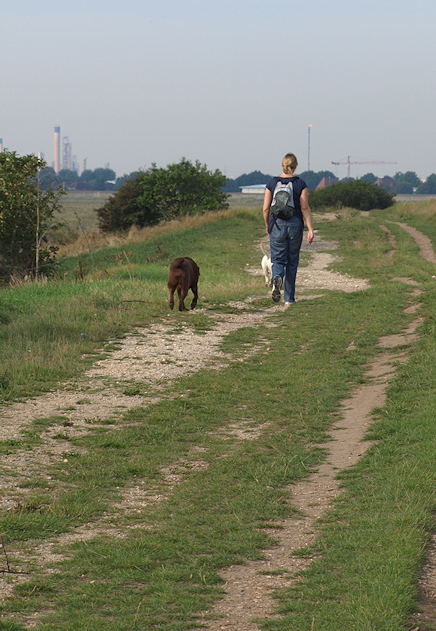
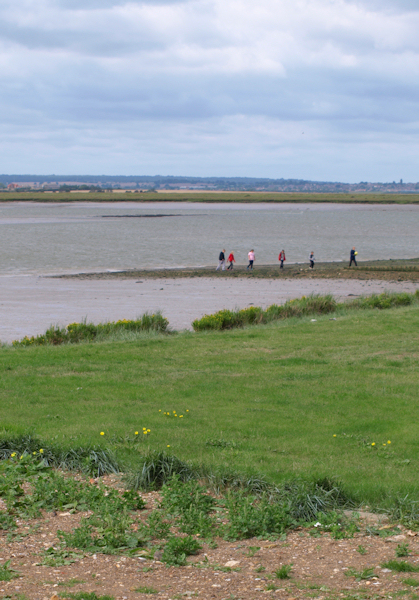
Walk from Southend towards Basildon, Ruth's coastal walk, Essex From Southend, I walk along a well trodden footpath, following the coastal bank that runs along the side of Benfleet Creek. This creek leads inland to Basildon. On my left I pass Two Tree Island, a great bird spotting place, and then Canvey Island.

The path becomes a wide track, gravel to start with and then grass. The walking is easy and pleasant. I meet dog walkers and some serious backpacking walkers with maps dangling from their necks in waterproof pouches. There is no need for the waterproof pouches; the sky is overcast but the clouds are light in colour and there is no hint of rain.

Wild geese and ducks fly past me, flying low across the marshes and heading up the creek. I take a photograph, panning the camera to keep the geese in focus while blurring the landscape.
Geese flying up Benfleet Creek, Ruths coast walk in Essex

Across the creek, on Canvey Island, I see residential buildings and some industrial buildings beyond.
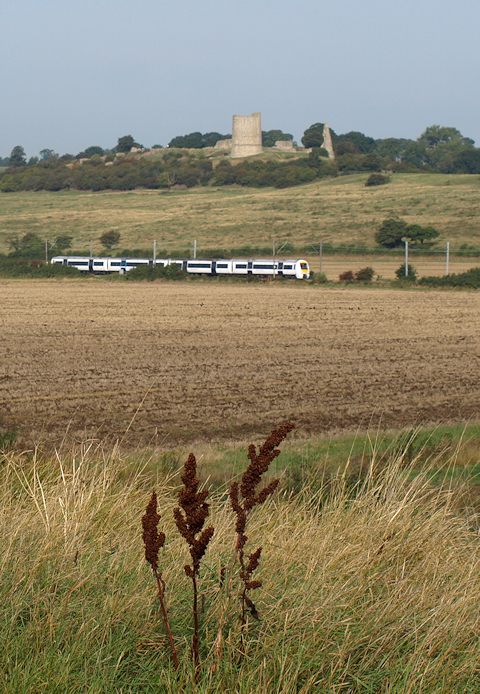
View of castle on ridge, and train. Ruth's coastal walk, Essex. To my right is a good view across marshes and fields to the railway line. Frequent trains rumble past – carrying commuters, shoppers and sightseers. Beyond the railway, the land rises to become a ridge. I see the ruins of a castle.

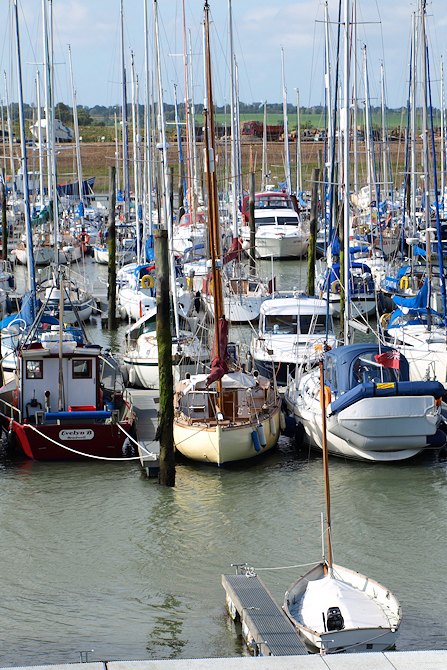
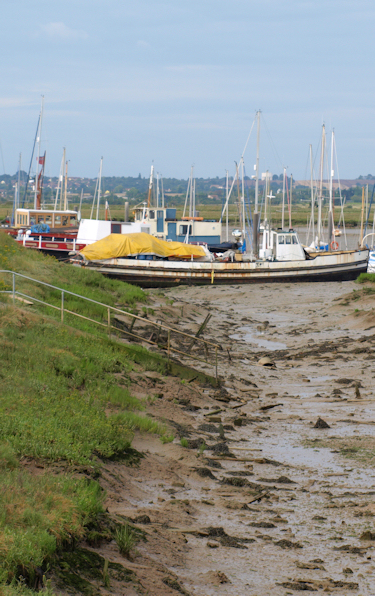
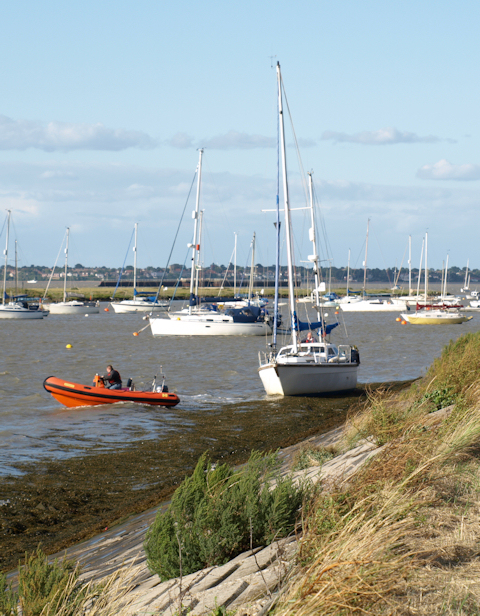
As the creek narrows, the path runs through a pretty marina, where small sailing ships are moored.

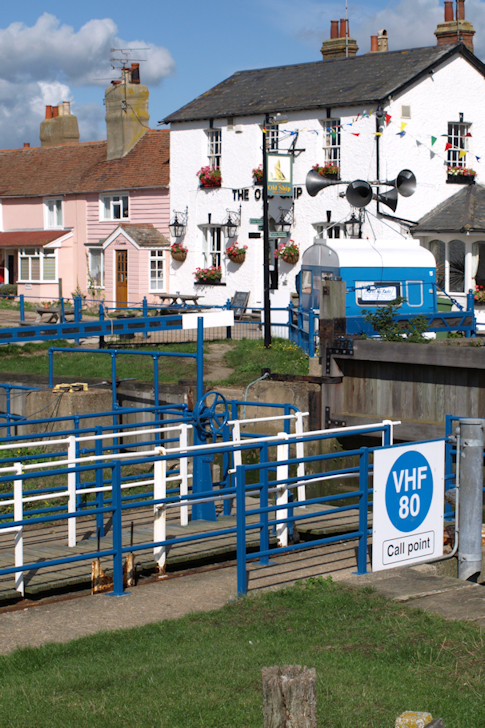
The public right of way is not very clearly signed, but crosses the marina and emerges along the bank at a point where there is a barrier across the creek. The barrier is part of the flood defence system and, just beyond, a very busy road crosses the river. The change from countryside to urban environment is sudden and takes me by surprise. This is South Benfleet.

Marina, Benfleet creek, Ruth's coastal walk.

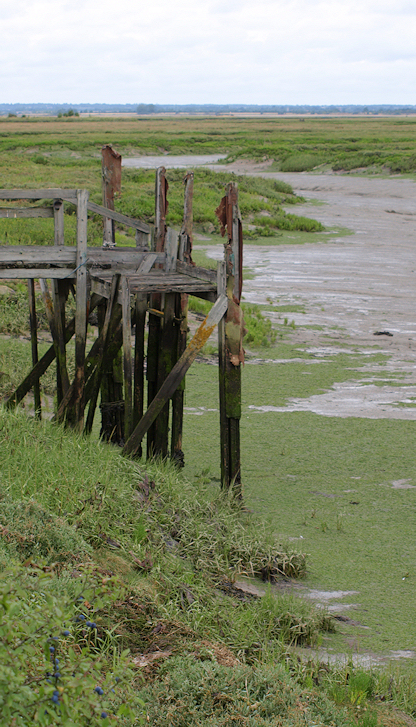
I cross the road and continue along the bank of the narrow creek. The water looks dirty – complete with floating plastic bags and sunken shopping trolleys; more like a river than a creek. Although the footpath continues alongside the water, I can see from the map that it comes to a dead-end further along. I need to find another route. Turning inland, I pass under the railway line and find a nicely paved footpath that runs along the edge of playing fields, hugging the north side of the railway.
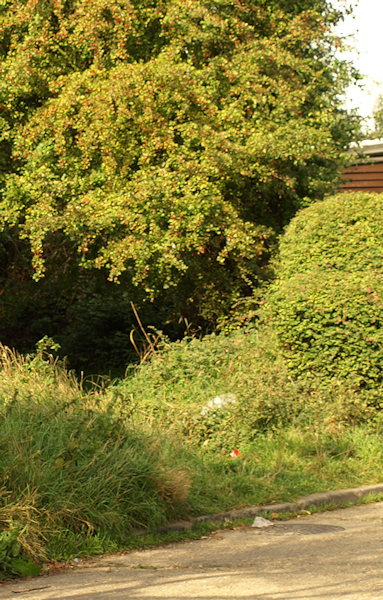
Overgrown path, Benfleet. Ruth's coastal walk, Essex. Beyond the playing fields I see, with some dismay, that the footpath disappears into a narrow alleyway, running behind garden fences and bordered on the other side by overgrown bushes marking the edge of the railway. The path is narrow, two to three feet wide at most. The fencing is in various stages of decay. The bushes arch across from the gardens, meeting the overgrown growth on the railway side and forming a dark green tunnel.

I hesitate outside the dark mouth of this gloomy path. I can see dog excrement, plastic bags, discarded crisp bags and cigarette butts. A few yards inside and there is a bend, beyond which the path disappears into an even darker tunnel.

For the first time on my whole journey, I feel very uneasy. For a change, I am not concerned about tides, or mud, or even snakes. It is the thought of meeting other human beings in this unpleasant, dark place that worries me.

Well, I have to continue.

So I walk, as quickly as I can, into that dark, green, gloom.

After a few bends the ground is cleaner – less dog excrement and less litter – but the path becomes more overgrown. There are nettles and brambles reaching across the narrow walkway. I wish I had a stick. But at least I am making progress. And I meet nobody.

Emerging, blinking, into open land, I am relieved at having passed unscathed from the gloomy alleyway. I find myself in a field. How wonderful to be out in the open, in a familiar, rural environment.

Then I see the horses. I am nervous of horses. Or should I say, I was nervous of horses. In my relief at my safe passage through the alley, I greet them like old friends. They wander up to see if I carry anything interesting in my rucksack and then, disappointed, wander away again.

Horses, Ruths coastal walk

At the end of the field, I cross broken styles and find a track leading under a busy road, the A130. There are a number of footpaths to choose from. My plan is to arrive in Basildon for lunch. I try to find a path with a signpost for Basildon, but can’t find one. Eventually, I choose a path that runs along the righthand side of the railway track. This should be the right way, according to my map. I am a little confused because this path is signposted as leading to a church, not to Basildon.
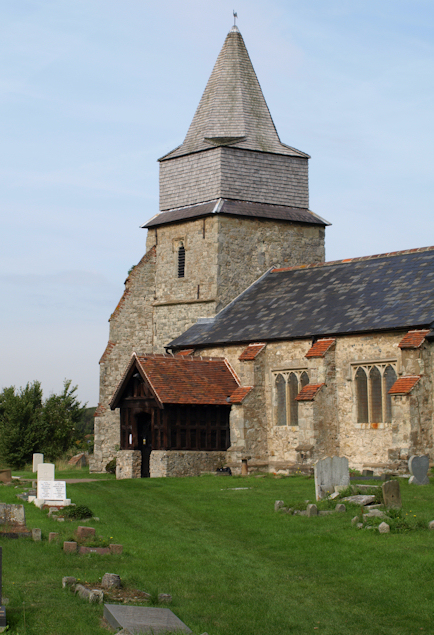
St Margaret's Church, Bowers Gifford, Essex, Ruth's coastal walk After a mile or so, the footpath emerges into a small churchyard. The sun comes out and I find myself in a wonderful place. St Margaret’s Church is very ancient, full of history and nestles in a beautiful, peaceful setting. I sit on a bench, in the sunshine, and have a drink and snack. What a fantastic place this is.

From the church, the footpath continues along the railway line, through fields with more horses and behind the back gardens of more residential houses.

I can hear the roar of traffic. This must be Basildon.

Emerging onto the A13, I am surrounded by noisy roads, flyovers, slip roads and rushing cars. Telephoning my husband, we find each other in an underpass. He has been unable to find a pub nearby and, therefore, we head for the large M of a MacDonald’s sign. On the way we spot a small cafe. We sit inside and have a good lunch.

After lunch, finding the footpath again is difficult. I walk back and forwards along the road near the station. Finally, I realise the path runs through a yard. There are parked lorries and vans. I feel distinctly out-of-place, marching through this yard with my walking gear on.
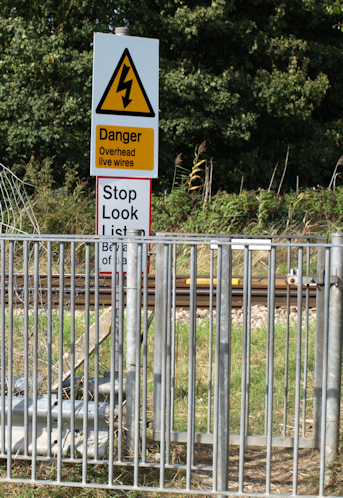
Crossing the railway line, Basildon, into Vange marshes. Now the path winds through wasteland. Signs tell me this is not public land, please keep to the footpath. The belly of a large flyover rises to one side of me. There are workmen up on a platform, inspecting the underside of the flyover. I wonder what they are looking for. Cracks? We always assume these structures are safe and solid when we pass over them in our cars.

Crossing the railway line, I emerge into a large open space. This is a huge nature reserve, spread across Vange Marshes, the marshy land at the end of an estuary leading up to the edge of Basildon and finishing here. There are public footpaths crossing the marshes and free right to roam.
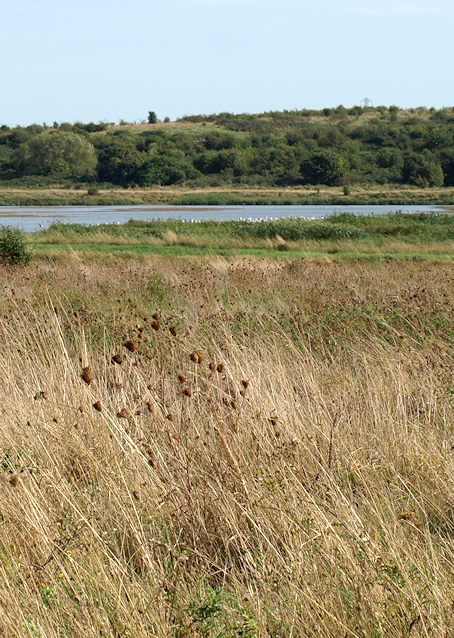
Vange Marshes, Essex. Ruth's coastal walk. I stick to the edge of this marshy area, following the footpath that runs around the perimeter. As I continue further, the footpath signs become increasingly faded and the styles become increasingly decrepid. Eventually, the path disappears altogether – and I wade through long grass, following what I hope is the general line of the footpath.

Worried about snakes, I put on my gaiters. These make my legs hot, but will protect me from adder bites – I hope.

Finally, I reach a track. Good. This is on my map. Now I am looking for a footpath that crosses farmland, leading to Fobbing Marshes. I can see no sign of the footpath I am searching for, although another footpath is marked, leading along the track and then into marshland – but this is not the one I want.

Walking courteously around the edge of the field, I find the point at the far side of the field where the footpath should emerge. Here there is a stream running through a deep ditch and a rotten plank is laid between the banks and gives me a means of crossing the water. I assume the presence of this wobbly “bridge” means I am on the footpath. But there are no signs indicating that my assumption is right.

I continue along more ploughed fields, heading south and keeping parallel to the ridge of high ground I see running to my right. I can see the church spire of Fobbing church, my final destination, ahead of me. I can even hear the church bells ringing. But the footpath, so clearly marked on the map, is still invisible to me. The fields are intersected with long hedges and ditches. Walking in a straight line is impossible. Growing tired, I become reluctant to walk farther than absolutely necessary.

Now I see a tractor and trailer coming up behind, heading towards me. There is a young man driving it. My spirits lift. He will be able to tell me where the footpath is.

As he draws near, I wave to him. He waves cheerily back – and passes me. Disappointed, I set off after him. He stops the tractor ahead and maneuvers it around so it is at right angles to me. Ah, he is waiting for me to catch up. I break into a jog.

But I made a false assumption. He hasn’t seen me running up behind him. Now the tractor sets off at high-speed across the field and a spray of brown material comes from the back of the trailer.

Manure! He is spreading manure!

The brown stuff is blown by the wind and heads straight towards me. Luckily it is dry powder, not wet mulch, but it coats my sweaty face and arms in a brown dust. Yuck!

I watch the tractor disappearing to the far end of the long field and make a decision. I have had enough of agriculture. I have had enough of tramping around trying to find a non-existent footpath. I have just had enough.

Following the edge of the field, I turn westwards and make for the ridge of high land. I can see residential houses here and the flash of a car passing along a road that runs along the top. Luckily I find a track with a bar gate at the end. The last part of the walk is easier, albeit uphill, and I can climb over the gate into the road.
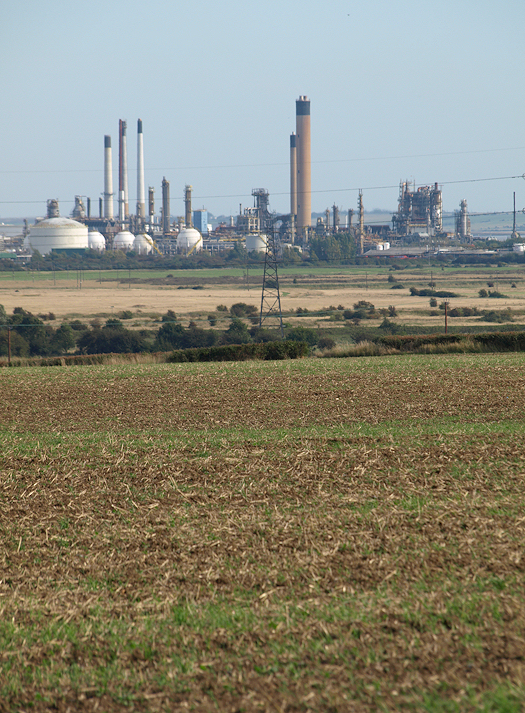
Oil Refinery across Fobbing Marshes, Ruth's coastal walk, Essex The walk along the pavement is easy. There are great views over the valley and the marshes, with the distant structure of the oil refinery in the distance providing a dramatic backdrop to the open green ground in front of it.

I stop and take some photographs. Unfortunately, the light is poor. I notice very clear signposting of footpaths from this road to the West, but not to the East – where my path was supposed to run.

The church bells are still ringing and this joyful sound becomes louder and louder as I walk, until, with relief, I arrive at Fobbing church. My husband’s car is parked by the church, but the car is empty. I can see his car alarm is flashing, but the noise – if there is one – is drowned by the sounds of the bells pealing.

I walk round one side of the church to the entrance porch. The is no sign of activity outside the church; only the noise of the bells inside. No sign of my husband either. I try to phone him but, although I know he has answered, we cannot hear each other because of the noise. I text him. “I am at the church”. He texts back, “So am I.” I continue walking round. Still no sign of him. Are we both circling the church in the same direction trying to find each other?

Eventually I text him “Stand still!”. Walking around the corner of the church again, I find him.

My husband has had a problem with his car alarm. It sounds continually as we drive off, passing a police car on the way. Luckily the noise of the faulty alarm is drowned by the pealing bells.


Later I try to report the problem with the footpath.

Who is responsible? The footpath crosses from Essex into an area controlled by Thurrock Council. As the point at which I lost path is just inside the Thurrock area, I report it to Thurrock council and give them a map reference. Unfortunately, they take the map reference as a single point, rather than an area – and deny responsibility as this point lies in an area for which Essex County Council is responsible.

Perhaps I should have pursued this, but life is too short and I have walking to do ….


Vital stats = ?
For the first time, my Trip Journal app lets me down. It reports a 5.8 mile walk. I know I have walked farther this this. So out comes my piece of string and the OS map.
According to the map, miles walked = 10


September 2014 Update: Basildon to Fobbing

This section is now covered by the new Thames Estuary Path. I haven’t been back to walk the route, but would expect it to be well signposted.

Poor Basildon gets bypassed altogether!
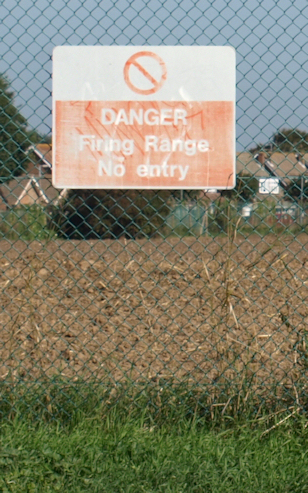
Posted in 04 Essex | Tagged , , , , , , , , , , , , , , , , , , , | 11 Comments

28. Great Wakering to Southend to Leigh-on-Sea

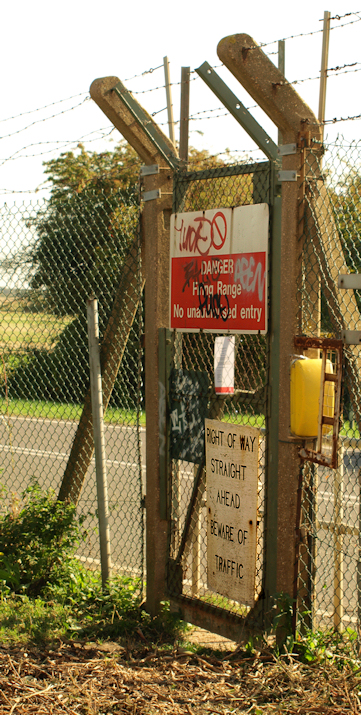
No Entry sign, Shoeburyness. Ruth's coastal walk in EssexFirst task of the morning is to ring the MoD hotline to find out what sections of the coastal route are open and what sections are closed for artillery practice.

The person on the end of the line is a bit vague about geography but, unfortunately, I discover the coastal path near Foulness is closed today. It will open tomorrow, we are informed, but that is too late; I need to walk today. I resign myself to an inland detour.

The weather is glorious. The sun is hot in a cloudless sky. There is a heat haze on the horizon.

MoD warning sign, Ruth's coastal walk, Shoeburyness I set off along a road from Samuel’s Corner and find a footpath that runs along the outside of the MoD fence. Dire warning signs forbid entry to this dangerous territory. I hear no shots and see no smoke. Whether any real shooting takes place today, I don’t know. Interestingly, the MoD territory is guarded by the private company, CinetiQ. Am I the only person to find this odd?

The footpath ends and I am forced to follow the road to Shoeburyness. Workmen are out mowing the roadside verges. I meet cyclists, walkers and the inevitable dogs.

Today I am scratching my upper arms, following the mosquito attack I suffered near Potton Island yesterday. They managed to land seven bites before I could deploy the repellent spray. I don’t mind mosquitoes biting me. I am happy to share my blood – in small amounts anyway. What I do mind is the itching they inflict.

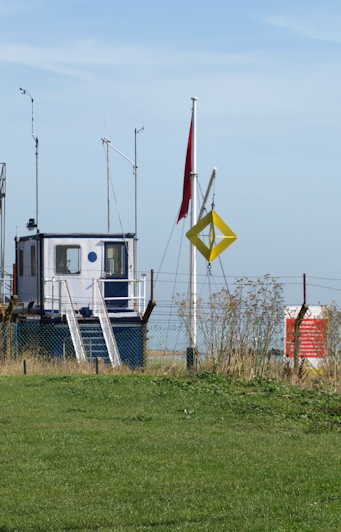
Yellow sign on Shoeburyness beach, Ruths coastal walk, Essex As soon as I can, I head towards the sea, skirting round fenced off MoD property, and reach the beginning of Shoeburyness beach. There is a long breakwater, stretching out to sea, marking the barrier between prohibited, MoD beach and the beach where public access is allowed. Signs forbid entry to the public beach unless a yellow diamond sign is being displayed. I am relieved to see the yellow sign is up.

The sea is calm with long, lazy waves; just rippling the surface. The sky is blue. The sun is warm.

A young woman and child walk gingerly across the pebbly beach. They appear relaxed together but the child maintains a certain distance from the woman, who is very young. I suspect, from her age and from the child’s slight shyness, she is a nanny or au pair. Shoeburyness beach, near MoD barrier, Ruth's coastal walk

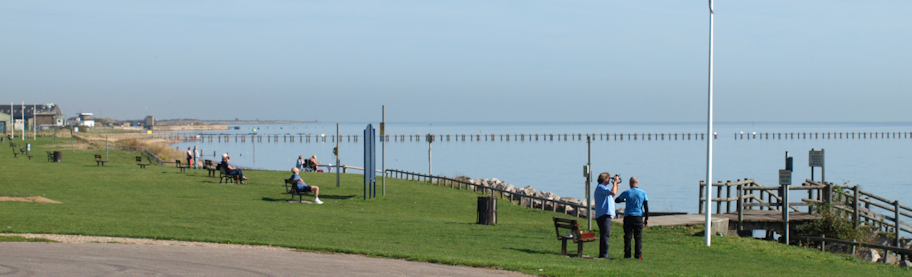
The beach is flanked by an open green space. There are people walking, cycling, jogging – and some people just sitting and enjoying the morning sun. I walk along, enjoying the weather and the pleasant, relaxed feel of this pretty, green area. Shoeburyness beach, Essex, Ruth's walk round the coast

At the end of the beach is a large derelict property, in the process of being renovated and with a tall fence of boards around it. My way along the sea wall is interrupted by this building site. But after the long inland detour I have just made, I am determined to follow the coastal path.

So, I ignore “No Entry” signs, and climb over some barriers, to follow the crumbling sea wall as best I can. The wall runs along the bottom of a steep bank, with the building looming ominously above me. I have to skirt around thorny blackberry bushes – hanging over the wall in places – by clambering up and down the dangerously steep, grass bank to find a way through.

I come to a place where the wall is interrupted by a stairwell of old stone steps, leading down to the beach from the abandoned property above. Without thinking, I jump down into this stairwell and, for one awful moment, I find myself trapped.

The stairwell is dark and damp; and smells of decaying mud. I am in a narrow enclosure with tall walls on either side. There is no foothold to help me clamber up onto the opposite wall. The steps leading upwards are barred by tall, rusted gates, interwoven with barbed wire and overhung with blackberry bushes. Below the tide is in and there is no shore to walk along; the steps end in the sea.

I try to climb back up the wall I have just jumped down from. No success. Then, I try to hoist myself onto the wall by standing with my back to it and levering myself up with my arms. This does not work. I am not strong enough.

I fight back panic.

Beginning to feel desperate, I turn and face the wall. Placing my hands on the top, I force myself upwards, throwing myself up and forward onto the wall as I kick my legs up behind me. It may not be elegant, but it works. I get my chest onto the wall and, squirming like a worm, I manage to wriggle forwards until most of my torso is balanced on top. Crawling forwards, I manage to get my knees up.

Panic over. I am back up on the wall.

With thumping heart, I continue onwards. Now I reach a small section of beach, where a few people sitting on the sea wall look startled to see me emerging, somewhat disheveled and sweaty from the blackberry bushes. I stick to the proper walkway now, as it follows the sea wall. There are some old fortifications and a cycle route.

Eventually I reach the coastguard lookout point at Shoebury Ness. From here onwards, there is a wide promenade with a lovely, new, cycle route. There are beach huts, many in use, and people out enjoying the glorious sunshine.

But the beach is empty. Everyone is sitting on the promenade. There is nobody on the beach. Strange.

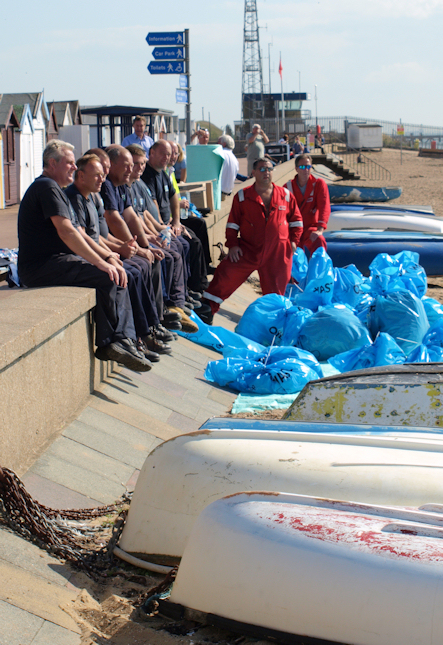
Oil clean up crew, Essex. Ruth's coastal walk. Then I notice warning signs. There has been an oil spill. Men in dungarees have been cleaning the beach and there is a collection of large, blue plastic bags. A local photographer has arrived (from the local paper?) and is assembling the men in order to take their photo. I use the opportunity to snap a cheeky shot. The workmen see me, behind the official photographer, and smile at me.

I continue walking and can see Southend Pier, stretching out into the sea, in the distance. It seems like an enormously long centipede. Beyond this is the far side of the Thames Estuary. I am at the mouth of this mighty river. Just visible in the milky haze on the horizon, I can see the shapes of an industrial landscape – towers, refinery tanks and cranes – pale ghosts. One day, I will be walking along that distant shore.

This walk along the promenade is hot and tiring. I want to walk on the softer sand of the beach, but the warning signs are still in place and I would regret getting oil on my boots, so I stick to the concrete path, running next to the cycle route that stretches the length of the promenade. Suddenly, I am surprised to see my husband cycling towards me. We agree we are both in need of an early lunch and he suggest a pub a short distance ahead.

The pub is Edwardian and has many of its original features. The “special” is roast beef and yorkshire pudding. But the sun is shining and we are too hot for this. I have a ploughman’s and hubby has a steak sandwich. We sit outside in the shade of an umbrella and watch the world go by.

Southend Pier, Ruth's coastal walk. Essex.

Later, I walk along the promenade, passing the end of Southend Pier. This is the longest pleasure pier in the world and it stretches across the sea, with its far end almost lost from view in the haze. I stop to watch the small train that runs up and down. By this time, the sky has become overcast and the light has faded. This change in the weather only lasts for an hour or so, but spoils the opportunity for good photographs of the pier.

Southend Cliff Lift, Ruth's coastal walk.
Further along is one of those wonderful cliff lifts, carrying people up and down the steep slope. I can remember seeing one in Scarborough, many years ago. Later I learn this lift was only recently re-opened, after a renovation project.

I have to confess to being very surprised by Southend. It is a beautiful place.

As I continue on my walk, Southend merges into Westcliff-on-Sea.

The tide is out. Children are digging in the mud with sticks. School is out and parents are strolling with their children in the afternoon sunshine. Sunlight reflects off the shore and the flat sea; there is light everywhere. This is beautiful.
Light on the beach, Westcliffe, Essex. Ruth's coastal walk.

Then the promenade ends and I follow a footpath running along the railway line. A student has decorated a boring wall with a series of graffiti images: part of a college project.
Art work on wall, Southend-on-Sea, Essex - Ruth walks the coast.
The path is narrow and occasional widens into jetties belonging to various yacht clubs. This is a busy path. People are coming home from work and school. Walkers jostle with pushchairs and cyclists.

I arrive in Leigh-on-Sea. I wasn’t expecting this – what a wonderful place! I wander down narrow streets with quaint houses and interesting shops. There are cafes with decking; and early diners are enjoying drinks in the evening sunshine, overlooking the estuary.

Then I reach the small, railway station. It is nearly five in the afternoon and commuters are arriving back, leaving the station and heading towards the town on foot, or disappearing into the car park. Here I meet my husband.

View from Leigh-on-Sea, Essex. Ruth's coastal walk
We drive back into Southend and we stop at the top of a hill to enjoy the view over the estuary. The sun is low and the light is golden. To the East is the mouth of the Thames, open to the sea, with large ships, pale in the haze, gliding across the water. Ahead of us, due South, is gleaming mud with the white shapes of moored boats. Beyond the mud is the Thames itself and, on the distant bank, we can see the ghostly outline of refineries and industrial complexes – pale and romantic in the setting sun. To the West is Two-tree Island and beyond the bright light of the sun shining on distant estuary mud and water.

A perfect end to a beautiful day……


Vital stats: miles walked = 10

Posted in 04 Essex | Tagged , , , , , , , , , , , , , , , , , , , , , , , | 18 Comments

27. Rochford to Great Wakering

Footpath through Rochford, Essex. Ruth's coastal walk Today starts sunny and warm. My husband is joining me. But first he drops me off at Tinkers Lane, where I follow the footpath, meandering through green spaces in Rochford. I am unable to reach the river bank, as it is surrounded by industrial units and there is no public right of way along the bank at this point. But I enjoy this walk. It is amazing to be on these hidden foot paths, surrounded by greenery, in the middle of the busy town.

Then I cross a road and am momentarily confused by the convergence of five different footpaths. Choosing one, I head off across a farmer’s field, hoping I am heading towards Sutton Church.

Searching for a church spire, I finally spot it, short and hidden in trees. Yes, I am on the right path.

My husband, Ruth's coastal walk I see my husband waiting for me at the end of a long, straight path across harvested corn fields. He stands so still that, from the distance, I think he is a sign post. He gallently offers to carry the rucksack. He has brought nothing, not even water – what an amateur!

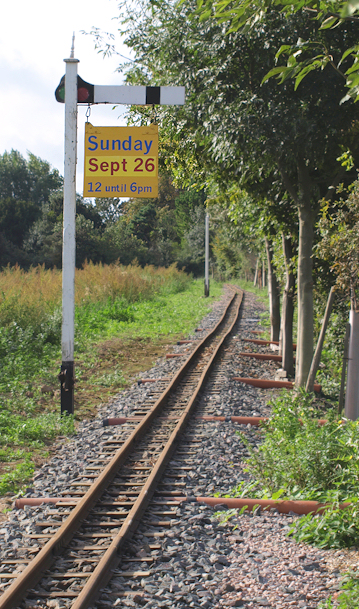
Minature Railway Line, Essex, Ruths coast walk Crossing the road, we find the continuation of the footpath and, to our surprise, stumble across a minature railway line. A sign tells us there will be trains running on Saturday 26th September. At the moment, all is quiet and the line looks old and unused.

We walk along a wide grassy footpath, an avenue between lines of trees, with the railway line running on our right. A section of line is not in place and the rails lie on one side. We hope they fix this before the 26th or the train ride will come to a bumpy end. At the end of the grassy avenue we find a road. After turning left and walking along this road for a short time, we pick up a bridleway. This leads us down a track and then through fields, until we end up in a farm yard – Mucking Hall, not an apt name as the yard was very clean and tidy – and we walk down the wide driveway until we reach another road. After a short walk down the quiet road, we find track, taking us past livery stables, to reach the footpath that takes us to the river bank.

Beautiful butterfly, Ruth's coast walk, Essex Along this footpath are late ripening blackberries. We gorge on juicy berries and admire pretty butterflies.

We reach the bank and I am happy to be back on the “coastal path”. The tide is in and the Roach river looks deceptively wide and deep. There are no ships sailing. We pass a couple of walkers with their dogs. Across the water I see the route I followed yesterday. Today there are workmen on the bank and a large group of walkers in the distance. Yesterday the route had been empty and lonely.

As we follow the river bank, the tide recedes and mud begins to appear. We pass tumbledown jetties.

Snake stick, Ruth's coastal walk, Barling Marsh This area of the walk is poorly maintained and the grass is long. I worry about snakes. My husband retrieves a couple of sticks from the driftwood at the edge of the river. We walk, beating the ground to scare the snakes. My husband breaks his stick and is reduced to waving the shortened remains ineffectively in the air.

I discover walking with a stick is easier than without, and resolve to buy a walking pole.

Barling Tip, with gulls, Ruths coastal walk, Essex Coast
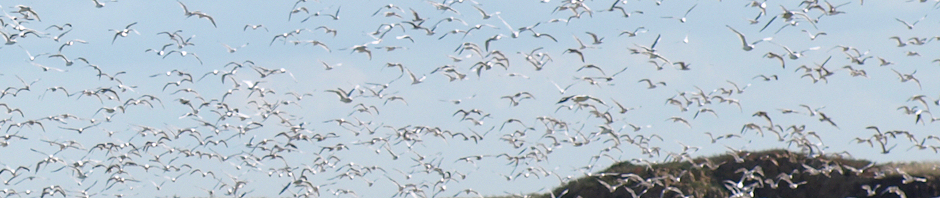
Across fields on our right, we see Barling Marsh and we pass a large rubbish tip, with accompanying smells carried towards us on the warm breeze. The fields and skies around the tip are swarming with noisy seagulls. We notice several different species. Every so often they rise up into the air in a huge cloud, whirl around and then settle again – sometimes on water and sometimes on the fields.

In the sun, Barling Marshes, Ruth's walk round the coast We reach Barling Ness and sit on the grass, enjoying the warm sun. Across the water we see the boatyard at Paglesham Eastend. There are boats in the water and the walkers have reached the boatyard and disappear from view. We wonder if they are heading for the same pub as we ate our lunch in yesterday. I have walked so many miles, but am only a stone’s throw from where I was this time yesterday!

Now the bank winds inland along a creek. There is a lot of mud and very little water. We pass a few derelict boats.

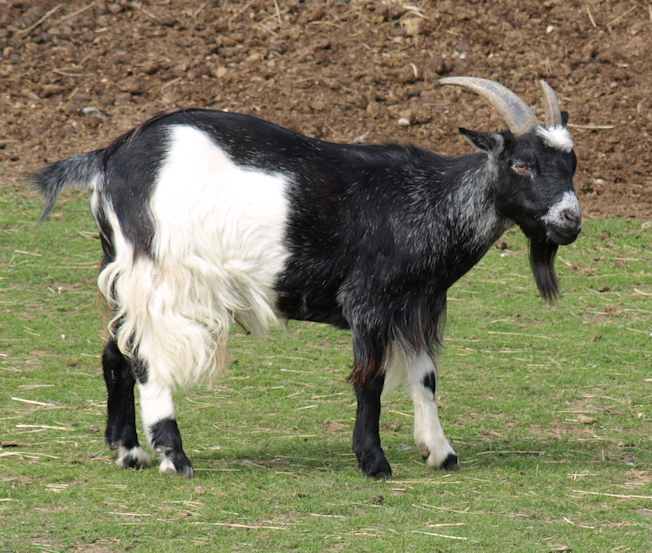
Goat, Little Wakering, Essex, Ruth's coastal walk
At the end of the creek is Little Wakering and we come across a smallholding with goats, hens and ponies. I stow my stick beside the footpath sign, hoping to pick it up again when I resume the walk, but not wanting to carry a hefty looking stick through the village.

We are now in Little Wakering and walk along the road to The Castle Pub. I enjoy a wonderful meal of fish and chips. And a large bottle of cider.

After lunch, I set my husband on his way back along the fields. He is returning to Sutton Church to pick up the car. I head off back along the other side of the creek, disappointed to find that my stick has disappeared and there are remains of it strewn around the path. I blame school boys for this wanton destruction of my precious stick.

Walking along the creek, I meet a lady jogger with a large dalmation. He passes me without problem, but looking back at me, he is not happy when he sees my back pack and comes back to woof at me. I let him lick my hands and all is well. He shakes himself and sprays smelly creek water over my trousers.

Now I am alone on the wall. The path is overgrown in places and I try not to think of snakes.

MoD land, Potton Island, Ruth's coastal walk Across the water is Potton Island, reached by a causeway and a bridge. This is used by the army and is inaccessible to me; this area is marked “danger zone” on the map. I take photographs as the late afternoon sun slants across the fields. I hope the army does not mind me photographing their military structures.

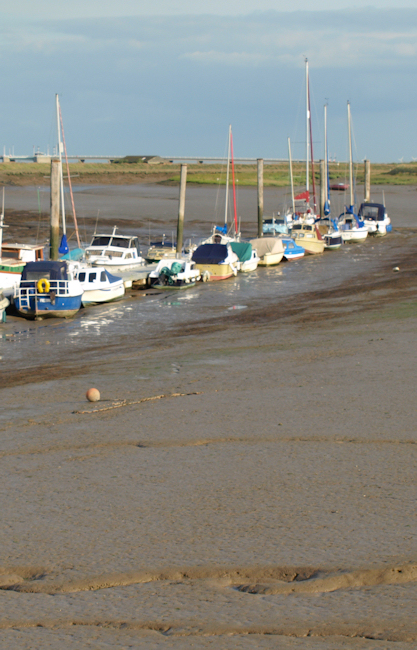
Boats in the mud, Potton Creek, Essex, Ruths coastal walk Later, I come across another boatyard with boats in a variety of states of disrepair. And a jetty of small ships, all now marooned in the mud. Beyond this are larger boats, possibly being used as boathouses – so firmly embedded in mud it is hard to imagine them ever moving.

Overgrown path, probably full of snakes, Ruth's coastal walk
The path is very overgrown and, suddenly, I see a small, thin snake moving across the path. I have stepped over it before I notice it. Turning round, I put down my rucksack to grab my camera and, in a wiggle, it is gone.

The snake was smooth, light brown with a long darker stripe. It did not look like an adder. But I wonder if baby adders have different markings. I am really worried now. I put on my gaiters for protection.

A few steps later and I see a small sign against a farmer’s gate. It is black with one word scrawled in white chalk – “Adders!”.

Despite this, there are people out walking in shorts and sandals, with accompanying dogs.

Further along the wall, I am suddenly attacked by mosquitoes. Luckily I have spray in my rucksack and I annoint myself with insect repellent, but not before I have been bitten by a few of the little pests.

I reach a farm house (Oxenham Farm) and, after checking with my map, come down off the wall, following the public right of way along the farm track heading towards Samuel’s Corner. There I find my husband with the car.


Later, I look on the internet to try and identify the “snake”. I discover there are only 3 species of snakes in the UK – adders, grass snakes and smooth snakes. My snake did not resemble any of these. Then I find a picture that matches. It was a Slow Worm, otherwise known as a legless lizard. These harmless creatures are often mistaken for snakes. Read more about the Slow Worm here.

Vital stats: Miles travelled = 12.5, snakes seen = 0, slow worms = 1.

I also discover the RSPB recommend Barling Tip as a great site for bird watching.
Seagulls on Barling Tip, Essex. Ruth's coastal walk

Posted in 04 Essex | Tagged , , , , , , , , , , , , , , , , , , , , , | Leave a comment

26. Burnham on Crouch to Rochford

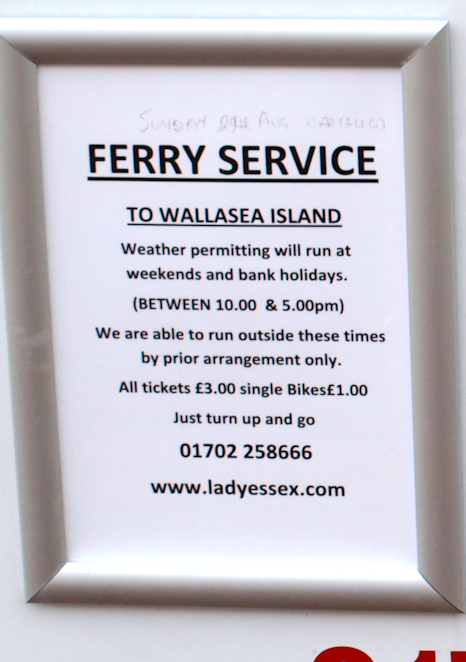
Burnham Ferry, Ruth's coastal walk There is a summer ferry service from Burnham-on-Crouch to Wallasea Island. I sit on a bench outside a pub, waiting. There were revellers here last night, but all is quiet now. It is just after nine in the morning; an early start because we stayed overnight in a hotel in this town. It is of little benefit to be here early – I have already telephoned to check the passage times and was told the captain hadn’t arrived yet. The ferry doesn’t start running until ten o’clock.

[Please note: the ferry has recently changed hands. For current contact details, see the comments section below.]

By the time the small boat arrives, Continue reading

Posted in 04 Essex | Tagged , , , , , , , , , , , , , , , , , , , , , , , , , | 5 Comments

25. Tillingham Marshes to Burnham on Crouch

Signpost at beginning of walk, Tillingham Marshes, Ruth's coastal walk
Leading East from Tillingham is a narrow road – a track really. It winds around a few bends and, opposite a telephone box, there is an impressive farm entrance. Next to this farm entrance, so insignificant in appearance you can easily miss it, is a small track leading directly due East. At a bend in this track, is a signpost. Here starts a public right of way that runs for a mile, passing through Tillingham Marshes, to the sea wall.

Why am I taking this route? The coast path itself runs uninterrupted for 17 miles from Bradwell Marina to Burnham on Crouch. South of St Peter’s Chapel, there is no other place in the Dengie Peninsula where a public road comes within a mile of, and gives footpath access to, the coastal path; not until you reach Burnham on Crouch itself. Therefore, I am rejoining the walk at this unlikely spot to make this section of the walk a manageable distance. Burnham is now only 9 miles away.

The footpath runs for a mile, and has been diverted by the farmer, taking a course further South then the route marked on the map and involving a right angle turn around the bottom of a field. Very few people walk this path and the route is unclear. Luckily, I have been here before and I find, among the tall grasses, the small bridge that crosses the culvert. Then I make the short climb to regain the coastal path running along the top of the grassy bank.

Endless coastal walk, Dengie Peninsula, EssexInitially I enjoy the walk. Being up on the bank, close to the sea, breathing fresh air, gives me a an energy boost. The sun is shining and it is unseasonably hot for September.

To my left are marshes, covered in uniform green vegetation. They stretch almost as far as the eye can see. Beyond is a small sliver of shining sea and the distant glimpse of an occasional big cargo ship. To my right is a grassy track running parallel to the sea bank, then a watery culvert and then farmland – flat and featureless. I see nobody.

The sea wall seems endless. The view is monotonous.

I am bored and my energy drains away. This is hard work.

Mud, Denghie Peninsula, Ruth's coastal walkThen I reach an area where the grassy bank gives way to a concrete wall and path. Here the sea comes nearer and there is mud with interesting patterns. I must be bored, I think to myself, if I find mud interesting. But the mud makes a welcome change from the featureless marsh vegetation and I enjoy looking at the patterns – the sinuous curves, the ripples and the furrows.

Sea wall, Dengie Marshes, Ruths coastal walkI stop for lunch on an area of wall that has been widened to form a semicircle. A handy, nearby blackberry bush provides a tasty dessert. And, what a relief, I can see the glimmer of the beginning of the River Crouch ahead of me. That distant view of the river tells me I am near the end of this stretch of walk.

Looking back the way I have travelled, I am amazed to find that I can still see St Peter’s Chapel. And beyond I can just make out the Blackwater River. But wait; there is something very odd here. The river level seems unusually high, higher than the sea level beyond it. And appears to be flooding the far bank. I can see bushes, or trees, with their roots apparently hidden by the water.

Distant Mirage, River Blackwater, Ruth's coastal walkWith the telephoto lens of my camera, I have a clearer view of the far bank of the river, with trees and bushes floating above hazy, blue water. And a sailing ship hovering, almost in mid-air. Very strange. Are my eyes playing tricks?

Then I realise. This is a mirage. A genuine mirage.

I linger to take photos and enjoy this rare and intriguing phenomena.

A few miles further on, I come across another strange sight.

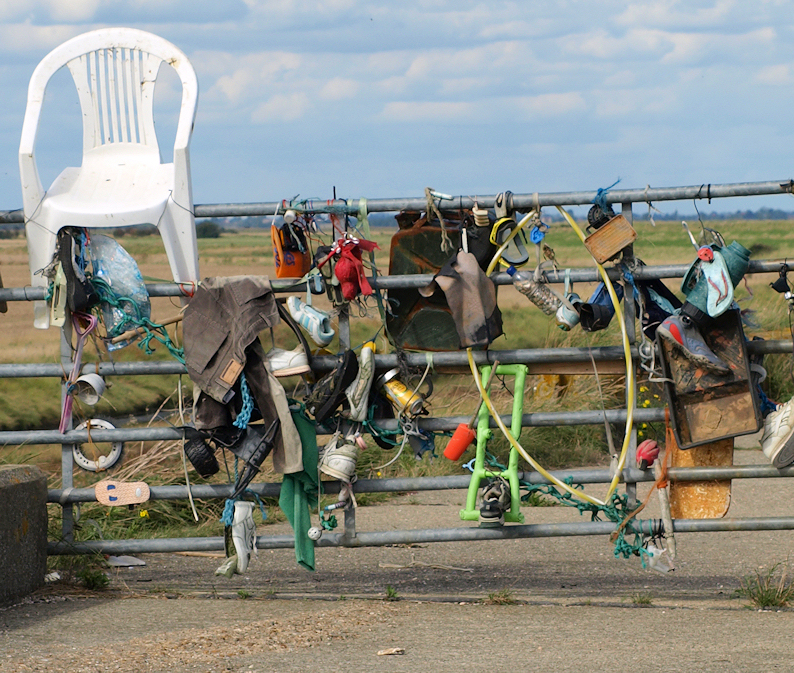
Decorated Gate, Ruths coastal walkThere is a gate across the concrete path. And the gate is decorated. It is covered in objects; ordinary objects such as a single flip-flop sandal, a sock, an empty can of lager, a pair of trousers, a number of trainers and, most incongruous of all, a white plastic chair.

I wonder if this is debris left over from some event. Or has each walker simply added something of their own to the gate, just as walkers in the hills add stones to a pile at the top of a peak? I consider adding some item of my own, but I have nothing spare in my rucksack; travelling light and carrying nothing unnecessary.

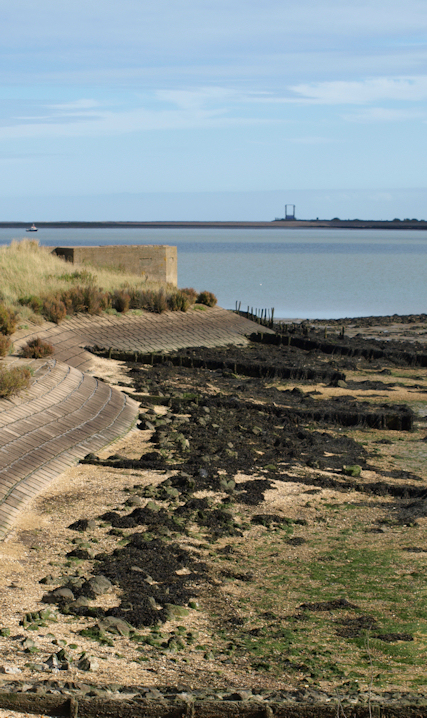
Pill-box sea defence, bank of River Crouch, Ruth's coastal walkContinuing, I reach the mouth of the River Crouch and enjoy watching the sailing boats. Along the bank of the river I come across defensive structures from the 2nd world war – pill-boxes. In some places, I notice a duo of pill boxes, with one facing the river and the other facing inland, both built into the river bank, back to back.
Defence structure, River Crouch, Essex
And here, in the fields, is a bigger structure that I believe must date from the war, but I am not sure. There are holes for guns and for keeping lookout. The buiding has a hexagonal shape giving 360 degree coverage of the surrounding countryside.

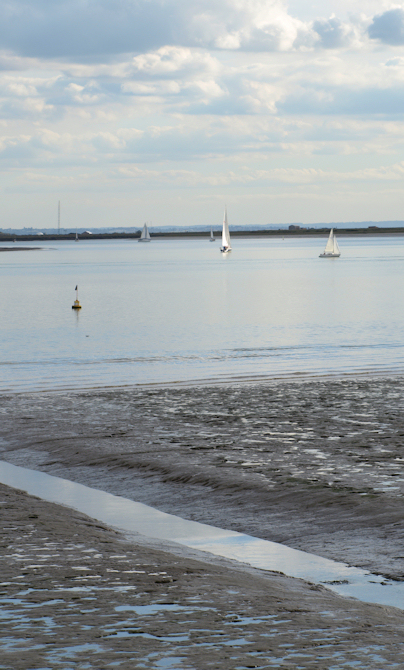
sailing ships on River Crouch, Essex, Ruth's coastal walkI enjoy this section of the walk. There is plenty to see. It is cooler now, the sun is behind clouds, and there is a strange, pale-blue light, giving an ethereal appearance to the water and the sailing ships on the river. There is hardly any wind. The tide is out and there are no waves. The ships move lazily across the water.

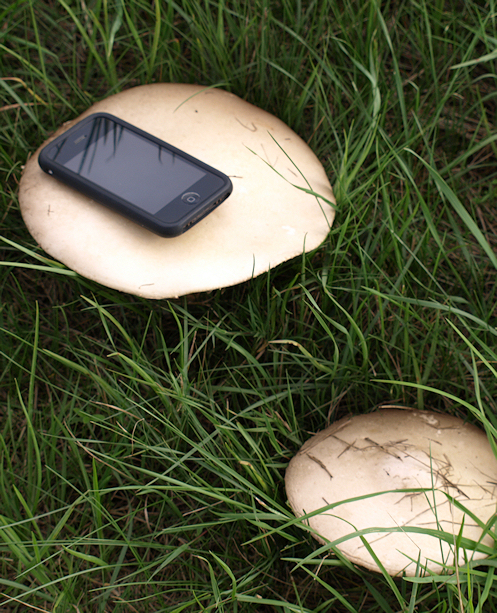
Giant mushrooms, Ruths coast walkSeeing some large, white, circular objects in the grass, I stop to investigate. These turn out to be enormous mushrooms. They look edible. In fact, they look delicious. I must be getting hungry. I balance my iPhone on the top of one. It is as large as a dinner plate. You could feed a whole family from this one mushroom.

Continuing, I reach the outskirts of Burnham on Crouch. There is a path along the river front, weaving between shipyards, running along the back of the yacht club, and cutting through small alleyways. Pubs overlook the river and there are people out enjoying an early evening drink. After the emptiness of the Dengie area, I am excited by the people and the energy of this vibrant little town.

This is the end of my journey. Tonight we are staying in a pub in the town. Tomorrow, I am planning to take the ferry across to Wallasea Island and the next phase of my journey along the winding Essex coastline.


Miles walked = 11
Mirages seen = 1
Boring time = 2 hrs
Interesting time = all the rest

Posted in 04 Essex | Tagged , , , , , , , , , , , , , , , , , , , , | 20 Comments

24. Bradwell to Tillingham Marshes

Marina at Bradwell Waterside, Ruth's coastal walk, Essex Bradwell Marina is quiet today in the early morning light. Yesterday the ships were screaming as the wind howled through their rigging. Today, there is a stiff breeze, but the ships are silent.

I wonder about the ship I saw being blown up against the sea wall yesterday. Did the small motor boat succeed in towing it out of trouble? For a moment I am tempted to go back and see if it is still there. But that would take me across the muddy development area and in the wrong direction. So, I walk along the sea wall, heading East and skirting the edge of the marina.

Then I see it. The same boat. I recognise the name. It is up on a hoist, hull exposed, resting gently in a quiet corner. There appears to be no damage. I feel relieved – at least I know the outcome and the ship is unscathed.

River bank, towards Bradwell power station, Ruths coastal walk
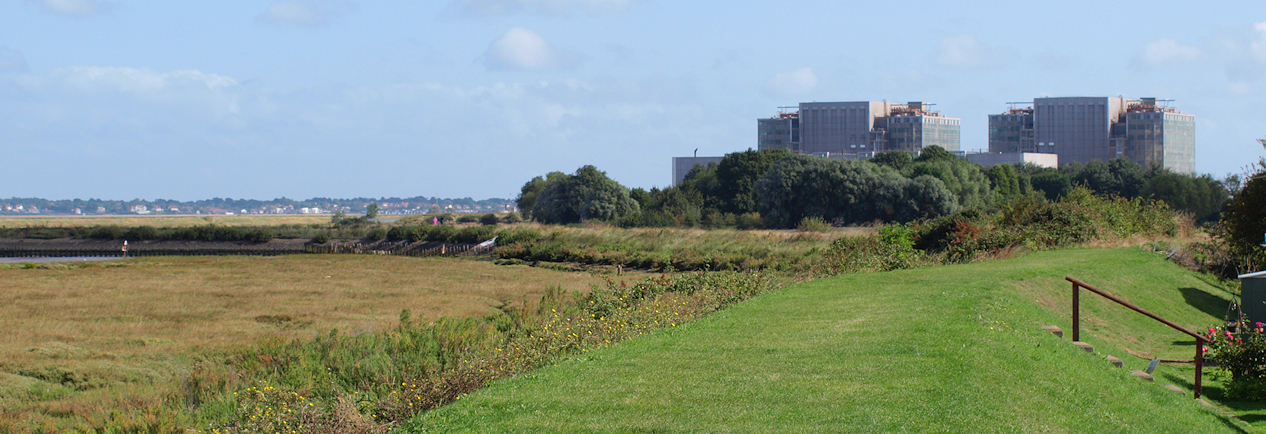
The sea wall winds towards Bradwell power station and the twin blocks of this station are my constant companions for this morning’s walk. There are people out enjoying this lovely bank holiday Monday – walking with dogs along the sea bank for short stretches. Some people have properties that back onto the bank, with gates from their gardens leading up onto the walk.

I try not to think about adders. The grass is short and well trodden. I should be safe.

As I approach the power station, I see a long structure in the water – a jetty.
It rises, uncompromisingly, out of water – a long, tall shelf of metal – running parallel to the shore and completely separate from the mainland. The only way to and from it would be by boat. I wonder what purpose it served. There are no ships are here today. The structure looks impressive and I stop to take photographs.
Jetty off Bradwell Power Station, Ruth's coastal walk, UK

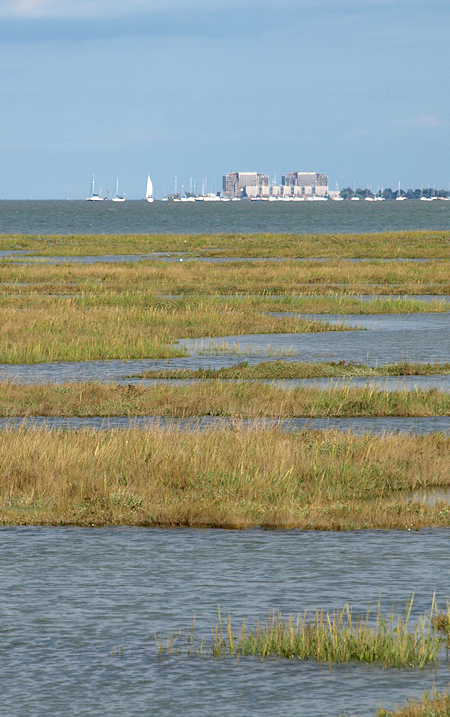
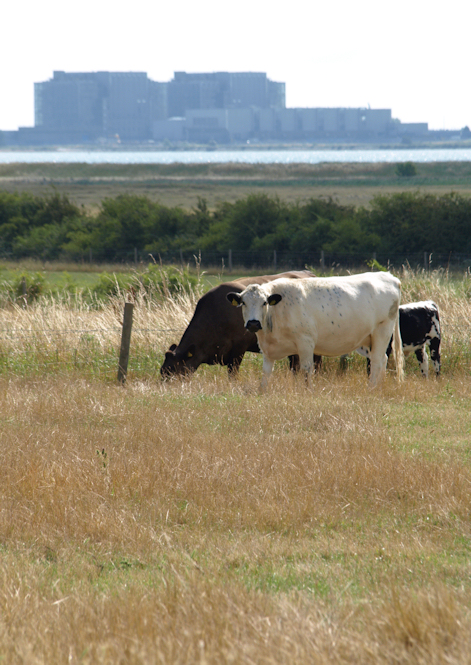
Now I pass the power station. There is no noise, no hum of machinery, no sounds of traffic or of industry. There are signs warning of private property, but no signs to indicate danger. I am surprised. Compared to Sizewell, where I walked some weeks ago, this is spookily quiet.

I later learn that Bradwell was a nuclear power station and is no longer functioning. It has been “decommissioned”. I wonder how much radioactivity, if any, still lurks inside it.

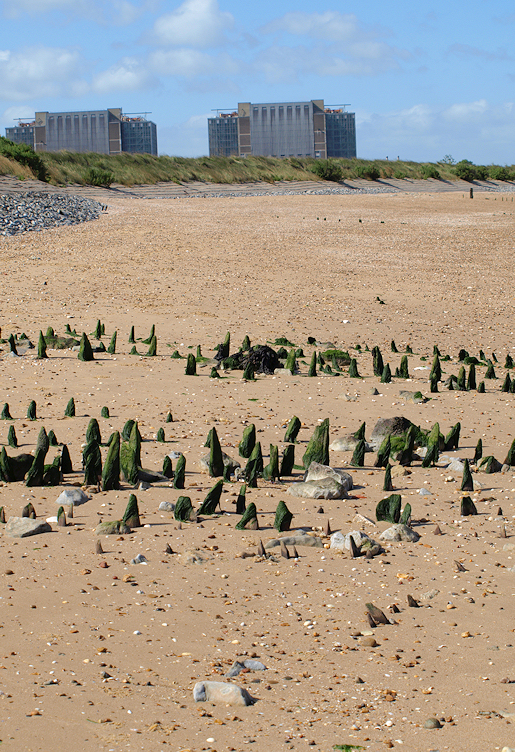
Beach at Bradwell Power Station, Ruths coastal walk
In the morning light these large, silent buildings are strangely attractive. And the area around them is truly beautiful. Here is a wonderful, pebbly beach, stretching out along this far reach of the Blackwater estuary towards the open sea. The breeze is fresh. The air is clear. I feel a sense of exhilaration. After so many miles of estuary and river banks, I am finally approaching the edge of the real sea again.

Beach towards Sales Point, Ruth's walk along Essex coastAs I walk along the beach, I realise it is covered in shells. Across the water I can see the shore on the far side of the River Blackwater – Tollesbury marshes and Shinglehead Point. It seems a long time since I strolled round those lonely marshes. In the further distance, I can see the shoreline of West Mersea with buildings and boats. It has been 5 days of walking and 65 miles since I left West Mersea. Yet I have only travelled a couple of miles as the crow flies.

Two miles in 5 days!

I fight off a feeling of despondency. I have had a wonderful time walking along the Blackwater River and Maldon was a delightful place. Since then I have learnt about vikings, encountered adders and coped with gale force winds. Now the open sea beckons and I will have miles of uninterrupted coastal walking, around the Dengie peninsula, before I reach the next estuary and the River Crouch.

Ahead of me I see a fisherman and I pass a couple of joggers. There are very few people around and I am surprised to find this place so isolated, given its wild beauty. There is a pill-box on the beach, proudly guarding the entrance to this river. An elderly gentleman is peering through one of the small windows. His wife waits impatiently on the beach. My father spent some weeks in a pill-box like this one, in Kent, waiting for the German invasion. I wonder if this man has similar memories.

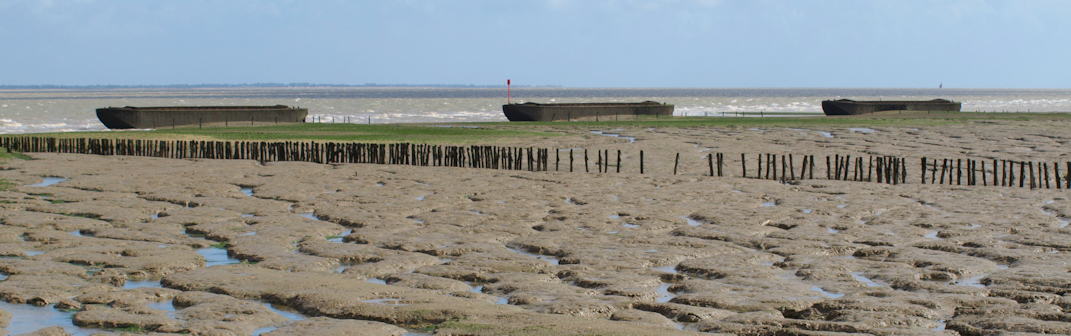
Barges as breakwaters at Sales Point, Dengie Peninsula, Ruth's coastal walk.
I continue along the sea wall. Ahead I see the beach gives way to an expanse of mud. I see some oddly shaped breakwaters beyond the mud – breakwaters that look strangely similar to barges. As I approach, I realise that is exactly what they are; sunken barges in a line, protecting this part of the coast from erosion. I have seen many different forms of coastal defence in my walk through Norfolk, Suffolk and, now, Essex. But this is a surreal sight.

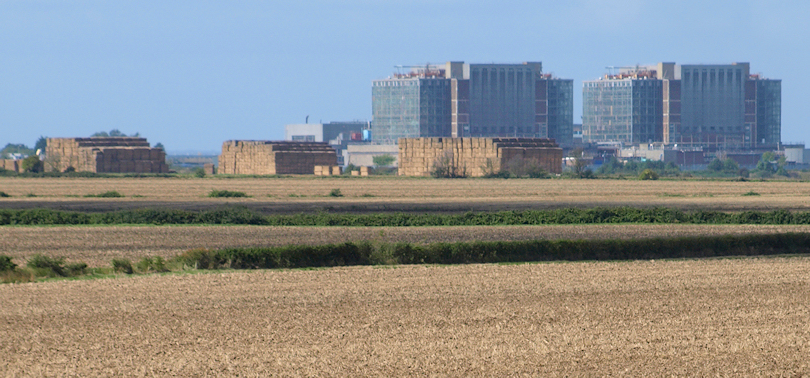
To my left are open fields with some giant haystacks in the distance and, beyond these, the twin buildings of Bradwell power station. I like the juxtaposition of these two contrasting rectangular constructions – the enormous haystacks and the industrial buildings – and I stop to take more photographs. I realise this will be my last real view of the Bradwell site. I feel strangely sad to leave the buildings behind. They have been my constant companions ever since I first spotted them across the water from Mersea Island. Bradwell and giant haystacks, Ruth's coastal walk.

Around the Dengie Peninsula, there is a coastal path stretching from Bradwell Power Station to Burnham on Crouch; seventeen miles of coastal footpath, with no villages, no towns and no marinas; along which the only building of any significance is St Peter’s Chapel.

As I walk around the point, the sea wall suddenly becomes crowded. Young couples and families are out walking. I find this strange because this area is not as attractive as the quiet beach I have just left, hidden around the corner. But the reason for the influx of sightseers is because I am approaching St Peter’s Chapel.

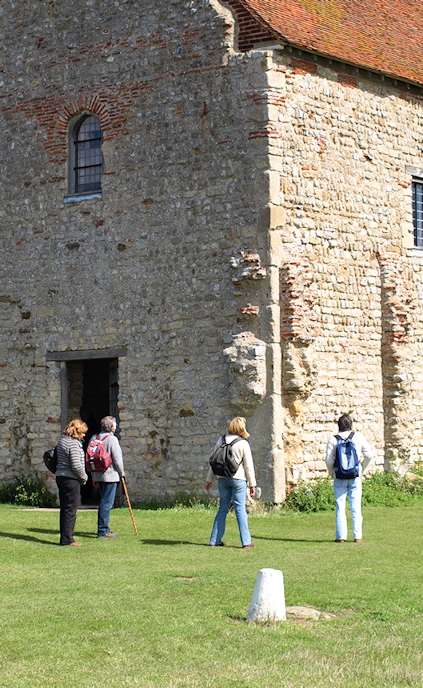
St Peter's Chapel, Bradwell, Essex, Ruth's coastal walk St Peter’s Chapel lies at the beginning of St Peter’s Way, a long distance footpath that follows the coast path for a short distance before turning inland. The Romans built an ancient fort here, Orthona, long since disappeared and now covered by marsh and sea. The chapel was built by St Cedd, who left Lindisfarne and came ashore here in 653. He built a “cathedral”, using stone from the old Roman walls, at the site of the old Roman gatehouse. As the years passed, the chapel fell into disuse and was later used as a barn, before being restored in 1920.

Unprepossessing from the outside, the inside of the chapel is simply decorated. But for me, the amazing thing is the powerful atmosphere that fills the place – an atmosphere of peace and serenity – along with a sense of being in a very, very old place.

I linger for a while, and sit on the sea wall nearby to eat a snack and have a drink.

Then, I start off along the official path – St Peter’s way – following the sea wall and heading South. Ahead of me lies fourteen miles of footpath with nothing en route, until I come to Burnham on Crouch.

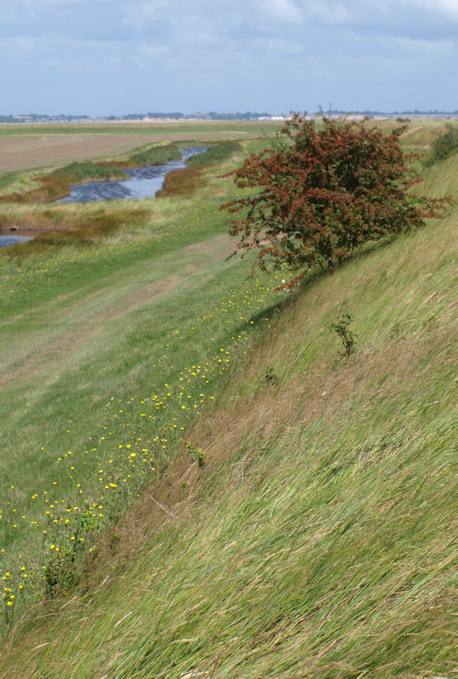
Endless wall, Tillingham Marshes, Ruth's coastal walkSoon, I am alone. The St Peter’s Chapel tourists have been left far behind. The sun is slanting across the fields to my right. To my left is nondescript marshland, green and featureless. Beyond this is just a glimpse of bright sea. Notices declare this area to be a nature reserve. I see few birds, few plants; precious little of anything. My legs are tiring. The path stretches ahead towards the horizon. Occasionally, the bank takes a right angle turn, taking me nearer to the distant sea. Then another right angle turn takes me back inland again.

Bradwell Marshes give way to Tillingham Marshes. The view is the same. The intermittent sluice outlets, and an occasional bush, provide the only relief from the flatness of mud and fields. Ahead I see a shape on the wall. It must be another bush. It looks like a man, sitting down, but that must be just my eyes playing tricks. Then, as I draw nearer, I realise it is a young man.

He is sitting with a rucksack beside him and he is eating lunch, tucking into a yoghurt pot with a vigorous spoon. He hears my footsteps and looks up, rather startled.

“Hello,” he says, squinting up at me. I must be silhouetted against the late afternoon sun.

He has been following St Peter’s Way and has reached the coast, stopping for lunch on the sea wall before heading North up to the Chapel. I explain I am heading down the coast towards – and then I realise I have forgotten the name of the place where I am going.

“The town on the next river,” I explain, somewhat lamely. He must think I am a demented old woman, out here in the wilds, unsure of where I am going.

“Burnham on Crouch?” he asks. Of course, yes.

“It’s too far for me to walk in one day,” I say. “So I am heading off the path soon to meet my husband.”

“Another day,” he says. “You can finish the walk on another day.”

“Yes. I will.”

So I continue, along the endless wall.
Strange structures, Tillingham Marshes, Ruth's coastal walk.
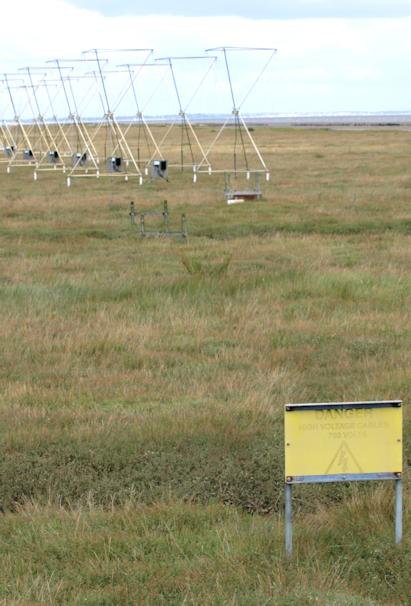
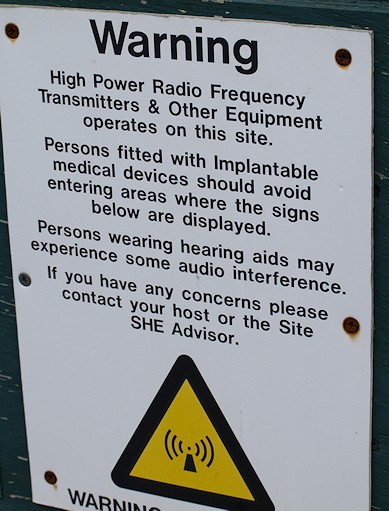
I come to a place where there are strange structures on the marshland. I had seen them from some distance away. Too small to be electricity pylons, too frail to be pumps or windmills, too permanent to be farm watering devices; I had no idea what they were. warning signThen a warning sign identifies them as “High power radio frequency transmitters” and warns me that it would be dangerous to be here if I had an implantable medical device. What these transmitters do, I have no idea. Maybe they operate some of the sluices and drainage systems. Maybe they control offshore structures.

I continue on, consulting my map frequently. There is little opportunity to drive a car close to this particular section of coastal path. But at one point a footpath leads inland and meets a track. The track connects a couple of farms and, I presume, be accessible by car. This is where I am planning to meet my husband.

I find where, I believe, the footpath starts. There is no footpath sign, but there is a small, rickety footbridge crossing a water-filled ditch and with a vague path leading across a farmer’s field. I lose the path in the field and end up in a ploughed area with sweetcorn plants. I stumble along uneven ground until I find a track. I hope this is the right track. I hope there is access for cars. If I am wrong, I may have miles further to walk to find a road.

Then I see him. There, walking to meet me, is my husband. I am very relieved. This was the right track after all. And he has managed to find it and drive the car to within a mile of the coastal path.

Back at the car, I change out of my walking boots. We drive to Tillingham – a very pretty village – with a pub that serves late lunches. After a good meal and a rest, it is time to head home.


Stats: miles walked = 9.1 miles

Posted in 04 Essex | Tagged , , , , , , , , , , , , , , , , | 10 Comments

23. Maylandsea to Bradwell

Boats at Maylandsea, Ruth's coastal walk in EssexIt is a stormy Sunday; the last bank holiday weekend of the summer and the weather is suitably wild.

From Maylandsea, I set off walking on the sea wall. There are boats moored here but, perhaps due to the weather, this small marina has an air of dereliction and abandonment. I see no ships sailing – it is too rough.

As the path winds along the sea wall, I come to an area where the wall has crumbled. There is no obvious diversion of the path, just a “path closed” sign. I decide to continue, picking my way carefully along the crumbling edge and then climbing over a pile of loose earth and gravel, heaped up as a temporary barrier to the sea.

Luckily, this dangerous clamber over crumbly ground doesn’t last long. I am soon back on the official path. But, perhaps because of the obstruction, this section is very overgrown. The grass is long and I cannot see my feet. I am vaguely worried about snakes but reassured by remembering that adders like dry grassland, don’t they?

Across Mayland Creek, Ruths coastal walk

Ahead I see a figure of a man. He is dressed in shorts and long hiking boots and is sitting on a tree trunk. Another walker! He tells me he often does this walk and loves it. He often sees hares dashing around in the marshes and, sometimes, spots a sea harrier. The one creature he doesn’t like, he says lowering his voice, “Are the slithery things.” And he moves his hand to mimic the unmistakable wiggle of a snake. I smile and tell him about my walk. He wishes me luck; and I walk on.
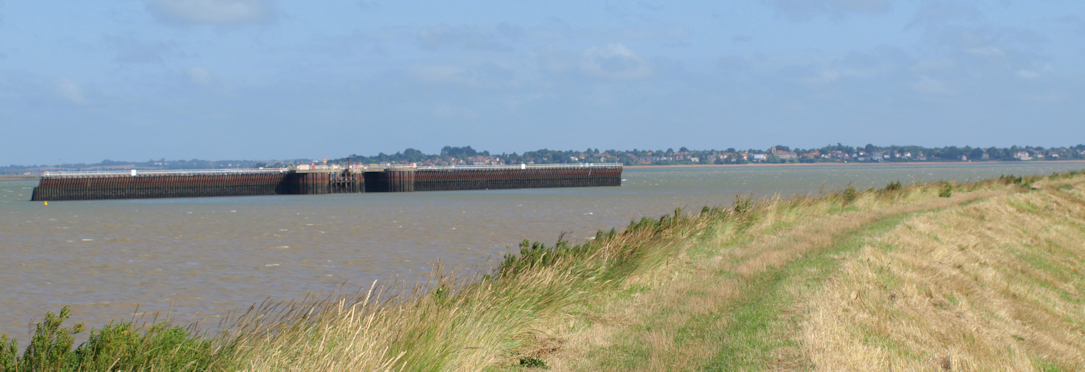
Ruined Jetties, Mayland Creek, Ruth's coastal walk, Essex.
The main obstacle on my route is Mayland Creek. I follow the path down the creek, passing ruined jetties, until I can, eventually, begin to make my way up the far bank. At least I am sheltered from the worst of the wind during this inland detour. This section of path corresponds with St Peter’s Way, one of the long distance footpaths that criss cross the British mainland. I meet nobody along the way.

Half way up the creek, St Peter’s Way heads off to the East, passing inland to meet the coast near Tillingham marshes, before heading up along the coast to end at St Peter’s chapel. I will meet the foot path again, hopefully tomorrow.

Mouth of Mayland Creek, Ruths coastal walkIn the meantime, I continue along the lonely bank and, eventually, reach the mouth of the creek. Here is a campsite. There are tents blowing in the fierce wind and a few people out, braving the blast, to look at the sea. I stop and have a snack, interrupted by a friendly dog, bouncing up to greet me and hoping, I presume, for some of my snack. I am too hungry – and greedy – to share.

Continuing along the sea wall, I can look across to Osea Island. And ahead I can see Bradwell power station, looming in the distance, further away now then it was when I set off from Tollesbury, a few walking days ago.

I round another creek. The tide is. The sea wall is well cut and the grass is shorter here. The walking would be easy if it wasn’t for a gusting, sideways wind that continually buffets me, threatening to blow me off the wall. I try to pick up my pace.

Then, suddenly, I come to a dead stop. I was looking out to sea and the foam tipped waves. But my peripheral vision must have picked up the danger and some primitive part of my brain had temporarily taken control and brought me to a halt.

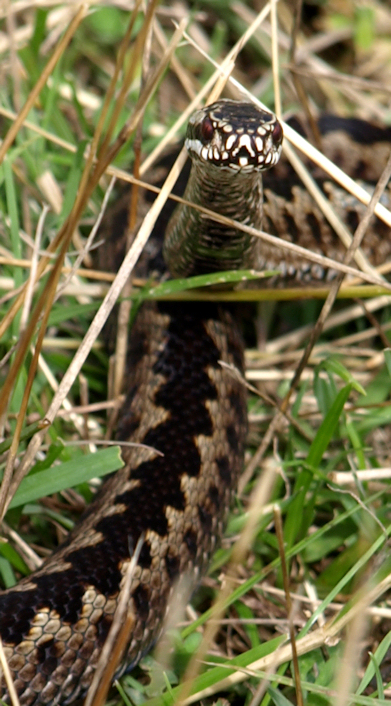
Adder, Ruth's coastal walkAhead of me, about two feet away, crossing the path, is a snake.

I know very little about snakes. But if I had to make up a venomous snake, it would look like this one. It is white with black zig-zag markings, about 18 inches in length, with a body considerably thicker than my thumb.

It senses me and stops too, half way across the path. Then it coils itself up and turns to face me. Tongue flicking in and out. Two pits (are they nostrils?) opening and closing behind its mouth. It is sniffing me – no, it is tasting me.

I do what all good bloggers would do in the situation. I take one step back, swinging my rucksack off my shoulders, while keeping a steady eye on the snake and its flicking tongue. A quick unzip and I have my camera out.

My hands are shaking and my body is buffeted by the wind. It is difficult to focus in these conditions. I take a number of shots before the snake, with one last dart of its tongue, turns round and slithers back the way it came, off the path, down the bank towards the sea.

Considerably shaken, I swing my rucksack back up across my shoulders and continue on. Now my eyes are glued to the path, constantly scanning for snakes. I am very unsettled.

First of all, I thought snakes were frightened of humans. I have assumed that snake hear the vibrations of our footsteps and would run away. This snake wasn’t frightened. And he didn’t run.

Secondly, the grass here is short. But what would have happened if I stepped close to the snake in long grass? He was coiled up above the level of the top of my boots. If it was an adder, and I wasn’t sure, I would have had a nasty bite on my ankle. And I was miles away from a road or path.

I tried to remember the case of an adder bite I had seen when working as a junior doctor in Southampton. A young lad walking in the dry grass of the New Forest had been bitten. I remembered his swollen, bruised leg. But the swelling didn’t happen immediately, taking time to develop. Perhaps I would have been able to limp back to a road? I wish I had a stick – not to attack the snake with, that did not occur to me – but to lean on in case of an adder bite.

Now I come across an obstruction on the sea wall. A fence bars my path. There is a sign, too faded to read. And barbed wire.

Through the fence I can see children’s play equipment on the bank and a shed or out-house.

I would have walked around on the sea-shore. But the tide is too high and there is no way round.

Pulling my map out, I see the official public footpath deviated off to the right some time ago. I hadn’t noticed and hadn’t seen any need to check my map when the route appeared so clear. Damn it! It was a long way back and, I realise, through snake infested territory.
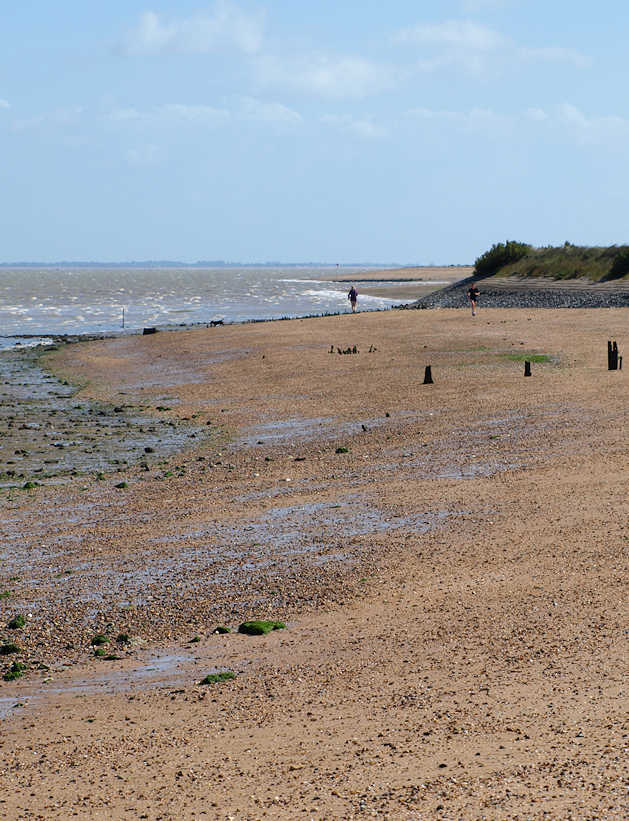
I cursed the inconsiderate land owner who has commandeered this section of bank. I cursed the tide for being high. I cursed myself for being complacent with my map reading.

Then I see that I can cut across a farmer’s field towards the road where the footpath runs parallel to the sea bank. There is a gate I can climb over and a short grassy track to follow. The sun comes out. I bless the farmer and set off.

Half way across the field, I come across a rabbit. It is sitting with eyes closed, dozing in the sunshine. I approach within a couple of yards, then, realising I could frighten it to death if I got nearer, I call out, “Hey bunny”. The rabbit leaps into the air as if on a spring and shoots off across the field, his tail bobbing behind.

Picking up the footpath as it runs along the road, I see a sign adjacent to the fenced off area. “No entry. Nature Reserve.”

I feel very angry about the sign. Clearly this was not a nature reserve, but was someone’s private garden, albeit overgrown in parts. Presumably they put up the sign so that well-mannered hikers would be deterred from crossing their land. Oh, I do hope soon we will have legislation passed to establish a proper coastal route around our shoreline.

Passing through a small marina, I reach the sea wall again. Now I am approaching a small village, St Lawrence, and my rendezvous with my husband for lunch.

We sit outside, overlooking the sea and have a drink. I show him the photographs of the snake. He is suitably impressed and then concerned. Then the sky darkens and we scuttle indoors to eat our lunch as the rain pours down outside.

Private gardens across sea wall, Ruth's coastal hikeAfter the rain, I set off to follow the sea wall again. But I can’t find a way through. Next to the pub is a car park and, on the other side, the sea wall has a fence across it. The tide is still high and there is no way round. I am forced to walk along the road. I wander around a housing estate until a kindly lady directs me to a track leading to the sea wall. At the end of the track, I see the footpath ahead but my route is barred by a green area of open land with signs saying “No public right of way.” I ignore the signs and cross the small area of private property to reach the footpath. Another lady, walking her dog, tells me that you can walk along the footpath all the way to the pub, but you have to go down off the bank onto the shore to get past the gardens. This is impossible with the tide high as the water comes up to the bank.

Again, I curse the landowners who have built houses close to the bank and taken the sea wall as part of their gardens.

Bradwell Power Station, Ruth's coast walkThe rest of my walk passes uneventfully. I walk along the bank in the fierce wind, heading towards the Bradwell power station. To my left, I look over the River Blackwater to Tollesbury marshes and, beyond these, West Mersea in the distance.

As I reach Bradwell, I hear a screaming noise. It is the wind, shrieking, as it blows through the rigging of the ships in Bradwell Marina. The noise is incredible.

Ship against sea wall, Bradbury marina, Ruth's coastal walkThen I see a ship in trouble. It is a sailing ship with a deep keel, I suspect, up against the sloping concrete sea wall. The wind is blowing it against the wall, while the tide is going out – threatening to maroon the boat and to damage its hull. A small motor boat is alongside. The man on the ship is throwing a line to the man in the motorboat. The motor boat man secures the rope and tries to pull the boat free, churning up the water and whipping up a spray. The sailing ship does not budge. He slackens the rope and comes alongside the ship to talk to the man on the ship.

I would like to stay and watch to see what happens. But I am tired with the wind and the exertion of the walk today. I leave the unhappy scene and make my way around the edge of the marina. There is some redevelopment going on here and ground has been churned up by heavy machinery. My boots instantly become caked in clay-like mud and my feet feel heavy and cumbersome.

Trudging through the marina in my weighty boots, heading towards my husband’s waiting car, my ears are assailed by the noise from the wind – howling, shrieking, roaring, clanking through the rigging. The ships seem to be alive and screaming.


At home, I check the photograph of my snake on the Forestry Commission’s web site. Yes, it is an adder, a male adder. I also learn that this is a protected species.

Miles walked = 13
Deviations due to appropriation of sea bank by householders = 2
Adders seen = 1

Posted in 04 Essex | Tagged , , , , , , , , , , , , , , , , , , , , | 3 Comments

22. Maldon to Maylandsea

Heybridge Basin, Lock. Near Maldon Essex. Ruth's coastal walkHeybridge Basin is quieter today. Last time I was here, the pubs were open and the walkway was crowded. Now there is a fundraising event, with stalls being set up on the grass on either side of the lock.

I have plenty of time for the first section of my walk today and I linger to take photographs. Then I walk over the top of the lock gate and begin my walk around the coast, heading back into Maldon. There are a few people out, walking their dogs.

To my left, over the water, I can see Maldon. There is a lovely green area, pubs and cafes. It looks very picturesque. Maldon, Ruths Coastal walk around the UK

To my right are fields and a nature reserve, giving way to a new development of town houses. The path then leads through an industrial area, reaching a road, crossing a bridge and then back along a quayside walk.

Promenade Park, Maldon, Ruth's coastal walkI reach an area where there are pubs, cafes and a lovely, large Park. Promenade Park is a wonderful open space, overlooking the water, with a large duck pond and fountains.

I phone my husband and we meet at one of the pubs to enjoy a delicious meal, eaten outside in glorious sunshine.

After lunch, I walk through the Promenade Park, passing a great children’s play area, and head out along the sea wall.

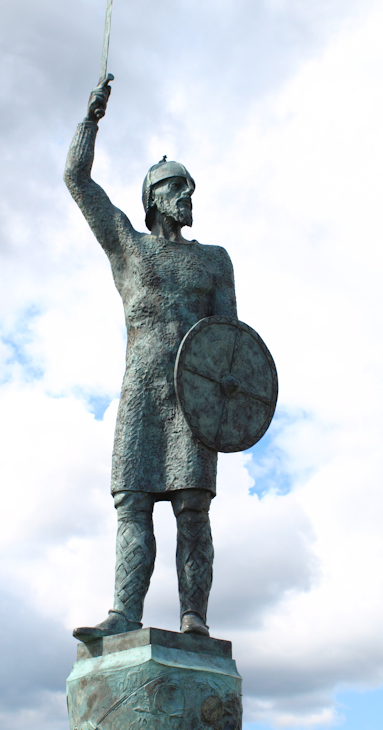
Statue of Byrhtnoth, Ruth's walk around the British coast At the end of a rocky outcrop there is a wonderful modern statue of Byrhtnoth, the Earldorman of Essex, bold and fierce, looking out to sea. Byrhtnoth lived at the time of King Ethelred, 10th Century, and bravely stood against the Viking marauders, losing his life in the Battle of Maldon. The battlefield is just inland of this point.

The afternoon walk takes me along the sea wall through marshes. The path is overgrown with grass in many areas. I wonder about snakes.

Bradwell Power Station, Ruth's coastal walk in EssexThe path curves in and out and the going is tough, both physically and mentally. I see Bradwell Power Station ahead of me and realise I am no closer to this structure, as the crow flies, than I was a few days ago. In fact, I am further away now than I was at Tollesbury marshes.

I plot my route with way points using Trip Journal app on my iPhone. But, due to the bends, I have taken many GPS readings and have used my phone too much. With horror, I realise I only have a few minutes of battery left. I text my husband and let him know I am on schedule for our afternoon rendezvous.

Then the phone dies.

Path along marsh wall, Ruth's coastal walk - Essex marshes.The path is difficult to see with tall grass hiding the ground. The wall is narrow and it is easy to miss the safe, flat top and put my feet on the slanting sides. I stumble frequently. Now I am worried about twisting an ankle. And with my phone dead, I have no way of summoning help.

Eventually, I reach an area where the path is wider and the grass shorter. I see a caravan site, and there are other people walking along the wall.

Ahead of me is Maylandsea. I walk along the sea wall, concrete now. I am glad of the firm ground and the easy route, my legs are very tired. The sky is dark and threatening rain. At the end of Maylandsea promenade I join a road and walk back along it, looking for my husband’s car. I find it, locked of course, and wait under the darkening sky for him to arrive.

Oyster smack on River Blackwater, Near Maldon - Ruth's coastal walk

Vital stats: miles walked = 12

Posted in 04 Essex | Tagged , , , , , , , , , , , , , , , | 3 Comments

21. Tollesbury to Maldon

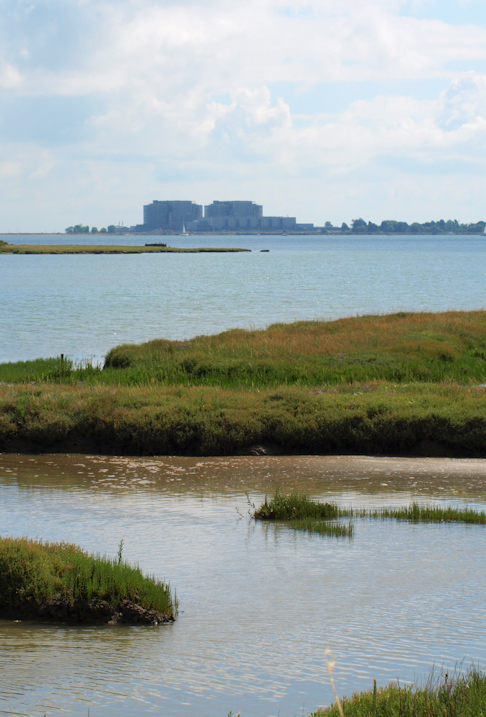
Cows and Bradwell Power Station, Ruth's coastal walk
My husband drops me off at the end of a lane and I pick up the footpath towards the coast. Bradwell Power Station looms ahead of me as I walk through fields of cows, past hedgerows flush with autumn berries and am surrounded by dancing butterflies.
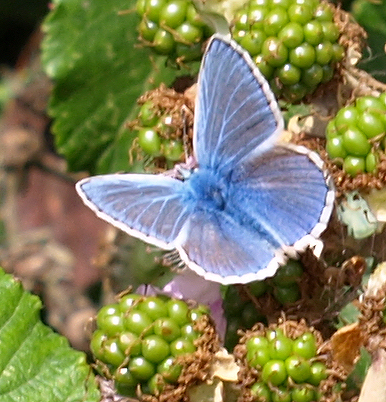
Blue Butterfly, Ruths coastal walk, Essex

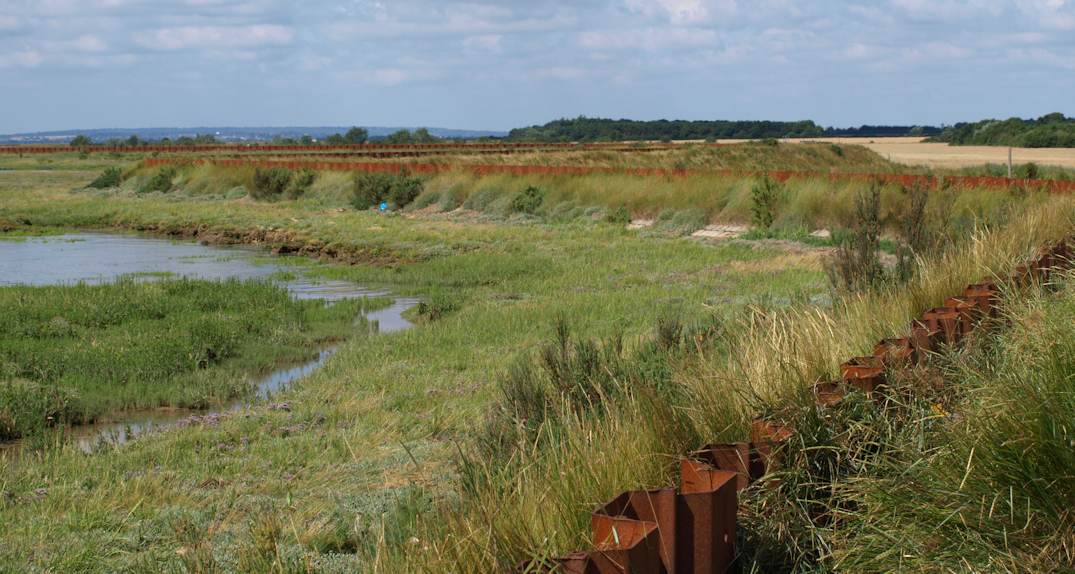
The wide sky above me and the empty marshes ahead, I climb up onto the sea wall. My route winds in and out, following the meanderings of the river bank, adding miles to my walk. I can see the path snaking ahead of me with wide, curving bends; marked by a rusting, red, metal wall.

Meandering bank, River Blackwater, Ruth's coastal walk

I see nobody. To my right is farmland. To my left are mud flats and the broad, gleaming river, with its far bank lost in blue haze in the distance. The only sign of human life is the small boats gliding along the far bank of the River Blackwater – their sails glinting in the distance.
Marshes and River Blackwater, Ruth's coastal walk
Later, as the morning clouds disappear and the sun comes out, people appear. I meet a few walkers. Then a grim-faced young woman passes me. I wonder why she is looking so glum on this beautiful day.

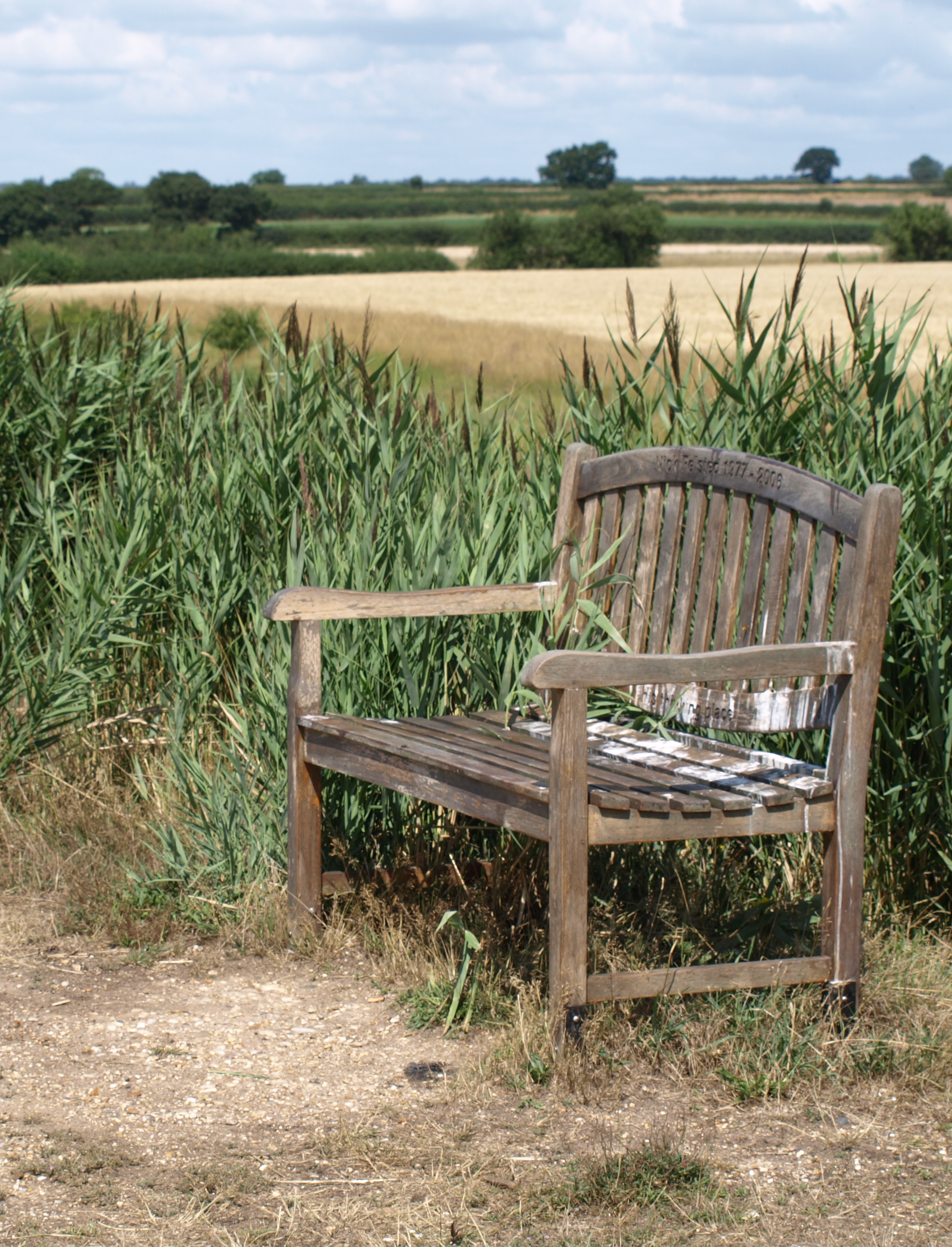
A seat comes into view – a bench. Surprised to see it here, so far from anywhere, I sit down glad of a rest. The back of the seat is covered in seabird droppings but has been washed, with the droppings smudged into a whitewash on the back of the seat. I realise someone must have tried to clean this bench.
Nick Felsted's bench - Ruth's coastal walk, Essex
I see the inscription on the back of the seat. I have got used to this new custom, erecting benches in memory to dead people. But then I take a closer look and realise this is different. “Nick Felsted 1977 -2006”. And below this are the words “His thinking place”. A young man, dying aged 29 or possibly 30; and obviously a thoughtful young man. There are no clues as to why he died so young. Later I search for his name on the internet but find no obvious matches.

Was the sour faced young woman his sister? Did she have a bottle in her hand? With water to wash the bench? I struggle to remember.

Sitting for a while, I have a drink and eat an apple. There is something very mournful about this lonely bench with its sad inscription.

Friendly sheep, on Ruth's coastal walk
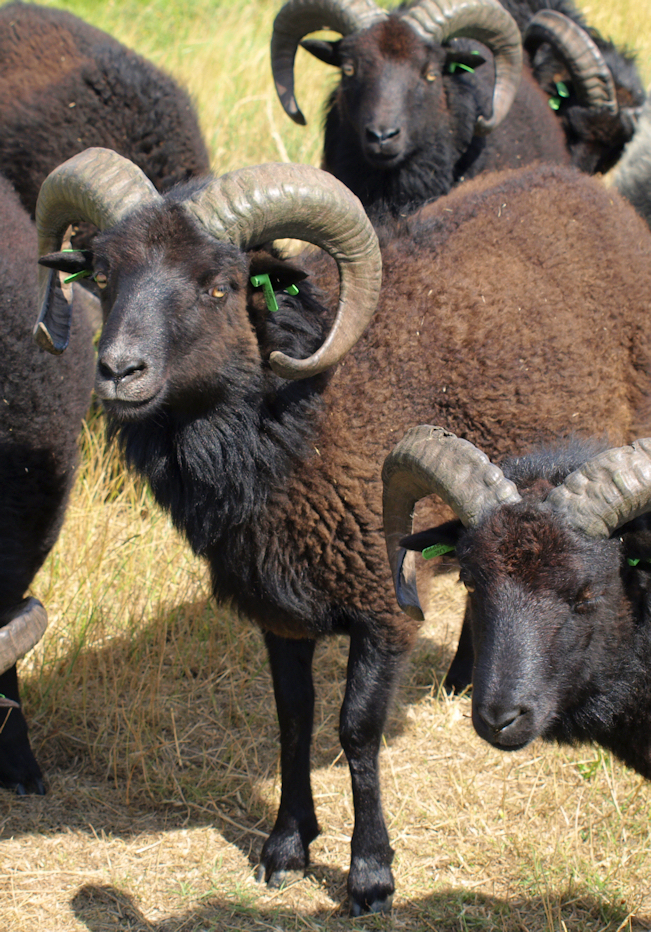
Later I meet a group of sheep – or are they goats? With enormous curled horns they look fierce. They come up onto the path and, when I put down my rucksack to take my camera out, they charge up to the rucksack – hoping for food. I am sorry I ate my apple so soon. The sheep would have enjoyed it. We make friends and they pose for photos.

Now the sun is out and the day has warmed up. Around a corner I come across a man, stripped down to a very brief pair of swimming trunks, lying on a rug across the path. He has a large umbrella up for shade but is, in fact, reclining in the sunshine. Sunday papers are spread around him. He seems surprised to see a walker and I feel a little embarrassed on his behalf. I have to walk around the edge of the bank to avoid his rug.

Towards Goldhanger, Ruths coastal walk

The path continues its winding way along the coast. I pass a few farmhouses and isolated beach huts. Then I reach a small estuary with moored boats and people emerging from woods at the end. Families are strolling along the sides of the estuary, dogs are running around after balls and children are being pushed in a variety of strollers. This is the creek leading up to the village of Goldhanger. It is time for lunch.

From the creek, a path runs up to the meet the road. This is overhung with branches, creating a lovely green tunnel; a welcome change from the exposed river bank. The pub is friendly, crowded and rather old-fashioned. I sit and read in the cool “snug” – a book about the early life of Alfred Wainwright, the famous Lake District fell walker. The biography begins with an account of his childhood and some vivid descriptions written by Alfred’s sister of his difficult family life, with his drunken father and long-suffering mother struggling to make ends meet.

Goldhanger church, Ruths coastal walkAfter a leisurely lunch, I rejoin the river bank. Passing plastic greenhouses, I stop to take photographs of Goldhanger church. The path becomes busier here – people out walking and cycling.

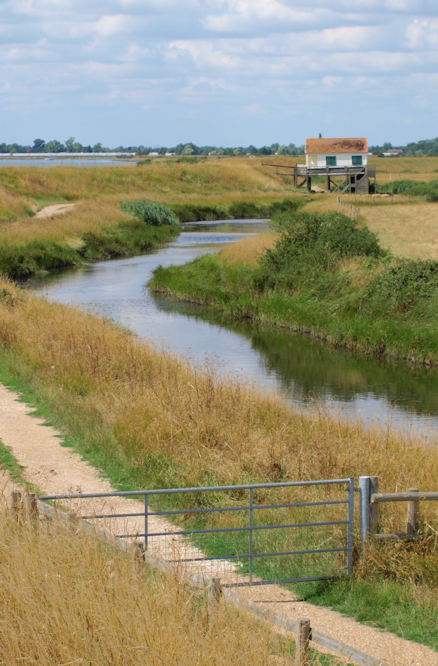
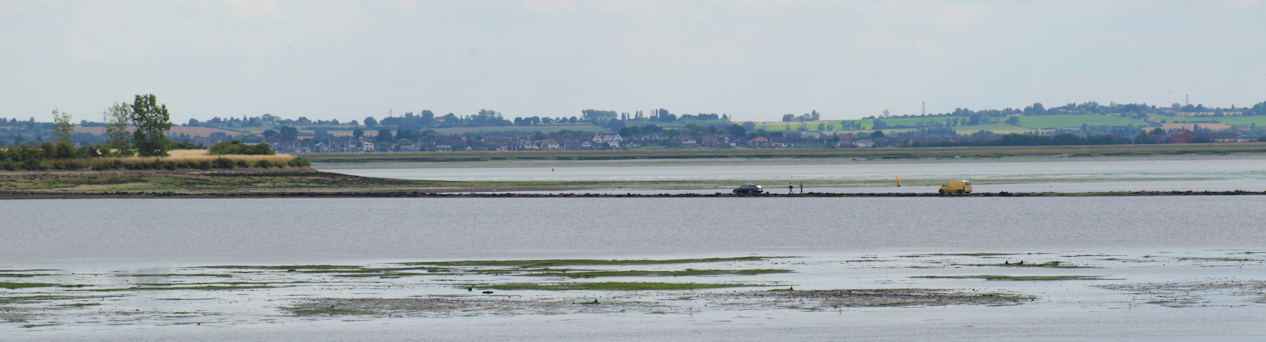
Now I reach Osea Island, joined to this side of the river by a causeway. The tide is out, and the causeway is just visible as a dark ribbon winding through the mud. There are cars, and then a couple of vans, crossing. They make their way slowly and carefully.
Causeway to Osea Island

Later, as I draw close to the start of the causeway, signs warn that the island is private property. I wonder what business goes on there. A concrete walkway begins at this point, and a gaggle of children head towards me, riding bikes. They are excited and shout to each other. The leader turns onto the causeway and they follow – pedalling hard and whooping with delight. I stop and watch, wondering how far they will go. Will they be stopped? Will whoever owns this island turn them back?
Children on bikes, to Osea Island, Ruth's Coastal Walk
I don’t have the patience to wait longer to see what happens and continue on my way. Some time later I am passed by a lone boy pedalling furiously on his bike. His back is spattered with mud thrown up by his back wheel. I recognise him as a member of the group of children I have just seen heading for the island.

“They are going to get killed,” he mutters darkly to himself as he speeds by. There is a note of grim satisfaction in his voice. He could mean the tide or the mud, but I suspect it is an angry parent who is going to be the “killer” in this case.

I walk past caravan sites and the walkway broadens into a promenade. Here is a pub with people spilling onto the promenade, next to a muddy beach, Mill Beach on the map. There are a host of small ships, either moored out to sea or perched in the mud.
Mill Beach, near Maldon, Ruth's coastal walk

Winding around small inlets, the path becomes narrow and overgrown with grass. My legs are growing tired and I am resentful when a group of holiday makers climb onto the path ahead of me and meander along, slowing my progress.

Now I reach a crowded area. The sea wall meets a roadway. Here there are cars, lots of people, a couple of pubs and, ahead, I can see a canal with large lock gates. Boats are moored. People are out walking and enjoying the late afternoon sunshine.

I sit on the sea wall and phone my husband. It has been another glorious day of walking – starting with wide skies and emptiness, and ending at this point, crowded with noisy, cheerful people.


Vital stats: miles = 16, blisters = 0

Posted in 04 Essex | Tagged , , , , , , , , , , , , , , , , | 10 Comments

Stage 20. Old Hall Marshes to Tollesbury

John - transporter, lunch provider, supporter: Ruth's coastal walk in Essex We drive along the bumpy track, back to Old Hall Farm. The road comes to an end at a cattle grid – where signs tell us we can drive no further without a permit from the nature reserve. We stop the car and, as I begin to lace up my walking boots, a bossy woman emerges to advise us not to block the farm entrance. We assure her we are not staying. She seems reluctant to believe us. I wonder if she lives in the rather nice house that I believe is the modern version of Old Hall Farm.

While my husband drives away, I set off across the cattle grid and along the farm track. I come to the sea wall and climb up to find a footpath stretching in either direction. Consulting my map, I realise this is not the start of my route. In fact, this is my return route. I am about to embark on a walk around a peninsula and, after 7 miles of walking, I will end up back here again – a few yards from the start of my journey today.

For a moment I hesitate, tempted. I could start here, turn right along the sea bank, and save myself 3 hours of walking around a bleak peninsula. But that would mean cutting out a section of the coast and would, according to my internal rules, be cheating.

So I climb back down off the sea bank and continue along the farm track as it meanders northwards, through a nature reserve, to the north shore of Old Hall Marshes.
Sea wall, Old Hall Marshes, looking towards Mersea: Ruth's coastal walk

The bank here is overgrown with grass, wet with dew. I decide to try out my gaiters. This new purchase was suggested by David Cotton as an aid to keeping feet dry. After struggling briefly with the unfamiliar gaiters and glad there is nobody here to see my clumsy efforts, I set off briskly, determined to make good progress this morning.

The long grass is buzzing with insects. Brown grasshoppers dart away from beneath my feet, popping up in front of my boots in a constant wave of activity the accompanies me along this section of the bank. Butterflies – blue, brown, white and multicoloured – flutter around my knees. Around my arms, small flies dart and buzz.

Spiders have laid sticky traps across the path, spinning webs between high blades of grass. As I walk, I gather a tangle of webs on the front of my trousers. Initially, I attempt to brush them off, wiping sticky strands away with my hands and then flicking my hands in the air to try to clear my fingers of the softly persistent threads. Eventually I give up. Within a few minutes, the front of my trousers begins to look like an insect graveyard – sticky webs are intertwined with displaced spiders and their prey – flies, butterflies, beetles, ladybirds… I am the grim reaper of insect life, the collector of little corpses.

Little flies extract their revenge on behalf of the insect kingdom. Their plump, black bodies appear innocently harmless and at first I think I am imagining their bites. But no, they are attacking my upper arms. I flick them away constantly.

Ships in Mersea Quarters, seen across Old Hall Marshes, Ruth's coastal walk

On my left I look over water of Salcott Channel towards a far bank and Mersea Island, visible beyond. There is nobody out here. But a small motorboat is playing up and down the channel, pulling a waterskier. To my right is farmland and then marshland with water and occasional ducks. I gather this nature reserve is a great breeding ground for water fowl, but there is little sign of them today.

The gaiters have kept my trousers dry, but the tops of my boots are wet and moisture has seeped between the laces and into the inner part of my boots. I round the eastern end of the peninsula. Here the wind picks up and the grass is dryer. The wind does me another favour too; it blows away the little flies that have plagued me.

Drying out Ruth's kit, Old Hall Marshes, Ruth's coastal walk in Essex

With the path now dry, I take off my gaiters and my boots. Hanging my socks on a convenient style, I have a snack while I change into dry socks. I have learnt the two most comforting things on a long walk are, firstly, a change of socks and, secondly, a nice bar of chocolate.

The path continues round the peninsula. There are plenty of goose droppings on the bank, making walking difficult in some sections. Part of the bank is closed to allow wild fowl to use it as nesting ground – but the nesting season has passed. Some of the geese are still here. I can see them in the distance on the inland lakes within the marshes. But the bank itself is deserted.

Old Hall Farm houses: Ruth's coastal walk in Essex

Following the bank, I am heading inland along the edge of Tollesbury Fleet. I hear music ahead, carried on the wind. At first I think it is my imagination but, no, there is some kind of concert going on in the hills ahead of me. As I return towards Old Hall Farm the music becomes more distinct – the Stones, the Beatles and other 60s songs.

Now I am back to the beginning of my walk. I am in front of the rather nice house, which I believe is the new Old Hall Farm house. There is a quay here and some small boats moored. But the tide is out and the boats are sitting in mud, not water.

The bank rounds the corner and heads back out to sea again. An elderly woman appears and strides briskly ahead. She overtakes me. I am feeling very tired and find it hard to make good progress.

Drowned trees - Old Hall Creek, Ruth's coastal walk

The sea appears to have consumed some of the fields. I see trees damaged, I believe, by salt water. Now dead, they raise bare arms to the sky.

I continue along the bank, heading towards the Tollesbury Marina, where I am meeting my husband for lunch. I can see the masts of the boats moored there, but the bank meanders in and out and progress is painfully slow.

Finally, I arrive, following the path as it winds through a boat yard and around the edge of the Marina.

Tollesbury Marina, Essex - Ruth's Coastal Walk

Beyond the moored yachts, I see a strange red boat, perched in the mud. It looks like a floating lighthouse. Later I learn this is Trinity Light Vessel, now used by FACT for spiritual holidays and retreats.

Just behind the marina is an empty basin – the old outdoor swimming pond – now unused. There are picnic seats here. I continue further along because I have spotted a pub. No, it is a private yacht club. In fact, there is no public house providing lunches at the weekend in Tollesbury. A terrible shame because this seems an obvious amenity for the village to offer to weekend visitors.

Beyond the club, I find a seat, perched high on a knoll, overlooking Tollesbury Fleet and with West Mersea gleaming in the distance. I suspect this is the best viewpoint in the whole area.
John arriving with lunch, Tollesbury Marina, Ruth's coastal walk
Now my husband arrives on his bicycle. He has stopped at the village store and has brought a wonderful picnic lunch. We eat in this lovely spot, enjoying the magnificent view.

I can see storm clouds gathering. The light fades. There is rain coming.

Ruth enjoying lunch - Tollesbury Marina, Ruth's coastal walk

We eat the rest of the food and enjoy a drink. I cannot prolong lunch any further. There is still a long walk ahead of me. This afternoon, I plan to complete this section, around Tollesbury Wick Marshes. Beyond that, the path continues along the Blackwater estuary towards Maldon, and I plan to do that section next weekend.

The sky is dark when we pack up the remains of our lunch and I say goodbye to my husband.

Water, boats and wind farm, River Blackwater: Ruth's coastal walk

The footpath ahead is deserted. The wind has picked up. The light is changing. As I head out along the bank, I can see ships moored in open water ahead and, far beyond, I can see a wind farm. This is the same wind farm that I first saw at Walton-on-the-Naze, off the coast at Clacton. The blades gleam white against the darkening sky.

Strange light on the Tollesbury Fleet - Ruths Coastal Walk
Now the strange, pre-storm light has changed the colours of the landscape. The mud has taken on a pinkish purple hue. The water looks like pale, blue steel. The inland water shines golden, like polished copper. I take photographs, not sure how the colours will look, but wanting to capture the magic of this colour change.

Storm clouds brewing, Tollesbury Wick Marshes, Ruth's coastal walk in Essex

The sky darkens further. Ahead of me I see an old pill-box with, bizarrely, a “smiley” face painted on the side. I stop here and stow my camera deep in my rucksack. Then I put on my waterproofs, making sure my iPhone is tucked deep into a waterproof pocket. Just in time. As I set off from the pill-box the rain hits my back. The sky becomes very dark indeed.

Old Pier, Tollesbury: Ruth's coastal walk

Luckily, the rain stops some few minutes later. Just as I reach a point on the walk I have been looking forward to. Here is the remains of an old pier. Once upon a time there was a doomed attempt to launch Tollesbury as a seaside resort to equal Clacton and others. Build a fine pier and the trippers will come. The locals hoped boats would dock here, perhaps bring tourists from other resorts. They even built a light railway, to link the pier with the village.

Sadly the venture was doomed and the remains of the pier were blown up at the start of World War 2, to prevent the structure being used as a landing post for German invaders. Now all that remains is the base of the structure – visible in the mud with the tide out. There is a little sign, explaining the history of the pier venture and also describing the wildlife that inhabits the area, now undisturbed by tourists.

Beyond the pier I can see the menacing silhouette of the large building. I first noticed this building at the end of my last walk. From the map it is clear that this must be Bradwell Nuclear Power Station.
Bradwell Power Station, silhouette - Ruths coastal walk
I later learn that Bradwell is no longer in use, being one of our first nuclear reactors to be closed down in 2002 and now in the process of being decommissioned.

Just beyond the remains of the pier, I turn inland, following a footpath that takes me up the side of Mill Creek, close to the route of the old dismantled railway. From there I follow the footpath to a farm track and then reach the end of a narrow road.

As I walk through the late afternoon sunshine, I wonder what it was like for the local people when they found out that their pier was to be blown up. I wonder if there were children, or grandchildren, of the original builders who witnessed the final death of this doomed dream. And now there is the demise of the nuclear reactor too. Our human projects seem puny and fragile under the weight of this wide sky, swamped by the vastness of this empty landscape.


Vital stats: blisters=0, wet socks=2, miles walked=12

Posted in 04 Essex | Tagged , , , , , , , , , , , , , , , , , , , , , , , , | 10 Comments